On this page
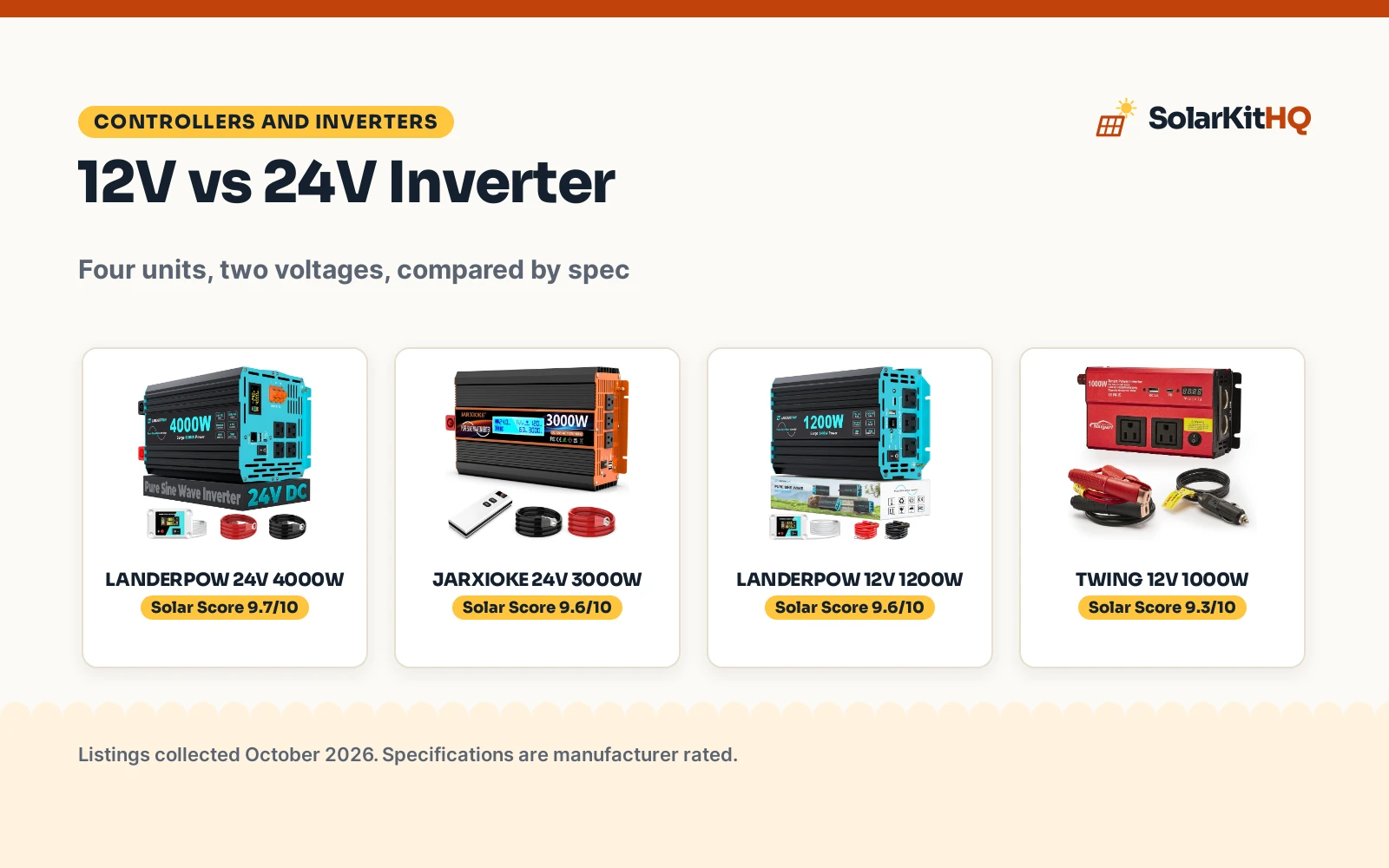
The 12v vs 24v inverter question is really a question about your battery bank, because the inverter has to match the voltage you already store. These four listings split exactly in half: two 12V units, a 1200W pure sine LANDERPOW and a 1000W modified sine TWING, and two 24V units, a 4000W LANDERPOW and a 3000W JARXIOKE. We compared stated continuous and surge watts, waveform, efficiency, outlets, cables and warranty terms, using only what each listing publishes.
SolarKitHQ earns a commission when you buy through links on this page, at no extra cost to you. As an Amazon Associate I earn from qualifying purchases. Affiliate disclosure.
Compare the picks
| Spec | LANDERPOW 24V 4000W | JARXIOKE 24V 3000W | LANDERPOW 12V 1200W | TWING 12V 1000W | Amazon |
|---|---|---|---|---|---|
| Input voltage | 24V DC | 24V DC | 12V DC | 12V DC | |
| Continuous power | 4000W | 3000W | 1200W | 750 watts | |
| Surge or peak | 8000W | 6000W | 2400W | 1000W peak | |
| Waveform | Pure sine wave | Pure sine wave | Pure sine wave | Modified sine wave | |
| AC outlets | 4 plus hardwire | 3 | 3 | 2 | |
| Warranty | 3-Year Total Coverage | 24 months warranty | 3-Year Total Coverage | Not stated |
Specifications are manufacturer rated as listed, collected 22 October 2026. Continuous watts are the figure to size against; surge covers motor starts.
The picks: 12v vs 24v inverter
| # | Product | Solar Score | Buy |
|---|---|---|---|
| 1 |  LANDERPOW 24V 4000W | 9.7/10 | Buy on Amazon |
| 2 |  JARXIOKE 24V 3000W | 9.6/10 | Buy on Amazon |
| 3 |  LANDERPOW 12V 1200W | 9.6/10 | Buy on Amazon |
| 4 |  TWING 12V 1000W | 9.3/10 | Buy on Amazon |
LANDERPOW 24V 4000W
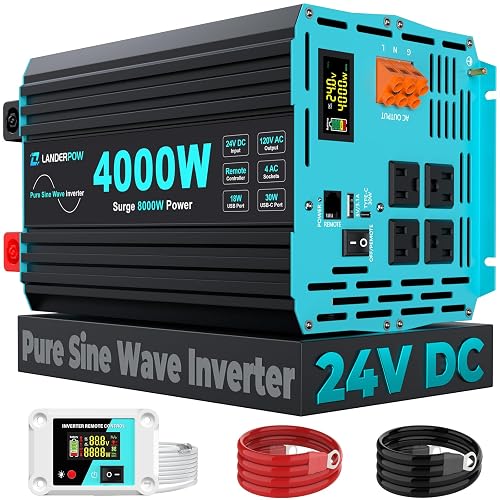
The LANDERPOW 24V 4000 watt pure sine wave inverter, 8000W surge, 4 AC outlets plus a hardwire terminal, with 1AWG copper cables and a 15ft remote.
Pros
- 4000W continuous, 8000W surge
- Hardwire terminal for big loads
- 1AWG pure copper cables
- Remote with LED screen
Cons
- Needs a 24V bank to start
- Heaviest here at 9.7 pounds
- Oversized for car use
- Two 2FT cables only
Detailed Review
The listing states 4000W continuous pure sine wave power at over 91% efficiency with an 8000W surge, 4 AC outlets plus a hardwired AC terminal for high current appliances, 5V 3.1A USB and 30W Type-C ports, two 1AWG pure copper battery cables, a 15ft wired remote with an LED screen tracking battery level, output and errors, and a full metal shell. Its stated specifications met are UL and FCC, and its coverage is 3 years total: a 1-year replacement plus 2-year extended support.
Who it's for: 24V RV, truck and off-grid systems running a refrigerator, window AC or power tools. Who should skip it: anyone on a 12V battery, since this unit cannot run from one at all.
Its Solar Score of 9.7/10 comes from performance 33/35, build 21/25, value 19/25, safety 8/10 and warranty 4/5: 85 of 100 points, placed on our 9.2 to 9.8 scale.
Key Specifications
| Input | 24V DC |
|---|---|
| Continuous | 4000W pure sine wave |
| Surge | 8000W |
| Outlets | 4 AC plus hardwire terminal |
Figures as published on the retailer listing, collected 22 October 2026. Performance figures are manufacturer rated.
Safety and Warranty
What this listing states. UL, FCC, so safety scores 8 of 10. 3-Year Total Coverage. It does not say everything a buyer needs, such as who pays return shipping, so warranty scores 4 of 5. See How We Pick.
Inverter limits. Stay within the stated continuous watts (surge watts last only a moment), use the cable size and fuse the manual gives, ventilate it, and never connect an inverter to home wiring yourself; that is work for a licensed electrician.
This is general buying information, not professional advice. Follow each product manual and local rules, and see our Safety Disclaimer.

JARXIOKE 24V 3000W
The JARXIOKE 3000 watt pure sine wave inverter for 24V, 6000W peak, with an LCD display, remote control and a 24 months warranty.
Pros
- 3000W continuous, 6000W peak
- Remote works within 100 meters
- LCD display and alarms
- Soft-start, isolated design
Cons
- Model name is a UUID string
- Warranty field reads just 1
- No hardwire terminal
- Efficiency stated over 90%
Detailed Review
The listing states true 3000W continuous and 6000W peak pure sine wave power at over 90% efficiency, 3 AC sockets, a Type-C port and dual USB ports, an LCD display, and a remote that controls the inverter within 100 meters once the unit's own switch is off. Protections run overvoltage, low voltage, overload, short circuit, overheat and reverse polarity, with automatic restart and GND leakage protection; the stated specification met is UL, and the bullets promise a 24 months warranty even though the spec table's warranty field reads only 1. Its model name field is a UUID string, the sloppiest spec entry in this set.
Who it's for: 24V home and off-grid setups that want display and distance control at 3000W. Who should skip it: anyone wiring a hardwired circuit, where the LANDERPOW 4000W's terminal is the deciding feature.
Its Solar Score of 9.6/10 comes from performance 30/35, build 20/25, value 18/25, safety 7/10 and warranty 4/5: 79 of 100 points, placed on our 9.2 to 9.8 scale.
Key Specifications
| Input | 24V DC |
|---|---|
| Continuous | 3000W pure sine wave |
| Peak | 6000W |
| Display | LCD |
Figures as published on the retailer listing, collected 22 October 2026. Performance figures are manufacturer rated.
Safety and Warranty
What this listing states. UL, so safety scores 7 of 10. 24 months warranty. It does not say everything a buyer needs, such as who pays return shipping, so warranty scores 4 of 5. See How We Pick.
Inverter limits. Stay within the stated continuous watts (surge watts last only a moment), use the cable size and fuse the manual gives, ventilate it, and never connect an inverter to home wiring yourself; that is work for a licensed electrician.
This is general buying information, not professional advice. Follow each product manual and local rules, and see our Safety Disclaimer.

LANDERPOW 12V 1200W
The LANDERPOW 1200 watt pure sine wave car power inverter for 12V, 2400W surge, 3 AC outlets, with 7AWG cables and a 15ft remote.
Pros
- Pure sine at car scale
- 2400W surge for startups
- 7AWG cables included
- Remote with LED screen
Cons
- 1200W ceiling for appliances
- 12V draws heavy current
- No hardwire terminal
- Shell claims outrun the class
Detailed Review
The listing states 1200W continuous pure sine wave power at over 91% efficiency with a 2400W surge, grid-quality output for sensitive electronics and inductive loads, 3 AC outlets, 5V/3.1A USB and 30W PD ports, two 7AWG battery cables, a 15ft wired remote with an LED screen, and a full metal shell with the standard six protections. Its stated specification met is UL, and coverage matches its 24V sibling: 3 years total, 1-year replacement plus 2-year extended support.
Who it's for: 12V vehicles and small solar setups that want pure sine quality without rewiring the battery bank. Who should skip it: loads above 1200W, where the 24V side's headroom is the whole argument.
Its Solar Score of 9.6/10 comes from performance 28/35, build 19/25, value 18/25, safety 8/10 and warranty 4/5: 77 of 100 points, placed on our 9.2 to 9.8 scale.
Key Specifications
| Input | 12V DC |
|---|---|
| Continuous | 1200W pure sine wave |
| Surge | 2400W |
| Outlets | 3 AC |
Figures as published on the retailer listing, collected 22 October 2026. Performance figures are manufacturer rated.
Safety and Warranty
What this listing states. UL, so safety scores 8 of 10. 3-Year Total Coverage. It does not say everything a buyer needs, such as who pays return shipping, so warranty scores 4 of 5. See How We Pick.
Inverter limits. Stay within the stated continuous watts (surge watts last only a moment), use the cable size and fuse the manual gives, ventilate it, and never connect an inverter to home wiring yourself; that is work for a licensed electrician.
This is general buying information, not professional advice. Follow each product manual and local rules, and see our Safety Disclaimer.

TWING 12V 1000W
The TWING car 1000W inverter for 12V, a modified sine wave unit with dual AC outlets, USB and Type-C, connecting by cigarette lighter or battery clamps.
Pros
- Cigarette lighter connection
- Digital display on board
- Dual AC plus USB, Type-C
- Lightest here at 3 pounds
Cons
- Modified sine wave output
- 750W continuous, not 1000W
- Lighter socket caps at 150W surge
- Warranty stated as no
Detailed Review
The listing states a modified sine wave inverter whose continuous output is 750 watts against the 1000W in its name, with dual 110V AC outlets, USB and Type-C charging, a digital display, a cooling fan and a mini slip fuse, connecting by cigarette lighter plug, itself capped at 150 watt surge capacity per the bullets, or directly to a 12V battery with clamp wires. Its certifications are stated as CE and FCC, and its warranty description reads simply no.
Who it's for: light in-car loads, lamps, cameras and laptops on the move. Who should skip it: sensitive electronics and anything with a motor, where modified sine and a 750W continuous ceiling are the wrong tool; both LANDERPOW units exist for that work.
Its Solar Score of 9.3/10 comes from performance 22/35, build 16/25, value 18/25, safety 7/10 and warranty 0/5: 63 of 100 points, placed on our 9.2 to 9.8 scale.
Key Specifications
| Input | 12V DC |
|---|---|
| Continuous | 750 watts |
| Waveform | Modified sine wave |
| Connection | Lighter plug or clamps |
Figures as published on the retailer listing, collected 22 October 2026. Performance figures are manufacturer rated.
Safety and Warranty
What this listing states. CE, FCC, so safety scores 7 of 10. No warranty term, so warranty scores zero. See How We Pick.
Inverter limits. Stay within the stated continuous watts (surge watts last only a moment), use the cable size and fuse the manual gives, ventilate it, and never connect an inverter to home wiring yourself; that is work for a licensed electrician.
This is general buying information, not professional advice. Follow each product manual and local rules, and see our Safety Disclaimer.
As an Amazon Associate I earn from qualifying purchases.
How we scored them
The Solar Score weighs performance, build, value, safety and warranty. Performance here means continuous pure sine watts and surge headroom; safety means the stated specifications met, UL on three listings and CE with FCC on the fourth; warranty separates the field, with 3-year total coverage on both LANDERPOW units, 24 months on the JARXIOKE, and none on the TWING, whose warranty field reads no. The scores rank the four listings, but the voltage split comes first: a 24V winner cannot run on a 12V bank at any score.
| Product | Solar Score | Perf. /35 | Build /25 | Value /25 | Safety /10 | Warranty /5 |
|---|---|---|---|---|---|---|
| LANDERPOW 24V 4000W | 9.7 | 33 | 21 | 19 | 8 | 4 |
| JARXIOKE 24V 3000W | 9.6 | 30 | 20 | 18 | 7 | 4 |
| LANDERPOW 12V 1200W | 9.6 | 28 | 19 | 18 | 8 | 4 |
| TWING 12V 1000W | 9.3 | 22 | 16 | 18 | 7 | 0 |
Scores run from 9.2 to 9.8: each product’s point total is placed on that range, so more points always means a higher score.
Why the 24V side states bigger numbers
The 24V listings carry the power figures: 4000W continuous and 8000W surge on the LANDERPOW, 3000W and 6000W peak on the JARXIOKE, against 1200W and 750W continuous on the 12V side. The listings themselves show why in their cables: the 24V LANDERPOW ships 1AWG pure copper, the 12V LANDERPOW 7AWG, because the same watts at half the voltage need roughly double the current and far heavier copper to carry it. A 24V bank is the platform for appliance-scale loads, refrigerators, window AC and power tools, all named by the 24V listings; the 12V side names laptops, CPAPs and kettles at the top of its range.
Waveform: the split inside the 12V side
Three of the four are pure sine wave, and the exception is a 12V unit: the TWING outputs modified sine wave, the waveform its own listing names, with a continuous rating of 750 watts under a 1000W title. The pure sine listings all make the same claim in their own words, grid-quality power that protects sensitive electronics and runs inductive loads without hum. If your loads include a microwave, a CPAP or audio gear, the waveform line settles the 12V choice before price does: the LANDERPOW 1200W is the only 12V pick here that states pure sine.
Control and connections
Both LANDERPOW units include a 15ft wired remote with an LED screen showing battery level, output and errors; the JARXIOKE’s remote works within 100 meters and its LCD sits on the unit. Outlets run 4 AC plus a hardwire terminal on the 24V LANDERPOW, the only hardwire option here, 3 AC on the JARXIOKE and the 12V LANDERPOW, and dual AC on the TWING, which also plugs into a cigarette lighter socket, a connection its bullets cap at 150 watt surge. Fixed installations belong on the 24V side; portable car use is the TWING’s whole design. More single-purpose picks sit in the power inverter for camping roundup.
Sizing Notes
- Your bank decides: 12V battery, 12V inverter. There is no adapter between these listings.
- Size on continuous watts: 750, 1200, 3000 and 4000 are the four honest ceilings here.
- Surge is for motor starts: 2400W, 6000W and 8000W on the pure sine three.
- Cable gauge is stated for a reason: 1AWG on the 4000W, 7AWG on the 1200W; do not substitute thinner cable.
Frequently Asked Questions
Can a 24V inverter run on a 12V battery?
No. Each listing states its input voltage, 12 volts of direct current or 24, and the inverter must match the bank. The voltage choice is made when the battery bank is built.
Which side runs a refrigerator or window AC?
The 24V side names both loads: the LANDERPOW 4000W lists refrigerator and window AC among its heavy startups, backed by an 8000W surge. The 12V listings top out at kettles and CPAPs.
Is pure sine wave worth it over modified?
On these listings, for sensitive electronics and motor loads yes: the three pure sine units all claim protection for such loads, while the modified sine TWING is built for light vehicle loads at 750 continuous watts.
What does the hardwire terminal add?
On the 24V LANDERPOW, a hardwired AC terminal for high current appliances and tools, beyond its 4 outlets. It is the only listing here with one.
Related guides
See every controllers and inverters guide.
More picks: browse power inverters for a minivan, power inverters with a battery and power inverters for a home office.