On this page
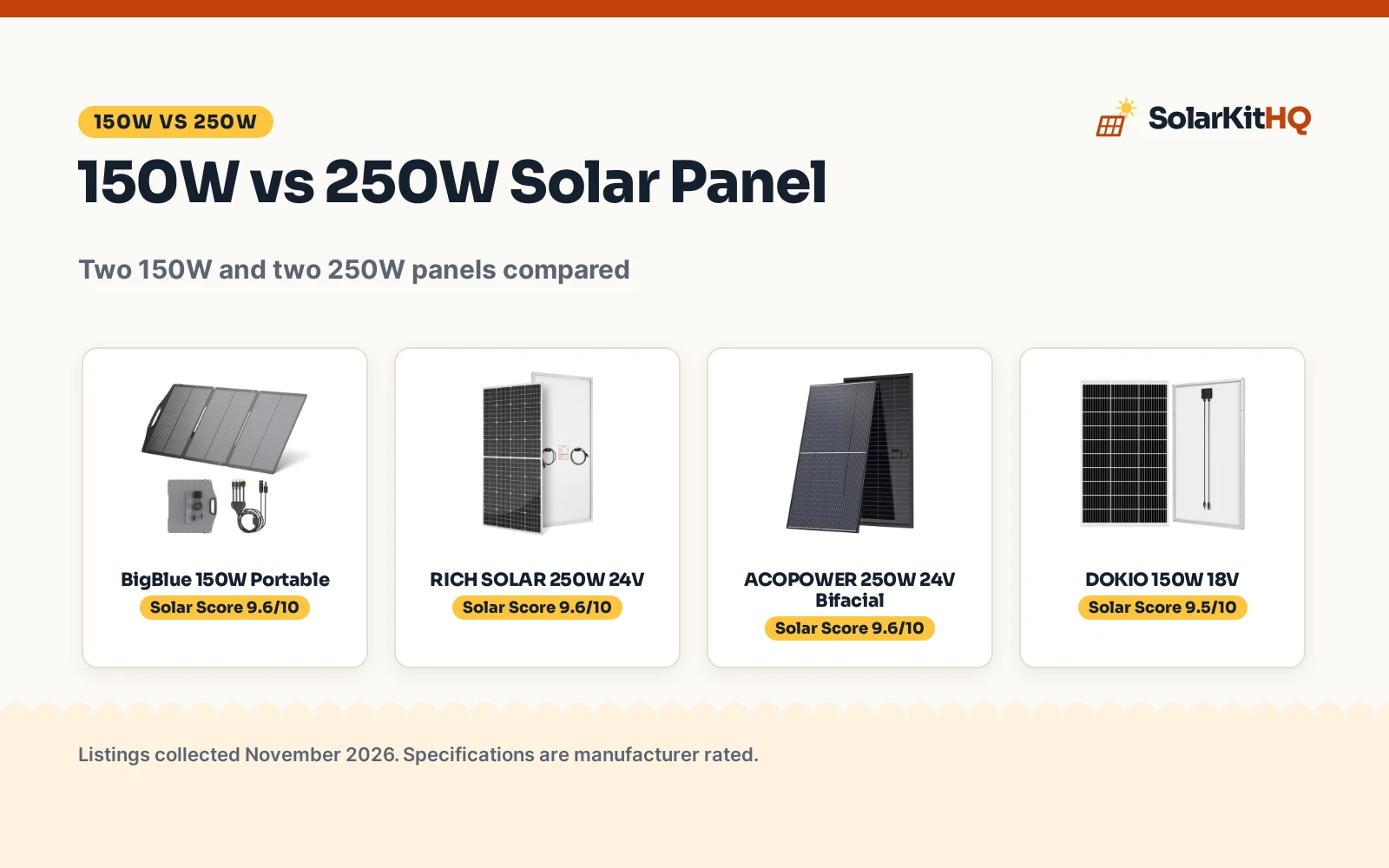
The short answer on 150w vs 250w solar panel sizing: pick the 150W side for a folding panel that feeds a power station at camp, and pick the 250W side for a fixed roof or rack with room for a larger rigid 24V panel. Two panels on each side are compared here on watts, voltage, size, weight and warranty.
SolarKitHQ earns a commission when you buy through links on this page, at no extra cost to you. As an Amazon Associate I earn from qualifying purchases. Affiliate disclosure.
150w vs 250w solar panel: side by side
| 150W vs 250W | BigBlue 150W Portable | RICH SOLAR 250W 24V | ACOPOWER 250W 24V Bifacial | DOKIO 150W 18V | Amazon |
|---|---|---|---|---|---|
| Watts | 150W | 250W | 250W | 150W | |
| Voltage | 17.4V | 24V | 24V | 18V | |
| Efficiency stated | 25% | High Efficiency | 25.4% | High Efficiency | |
| Weight | 8.8 lbs | 26.9 lbs | 26.31 lbs | 18.52 lbs | |
| Size | Not stated | 60.6 x 29.9 x 1.2 in | 61.0 x 30.0 x 1.38 in | 38.8 x 38.8 x 1.4 in | |
| IP code stated | IP68 | Not stated | IP67 junction box | Not stated | |
| Warranty | 2-year | 25-year power, 10-year material | Not stated | Not stated |
These specs are rated by the maker and quoted from each listing on 9 November 2026.
Watts and voltage
The gap is plain in watts: the 150W pair states 150W each, and the 250W pair states 250W each. The BigBlue states 17.4V at 8.62A through MC-4, the DOKIO states 18V for 12V systems, and both 250W panels state 24V. The ACOPOWER panel is designed for 24V systems and works with 12V systems with a suitable charge controller, while the DOKIO panels wire in series or parallel for 24V or 48V setups. The BigBlue lists MC-4 and XT60 plus DC5521, 8020 and 7909 adapters for power stations.
Size and weight
Size and weight pull the two sides apart. The BigBlue folds, carries kickstands and states 8.8 lbs, with no dimensions in the listing. The DOKIO is a rigid square at 38.8 by 38.8 by 1.4 inches and 18.52 pounds, while the two 250W panels are long rectangles: the ACOPOWER at 61.0 by 30.0 by 1.38 inches and 26.31 pounds, and the RICH SOLAR at 60.6 by 29.9 by 1.2 inches and 26.9 pounds.
Build and weather protection
All four list a frame and glass or a folding face. The BigBlue states an IP68 code, N-Type cells at 25% efficiency, ETFE arrays and built-in diodes that bypass faulty panels. The ACOPOWER states an IP67-rated junction box, tempered glass, a corrosion-resistant aluminum frame and N-Type cells at 25.4% efficiency, plus a bifacial design that captures reflected light. The DOKIO and the RICH SOLAR state no IP code: the DOKIO states tempered glass, a corrosion-resistant aluminum frame, bypass diodes and wind 2400Pa and snow 5400Pa figures, while the RICH SOLAR states a 1.3mm anodized aluminum frame, tempered glass with an anti-reflective coating and 14 pre-drilled holes.
What the listings leave unclear
The ACOPOWER and the DOKIO state no warranty term, while the BigBlue states 2 years and the RICH SOLAR states 25 years for power output and 10 years for material and craftsmanship. The BigBlue listing also disagrees with itself on weight: the bullets state 8.8 lbs and the spec table lists 8.21 pounds, so use the 8.8 lbs figure. The DOKIO and RICH SOLAR listings state no efficiency percent, only a High Efficiency class, and the BigBlue listing states no panel dimensions.
Four examples
| # | Product | Solar Score | Buy |
|---|---|---|---|
| 1 |  BigBlue 150W Portable | 9.6/10 | Buy on Amazon |
| 2 |  RICH SOLAR 250W 24V | 9.6/10 | Buy on Amazon |
| 3 |  ACOPOWER 250W 24V Bifacial | 9.6/10 | Buy on Amazon |
| 4 |  DOKIO 150W 18V | 9.5/10 | Buy on Amazon |

BigBlue 150W Portable
A folding 150W panel with kickstands, an IP68 code, N-Type cells at 25% efficiency and MC-4 and XT60 connectors.
Pros
- Folding design with kickstands and an 8.8 lbs carry weight stated
- 25% conversion efficiency stated, with N-Type cells
- IP68 code stated, with built-in diodes that bypass faulty panels
- MC-4 connector at 17.4V and 8.62A, plus XT60 and other adapters
Cons
- No panel dimensions are stated
- Cables for parallel or series connections are not included
- 2-year warranty, while RICH SOLAR states 25 years
Detailed Review
The listing states a folding 150W portable panel with N-Type cells at 25% conversion efficiency, an IP68 code, ETFE arrays, built-in diodes that bypass faulty panels, kickstands and an MC-4 connector at 17.4V and 8.62A with XT60 and other adapters. It supports series and parallel connections, but the package does not include cables for them. The bullets state 8.8 lbs while the spec table lists 8.21 pounds, so use the 8.8 lbs figure. The warranty description is 2 years.
Who it's for: campers and power station owners who want a folding panel that carries light and sets up on kickstands. Who should skip it: anyone who needs stated panel dimensions or a fixed roof mount.
Its Solar Score of 9.6/10 comes from performance 29/35, build 21/25, value 20/25, safety 8/10 and warranty 2/5: 80 of 100 points, placed on our 9.2 to 9.8 scale.
Key Specifications
| Watts | 150W |
|---|---|
| Voltage | 17.4V, 8.62A |
| Efficiency | 25% |
| Weight | 8.8 lbs |
Figures as published on the retailer listing, collected 9 November 2026. Performance figures are manufacturer rated.
Safety and Warranty
What this listing states. IP68 stated, with built-in diodes stated, so safety scores 8 of 10. 2-year warranty stated. It does not say everything a buyer needs, such as who pays return shipping, so warranty scores 2 of 5. See How We Pick.
Panels make voltage in daylight. Keep connectors covered until you connect them, check the panel's stated open circuit voltage and current against your controller or power station input limits, and use cables rated for the current. Roof and permanent mounts belong to a qualified installer.
This is general buying information, not professional advice. Follow each product manual and local rules, and see our Safety Disclaimer.

RICH SOLAR 250W 24V
A 250W 24V rigid panel with N-Type 16BB cells, a 1.3mm anodized aluminum frame and a 25-year power output warranty.
Pros
- 25-year limited warranty for power output and 10-year limited warranty for material and craftsmanship stated
- 1.3mm anodized aluminum frame with tempered glass and anti-reflective coating stated
- 14 pre-drilled holes for Z-brackets, ground mounts, side pole mounts and tilt mounts
- N-Type cells with 16BB configuration for low LID and stable output
Cons
- No IP code is stated
- No efficiency percent is stated
- 26.9 pounds stated, the heaviest here
- 60.6 by 29.9 by 1.2 inch size needs a fixed mount
Detailed Review
The listing states a 250W 24V monocrystalline panel with N-Type cells in a 16BB configuration, a 1.3mm anodized aluminum frame, tempered glass with an anti-reflective coating and 14 pre-drilled holes for Z-brackets, ground, side pole and tilt mounts. It works in series or in parallel, and the size is 60.6 by 29.9 by 1.2 inches at 26.9 pounds. No IP code or efficiency percent is stated. The warranty is a 25-year limited warranty for power output and a 10-year limited warranty for material and craftsmanship.
Who it's for: RV, trailer, camper and marine owners who want a fixed 250W 24V panel with the longest stated warranty here. Who should skip it: anyone who needs a folding panel or a stated IP code.
Its Solar Score of 9.6/10 comes from performance 30/35, build 22/25, value 21/25, safety 0/10 and warranty 4/5: 77 of 100 points, placed on our 9.2 to 9.8 scale.
Key Specifications
| Watts | 250W |
|---|---|
| Voltage | 24V |
| Size | 60.6 x 29.9 x 1.2 in |
| Weight | 26.9 lbs |
Figures as published on the retailer listing, collected 9 November 2026. Performance figures are manufacturer rated.
Safety and Warranty
What this listing states. No UL, TÜV or IEC listing and no weather rating is stated, so safety scores zero. 25-year limited warranty for power output; 10-year limited warranty for material and craftsmanship stated. It does not say everything a buyer needs, such as who pays return shipping, so warranty scores 4 of 5. See How We Pick.
Panels make voltage in daylight. Keep connectors covered until you connect them, check the panel's stated open circuit voltage and current against your controller or power station input limits, and use cables rated for the current. Roof and permanent mounts belong to a qualified installer.
This is general buying information, not professional advice. Follow each product manual and local rules, and see our Safety Disclaimer.
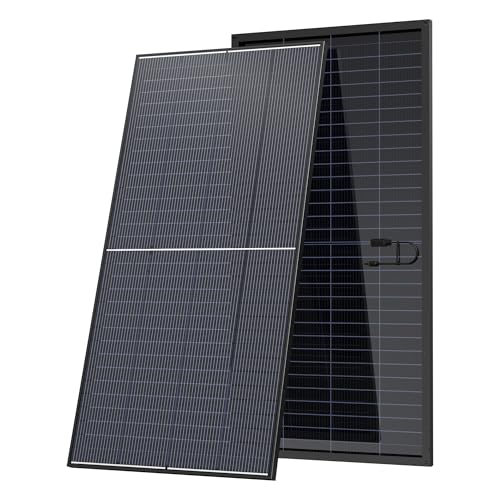
ACOPOWER 250W 24V Bifacial
A 250W 24V bifacial panel with N-Type cells at 25.4% efficiency, an IP67 junction box and 16BB cells.
Pros
- 25.4% cell efficiency stated, the highest percent here
- Bifacial design captures light from the front and reflected light from the rear
- IP67-rated junction box with tempered glass and a corrosion-resistant aluminum frame stated
- Designed for 24V battery charging systems, compatible with 12V systems with a suitable charge controller
Cons
- No warranty term is stated
- 26.31 pounds stated
- 61.0 by 30.0 by 1.38 inches is the longest panel here
- Bifacial gain depends on a reflective surface, per the listing
Detailed Review
The listing states a 250W 24V bifacial panel with N-Type cells at 25.4% cell efficiency and 16BB cells, built for RV, camper, boat and off-grid systems. It states high-transmission tempered glass, a corrosion-resistant aluminum frame and an IP67-rated junction box, and it produces power in cloudy weather, early morning and late afternoon conditions. No warranty term is stated.
Who it's for: RV, cabin and off-grid owners who want a 250W 24V bifacial panel with the highest stated efficiency here. Who should skip it: anyone who needs a stated warranty term or a smaller panel.
Its Solar Score of 9.6/10 comes from performance 32/35, build 22/25, value 21/25, safety 7/10 and warranty 0/5: 82 of 100 points, placed on our 9.2 to 9.8 scale.
Key Specifications
| Watts | 250W |
|---|---|
| Voltage | 24V |
| Efficiency | 25.4% |
| Size | 61.0 x 30.0 x 1.38 in |
Figures as published on the retailer listing, collected 9 November 2026. Performance figures are manufacturer rated.
Safety and Warranty
What this listing states. IP67-rated junction box, tempered glass and corrosion-resistant aluminum frame stated, so safety scores 7 of 10. No warranty term, so warranty scores zero. See How We Pick.
Panels make voltage in daylight. Keep connectors covered until you connect them, check the panel's stated open circuit voltage and current against your controller or power station input limits, and use cables rated for the current. Roof and permanent mounts belong to a qualified installer.
This is general buying information, not professional advice. Follow each product manual and local rules, and see our Safety Disclaimer.

DOKIO 150W 18V
A rigid 150W 18V monocrystalline panel with an aluminum frame, tempered glass and MC4 leads for 12V systems.
Pros
- Tempered glass and corrosion-resistant aluminum frame withstand wind 2400Pa and snow 5400Pa, per the listing
- Pre-drilled holes fit common Z-brackets, tilt or pole mounts
- MC4 connectors pair with 12V batteries and controllers, and wire in series or parallel for 24V or 48V
- 38.8 by 38.8 by 1.4 inch size fits a smaller roof space
Cons
- No warranty term is stated
- No IP code is stated
- No efficiency percent is stated, only a High Efficiency class
- 18.52 pounds stated, with no folding carry option
Detailed Review
The listing states a 150W 18V monocrystalline panel with an aluminum frame for 12V systems, with MC4 leads and pre-drilled holes for Z-brackets, tilt or pole mounts. It states tempered glass and a corrosion-resistant aluminum frame that withstand wind 2400Pa and snow 5400Pa, built-in bypass diodes that cut shading losses, and a size of 38.8 by 38.8 by 1.4 inches at 18.52 pounds. No warranty term, IP code or efficiency percent is stated.
Who it's for: RV, boat, shed and cabin owners who want a rigid 150W panel for a 12V system with a smaller footprint. Who should skip it: anyone who needs a folding panel, a stated warranty term or a stated IP code.
Its Solar Score of 9.5/10 comes from performance 28/35, build 21/25, value 20/25, safety 4/10 and warranty 0/5: 73 of 100 points, placed on our 9.2 to 9.8 scale.
Key Specifications
| Watts | 150W |
|---|---|
| Voltage | 18V |
| Size | 38.8 x 38.8 x 1.4 in |
| Weight | 18.52 lbs |
Figures as published on the retailer listing, collected 9 November 2026. Performance figures are manufacturer rated.
Safety and Warranty
What this listing states. Tempered glass, corrosion-resistant aluminum frame and bypass diodes stated, so safety scores 4 of 10. No warranty term, so warranty scores zero. See How We Pick.
Panels make voltage in daylight. Keep connectors covered until you connect them, check the panel's stated open circuit voltage and current against your controller or power station input limits, and use cables rated for the current. Roof and permanent mounts belong to a qualified installer.
This is general buying information, not professional advice. Follow each product manual and local rules, and see our Safety Disclaimer.
As an Amazon Associate I earn from qualifying purchases.
Where the points went
The Solar Score weighs performance, build, value, safety and warranty. For solar panels, safety means a stated IP code, bypass diodes, tempered glass or another protection the listing names. Two of the four state a warranty term. How we pick explains the weights.
| Product | Solar Score | Perf. /35 | Build /25 | Value /25 | Safety /10 | Warranty /5 |
|---|---|---|---|---|---|---|
| BigBlue 150W Portable | 9.6 | 29 | 21 | 20 | 8 | 2 |
| RICH SOLAR 250W 24V | 9.6 | 30 | 22 | 21 | 0 | 4 |
| ACOPOWER 250W 24V Bifacial | 9.6 | 32 | 22 | 21 | 7 | 0 |
| DOKIO 150W 18V | 9.5 | 28 | 21 | 20 | 4 | 0 |
Every total is translated into a figure between 9.2 and 9.8 with a linear formula; ranking by points and ranking by score always agree.
How to choose the best 150w vs 250w solar panel
Match voltage to the system
Start with voltage, not watts. The DOKIO states 18V for 12V systems and wires in series or parallel for 24V or 48V setups, while the ACOPOWER states 24V and works with 12V systems with a suitable charge controller. The BigBlue states 17.4V through MC-4 with an XT60 adapter for power station inputs. A panel whose voltage the controller or power station does not list is the wrong panel for that system.
Measure the roof before the watts
The 250W panels are long: the ACOPOWER measures 61.0 by 30.0 by 1.38 inches and the RICH SOLAR 60.6 by 29.9 by 1.2 inches, while the DOKIO measures 38.8 by 38.8 by 1.4 inches. The BigBlue folds and states no dimensions. For a fixed install, see the portable vs fixed solar panel guide.
Weigh the carry
If the panel moves, weight decides. The BigBlue states 8.8 lbs with kickstands and a folding face, against 18.52 pounds for the DOKIO, 26.31 pounds for the ACOPOWER and 26.9 pounds for the RICH SOLAR. The best 250 watt solar panel guide covers more fixed options.
Read the warranty line
The RICH SOLAR states a 25-year limited warranty for power output and a 10-year limited warranty for material and craftsmanship, the BigBlue states 2 years, and the ACOPOWER and DOKIO state no term. For the bifacial option, see the bifacial vs half cut solar panel comparison.
| If you need | Look at |
|---|---|
| Lowest carry weight | BigBlue 150W Portable, 8.8 lbs |
| Longest stated warranty | RICH SOLAR 250W 24V, 25-year power output |
| Highest stated efficiency | ACOPOWER 250W 24V Bifacial, 25.4% |
| Smallest rigid panel | DOKIO 150W 18V, 38.8 by 38.8 by 1.4 inches |
Sizing Notes
- Match the panel voltage the listing states, 17.4V, 18V or 24V, to the controller or power station input the maker lists.
- Match panel watts, 150W or 250W, to the input the controller or power station lists.
- Check roof space against the stated panel size: 38.8 by 38.8 by 1.4 inches, 60.6 by 29.9 by 1.2 inches or 61.0 by 30.0 by 1.38 inches.
- Fuse the leads and size cables as the manual gives.
FAQ: power away from the grid
Which panel here has the lowest stated weight?
The BigBlue at 8.8 lbs, against 18.52 pounds for the DOKIO, 26.31 pounds for the ACOPOWER and 26.9 pounds for the RICH SOLAR.
Can a 150W panel work on a 24V system?
The DOKIO states 18V for 12V systems and wires in series or parallel for 24V or 48V setups.
Which panel here has the longest warranty?
The RICH SOLAR, with a 25-year limited warranty for power output and a 10-year limited warranty for material and craftsmanship. The BigBlue states 2 years.
What does bifacial mean on the ACOPOWER panel?
The bifacial design captures sunlight from the front and reflected light from the rear, which increases total power generation over reflective surfaces such as concrete, sand or snow.
Do all four panels state an IP code?
No. The BigBlue states IP68 and the ACOPOWER states an IP67-rated junction box, while the DOKIO and the RICH SOLAR state no IP code.
Related solar guides
See every Solar Panels and Kits guide and all Portable Solar Panels guides.
More picks: best 250 watt solar panel, 30w vs 60w portable solar panel, portable vs fixed solar panel, best solar panel kit for rv.