On this page
A dead battery at the worst moment is the whole argument for owning heavy cable: no waiting for a jump, no borrowing a set that is too thin for the job.
SolarKitHQ earns a commission when you buy through links on this page, at no extra cost to you. As an Amazon Associate I earn from qualifying purchases. Affiliate disclosure.
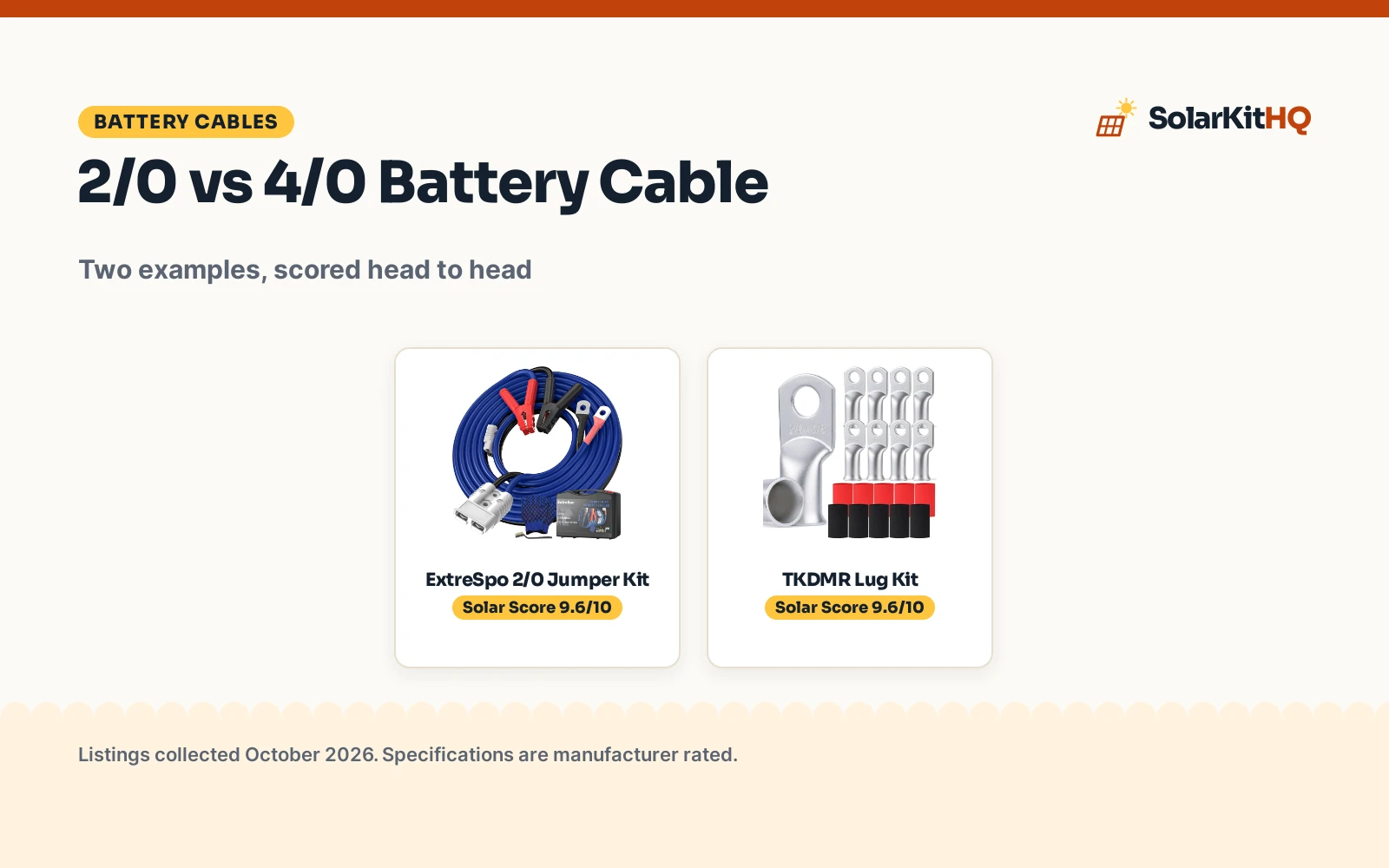
This 2/0 gauge vs 4/0 gauge battery cable comparison uses two listings as concrete examples, one from each side, and scores what each listing actually states.
2/0 gauge vs 4/0 gauge battery cable: the verdict
Pick the 2/0 gauge side, the ExtreSpo jumper kit, if you want a ready-to-use set: 30 feet of 2/0 gauge cable with a quick connect plug, 1500Amp stated, and a 3 years unconditional guarantee in the box with a carry case. Pick the 4/0 gauge side, the TKDMR lug kit, if you build your own cable ends: UL-listed tinned copper lugs with heat shrink tubing for 3/8 inch studs, with no cable and no warranty stated.
2/0 gauge vs 4/0 gauge battery cable: side by side
The two examples solve different problems. The ExtreSpo listing is a finished jumper cable for 12V and 24V vehicles, rated by the listing from -40℉~140℉ with a thick vinyl coating. The TKDMR listing is a parts kit: 10 ring lugs and 10 heat shrink tubes, made from 100% annealed copper with a tinned surface, meant to be crimped or soldered onto cable you already own.
On documentation the split is clean. ExtreSpo states the stronger warranty at 3 years but no certification and no weather protection code. TKDMR states UL in its spec table but no warranty and no amperage figure for the lugs themselves. Neither listing states what the other side’s headline spec would be, so this is a choice of form, not a single winner on paper.
ExtreSpo 2/0 Jumper Kit
The ExtreSpo example is the only complete cable here: 2/0 gauge high density copper clad aluminum, 30 feet long, with a quick connect plug so the short end installs once and the hood stays shut. The listing states 1500Amp of instantaneous current and compatibility with 12V and 24V vehicles including trucks.
The 3 years unconditional guarantee leads this pair, and the carry case, gloves and brushes make it a grab-and-go kit. The spec table lists 15.47 pounds, which is honest weight for this much copper clad aluminum, and the listing states the cable stays flexible in cold winters.
TKDMR Lug Kit (4/0 side)
The TKDMR example is the builder’s option on the 4/0 gauge side: 10 marine grade tinned copper ring lugs for 2/0 AWG cable with 3/8 inch studs, plus 10 pieces of 4:1 dual wall adhesive heat shrink tubing in black and red. The closed end pad design keeps moisture out and prevents solder from leaking during installation, per the listing.
The spec table lists UL under Specification Met and a 600 volts maximum, which is the only certification stated in this comparison. You supply the cable and the crimping: see our best battery cable crimping tool guide if you do not own one, and the best battery cable lugs guide for more end options.
| If you need | Look at |
|---|---|
| A ready-to-use jumper set for 12V and 24V vehicles | ExtreSpo 2/0 Jumper Kit, 1500Amp stated |
| The longest stated warranty | ExtreSpo 2/0 Jumper Kit, 3 years |
| UL-listed ends for cables you build yourself | TKDMR Lug Kit, UL stated |
| Tinned copper lugs with heat shrink included | TKDMR Lug Kit, 10 lugs per pack |
Sizing Notes
- Match the lug to both the cable and the stud: the TKDMR example fits 2/0 AWG cable on 3/8 inch studs, so check your battery posts before ordering.
- Jumper cable length matters more than it looks: the ExtreSpo example states 30 feet, enough to reach without moving either vehicle.
- A figure from one listing describes that listing only: the 1500Amp figure belongs to the ExtreSpo example, not to 2/0 gauge cable in general.
- For the wire itself, see our best wire for battery cables and 1-0 gauge vs 2 gauge battery cable guides, plus all battery guides.
Frequently Asked Questions
Which side of this comparison suits a DIY solar battery bank?
The 4/0 side example, the TKDMR lug kit, since banks are usually wired with custom cable lengths and the UL-listed lugs with heat shrink give finished, sealed ends. The 2/0 side example is a jumper set for vehicles, not bank wiring.
How long should jumper cables be?
Long enough to connect two batteries without moving either vehicle. The ExtreSpo example states 30 feet, which covers nose-to-nose or side-by-side parking with slack to spare.
Do I need a special tool to attach battery cable lugs?
The TKDMR listing states the lugs can be crimped or soldered. A proper crimping tool gives the most reliable joint; our best battery cable crimping tool guide covers the options.
What size lugs fit my battery terminals?
Measure the stud and match the ring: the TKDMR example states a 3/8 inch ring, a common stud size. The listing also warns that audio wire may not be a direct fit, so check dimensions before you buy.
Related guides
Also see our 1-0 gauge vs 2 gauge battery cable, best battery cable connectors and 12v vs 24v deep cycle battery guides.