On this page
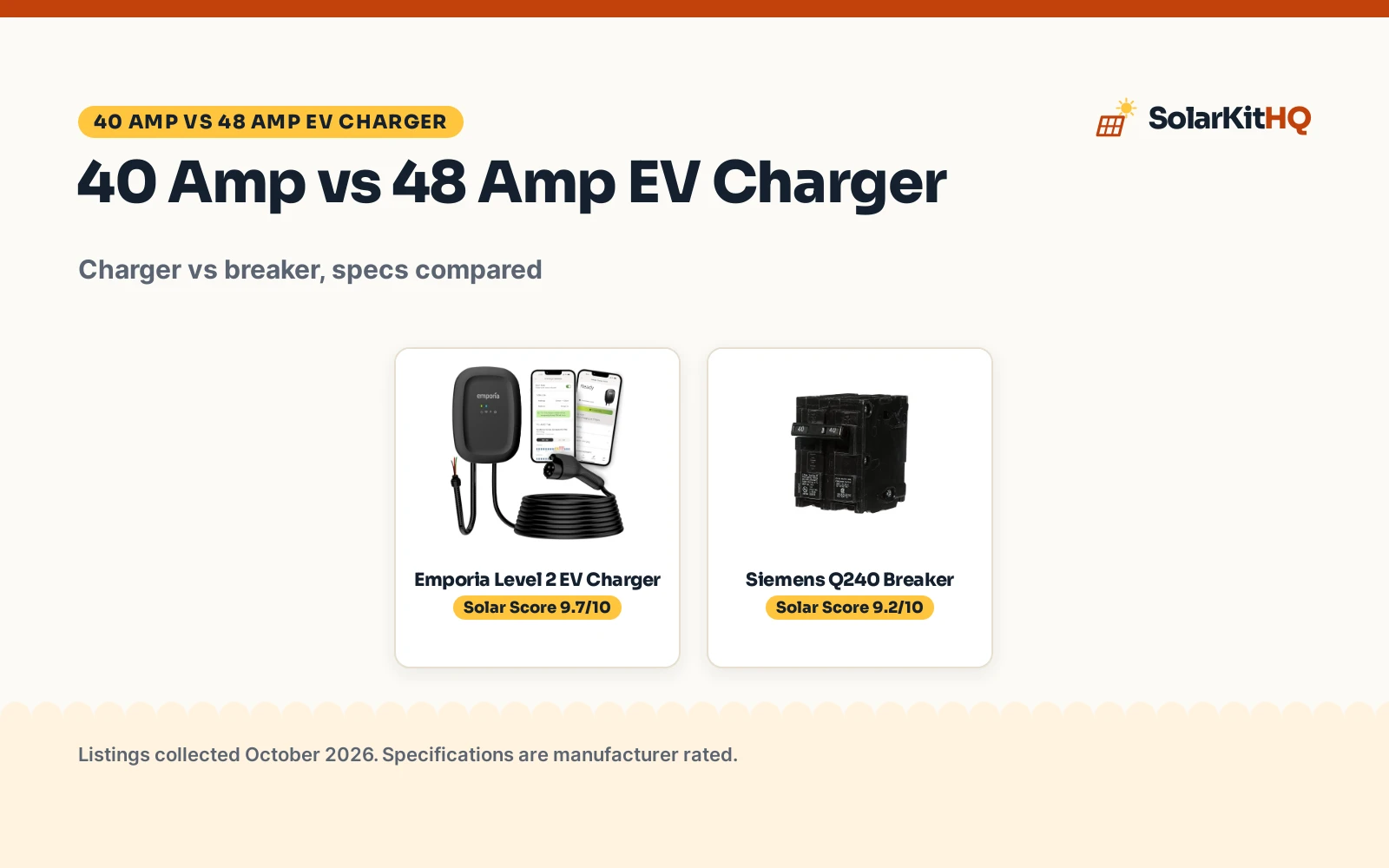
The short answer on 40 amp vs 48 amp ev charger: pick the 48 amp side if you want an EV charger, because the only charger example here is the 48 amp Emporia Level 2 unit. The 40 amp example here is not a charger at all. It is a Siemens circuit breaker for a load center, so this page has no 40 amp charger example to compare against the Emporia. We compared the two items on what each maker states: amps, voltage, item type, connector or fit, cable and warranty.
SolarKitHQ earns a commission when you buy through links on this page, at no extra cost to you. As an Amazon Associate I earn from qualifying purchases. Affiliate disclosure.
40 amp vs 48 amp EV charger: side by side
| Model | Solar Score | Side | Item type | Amps stated | Warranty stated |
|---|---|---|---|---|---|
| Emporia Level 2 EV Charger | 9.7/10 | 48 amp ev charger | Level 2 EV charger | 48 Amp | 3-year |
| Siemens Q240 Breaker | 9.2/10 | 40 amp | Circuit breaker | 40 Amp | 1 Year |
We copied each rating from the seller’s listing as the brand states it; data date 20 November 2026.
Charger vs breaker
This is the whole comparison. The Emporia example is a Level 2 EV charger with a J1772 connector, a 25ft cable and hardwired installation with whip, as its maker states. The Siemens Q240 example is a double pole circuit breaker that fits Siemens PL and ES series load centers and is used for overload and short-circuit protection of an electrical system, as its maker states. A breaker protects a circuit. It does not plug into a car, and it states no connector, cable or charging speed. Calling the 40 amp side a charger would be wrong on this evidence.
Amps and voltage as stated
Both examples state 240V, and the amp figures describe different jobs. The Emporia maker states 48 amp charging via hardwired connection, with up to 46 miles per hour charging speed stated by the maker. The Siemens maker states 40 Amp at 240V with a 10,000 AIC interrupting rating for the breaker. Because only one side states charging figures, this page does not call either side faster or stronger as a charger. The breaker figure describes protection in a load center, and the charger figure describes charging current from the Emporia example only.
Installation and fit
Fit is stated narrowly on both sides. The Emporia maker states preconfigured hardwired installation with whip for up to 48A and recommends professional installation. A Level 2 charger needs a 240V outlet or circuit, so a licensed electrician should install or check the outlet, and this page gives no wiring steps. The Siemens maker states plug-in connections in Siemens enclosures and compatibility with Siemens PL and ES series load centers, with an insta-wire feature stated. Electrical panel work also belongs with a qualified electrician, not with charger shopping.
What the listings leave unclear
There is no 40 amp EV charger example in this set, so any claim about how a 40 amp charger would compare on speed, cable length, app control or warranty would be a guess. The Emporia maker states WiFi connection via 2.4 GHz, real-time energy data and scheduling from a mobile device, plus UL listing and ENERGY STAR certification. The Siemens maker states no charging features, because the item is a breaker. Our best home EV charger picks cover actual charger models, and the portable EV charger vs Level 2 charger comparison covers charger types.
Two examples

Emporia Level 2 EV Charger
A 48 amp, 240V Level 2 EV charger with J1772 connector, 25ft cable, WiFi control and hardwired installation with whip stated.
Pros
- 48 amp hardwired charging stated
- J1772 connector with 25ft cable stated
- WiFi energy data and scheduling stated
- UL listed and ENERGY STAR certified stated
Cons
- Hardwired installation, professional install recommended
- J1772 port vehicles only as stated
- No plug-in option stated
- NACS vehicles need a different version stated
Detailed Review
The maker states a Level 2 EV charger at 48 amp and 240V with an SAE J1772 connector, a 25ft cable and hardwired installation with whip, plus up to 46 miles per hour charging speed stated by the maker. WiFi connection via 2.4 GHz gives real-time energy data and scheduling from a mobile device, and the maker states UL listing, ENERGY STAR certification and standards including NEC 625, SAE J1772 and UL 2594.
Who it's for: a J1772 EV owner who wants stated 48 amp home charging with app scheduling. Who should skip it: anyone without a 240V circuit checked by a licensed electrician, or with a NACS vehicle.
Its Solar Score of 9.7/10 comes from performance 30/35, build 21/25, value 20/25, safety 9/10 and warranty 3/5: 83 of 100 points, placed on our 9.2 to 9.8 scale.
Key Specifications
| Amps | 48 Amp stated |
|---|---|
| Voltage | 240V stated |
| Connector | SAE J1772 stated |
| Cable | 25ft stated |
Taken from the seller's listing on 20 November 2026. Capacity and output figures are rated by the manufacturer.
Safety and Warranty
What this listing states. UL listed and ENERGY STAR certified as stated, with NEC 625, SAE J1772, UL 817, UL 991, UL 2231, UL 2251 and UL 2594 stated, so safety scores 9 of 10. 3-year warranty. It does not say everything a buyer needs, such as who pays return shipping, so warranty scores 3 of 5. See How We Pick.
Match the charger. Use a charger mode that matches your battery's stated chemistry and voltage, connect in the order the manual gives, and keep it ventilated and dry.
This is general buying information, not professional advice. Follow each product manual and local rules, and see our Safety Disclaimer.

Siemens Q240 Breaker
A 40 amp double pole Type QP circuit breaker for Siemens PL and ES series load centers, for overload and short-circuit protection stated.
Pros
- 40 Amp double pole breaker stated
- Fits Siemens PL and ES load centers stated
- 10,000 AIC interrupting rating stated
- Plug-in connections with insta-wire feature stated
Cons
- Not an EV charger, charges nothing
- No vehicle connector or cable stated
- No charging speed stated
- Siemens enclosures only as stated
Detailed Review
This item is a circuit breaker, not a charger. The maker states a double pole 40 Amp, 240V Type QP breaker with a 10,000 AIC interrupting rating, plug-in connections in Siemens enclosures, compatibility with Siemens PL and ES series load centers, and use for overload and short-circuit protection. No EV connector, cable, charging speed or app control is stated.
Who it's for: an electrician fitting a 40 amp breaker in a Siemens PL or ES load center. Who should skip it: anyone shopping for an EV charger to plug into a car.
Its Solar Score of 9.2/10 comes from performance 6/35, build 15/25, value 10/25, safety 4/10 and warranty 2/5: 37 of 100 points, placed on our 9.2 to 9.8 scale.
Key Specifications
| Type | Double pole Type QP breaker |
|---|---|
| Amps | 40 Amp stated |
| Voltage | 240V stated |
| Fit | Siemens PL and ES load centers stated |
Taken from the seller's listing on 20 November 2026. Capacity and output figures are rated by the manufacturer.
Safety and Warranty
What this listing states. Overload and short-circuit protection stated by the maker, so safety scores 4 of 10. 1 Year. It does not say everything a buyer needs, such as who pays return shipping, so warranty scores 2 of 5. See How We Pick.
Match the charger. Use a charger mode that matches your battery's stated chemistry and voltage, connect in the order the manual gives, and keep it ventilated and dry.
This is general buying information, not professional advice. Follow each product manual and local rules, and see our Safety Disclaimer.
As an Amazon Associate I earn from qualifying purchases.
Where the points went
The Solar Score weighs performance, build, value, safety and warranty. For a charger, safety means certifications the maker actually states; the Emporia example states UL listing and ENERGY STAR certification, while the Siemens example states overload and short-circuit protection as a breaker. Both items state a warranty term. How we pick explains the weights.
| Product | Solar Score | Perf. /35 | Build /25 | Value /25 | Safety /10 | Warranty /5 |
|---|---|---|---|---|---|---|
| Emporia Level 2 EV Charger | 9.7 | 30 | 21 | 20 | 9 | 3 |
| Siemens Q240 Breaker | 9.2 | 6 | 15 | 10 | 4 | 2 |
We place weighted points on a scale whose ends are 9.2 and 9.8. Because the mapping is straight, a unit with more points never shows less.
40 amp vs 48 amp ev charger: which should you choose?
Choose the 48 amp Emporia example if you want to charge an EV at home and your vehicle uses the J1772 charge port, as its maker states compatibility with EVs that use that port. Choose the Siemens Q240 example only if you need a 40 amp double pole breaker for a Siemens PL or ES series load center, which is a different purchase handled by an electrician. If you want a true 40 amp charger comparison, neither item here gives you one, so shop the charger picks instead.
| If you need | Look at |
|---|---|
| Home EV charging at 48 amp stated | Emporia Level 2 EV Charger, J1772 and 25ft cable stated |
| A 40 amp breaker for a Siemens load center | Siemens Q240, PL and ES series compatibility stated |
| A 40 amp EV charger | Neither example here, shop charger picks instead |
Sizing Notes
- Match the item type first: charger for charging a car, breaker for protecting a circuit in a load center.
- Match the connector as stated: the Emporia example states an SAE J1772 connector for EVs with the J1772 charge port.
- Match voltage as stated: both examples state 240V, for different jobs.
- Have a licensed electrician install or check the 240V outlet or circuit for a Level 2 charger.
FAQ: power away from the grid
Is the Siemens Q240 a 40 amp EV charger?
No. Its maker states a double pole Type QP circuit breaker for Siemens PL and ES series load centers, used for overload and short-circuit protection. It states no vehicle connector or charging speed.
What charging speed does the 48 amp Emporia state?
The maker states up to 46 miles per hour charging speed via hardwired connection at 48 amp. Charging speed is stated by the maker for this example only.
Which cars does the Emporia charger fit?
The maker states compatibility with all EVs in North America that use the J1772 charge port, and names Chevrolet Bolt, VW ID 4, Nissan Leaf and Ford Mustang Mach-E among others. For NACS and Tesla vehicles, the maker directs buyers to a Tesla charger version.
Can I install a Level 2 charger myself?
A Level 2 charger needs a 240V outlet or circuit, so a licensed electrician should install or check the outlet. The Emporia maker also recommends professional installation for its hardwired charger.
Related solar guides
See every Home EV Chargers guide and all Batteries and Charging guides.
More picks: best home EV charger, best Level 2 EV charger, portable EV charger vs Level 2 charger and NACS vs J1772 EV charger.