On this page
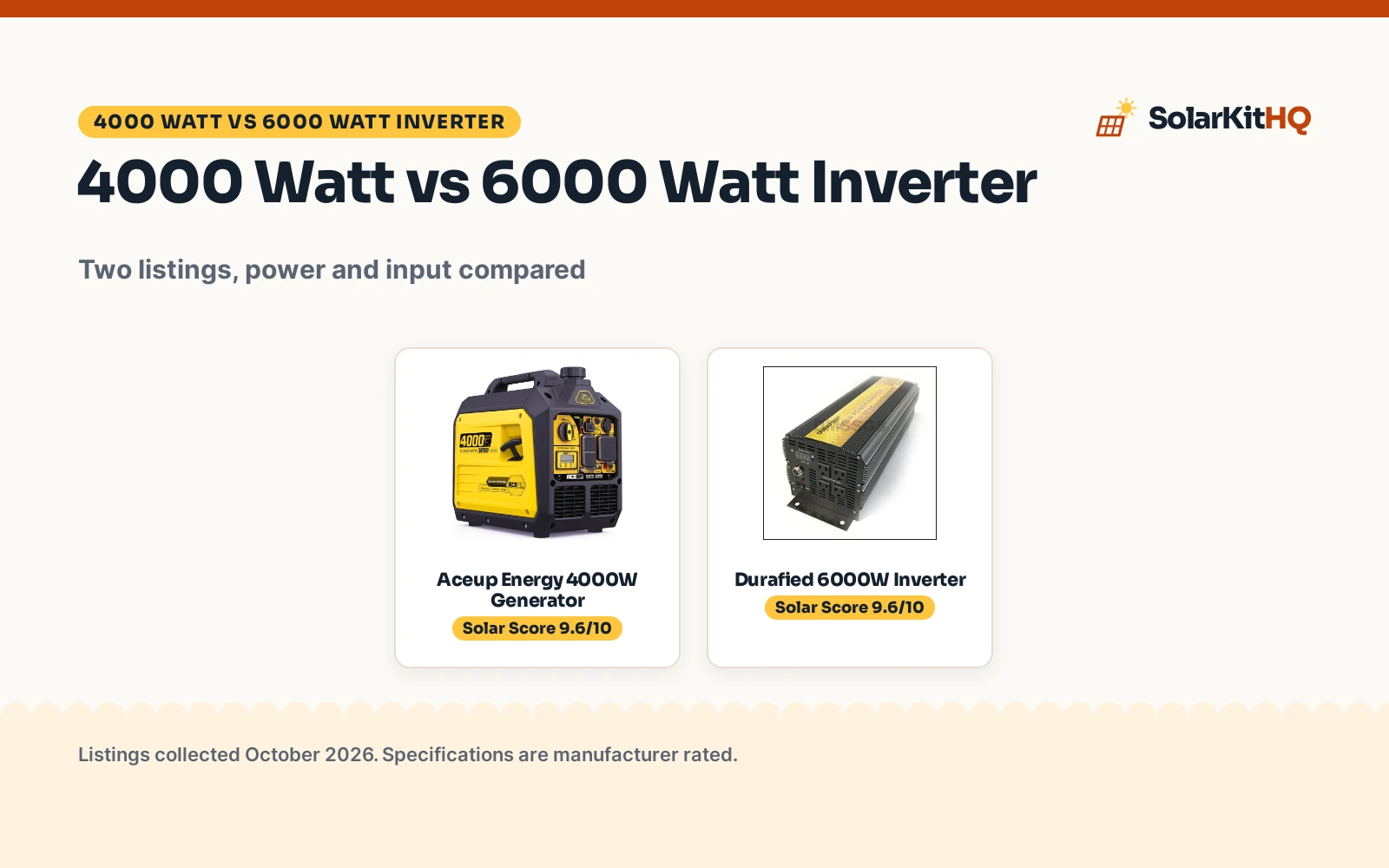
The short answer on 4000 watt vs 6000 watt inverter: pick the 4000 watt side if you want a fuel-powered generator, and pick the 6000 watt side if you want a battery-powered inverter. We compared the two listings on power, input, output, protections and warranty terms. The listings are different kinds of power equipment, so the choice turns on input type and outlet needs, not on the watt figure alone.
SolarKitHQ earns a commission when you buy through links on this page, at no extra cost to you. As an Amazon Associate I earn from qualifying purchases. Affiliate disclosure.
4000 watt vs 6000 watt inverter: side by side
| 4000 watt vs 6000 watt inverter | Aceup Energy 4000W Generator | Durafied 6000W Inverter | Takeaway |
|---|---|---|---|
| Power stated | 4000 peak watts, 3200 rated watts | 6000 continuous watts, 12000 peak watts | Different measures: peak and rated vs continuous and peak |
| Input | Gasoline, 149cc 4-stroke engine | 12V DC, range 10-15V DC | Fuel engine vs battery input |
| Output | 120V AC, one 20A outlet, one RV receptacle, one 12V DC 8.3A outlet | 110-120V AC, 4 outlets | Aceup lists outlet types; Durafied lists outlet count |
| Waveform | Inverter technology, THD below 1.5% | Modified Sine Wave | THD stated only for Aceup |
| Protection stated | Low oil LED, automatic shut down | Low voltage alarm, overload, short circuit, over voltage, reverse polarity protection | Both list protections, different sets |
| Weight | 48 pounds | Not stated | Weight stated only for Aceup |
| Warranty | 2-year limited warranty | Not stated | Warranty stated only for Aceup |
Specifications are manufacturer rated as listed, collected 25 October 2026.
Power and input
Power is stated in different measures here, so the watt figures do not line up directly. The Aceup listing states 4000 peak watts and 3200 rated watts from a 149cc 4-stroke engine, with gasoline as the fuel described in the bullets. The Durafied listing states 6000 watts continuous power and 12000 watts peak power from a 12V DC input, with a stated input range of 10-15V DC. One listing is a fuel-powered generator, the other is a battery-powered inverter, and that input difference matters more than the watt figure alone. See the solar generator vs gas generator home backup for the generator side of that split.
The Aceup listing states a fuel tank capacity of 1.32 gallon and up to 5 hours at half-load, while the spec table states a runtime of 10 hours with no load stated, so the bullets figure is the one used here. The Durafied listing states no runtime, no fuel tank and no battery capacity, because it draws from a 12V DC source rather than a tank. Neither listing states a watt-hour figure, so no run time comparison can be drawn between them.
Outlets and protections
Outlets are stated unevenly. The Aceup listing states one 20A outlet at 120V AC, one RV receptacle and one 12V DC 8.3A car charger outlet, with a total of 4 power outlets stated in the spec table. The Durafied listing states 4 outlets and an output of 110-120V, with no outlet types stated. The Aceup listing also states a 60Hz intelligent gauge that tracks voltage, run-time, gasoline meter, hertz and power output, plus a low oil LED and an economic mode. The Durafied listing states a wireless remote socket, soft-start technology and thermally controlled cooling fans.
Protections are stated on both sides, in different sets. The Aceup listing states automatic shut down as an additional feature, plus a low oil LED. The Durafied listing states a low voltage alarm with auto reset, overload, short circuit and over voltage protection, reverse polarity protection and thermally controlled cooling fans. The Durafied listing states a modified sine wave, while the Aceup listing states inverter technology with THD below 1.5%. For a closer look at inverter options, see the best inverter and the best small power inverter.
What the listings leave unclear
Several figures conflict inside the listings, and the bullets win where they conflict. The Aceup bullets state a 2-year limited warranty, while the spec table states a 1 year limited warranty. The Aceup spec table also lists propane running and starting watts, while the bullets describe gasoline only, so this comparison uses the gasoline figures. The Durafied spec table lists output voltage as 10 volts and 120 volts, while the bullets state an output of 110-120V, so the bullets figure is used here. The Durafied listing states no weight and no warranty term, and the Aceup listing states no handle or wheel detail, so those points stay unstated rather than filled in.
Two examples

Aceup Energy 4000W Generator
A 4000 peak watt gas inverter generator with 3200 rated watts, a 149cc 4-stroke engine and a 1.32 gallon tank.
Pros
- 4000 peak watts and 3200 rated watts stated, with a 149cc 4-stroke engine
- 120V AC outlet, RV receptacle and 12V DC 8.3A outlet stated
- About 60 decibels in Eco mode at 23 feet with 25% load stated
- THD below 1.5% stated, with low oil LED and economic mode
Cons
- Bullets state a 2-year limited warranty, while spec table states 1 year limited warranty
- Spec table states runtime 10 hours, while bullets state up to 5 hours at half-load
- Parallel kit sold separately, per the bullets
- No handle or wheel detail is stated
Detailed Review
The listing states a 4000 peak watt and 3200 rated watt gas inverter generator with a 149cc 4-stroke engine, recoil start, a 1.32 gallon tank, up to 5 hours at half-load, one 20A outlet at 120V AC, one RV receptacle and one 12V DC 8.3A outlet, plus a 60Hz intelligent gauge, a low oil LED and an economic mode. The bullets state a 2-year limited warranty, while the spec table states a 1 year limited warranty, and the spec table states a runtime of 10 hours against the bullets figure of up to 5 hours at half-load, so the bullets figures are used here. The spec table also lists propane running and starting watts, while the bullets describe gasoline only, so the gasoline figures are used here.
Who it's for: users who want a fuel-powered generator with a stated tank, a stated runtime at half-load and an RV receptacle. Who should skip it: anyone who wants a battery-powered inverter, or a single consistent warranty figure.
Its Solar Score of 9.6/10 comes from performance 30/35, build 21/25, value 21/25, safety 7/10 and warranty 2/5: 81 of 100 points, placed on our 9.2 to 9.8 scale.
Key Specifications
| Power | 4000 peak watts, 3200 rated watts |
|---|---|
| Engine | 149cc 4-stroke |
| Tank | 1.32 gallon |
| Outlets | 120V AC 20A, RV, 12V DC 8.3A |
Figures as published on the retailer listing, collected 25 October 2026. Performance figures are manufacturer rated.
Safety and Warranty
What this listing states. Automatic shut down and low oil LED stated, so safety scores 7 of 10. 2-year limited warranty stated. It does not say everything a buyer needs, such as who pays return shipping, so warranty scores 2 of 5. See How We Pick.
Inverter limits. Stay within the stated continuous watts (surge watts last only a moment), use the cable size and fuse the manual gives, ventilate it, and never connect an inverter to home wiring yourself; that is work for a licensed electrician.
This is general buying information, not professional advice. Follow each product manual and local rules, and see our Safety Disclaimer.

Durafied 6000W Inverter
A 6000 continuous watt and 12000 peak watt DC to AC power inverter with a 12V DC input and a wireless remote socket.
Pros
- 6000 watts continuous power and 12000 watts peak power stated
- Low voltage alarm, overload, short circuit, over voltage and reverse polarity protection stated
- Thermally controlled cooling fans stated, with soft-start technology
- Wireless remote socket stated, with an anodized aluminum case
Cons
- No warranty term is stated
- No weight is stated
- Modified sine wave stated, with no THD figure stated
- Spec table lists output voltage as 10 volts, while bullets state 110-120V
Detailed Review
The listing states a 6000 watts continuous power and 12000 watts peak power inverter with a 12V DC input in a range of 10-15V DC, an output of 110-120V at 60Hz, 4 outlets, soft-start technology, a low voltage alarm with auto reset, overload, short circuit and over voltage protection, reverse polarity protection, thermally controlled cooling fans and a wireless remote socket. The spec table lists output voltage as 10 volts and 120 volts, while the bullets state 110-120V, so the bullets figure is used here. The spec table also lists wattage as 12000 watts, which matches the peak figure in the bullets, not the continuous figure.
Who it's for: users who want a battery-powered inverter with a stated continuous and peak power figure and a stated set of electrical protections. Who should skip it: anyone who wants a fuel-powered generator, a stated weight, or a stated warranty term.
Its Solar Score of 9.6/10 comes from performance 32/35, build 20/25, value 20/25, safety 8/10 and warranty 0/5: 80 of 100 points, placed on our 9.2 to 9.8 scale.
Key Specifications
| Power | 6000 continuous watts, 12000 peak watts |
|---|---|
| Input | 12V DC, range 10-15V DC |
| Output | 110-120V AC, 4 outlets |
| Case | Anodized aluminum |
Figures as published on the retailer listing, collected 25 October 2026. Performance figures are manufacturer rated.
Safety and Warranty
What this listing states. Low voltage alarm, overload, short circuit, over voltage and reverse polarity protection stated, so safety scores 8 of 10. No warranty term, so warranty scores zero. See How We Pick.
Inverter limits. Stay within the stated continuous watts (surge watts last only a moment), use the cable size and fuse the manual gives, ventilate it, and never connect an inverter to home wiring yourself; that is work for a licensed electrician.
This is general buying information, not professional advice. Follow each product manual and local rules, and see our Safety Disclaimer.
As an Amazon Associate I earn from qualifying purchases.
How we scored them
The Solar Score scores each listing on performance, build, value, safety and warranty. Safety here means the protections each listing states, from low oil and automatic shut down on the generator side to overload, short circuit, over voltage and reverse polarity protection on the inverter side. One listing states a warranty term, and the other states no warranty term. How we pick explains the weights.
| Product | Solar Score | Perf. /35 | Build /25 | Value /25 | Safety /10 | Warranty /5 |
|---|---|---|---|---|---|---|
| Aceup Energy 4000W Generator | 9.6 | 30 | 21 | 21 | 7 | 2 |
| Durafied 6000W Inverter | 9.6 | 32 | 20 | 20 | 8 | 0 |
Scores run from 9.2 to 9.8: each product’s point total is placed on that range, so more points always means a higher score.
4000 watt vs 6000 watt inverter: which should you choose?
Choose by input and outlet needs, not by the watt figure alone. The generator side suits a fuel-powered setup with a stated tank, a stated runtime at half-load and a stated warranty. The inverter side suits a battery-powered setup with a stated continuous power figure, a stated peak power figure and a stated set of electrical protections. If the load needs a 12V DC source and a remote socket, the inverter side is the fit. If the load needs a fuel-powered generator with an RV receptacle, the generator side is the fit.
| Pick | Input | Output |
|---|---|---|
| 4000 watt side | Gasoline engine | 120V AC |
| 6000 watt side | 12V DC battery | 110-120V AC |
Sizing Notes
- Match the input to the source: gasoline for the generator side, 12V DC for the inverter side, within the stated 10-15V DC range.
- Match the outlet types to the load: the Aceup listing states a 20A outlet, an RV receptacle and a 12V DC 8.3A outlet, while the Durafied listing states 4 outlets with no types stated.
- Compare power measures like with like: peak and rated watts on the generator side, continuous and peak watts on the inverter side.
- Check the warranty term stated: the Aceup listing states a 2-year limited warranty, and the Durafied listing states no warranty term.
Frequently Asked Questions
Is a 4000 watt generator the same as a 6000 watt inverter?
No. The Aceup listing describes a fuel-powered generator with 4000 peak watts and 3200 rated watts, while the Durafied listing describes a battery-powered inverter with 6000 watts continuous power and 12000 watts peak power. They use different inputs and different power measures.
What outlets does each listing state?
The Aceup listing states one 20A outlet at 120V AC, one RV receptacle and one 12V DC 8.3A car charger outlet. The Durafied listing states 4 outlets and an output of 110-120V, with no outlet types stated.
Which listing states a warranty?
The Aceup bullets state a 2-year limited warranty, while the spec table states a 1 year limited warranty. The Durafied listing states no warranty term.
Does the Durafied listing state a modified sine wave?
Yes. The Durafied bullets state a modified sine wave, with soft-start technology and thermally controlled cooling fans. The Aceup listing states inverter technology with THD below 1.5%, with no sine wave type stated.
Can the Aceup generator run in parallel with another generator?
The bullets state it is parallel ready to connect 2 generators for double the power, with a parallel kit sold separately. No parallel kit is stated as included.
Related guides
See every Power Inverters guide and all Controllers and Inverters guides.
More picks: best inverter, best small power inverter, solar generator vs gas generator home backup.