On this page
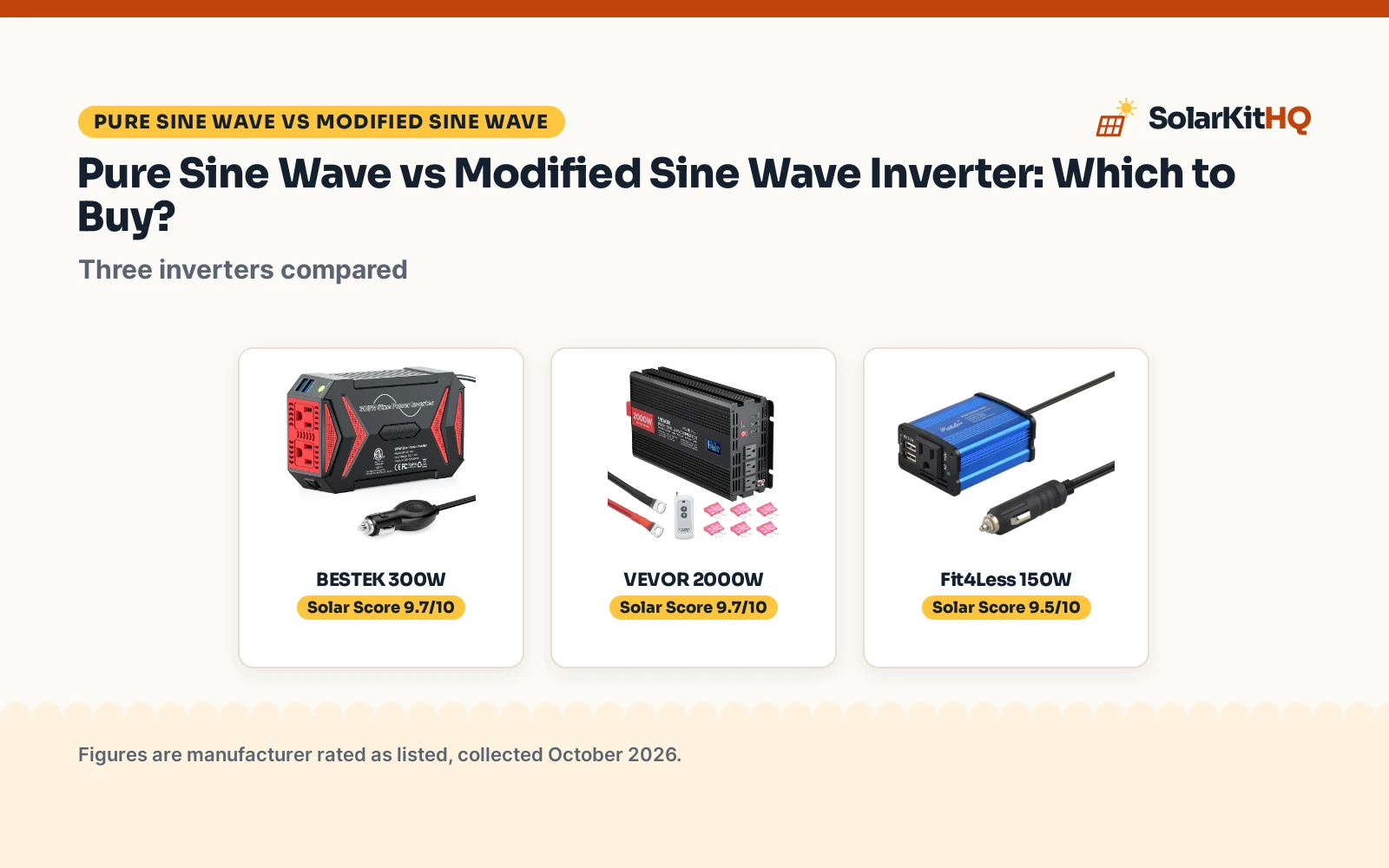
Pure sine wave vs modified sine wave inverter comes down to what you plug in: sensitive electronics and motors want the clean output, and simple loads do not care. We compared three listings, two pure sine wave inverters and one modified sine wave inverter, on wattage, waveform, outlets, protections and warranty, using each listing’s own figures. Verdict: pure sine wave is the safer pick for laptops, CPAP and appliances, and modified sine wave only makes sense for the smallest, simplest loads.
SolarKitHQ earns a commission when you buy through links on this page, at no extra cost to you. As an Amazon Associate I earn from qualifying purchases. Affiliate disclosure.
Pure sine wave vs modified sine wave inverter: side by side
| Model | Solar Score | Output | Waveform | Outlets | Warranty | Amazon |
|---|---|---|---|---|---|---|
| BESTEK 300W | 9.7/10 | 300W, 700W peak | Pure sine | 2 AC + 2 USB | 18-month stated | View on Amazon |
| VEVOR 2000W | 9.7/10 | 2000W, 4000W peak | Pure sine | 2 AC + 3 USB | Not stated | View on Amazon |
| Fit4Less 150W | 9.5/10 | 150W, 300W surge | Modified | 1 AC + 2 USB | 1-year stated | View on Amazon |
Specifications are manufacturer rated as listed, collected 21 October 2026.
The contenders
| # | Product | Solar Score | Buy |
|---|---|---|---|
| 1 |  BESTEK 300W | 9.7/10 | Buy on Amazon |
| 2 |  VEVOR 2000W | 9.7/10 | Buy on Amazon |
| 3 |  Fit4Less 150W | 9.5/10 | Buy on Amazon |

BESTEK 300W
A 300W pure sine wave car inverter with 700W peak and dual USB ports.
Pros
- 300W continuous, 700W peak stated
- Pure sine wave stated in spec table
- ETL, RoHS and FCC stated
- 18-month warranty stated
Cons
- 11-17V input, car only
- 2 AC outlets only
- 1.4 pounds but vents and fan needed
- Tesla compatibility stated, not explained
Detailed Review
The listing states a 300W pure sine wave power inverter for 11 to 17V DC to 110V AC, 700W peak, 2 AC outlets and 2 smart USB ports at 4.8A total, a 40A fuse with full protection against overheating, under and over voltage, short circuiting, overloads and overcharging, ETL, RoHS and FCC, and an 18-month warranty, at 1.4 pounds and 8.1 by 5.3 by 2.6 inches. The USB ports deliver up to 2.4A per port.
Who it's for: drivers who need clean power for laptops and CPAP from a lighter socket. Who should skip it: anyone who needs more than 300W.
Its Solar Score of 9.7/10 comes from performance 29/35, build 20/25, value 21/25, safety 7/10 and warranty 5/5: 82 of 100 points, placed on our 9.2 to 9.8 scale.
Key Specifications
| Output | 300W, 700W peak |
|---|---|
| Waveform | Pure Sine Wave |
| USB | 4.8A total |
Figures as published on the retailer listing, collected 21 October 2026. Performance figures are manufacturer rated.
Safety and Warranty
What this listing states. ETL, RoHS and FCC stated, so safety scores 7 of 10. 18-month warranty stated, so warranty scores 5 of 5. See How We Pick.
Inverter limits. Stay within the stated continuous watts (surge watts last only a moment), use the cable size and fuse the manual gives, ventilate it, and never connect an inverter to home wiring yourself; that is work for a licensed electrician.
This is general buying information, not professional advice. Follow each product manual and local rules, and see our Safety Disclaimer.

Pros
- 2000W continuous, 4000W peak stated
- Up to 88% full-load efficiency stated
- CE and FCC with six protections
- LCD display and wireless remote stated
Cons
- No warranty term is stated
- 8.8 pounds, the heaviest here
- Type-C limited to 30W
- 100m remote range is maker claim
Detailed Review
The listing states a 2000W pure sine wave power inverter for 12V DC to 120V AC, 4000W peak, up to 88% full-load efficiency, 2 AC outlets, 2 USB ports at 18W combined and 1 Type-C at 30W, CE and FCC certification with six protections including reverse polarity, an LCD display, a wireless remote, and an intelligent temperature-controlled fan, at 8.8 pounds and 14.7 by 3.2 by 6.5 inches. No warranty term is stated.
Who it's for: households and RVs that need appliance-level power with clean output. Who should skip it: anyone who wants a stated warranty.
Its Solar Score of 9.7/10 comes from performance 34/35, build 22/25, value 22/25, safety 9/10 and warranty 0/5: 87 of 100 points, placed on our 9.2 to 9.8 scale.
Key Specifications
| Output | 2000W, 4000W peak |
|---|---|
| Waveform | Pure Sine Wave |
| Efficiency | 88% stated |
Figures as published on the retailer listing, collected 21 October 2026. Performance figures are manufacturer rated.
Safety and Warranty
What this listing states. CE and FCC certified, 6-layer protection stated, so safety scores 9 of 10. No warranty term, so warranty scores zero. See How We Pick.
Inverter limits. Stay within the stated continuous watts (surge watts last only a moment), use the cable size and fuse the manual gives, ventilate it, and never connect an inverter to home wiring yourself; that is work for a licensed electrician.
This is general buying information, not professional advice. Follow each product manual and local rules, and see our Safety Disclaimer.

Fit4Less 150W
A 150W modified sine wave car inverter with 300W surge and USB ports.
Pros
- 150W rated, 300W surge stated
- Modified sine wave stated in spec table
- UL stated with built-in 20A fuse
- 1-year warranty stated
Cons
- Single AC receptacle only
- 3.1A USB shared, not per port
- Detachable cable is 2 feet
- 150W ceiling is low
Detailed Review
The listing states a 150W modified sine wave power inverter for vehicle DC to 110V AC, 300W surge, 1 AC receptacle, 2 USB ports at 3.1A shared, a detachable 2-foot 14AWG cigarette lighter cable with a built-in 20A fuse, UL, and a 1-year warranty, at 3.46 by 2.52 by 1.61 inches. It suits small loads under 150W.
Who it's for: drivers who need the smallest inverter for phones and laptops. Who should skip it: anyone who needs more than 150W or clean sine output.
Its Solar Score of 9.5/10 comes from performance 23/35, build 18/25, value 20/25, safety 7/10 and warranty 5/5: 73 of 100 points, placed on our 9.2 to 9.8 scale.
Key Specifications
| Output | 150W, 300W surge |
|---|---|
| Waveform | Modified Sine Wave |
| USB | 3.1A shared |
Figures as published on the retailer listing, collected 21 October 2026. Performance figures are manufacturer rated.
Safety and Warranty
What this listing states. UL stated, 20A fuse built in, so safety scores 7 of 10. 1-year warranty stated, so warranty scores 5 of 5. See How We Pick.
Inverter limits. Stay within the stated continuous watts (surge watts last only a moment), use the cable size and fuse the manual gives, ventilate it, and never connect an inverter to home wiring yourself; that is work for a licensed electrician.
This is general buying information, not professional advice. Follow each product manual and local rules, and see our Safety Disclaimer.
As an Amazon Associate I earn from qualifying purchases.
Where the points went
The Solar Score weighs performance, build, value, safety and warranty. For inverters, safety means stated protections and certifications; all three listings state at least one. Two of the three state a warranty term. How we pick explains the weights.
| Product | Solar Score | Perf. /35 | Build /25 | Value /25 | Safety /10 | Warranty /5 |
|---|---|---|---|---|---|---|
| BESTEK 300W | 9.7 | 29 | 20 | 21 | 7 | 5 |
| VEVOR 2000W | 9.7 | 34 | 22 | 22 | 9 | 0 |
| Fit4Less 150W | 9.5 | 23 | 18 | 20 | 7 | 5 |
Scores run from 9.2 to 9.8: each product’s point total is placed on that range, so more points always means a higher score.
How to choose: pure sine wave vs modified sine wave inverter
Wattage and peak power
The VEVOR example delivers 2000W continuous and 4000W peak at up to 88% full-load efficiency: household-appliance territory. The BESTEK example delivers 300W continuous and 700W peak: car and camp territory. The Fit4Less example delivers 150W rated and 300W surge: phone-and-laptop territory. Size the inverter to the load with headroom; running a 150W unit at its limit is a short life. For van builds, see our best 2000 watt pure sine wave inverter for van guide.
Waveform: what the listings state
The spec tables state the waveform outright: pure sine wave for the BESTEK and VEVOR examples, modified sine wave for the Fit4Less example. The listings do not state which devices misbehave on modified sine wave, so the article cannot either; the practical difference the data supports is that pure sine wave is stated by the two larger, certified units. Do not call a side better on waveform unless your load cares about it.
Outlets and USB
The BESTEK example has 2 AC outlets and 2 USB ports at 4.8A total. The VEVOR example has 2 AC outlets, 2 USB ports at 18W combined and 1 Type-C at 30W. The Fit4Less example has 1 AC receptacle and 2 USB ports at 3.1A shared. If the load is mostly USB, the AC count matters less.
Protections and certifications
The VEVOR example states CE and FCC certification with six protections including reverse polarity. The BESTEK example states ETL, RoHS and FCC with a 40A fuse and full protection against overheating, under and over voltage, short circuiting, overloads and overcharging. The Fit4Less example states UL with a built-in 20A fuse. All three state at least one certification, so buy the protections your setup needs.
Who should choose which?
Choose pure sine wave for anything with a motor, a compressor or sensitive electronics: the VEVOR 2000W handles medium household equipment at 8.8 pounds, and the BESTEK 300W handles car loads and CPAP at 1.4 pounds. Choose modified sine wave only for the simplest loads at the lowest wattage: the Fit4Less 150W handles phones, laptops and small fans. Neither listing here gives a reason to pick modified sine wave above 150W.
FAQ: power away from the grid
Which side handles bigger appliances?
The pure side: the VEVOR example states 2000W continuous and 4000W peak. The modified example states 150W rated and 300W surge.
Which is the smallest?
The Fit4Less example at 3.46 by 2.52 by 1.61 inches. The BESTEK example is 8.1 by 5.3 by 2.6 inches, and the VEVOR example is 14.7 by 3.2 by 6.5 inches.
Which states the most protections?
The VEVOR example with six stated protections, and the BESTEK example with full protection and a 40A fuse. The Fit4Less example states a built-in 20A fuse.
Which state a warranty term?
The BESTEK example at 18 months and the Fit4Less example at 1 year. The VEVOR example states none.
Which has a remote control?
The VEVOR example with a wireless remote and LCD display. Neither of the other two listings states one.
Related solar guides
See every Power Inverters guide and all Controllers and Inverters guides.
More guides: best 2000 watt pure sine wave inverter for van, best 300 watt pure sine wave inverter and best pure sine wave inverter for RV.