On this page
When the power goes out on a dark evening, the question behind portable power station vs propane generator is simple: what keeps the lights, the fridge and the phones running while the outage lasts? That moment frames the choice as a practical one, not a spec sheet debate: stored battery power with solar charging on one side, and fuel-burning power with a tank to refill on the other. The short verdict is plain: pick the portable power station side for battery backup with solar charging and no fuel to store, and pick the propane generator side for rated watts on propane with a stated runtime per tank. This comparison sets portable power station and propane generator listings side by side and uses each listing as a concrete example.
SolarKitHQ earns a commission when you buy through links on this page, at no extra cost to you. As an Amazon Associate I earn from qualifying purchases. Affiliate disclosure.
Portable power station vs propane generator side by side
| Generator | Solar Score | Side | Power stated | Runtime or recharge stated | Weight stated | Amazon |
|---|---|---|---|---|---|---|
| Westinghouse WGen3600DFcv | 9.6/10 | Propane generator | 4650W peak, 3600W rated gasoline; 4650W peak, 3240W rated propane | Up to 14 hours per tank | 108.0 pounds | View on Amazon |
| Westinghouse WGen3600DFc | 9.6/10 | Propane generator | 4650W peak, 3600W rated gasoline; 4650W peak, 3240W rated propane | Not stated | 121.1 pounds | View on Amazon |
| EcoVolt P5000 Plus | 9.6/10 | Portable power station | 5120Wh, 3600W, 5000W surge | 2.2 hours full charge | 112 pounds | View on Amazon |
Specifications are manufacturer rated as listed, collected 3 November 2026.
Fuel and charging
Fuel generators run outdoors only, far from doors and windows, because of carbon monoxide. The EcoVolt example stores power in a battery and charges from AC input or solar input, with no fuel tank to fill. The Westinghouse WGen3600DFcv example runs on gasoline or propane from a 4 gallon fuel tank with a fuel gauge, and the Westinghouse WGen3600DFc example also runs on gasoline or propane from a 4 gallon fuel tank with a fuel gauge. The Westinghouse WGen3600DFc example switches from gas to propane without shutting off the unit, while the Westinghouse WGen3600DFcv example states no such switching detail.
Power and outlets
The EcoVolt example states 5120Wh of capacity, a 3600W pure sine wave inverter, 5000W surge, and 15 output ports: 5 AC outlets at 3600W total, 4 USB-A ports, 2 USB-C PD ports, 2 DC ports, 1 cigarette lighter socket and 1 airline socket. The Westinghouse WGen3600DFcv example states 4650 peak watts and 3600 rated watts on gasoline, and 4650 peak watts and 3240 rated watts on propane, with a 5-20R 120V duplex receptacle, an RV-ready TT-30R 30 amp receptacle and an L5-30R 30 amp receptacle. The Westinghouse WGen3600DFc example states the same watts and the same three outlets: a 5-20R 120V duplex outlet, an RV-ready TT-30R 30 amp outlet and an L5-30R 30 amp outlet. The two Westinghouse listings share their watt figures and outlet panels, and they differ on starting and safety detail, as the picks below show.
Runtime and recharge
The Westinghouse WGen3600DFcv example states up to 14 hours of run time per tank, while the Westinghouse WGen3600DFc example states no run time figure, so the two listings cannot be compared on run time. The EcoVolt example charges from empty to full in 2.2 hours with 1800W AC input, and in 3.5 hours via standard AC, with 1000W solar input and a stated 23% solar conversion rate. A battery station needs a charge source before the next outage, while a propane generator needs fuel on hand, so the planning question differs: charge time for the EcoVolt example, and tank size and stated run time for the Westinghouse WGen3600DFcv example.
The kits we chose
| # | Product | Solar Score | Buy |
|---|---|---|---|
| 1 |  Westinghouse WGen3600DFcv | 9.6/10 | Buy on Amazon |
| 2 |  Westinghouse WGen3600DFc | 9.6/10 | Buy on Amazon |
| 3 |  EcoVolt P5000 Plus | 9.6/10 | Buy on Amazon |
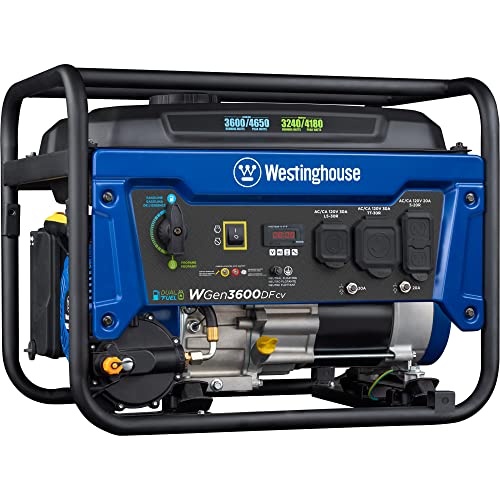
Westinghouse WGen3600DFcv
A dual fuel portable generator with stated rated watts on gasoline and propane, a 4 gallon fuel tank, and automatic low oil and carbon monoxide shutdown.
Pros
- 3600 rated watts on gasoline and 3240 rated watts on propane stated
- Runs up to 14 hours per tank from a 4 gallon fuel tank with a fuel gauge
- Automatic low oil and carbon monoxide shutdown stated
- 108.0 pounds, the lowest weight stated here
Cons
- No remote start is stated
- Propane rated watts of 3240W sit below the gasoline rated watts of 3600W
- No solar input is stated
- Outlets are limited to the three stated receptacles
Detailed Review
The listing states a dual fuel portable generator with 4650 peak watts and 3600 rated watts on gasoline, 4650 peak watts and 3240 rated watts on propane, a 4 gallon fuel tank with a fuel gauge, run time up to 14 hours per tank, a 5-20R 120V household duplex receptacle, an RV-ready TT-30R 30 amp receptacle and an L5-30R 30 amp receptacle with rubber covers, a 212cc 4-stroke OHV engine with a cast iron sleeve, automatic low oil and carbon monoxide shutdown, EPA compliance, and a 3-year limited service, labor and parts warranty. The listing weighs 108.0 pounds with dimensions of 23.3 x 18.5 x 18.9 inches.
Who it's for: buyers who want dual fuel watts with a stated run time per tank and automatic shutdown features. Who should skip it: buyers who want remote start or solar charging.
Its Solar Score of 9.6/10 comes from performance 29/35, build 21/25, value 21/25, safety 7/10 and warranty 2/5: 80 of 100 points, placed on our 9.2 to 9.8 scale.
Key Specifications
| Power | 4650W peak, 3600W rated on gasoline |
|---|---|
| Propane power | 4650W peak, 3240W rated on propane |
| Runtime | Up to 14 hours per tank |
| Weight | 108.0 pounds |
Figures as published on the retailer listing, collected 3 November 2026. Performance figures are manufacturer rated.
Safety and Warranty
What this listing states. Automatic low oil and carbon monoxide shutdown stated, rubber covers on all outlets stated, so safety scores 7 of 10. 3-Year Limited Service, Labor, and Parts Coverage. It does not say everything a buyer needs, such as who pays return shipping, so warranty scores 2 of 5. See How We Pick.
Power station limits. Stay within the stated continuous output and solar input limits, keep the unit ventilated and dry, charge within the stated temperature range, and never connect it to home wiring except through equipment a licensed electrician installs.
This is general buying information, not professional advice. Follow each product manual and local rules, and see our Safety Disclaimer.

Westinghouse WGen3600DFc
A dual fuel portable generator with remote electric start, auto choke, and the same stated rated watts as its sibling listing.
Pros
- 3600 rated watts on gasoline and 3240 rated watts on propane stated
- Electric push button and remote start with auto choke stated
- Switches from gas to propane without shutting off the unit
- Same three-outlet panel as the sibling listing, with an RV-ready outlet
Cons
- No run time figure is stated
- No low oil shutdown is stated in its bullets
- 121.1 pounds, the heaviest listing here
- No solar input is stated
Detailed Review
The listing states a dual fuel portable generator with 3600 rated watts and 4650 peak watts on gasoline, 3240 rated watts and 4650 peak watts on propane, a 4 gallon fuel tank with a fuel gauge, electric push button and remote start, auto choke, a 5-20R 120V duplex outlet, an RV-ready TT-30R 30 amp outlet and an L5-30R 30 amp outlet, dual fuel use that switches from gas to propane without shutting off the unit, EPA compliance, and a 3-year limited service, labor and parts warranty. Its title states a CO sensor. The listing weighs 121.1 pounds with dimensions of 23.3 x 22.8 x 21.3 inches, and it states no run time figure and no low oil shutdown.
Who it's for: buyers who want the same dual fuel watts with remote start and auto choke. Who should skip it: buyers who need a stated run time figure or stated low oil shutdown.
Its Solar Score of 9.6/10 comes from performance 29/35, build 20/25, value 21/25, safety 5/10 and warranty 2/5: 77 of 100 points, placed on our 9.2 to 9.8 scale.
Key Specifications
| Power | 4650W peak, 3600W rated on gasoline |
|---|---|
| Propane power | 4650W peak, 3240W rated on propane |
| Starting | Electric push button and remote start |
| Weight | 121.1 pounds |
Figures as published on the retailer listing, collected 3 November 2026. Performance figures are manufacturer rated.
Safety and Warranty
What this listing states. CO sensor stated in title, so safety scores 5 of 10. 3-Year Limited Service, Labor, and Parts Coverage. It does not say everything a buyer needs, such as who pays return shipping, so warranty scores 2 of 5. See How We Pick.
Power station limits. Stay within the stated continuous output and solar input limits, keep the unit ventilated and dry, charge within the stated temperature range, and never connect it to home wiring except through equipment a licensed electrician installs.
This is general buying information, not professional advice. Follow each product manual and local rules, and see our Safety Disclaimer.

EcoVolt P5000 Plus
A portable power station with 5120Wh of capacity, a 3600W pure sine wave inverter, solar input, and app control.
Pros
- 5120Wh capacity with a 3600W pure sine wave inverter and 5000W surge stated
- Charges in 2.2 hours with 1800W AC input, and accepts 1000W solar input
- 15 output ports, including 5 AC outlets at 3600W total
- LiFePO4 battery with over 3500 charge cycles stated and a battery management system
Cons
- Warranty term is unclear: bullets offer 3-year service and support while the spec table lists 5 year
- No fuel tank, so it needs AC power or solar input for the next charge
- 112 pounds to move, with a pull handle and wheels stated
- No rated watts on propane or gasoline, since it stores power in a battery
Detailed Review
The listing states a portable power station with 5120Wh of capacity, 120/240V output, a 3600W pure sine wave inverter, 5000W surge, 5 AC outlets at 3600W total, 4 USB-A ports, 2 USB-C PD ports, 2 DC ports, 1 cigarette lighter socket and 1 airline socket, 1800W AC input, 1000W solar input, a full charge in 2.2 hours with 1800W AC input and in 3.5 hours via standard AC, a 23% solar conversion rate, a LiFePO4 battery with over 3500 charge cycles, a battery management system that monitors voltage, current and temperature, an EPS mode with a switchover under 0.01 seconds, app control, a pull handle and wheels, a weight of 112 pounds and dimensions of 12.0 x 19.0 x 22.0 inches. The bullets offer 3-year customer service and technical support, while the spec table lists a 5 year warranty description, so the warranty term stays unclear in this listing.
Who it's for: buyers who want battery backup with solar charging, app control and no fuel to store. Who should skip it: buyers who need a firm warranty term or a fuel tank for long running without a charge source.
Its Solar Score of 9.6/10 comes from performance 32/35, build 21/25, value 20/25, safety 7/10 and warranty 0/5: 80 of 100 points, placed on our 9.2 to 9.8 scale.
Key Specifications
| Capacity | 5120Wh, 3600W inverter |
|---|---|
| Charging | 2.2 hours with 1800W AC input |
| Solar input | 1000W solar input |
| Weight | 112 pounds |
Figures as published on the retailer listing, collected 3 November 2026. Performance figures are manufacturer rated.
Safety and Warranty
What this listing states. Battery management system monitors voltage, current and temperature stated, so safety scores 7 of 10. No warranty term, so warranty scores zero. See How We Pick.
Power station limits. Stay within the stated continuous output and solar input limits, keep the unit ventilated and dry, charge within the stated temperature range, and never connect it to home wiring except through equipment a licensed electrician installs.
This is general buying information, not professional advice. Follow each product manual and local rules, and see our Safety Disclaimer.
As an Amazon Associate I earn from qualifying purchases.
Where the points went
The Solar Score weighs performance, build, value, safety and warranty. For this group, safety means a stated battery management system on the power station side, and a stated carbon monoxide feature, low oil shutdown or outlet covers on the generator side. The two Westinghouse listings state a 3-year warranty term, while the EcoVolt listing leaves its warranty term unclear, as its review explains. How we pick explains the weights.
| Product | Solar Score | Perf. /35 | Build /25 | Value /25 | Safety /10 | Warranty /5 |
|---|---|---|---|---|---|---|
| Westinghouse WGen3600DFcv | 9.6 | 29 | 21 | 21 | 7 | 2 |
| Westinghouse WGen3600DFc | 9.6 | 29 | 20 | 21 | 5 | 2 |
| EcoVolt P5000 Plus | 9.6 | 32 | 21 | 20 | 7 | 0 |
Scores run from 9.2 to 9.8: each product’s point total is placed on that range, so more points always means a higher score.
How to choose the best portable power station vs propane generator
Start from the load, then from the fuel or charge source on hand. A licensed electrician should install any connection to home wiring. For the fuel side, the dual fuel vs propane generator guide frames the same gas and propane questions in more detail.
Match rated watts to the load
Rated watts decide what stays on, so compare the stated rated watts, not peak figures alone. The EcoVolt example states a 3600W inverter with 5000W surge. The Westinghouse WGen3600DFcv example states 3600 rated watts on gasoline and 3240 rated watts on propane. The Westinghouse WGen3600DFc example states the same rated watts: 3600 rated watts on gasoline and 3240 rated watts on propane. On rated watts alone, the three listings sit close, so the choice turns on fuel, recharge and starting features instead.
Weigh recharge against refuelling
The EcoVolt example recharges in 2.2 hours with 1800W AC input and accepts 1000W solar input, so it suits a site with AC power or solar panels for the next charge. The Westinghouse WGen3600DFcv example runs up to 14 hours per tank from a 4 gallon fuel tank, so it suits a site with propane or gasoline stored for refuelling. The Westinghouse WGen3600DFc example states a 4 gallon fuel tank but no run time figure, so a buyer who needs a firm run time figure should rely on the Westinghouse WGen3600DFcv example for that figure.
Check weight, starting and safety detail
Weight and starting decide how the unit fits the site. The EcoVolt example weighs 112 pounds with a pull handle and wheels, the Westinghouse WGen3600DFcv example weighs 108.0 pounds, and the Westinghouse WGen3600DFc example weighs 121.1 pounds. The Westinghouse WGen3600DFc example states electric push button and remote start with auto choke, while the Westinghouse WGen3600DFcv example states no remote start. The Westinghouse WGen3600DFcv example states automatic low oil and carbon monoxide shutdown, while the Westinghouse WGen3600DFc example states a CO sensor in its title with no low oil shutdown stated in its bullets.
| If you need | Look at |
|---|---|
| Battery backup with solar charging | EcoVolt P5000 Plus, 5120Wh, 1000W solar input |
| Stated run time per tank | Westinghouse WGen3600DFcv, up to 14 hours |
| Remote start | Westinghouse WGen3600DFc, remote start stated |
| Lowest weight stated here | Westinghouse WGen3600DFcv, 108.0 pounds |
Sizing Notes
- Match stated rated watts to the loads planned: 3600W from the EcoVolt example, 3600 rated watts on gasoline and 3240 rated watts on propane for both Westinghouse examples.
- Match the outlet to the load: both Westinghouse examples state an RV-ready TT-30R 30 amp outlet, and the EcoVolt example states 5 AC outlets at 3600W total.
- Plan the next charge or refill before the outage: 2.2 hours with 1800W AC input for the EcoVolt example, and up to 14 hours per tank for the Westinghouse WGen3600DFcv example.
- Check weight and size for moving the unit: 112 pounds for the EcoVolt example, 108.0 pounds for the Westinghouse WGen3600DFcv example, and 121.1 pounds for the Westinghouse WGen3600DFc example.
FAQ: power away from the grid
Can a portable power station charge from solar panels?
Yes, for the EcoVolt example, which states 1000W solar input and a 23% solar conversion rate. The Westinghouse listings state no solar input, since they run on gasoline or propane.
Do both Westinghouse generators state the same watts?
Yes. Both state 4650 peak watts and 3600 rated watts on gasoline, and 4650 peak watts and 3240 rated watts on propane. They differ on starting, weight and safety detail, not on watts.
Which listing here states a run time per tank?
The Westinghouse WGen3600DFcv example, at up to 14 hours of run time per tank from a 4 gallon fuel tank. The Westinghouse WGen3600DFc example states no run time figure, and the EcoVolt example states charge times instead of a tank run time.
Do these listings state a carbon monoxide feature?
Yes. The Westinghouse WGen3600DFcv example states automatic low oil and carbon monoxide shutdown, and the Westinghouse WGen3600DFc example states a CO sensor in its title. The EcoVolt example states a battery management system that monitors voltage, current and temperature, with no fuel-burning exhaust.
Can the EcoVolt example run sensitive electronics?
The listing states a 3600W pure sine wave inverter and an EPS mode with a switchover under 0.01 seconds, and it names desktop PCs, file servers and networking equipment as examples. Check the load against the stated 3600W inverter figure before connecting it.
Related solar guides
See every Portable Power Stations guide and all Power Stations and Generators guides.
More picks: dual fuel vs propane generator, solar generator vs gas generator home backup, portable power station vs inverter generator.