On this page
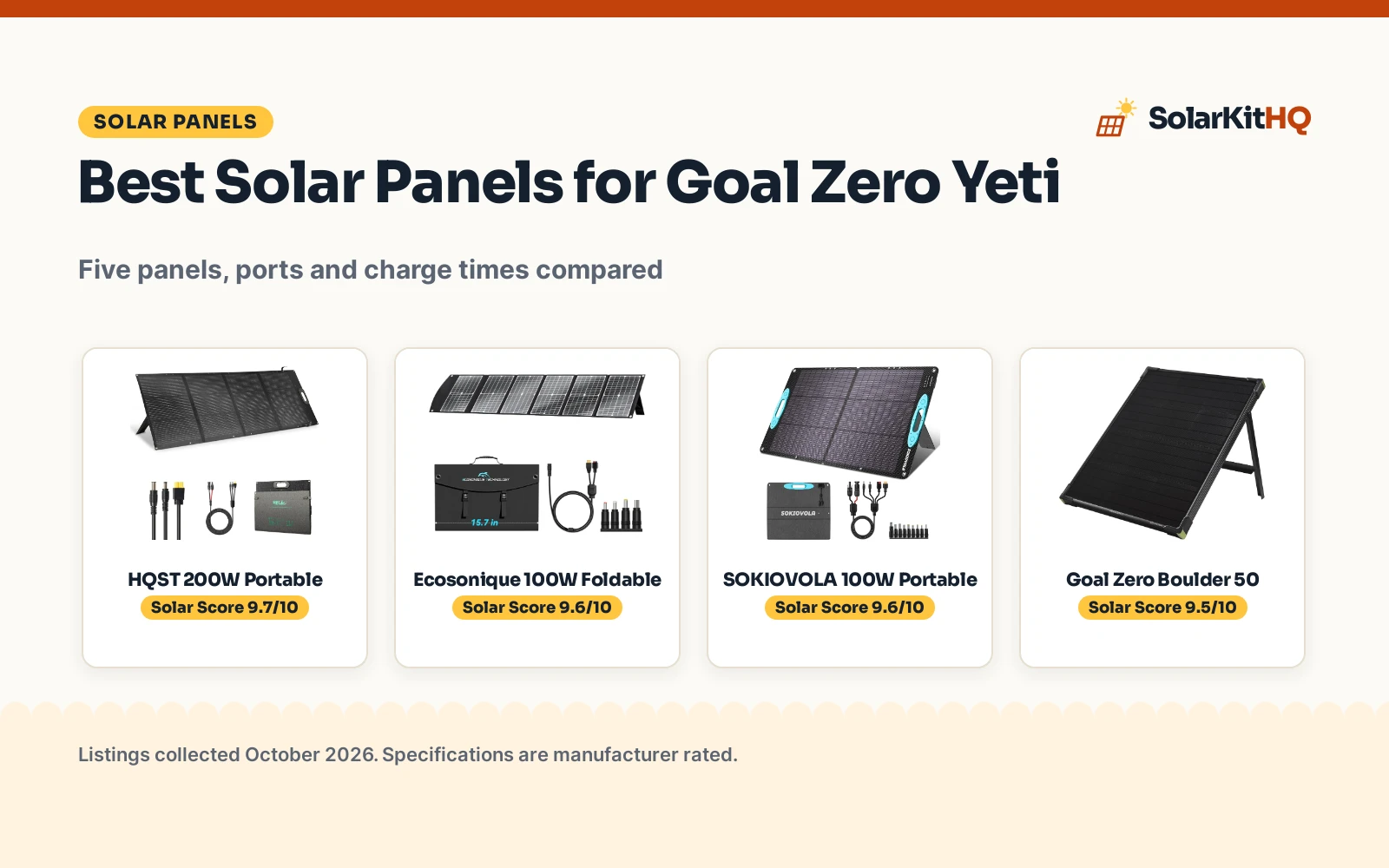
A Yeti charges from the sun only as fast as the panel and its port allow, so the panel question is really a matching question. The best solar panels for goal zero yeti stations are the ones whose connector and wattage the listing states plainly, and the five here split sharply: one Goal Zero panel made for the Yeti’s 8mm port with printed charge times, three third-party portables ranked on stated watts and ratings, and one 5 watt USB panel that is not a station panel at all. We compared them on stated watts, connectors, efficiency, weather ratings and warranty terms, using only what each listing publishes.
SolarKitHQ earns a commission when you buy through links on this page, at no extra cost to you. As an Amazon Associate I earn from qualifying purchases. Affiliate disclosure.
Quick picks
 Best Overall Goal Zero Boulder 50: made for Yeti, 8mm port, printed charge times, 2-year cover Check price on Amazon
 Most Watts HQST 200W Portable: 200W N-type portable, 25 percent stated, IP67 rating Check price on Amazon
 Best Foldable Ecosonique 100W Foldable: 100W foldable, XT60 and USB-C outputs, IP65 rating Check price on Amazon
The picks
| # | Product | Solar Score | Buy |
|---|---|---|---|
| 1 | HQST 200W Portable | 9.7/10 | Buy on Amazon |
| 2 | Ecosonique 100W Foldable Panel | 9.6/10 | Buy on Amazon |
| 3 |  SOKIOVOLA 100W Portable Panel | 9.6/10 | Buy on Amazon |
| 4 | Goal Zero Boulder 50 | 9.5/10 | Buy on Amazon |
| 5 | 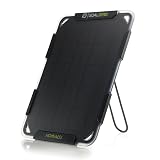 Goal Zero Nomad 5 | 9.2/10 | Buy on Amazon |

HQST 200W Portable
A 200W portable panel with 25% N-Type cells, IP67, kickstands, a 3-in-1 cable and a 12-month warranty.
Pros
- 200W with 25% N-Type 16BB cells
- 11.82 lb, 37% lighter than most 200W portables stated
- 3-in-1 adapter cable included
- Adjustable kickstands, 40 to 60 degrees
Cons
- 12-month limited warranty
- No ETFE stated
- 11.82 lb for one-hand carry is optimistic
- Folds to 1.97 in thick
Detailed Review
The listing states a 200W portable panel with N-Type 16BB cells at up to 25% efficiency, stated to capture more energy on cloudy days, at 11.82 lb and folding to 1.97 in thick. It lists a 4.9 ft 3-in-1 adapter cable (XT60, DC7909, DC5521) for Jackery, EcoFlow, BLUETTI, Goal Zero, Anker and FlashFish, two kickstands from 40 to 60 degrees, and series or parallel connection for advanced users. It states an IP67 rating with fully laminated construction and PVDF coating, a 12-month limited warranty and lifetime technical support.
Who it's for: campers and RVers who want 200W in a folding package. Who should skip it: anyone who needs ETFE or a longer warranty.
Its Solar Score of 9.7/10 comes from performance 32/35, build 21/25, value 20/25, safety 7/10 and warranty 2/5: 82 of 100 points, placed on our 9.2 to 9.8 scale.
Key Specifications
| Power | 200W, 25% N-Type |
|---|---|
| Weight | 11.82 lb |
| Cable | 3-in-1 adapter |
| Rating | IP67 |
Figures as published on the retailer listing, collected 20 October 2026. Performance figures are manufacturer rated.
Safety and Warranty
What this listing states. IP67 rating stated, so safety scores 7 of 10. 12-month limited warranty stated. It does not say everything a buyer needs, such as who pays return shipping, so warranty scores 2 of 5. See How We Pick.
Panels make voltage in daylight. Keep connectors covered until you connect them, check the panel's stated open circuit voltage and current against your controller or power station input limits, and use cables rated for the current. Roof and permanent mounts belong to a qualified installer.
This is general buying information, not professional advice. Follow each product manual and local rules, and see our Safety Disclaimer.

Ecosonique 100W Foldable Panel
A 100W foldable panel with 23.5 percent stated efficiency, a 20V DC XT60 port, PD3.0 USB-C and an IP65 rating.
Pros
- 100W with 23.5 percent conversion efficiency, the highest stated watts and efficiency here
- 20V DC XT60 port with stated adapters for EcoFlow, Bluetti, Jackery and Anker stations
- PD3.0 USB-C at 45W max plus QC3.0 USB-A for direct device charging
- IP65 rating with 6 adjustable kickstands and a 3-meter DC extension cable
Cons
- The spec table lists dimensions as 10 by 2.9 by 15 inches while the folded size is 16.34 by 11.42 by 3.54 inches
- 25 percent more sunlight claim for the 45-degree kickstand angle is the maker's figure only
- 99 percent station compatibility claim is the maker's figure, not independently checkable
- Single panel in the box with no multi-panel wiring detail stated
Detailed Review
The title states a 100W portable solar panel with USB-C and USB-A ports, a 20V DC XT60 port, 6-pound weight and an IP65 rating. The bullets add 23.5 percent efficiency from Grade A+ monocrystalline cells, QC3.0 USB-A at 24W max, PD3.0 USB-C at 45W max, 6 adjustable kickstands, a 3-meter DC5521 extension cable and over-current, over-voltage and short-circuit protection. The spec table lists item dimensions as 10 by 2.9 by 15 inches against a folded size of 16.34 by 11.42 by 3.54 inches, which do not agree; trust the title and bullets for the 100W and 6-pound figures. The listing states a 12-month manufacturer warranty.
Who it's for: station owners who want the most stated watts with the widest adapter list in this group. Who should skip it: buyers who want a panel under 5 pounds.
Its Solar Score of 9.6/10 comes from performance 30/35, build 21/25, value 21/25, safety 6/10 and warranty 2/5: 80 of 100 points, placed on our 9.2 to 9.8 scale.
Key Specifications
| Panel | 100W, monocrystalline silicon, 23.5 percent efficiency stated |
|---|---|
| Outputs | 20V DC XT60, PD3.0 USB-C 45W max, QC3.0 USB-A 24W max |
| Weight and folded size | 6 lb, folds to 16.34 by 11.42 by 3.54 inches |
| Weather rating | IP65 |
Figures as published on the retailer listing, collected 20 October 2026. Performance figures are manufacturer rated.
Safety and Warranty
What this listing states. IP65 rating and over-current, over-voltage and short-circuit protection stated, so safety scores 6 of 10. 12 months warranty stated. It does not say everything a buyer needs, such as who pays return shipping, so warranty scores 2 of 5. See How We Pick.
Panels make voltage in daylight. Keep connectors covered until you connect them, check the panel's stated open circuit voltage and current against your controller or power station input limits, and use cables rated for the current. Roof and permanent mounts belong to a qualified installer.
This is general buying information, not professional advice. Follow each product manual and local rules, and see our Safety Disclaimer.

SOKIOVOLA 100W Portable Panel
A 100W foldable panel with ETFE lamination, a stated IP68 rating and an MC4 to 4-in-1 cable plus 9 adapters in the box.
Pros
- MC4 to 4-in-1 cable plus 9 adapters included
- IP68 rating stated, the highest IP figure in this group
- 25% conversion efficiency stated from 16BB N-type cells with ETFE coating
- 12-month warranty stated from the date of purchase
Cons
- Spec table lists 160W solar power against the 100W title; trust the title
- Weight is stated three ways: 8.81 pounds in the bullets, 13.88 pounds and 5.15 kg in the spec table
- Folded size is stated two ways: 21 by 23 inches in the bullets, 18.38 by 23 inches in the spec table
- Anker compatibility is a brand-level claim, not a named C1000 Gen 2 fit
Detailed Review
The listing states a 100W foldable panel with 16BB N-type cells at up to 25% efficiency, ETFE lamination, an 18-volt maximum, a 78.74-inch MC4 to 4-in-1 cable (XT60, DC5521, DC7909 8mm, Anderson), 9 adapters, two kickstands and a 12-month warranty, with compatibility claimed across Jackery, EcoFlow, Bluetti, FlashFish, Goal Zero and Anker. The spec table contradicts the title and bullets: it lists 160W solar power, 13.88-pound net weight and 5.15 kg item weight, and an 18.38 by 23 inch folded size. Trust the title and bullets: 100W, 8.81 pounds, 21 by 23 inches folded.
Who it's for: buyers who want the most connectors in the box and a stated IP68 rating on a 100W panel. Who should skip it: buyers who want clean, contradiction-free spec tables.
Its Solar Score of 9.6/10 comes from performance 28/35, build 20/25, value 21/25, safety 7/10 and warranty 3/5: 79 of 100 points, placed on our 9.2 to 9.8 scale.
Key Specifications
| Rated power | 100W (spec table says 160W) |
|---|---|
| Max voltage | 18 volts |
| Cable | MC4 to 4-in-1, 78.74 in, plus 9 adapters |
| Weather rating | IP68 stated |
Figures as published on the retailer listing, collected 20 October 2026. Performance figures are manufacturer rated.
Safety and Warranty
What this listing states. IP68 rating stated, so safety scores 7 of 10. 12-month warranty from the date of purchase stated. It does not say everything a buyer needs, such as who pays return shipping, so warranty scores 3 of 5. See How We Pick.
Panels make voltage in daylight. Keep connectors covered until you connect them, check the panel's stated open circuit voltage and current against your controller or power station input limits, and use cables rated for the current. Roof and permanent mounts belong to a qualified installer.
This is general buying information, not professional advice. Follow each product manual and local rules, and see our Safety Disclaimer.

Goal Zero Boulder 50
The Goal Zero Boulder 50, a 50 watt monocrystalline panel with tempered glass, an aluminum frame and an 8mm solar port made for Yeti power stations.
Pros
- Made for Yeti stations, 8mm port
- Charge times stated per Yeti
- Tempered glass, aluminum frame
- Chainable for more capacity
Cons
- Only 50 watts
- 12.4 lbs for a small panel
- Slow for a Yeti 1000
- No IP rating stated
Detailed Review
The listing states a 50 watt monocrystalline panel at 22.6 percent efficiency, with an 8mm solar port, an open circuit voltage of 18-20V, and charge times printed per station: a Yeti 150 in 6-12 hours, a Yeti 400 in 16-32 hours and a Yeti 1000 in 40-80 hours. The frame is anodized aluminum with corner protection and tempered glass, a kickstand is built in, panels chain together for greater capacity, and a 2-year warranty is stated.
Who it's for: Yeti owners who want the maker's own panel and its printed charge times. Who should skip it: anyone filling a big Yeti fast, where 50 watts makes the 40-80 hour figure the whole story.
Its Solar Score of 9.5/10 comes from performance 30/35, build 21/25, value 19/25, safety 0/10 and warranty 4/5: 74 of 100 points, placed on our 9.2 to 9.8 scale.
Key Specifications
| Power | 50 watts |
|---|---|
| Port | 8mm solar port |
| Efficiency | 22.6% |
| Weight | 12.4 lbs |
Figures as published on the retailer listing, collected 21 October 2026. Performance figures are manufacturer rated.
Safety and Warranty
What this listing states. No UL, TÜV or IEC listing and no weather rating is stated, so safety scores zero. 2-year warranty. It does not say everything a buyer needs, such as who pays return shipping, so warranty scores 4 of 5. See How We Pick.
Panels make voltage in daylight. Keep connectors covered until you connect them, check the panel's stated open circuit voltage and current against your controller or power station input limits, and use cables rated for the current. Roof and permanent mounts belong to a qualified installer.
This is general buying information, not professional advice. Follow each product manual and local rules, and see our Safety Disclaimer.

Goal Zero Nomad 5
The Goal Zero Nomad 5, a 5 watt USB solar panel with a built-in kickstand, made for Flip power banks and small USB devices.
Pros
- Only 12.7 oz
- USB-A output for devices
- Built-in adjustable kickstand
- Goal Zero made
Cons
- 5 watts, not for Yeti stations
- USB only, no 8mm port
- No warranty stated
- Slow by design
Detailed Review
The listing states a 5 watt monocrystalline laminate panel in a rugged enclosure, with a USB port at 5V up to 1A, an adjustable kickstand and a weight of 12.7 oz, aimed at Flip power banks, phones, headlamps and lanterns. It is a device charger, not a Yeti station panel: no 8mm port and no station charge times are stated.
Who it's for: hikers keeping a phone and a Flip bank alive. Who should skip it: every Yeti owner, since 5 watts over USB is not station charging.
Its Solar Score of 9.2/10 comes from performance 18/35, build 15/25, value 15/25, safety 0/10 and warranty 0/5: 48 of 100 points, placed on our 9.2 to 9.8 scale.
Key Specifications
| Power | 5 watts |
|---|---|
| Port | USB, 5V up to 1A |
| Weight | 12.7 oz |
Figures as published on the retailer listing, collected 21 October 2026. Performance figures are manufacturer rated.
Safety and Warranty
What this listing states. No UL, TÜV or IEC listing and no weather rating is stated, so safety scores zero. No warranty term, so warranty scores zero. See How We Pick.
Panels make voltage in daylight. Keep connectors covered until you connect them, check the panel's stated open circuit voltage and current against your controller or power station input limits, and use cables rated for the current. Roof and permanent mounts belong to a qualified installer.
This is general buying information, not professional advice. Follow each product manual and local rules, and see our Safety Disclaimer.
As an Amazon Associate I earn from qualifying purchases.
More picks to compare
 Goal Zero Nomad 100 Watt MonocrystallineCheck on Amazon
 RENOGY REGO 200W Portable Solar PanelCheck on Amazon
Compare the picks
| Panel | Solar Score | Watts | Yeti fit as listed | Rating | Amazon |
|---|---|---|---|---|---|
| Goal Zero Boulder 50 | 9.5/10 | 50 | 8mm port, charge times stated | Not stated | View on Amazon |
| HQST 200W Portable | 9.7/10 | 200 | Connector not stated | IP67 | View on Amazon |
| Ecosonique 100W Foldable | 9.6/10 | 100 | XT60, USB-C | IP65 | |
| SOKIOVOLA 100W Portable | 9.6/10 | 100 | 4-in-1 connectors | Not stated | |
| Goal Zero Nomad 5 | 9.2/10 | 5 | USB devices only | Not stated | View on Amazon |
Specifications are manufacturer rated as listed, collected 21 October 2026. Only the Boulder states Yeti charge times.
How we scored them
The Solar Score weighs performance, build, value, safety and warranty. For a Yeti panel, performance means stated watts against the station’s size and a connector that fits; safety means a stated weather rating, which the HQST carries as IP67 and the Ecosonique as IP65. Only the Boulder states a warranty term, 2 years, so the other four score zero there rather than having one guessed for them.
| Product | Solar Score | Perf. /35 | Build /25 | Value /25 | Safety /10 | Warranty /5 |
|---|---|---|---|---|---|---|
| Goal Zero Boulder 50 | 9.5 | 30 | 21 | 19 | 0 | 4 |
| Goal Zero Nomad 5 | 9.2 | 18 | 15 | 15 | 0 | 0 |
Scores run from 9.2 to 9.8: each product’s point total is placed on that range, so more points always means a higher score.
How to choose the best solar panels for goal zero yeti stations
Match the port before the watts
The Yeti input on these listings is the 8mm solar port, and only the Boulder 50 states it. The HQST, Ecosonique and SOKIOVOLA state watts and, for two of them, ratings, but no Yeti connector: the Ecosonique names a 20V DC XT60 and USB-C, the SOKIOVOLA a 4-in-1 connector set. A 200 watt panel with the wrong plug charges nothing until an adapter settles it, so the port check comes first and the wattage second. The rigid and flexible solar panels hub covers the mounted side of the range.
Read the charge times, not just the watts
The Boulder prints its arithmetic: 6-12 hours for a Yeti 150, 16-32 for a Yeti 400, 40-80 for a Yeti 1000. Those ranges are the honest shape of solar charging, and they say a single 50 watt panel is a small-station or top-up choice; the listing’s answer for bigger stations is chaining, with multiple Boulder panels combined for greater capacity. No other listing here states charge times, so their speed on a Yeti cannot be judged from the listing alone.
Portable or mounted
The Boulder is built to do both: a kickstand for the field and a frame that mounts on vans, vehicles and sheds per its listing. The three third-party panels state portable or foldable formats, and the Nomad 5 is a pocket device charger at 12.7 oz. Decide where the panel lives before you buy it; a mounted panel wants the frame and glass of the Boulder, a carried panel wants a fold.
Sizing Notes
- One Boulder 50 suits a Yeti 150 on its stated 6-12 hour figure; chain panels for a Yeti 400 or 1000.
- Third-party panels need their connector matched to the Yeti input before their watts count.
- The Nomad 5 charges USB devices and Flip banks, not Yeti stations.
- Efficiency as stated: Boulder 22.6 percent, HQST 25 percent.
Frequently Asked Questions
Which panel charges a Yeti fastest here?
On stated watts, the HQST at 200 watts, provided its connector matches. On stated charge times, only the Boulder gives figures: 6-12 hours for a Yeti 150 up to 40-80 hours for a Yeti 1000 from one 50 watt panel.
Can I chain Goal Zero panels?
The Boulder listing says yes: chain multiple Boulder panels for greater solar capacity. No chaining is stated for the other panels here.
Does the Nomad 5 charge a Yeti?
No. Its listing aims it at Flip power banks and small USB devices, with a 5V USB port up to 1A and no 8mm station port.
What warranty do these panels carry?
Only the Boulder states one: a 2-year warranty. The other four listings state no warranty term in the data shown.
Related guides
See every solar panels guide.
More picks: browse portable solar panels, mounts, cables and connectors and solar generators.