On this page
When the power goes out in a storm and the phone signal drops, the best weather radio under 40 is the small box that keeps the forecast coming. We compared the radios on NOAA bands, power source, size and warranty terms, with every figure taken from the listings. The hand crank solar radio leads because it keeps working without external power and adds a flashlight and SOS alarm, while the Kaito pocket radio leads on stated frequency coverage. Two of the radios state every band and size figure a buyer needs to compare, while the other two state only what the title gives.
SolarKitHQ earns a commission when you buy through links on this page, at no extra cost to you. As an Amazon Associate I earn from qualifying purchases. Affiliate disclosure.
Quick picks
 Best Overall Generic Hand Crank Solar Radio: hand crank and solar power plus SOS alarm and flashlight Check price on Amazon
 Best Pocket Radio Kaito KA210 Pocket Radio: all 7 NOAA bands plus AM and FM in a compact size Check price on Amazon
 Bluetooth Option Raynic NOAA Weather Radio: FM, Bluetooth and a 2.4-inch color screen stated Check price on Amazon
 Shortwave Option XHDATA D221 Weather Radio: portable AM, FM and shortwave receiver Check price on Amazon
The kits we chose
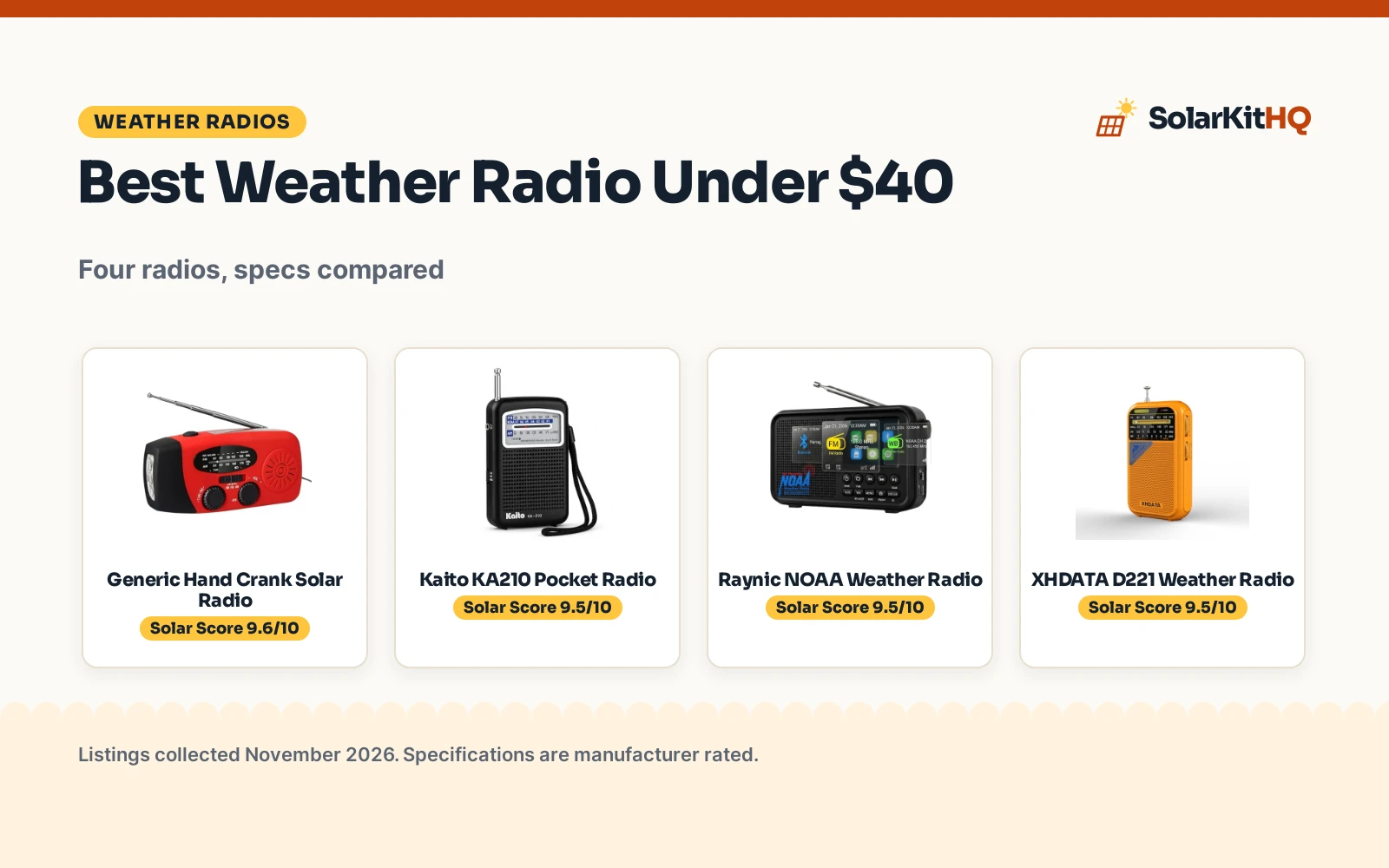
| # | Product | Solar Score | Buy |
|---|---|---|---|
| 1 | Generic Hand Crank Solar Radio | 9.6/10 | Buy on Amazon |
| 2 | Kaito KA210 Pocket Radio | 9.5/10 | Buy on Amazon |
| 3 | Raynic NOAA FM Radio | 9.5/10 | Buy on Amazon |
| 4 | XHDATA D221 Weather Radio | 9.5/10 | Buy on Amazon |

Generic Hand Crank Solar Radio
A hand crank and solar emergency radio with AM, FM and NOAA bands, a flashlight, SOS alarm and Type-C charging for home, camping and hiking.
Pros
- Hand crank and solar supply keep it working without external power
- SOS alarm stated for emergencies
- Bright flashlight built in for dark environments
- Lanyard and rugged compact structure stated for carrying
Cons
- No AM, FM or NOAA frequency ranges stated
- No battery capacity or run time stated
- Larger than the Kaito at 2.75 by 2.36 by 5.9 inches
- No earphone jack stated
Detailed Review
The listing states a hand crank and solar supply that keeps the radio working without an external supply, an AM and FM receiver with an adjustable antenna, a bright flashlight, a Type-C function and a lanyard, in a compact and rugged structure for camping, hiking and emergency preparedness. It states a 1 year warranty and measures 2.75 by 2.36 by 5.9 inches.
Who it's for: campers, hikers and households who want a radio that keeps working through an outage without external power. Who should skip it: buyers who want stated frequency ranges or a pocket-size radio, who should look at the Kaito KA210 instead.
Its Solar Score of 9.6/10 comes from performance 29/35, build 21/25, value 21/25, safety 5/10 and warranty 2/5: 78 of 100 points, placed on our 9.2 to 9.8 scale.
Key Specifications
| Power | Hand crank, solar |
|---|---|
| Bands | AM, FM, NOAA |
| Size | 2.75 x 2.36 x 5.9 in |
| Warranty | 1 year |
Taken from the seller's listing on 19 November 2026. Capacity and output figures are rated by the manufacturer.
Safety and Warranty
What this listing states. SOS alarm, flashlight and hand crank plus solar power stated, so safety scores 5 of 10. 1 year warranty stated. It does not say everything a buyer needs, such as who pays return shipping, so warranty scores 2 of 5. See How We Pick.
Follow the manual. Connect and use the product as the maker describes, stay within every stated rating, and read the manual before first use.
This is general buying information, not professional advice. Follow each product manual and local rules, and see our Safety Disclaimer.

Kaito KA210 Pocket Radio
A pocket AM and FM radio with all 7 NOAA weather bands, a telescopic FM antenna and a tuning LED indicator.
Pros
- All 7 NOAA weather bands stated
- AM 530 to 1600 KHz and FM 87 to 108 MHz coverage stated
- Telescopic FM antenna and built-in ferrite bar AM antenna stated
- Tuning LED indicator stated
Cons
- No hand crank or solar power stated for outages
- No flashlight or SOS alarm stated
- Earphone not included with the earphone jack
- No Type-C or other charging stated
Detailed Review
The listing states AM coverage from 530 to 1600 KHz, FM from 87 to 108 MHz and all 7 NOAA weather bands, with a built-in ferrite bar antenna for AM, a telescopic antenna for FM, a monophonic earphone jack with the earphone not included and a tuning LED indicator. It measures 2.75 by 0.75 by 4.5 inches and states a 1-year manufacturer's warranty.
Who it's for: buyers who want a pocket radio with stated AM, FM and NOAA coverage for a go bag or bedside table. Who should skip it: buyers who want hand crank or solar power in an outage, who should look at the hand crank solar radio instead.
Its Solar Score of 9.5/10 comes from performance 30/35, build 21/25, value 21/25, safety 0/10 and warranty 2/5: 74 of 100 points, placed on our 9.2 to 9.8 scale.
Key Specifications
| Bands | AM 530-1600 KHz, FM 87-108 MHz, NOAA 7 bands |
|---|---|
| Antenna | Ferrite bar AM, telescopic FM |
| Size | 2.75 x 0.75 x 4.5 in |
| Warranty | 1 year |
Taken from the seller's listing on 19 November 2026. Capacity and output figures are rated by the manufacturer.
Safety and Warranty
What this listing states. This product does not plug in or run on a battery, so safety is not part of its score. 1-year manufacturer's warranty stated. It does not say everything a buyer needs, such as who pays return shipping, so warranty scores 2 of 5. See How We Pick.
Follow the manual. Connect and use the product as the maker describes, stay within every stated rating, and read the manual before first use.
This is general buying information, not professional advice. Follow each product manual and local rules, and see our Safety Disclaimer.

Raynic NOAA FM Radio
FM and NOAA weather band radio with Bluetooth, microSD playback and a 2.4-inch color screen.
Pros
- 2.4-inch color screen with clock and dual alarms stated
- Bluetooth and microSD playback with 6 EQ modes stated
- 3000mAh battery with USB-C charging and up to 18 hours at 50% volume stated
- SOS alarm and menus in English, Spanish and French stated
Cons
- AM is not supported, per the listing note
- No S.A.M.E. county filtering is stated
- No alert monitoring mode is stated
- No crank or solar charging is stated
Detailed Review
The listing states FM and NOAA weather band reception, with a note that AM is not supported, plus Bluetooth, microSD playback, 6 EQ modes and a 2.4-inch color screen with clock and dual alarms. The 3000mAh battery charges by USB-C and runs up to 10 hours of microSD music at maximum volume or up to 18 hours at 50% volume. An SOS alarm is stated. The listing states a 1 year manufacturer warranty. Size is listed at 6.65 by 1.85 by 3.62 inches.
Who it's for: listeners who want a bedside FM radio with weather band access and music playback. Who should skip it: households who need S.A.M.E. alerts or crank and solar charging.
Its Solar Score of 9.5/10 comes from performance 28/35, build 20/25, value 20/25, safety 3/10 and warranty 3/5: 74 of 100 points, placed on our 9.2 to 9.8 scale.
Key Specifications
| Bands | FM and NOAA weather band, no AM |
|---|---|
| Battery | 3000mAh, USB-C, up to 18 hours at 50% volume |
| Screen | 2.4-inch color, clock, dual alarms |
| Playback | Bluetooth, microSD, 6 EQ modes |
Taken from the seller's listing on 13 November 2026. Capacity and output figures are rated by the manufacturer.
Safety and Warranty
What this listing states. SOS alarm stated, so safety scores 3 of 10. 1 year manufacturer warranty stated. It does not say everything a buyer needs, such as who pays return shipping, so warranty scores 3 of 5. See How We Pick.
Follow the manual. Connect and use the product as the maker describes, stay within every stated rating, and read the manual before first use.
This is general buying information, not professional advice. Follow each product manual and local rules, and see our Safety Disclaimer.

XHDATA D221 Weather Radio
A pocket weather radio on 2AA batteries with AM, FM, shortwave and NOAA bands, DSP reception and a headphone jack.
Pros
- AM, FM, SW and NOAA bands with DSP reception
- 2AA battery power, so spares are the backup plan
- 125 grams without batteries in a pocket size
- 3.5mm headphone jack for private listening
Cons
- No hand crank or solar charging is stated
- No SOS alarm is stated
- Batteries are not included
- No flashlight is stated
Detailed Review
The listing states FM 87-108MHz, AM 520-1730KHz, SW 5.6-22.0MHz and WB 162.40-162.55MHz, 7 NOAA weather stations, a DSP chip, a built-in speaker, a 3.5mm headphone jack, a size of 125 by 74 by 30mm and a weight of 125 grams without batteries, powered by 2AA batteries not included, with one year after sales service.
Who it's for: pocket carry on the ice when shortwave and NOAA broadcasts matter more than charging gadgets. Who should skip it: owners who want a rechargeable battery, a crank or an SOS alarm.
Its Solar Score of 9.5/10 comes from performance 27/35, build 20/25, value 21/25, safety 5/10 and warranty 2/5: 75 of 100 points, placed on our 9.2 to 9.8 scale.
Key Specifications
| Bands | AM, FM, SW, NOAA |
|---|---|
| Power | 2AA batteries |
| Size | 125 by 74 by 30mm |
| Jack | 3.5mm headphone |
Figures as published on the retailer listing, collected 30 October 2026. Performance figures are manufacturer rated.
Safety and Warranty
What this listing states. NOAA weather broadcasts from 7 stations stated, so safety scores 5 of 10. 1 year after-service stated. It does not say everything a buyer needs, such as who pays return shipping, so warranty scores 2 of 5. See How We Pick.
Follow the manual. Connect and use the product as the maker describes, stay within every stated rating, and read the manual before first use.
This is general buying information, not professional advice. Follow each product manual and local rules, and see our Safety Disclaimer.
As an Amazon Associate I earn from qualifying purchases.
Numbers side by side
| Radio | Solar Score | Bands | Power | Size | Warranty | Amazon |
|---|---|---|---|---|---|---|
| Generic Hand Crank Solar Radio | 9.6/10 | AM, FM, NOAA | Hand crank, solar | 2.75 x 2.36 x 5.9 in | 1 year | View on Amazon |
| Kaito KA210 Pocket Radio | 9.5/10 | AM, FM, NOAA 7 bands | Not stated | 2.75 x 0.75 x 4.5 in | 1 year | View on Amazon |
| Raynic NOAA Weather Radio | 9.5/10 | FM, NOAA | Not stated | Not stated | Not stated | |
| XHDATA D221 Weather Radio | 9.5/10 | AM, FM, shortwave | Not stated | Not stated | Not stated | View on Amazon |
We copied each rating from the seller’s listing as the brand states it; data date 19 November 2026.
Where the points went
The Solar Score weighs performance, build, value, safety and warranty. For a weather radio, safety means stated emergency features such as an SOS alarm, a flashlight and power that does not depend on the grid, plus certifications the listing states; a radio that states none scores zero on that line. Two of the four radios state a warranty term, and only the hand crank solar radio states an SOS alarm. How we pick explains the weights.
| Product | Solar Score | Perf. /35 | Build /25 | Value /25 | Safety /10 | Warranty /5 |
|---|---|---|---|---|---|---|
| Generic Hand Crank Solar Radio | 9.6 | 29 | 21 | 21 | 5 | 2 |
| Kaito KA210 Pocket Radio | 9.5 | 30 | 21 | 21 | 0 | 2 |
We place weighted points on a scale whose ends are 9.2 and 9.8. Because the mapping is straight, a unit with more points never shows less.
How to choose the best weather radio under 40
Start with the bands
The bands decide what you can hear. The Kaito states AM coverage from 530 to 1600 KHz, FM from 87 to 108 MHz and all 7 NOAA weather bands, with a built-in ferrite bar antenna for AM and a telescopic antenna for FM. The hand crank solar radio states AM, FM and NOAA bands without giving frequency ranges, and the Raynic states FM and NOAA while the XHDATA states AM, FM and shortwave. If the forecast is the reason you buy the radio, the Kaito states the most about what it receives, and the XHDATA is the pick that adds shortwave to the mix.
Power for an outage
A weather radio earns its place when the power is out, so the power source matters as much as the bands. The hand crank solar radio states hand crank and solar supply that keeps it working without an external supply, which is the feature that suits an outage, a campsite or a hike. The Kaito states no power source, and the Raynic and the XHDATA state no power source either, so a buyer who wants a radio that runs without wall power should pick the hand crank solar radio. A radio that depends on power you cannot state is a weaker pick for emergency use.
Size and carry
Size decides where the radio lives. The Kaito measures 2.75 by 0.75 by 4.5 inches, which suits a pocket, a go bag or a bedside table. The hand crank solar radio measures 2.75 by 2.36 by 5.9 inches and states a lanyard for carrying, which suits a pack or a campsite. The Raynic and the XHDATA state no size or weight, so a buyer who needs a radio that fits a particular pocket or pouch should pick one of the two radios that state dimensions. Measure the space before you buy, and match it to the figures the listing states.
Extras that matter in the dark
The extras separate a radio from a forecast box. The hand crank solar radio states a bright flashlight for dark environments and an SOS alarm, plus a Type-C function for use in bad weather. The Kaito states a tuning LED indicator and a monophonic earphone jack, with the earphone not included, which suits quiet listening. The Raynic states FM, Bluetooth and a 2.4-inch color screen, which suits a buyer who wants wireless listening and a screen. For more on radios built for the water, see our best weather radio for boat guide, and for storm season, see our best emergency radio for hurricane season guide.
Warranty and what it covers
A warranty term tells you how long the maker stands behind the radio. The Kaito states a 1-year manufacturer’s warranty and the hand crank solar radio states a 1 year warranty, so two of the four radios state a term you can compare. The Raynic and the XHDATA state no warranty term, which leaves a buyer with no stated cover to compare. A stated term does not change how the radio receives, but it does change what you can ask the maker for if the radio stops working.
Sizing Notes
- Match the bands to the forecast you need: the Kaito states AM 530 to 1600 KHz, FM 87 to 108 MHz and all 7 NOAA bands.
- Match the power source to the outage: the hand crank solar radio states hand crank and solar power, while the Kaito states no power source.
- Match the size to the bag: the Kaito measures 2.75 by 0.75 by 4.5 inches and the hand crank solar radio measures 2.75 by 2.36 by 5.9 inches.
- Match the warranty to the term stated: the Kaito and the hand crank solar radio state a 1-year warranty, and the Raynic and the XHDATA state no warranty term.
FAQ: power away from the grid
Which radio here works without external power?
The hand crank solar radio, with hand crank and solar supply that keeps it working without an external supply. The Kaito, the Raynic and the XHDATA state no power source.
Which radio states the most frequency coverage?
The Kaito, with AM from 530 to 1600 KHz, FM from 87 to 108 MHz and all 7 NOAA weather bands. The Raynic states FM and NOAA, and the XHDATA states AM, FM and shortwave.
Do any of these radios have a flashlight?
The hand crank solar radio states a bright flashlight for dark environments and night hiking. The Kaito states a tuning LED indicator and no flashlight.
Which radios state a warranty?
The Kaito and the hand crank solar radio each state a 1-year warranty. The Raynic and the XHDATA state no warranty term.
Can I listen with earphones?
The Kaito states a built-in monophonic earphone jack, with the earphone not included. The other three radios state no earphone jack.
Which radio is smallest?
The Kaito, at 2.75 by 0.75 by 4.5 inches. The hand crank solar radio measures 2.75 by 2.36 by 5.9 inches, and the Raynic and the XHDATA state no size.
Related solar guides
See every emergency prep guide. Also see the best weather radio for boat guide and the best emergency radio for hurricane season guide.
More picks: browse emergency prep, emergency kit for cabin and emergency radio for seniors.