On this page
The lights go out at dinner time, the fridge hums to a stop, and the phone on the counter is already dark. That is the moment most people start asking how does battery work, and the answer is plain: a battery stores energy as chemistry and turns it into electrical energy when a circuit closes, then stores it again when current flows back in the other direction.
SolarKitHQ earns a commission when you buy through links on this page, at no extra cost to you. As an Amazon Associate I earn from qualifying purchases. Affiliate disclosure.
How does battery work
A battery is a container for a chemical reaction that can run in either direction. Inside the case, electrodes sit in an electrolyte, which is a substance that lets charged particles move between the electrodes while keeping the electrodes apart. When the circuit is open, the reaction waits. When the circuit closes, the reaction runs, electrons leave the negative terminal, travel through the wires and the load, and arrive at the positive terminal. That flow of electrons is the current that powers a light, a phone charger or a fridge.
The chemical reaction also moves charged particles inside the battery, through the electrolyte, from the negative side to the positive side. The movement inside and the movement outside the battery belong to the same reaction, so the battery keeps giving current while the reaction has material left to change. When the material on the electrodes has changed as far as it can, the battery is empty, and the reaction stops until charging reverses it.
What happens when a battery discharges
Discharging is the battery giving energy to a load. Closing the circuit lets the reaction run, and the current flows until the load is switched off or the battery is empty. A fridge, a light or a pump draws current while it runs, and the battery gives what the load asks for, up to the limits the maker states for that battery.
The signs that a battery is running low are plain to read in the load, not in the battery. A light dims, a pump slows, and a fridge compressor struggles to start. Those signs mean the reaction has little material left to change, and the battery needs charging before it can give full current again.
What happens when a battery charges
Charging runs the reaction in reverse. A charger, a solar panel through a charge controller, or a generator pushes current back into the battery, from the positive terminal toward the negative terminal, and the material on the electrodes changes back toward its charged state. The battery stores energy again as chemistry, ready to give current when the circuit closes.
A charge controller sits between a solar panel and a battery, and it manages the current so the battery is not overcharged. Charging stops when the battery is full, and the reaction waits again until a load calls for current. A battery that is kept charged and clean gives better service in ordinary use than a battery that is left flat for long stretches. See the How Long Do Deep Cycle Batteries Last? for more on battery life.
The battery in a standby generator
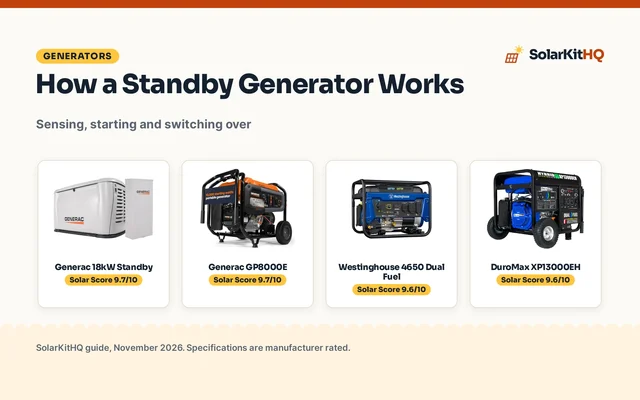
A standby generator needs its battery to turn the engine over and start. The battery gives a short, strong burst of current to the starter, the engine catches, and the generator then makes its own power for the house. Fuel generators run outdoors only, far from doors and windows, because of carbon monoxide.
The same generator needs routine care, and the maintenance kit for it shows what that care covers. The Lvdrwi maintenance kit fits air-cooled standby generators in the 16 to 26 kW range with a 999CC engine, and the kit holds 6 items: 1 air filter, 1 oil filter, 1 funnel, 1 wipe and 2 spark plugs. The air filter measures 9.29 inches by 5.47 inches by 1.34 inches, and the oil filter measures 2.68 inches across by 3.54 inches high. See the Generac Generator Maintenance Kit: What to Buy and When for what to check and when.
When the power goes out, the battery is what starts the generator, so it deserves the same attention as the filters and spark plugs in the kit. A generator that cannot start gives no power at all, whatever the state of its filters, so check the battery during routine maintenance and keep it charged.
What to check on a battery
A battery asks for little, and the checks are plain. Look at the terminals, the cables and the case, and keep the battery charged so it is ready when the power goes out.
- Terminals: keep them clean and tight, and clean away any crust that builds up around the posts. See the How to Clean Battery Terminal Step by Step for the method.
- Cables: look for cracks, fraying and loose ends, and replace a damaged cable before it causes trouble.
- Charge: keep the battery charged, and recharge it after use so it is ready for the next outage.
- Case: look for swelling, cracks and leaks, and keep the battery dry and out of standing water.
FAQ: power away from the grid
How does a battery store energy?
A battery stores energy as chemistry. Electrodes and an electrolyte hold a reaction that waits while the circuit is open, and the reaction runs when the circuit closes, sending current through the load. Charging reverses the reaction and stores the energy again.
Why does a battery go flat when it sits unused?
A battery loses charge while it sits, because the reaction inside never stops entirely and small currents drain the stored energy. A battery left flat for long stretches may not take a full charge again, so keep it charged during storage.
Can a solar panel charge a battery?
Yes. A solar panel makes current from sunlight, and a charge controller passes that current to the battery at a level the battery can accept. The battery stores the energy as chemistry and gives it back when a load calls for current.
What does the battery do in a standby generator?
The battery turns the engine over so the generator can start when the power goes out. In a standby generator in the 16 to 26 kW range with a 999CC engine, the battery gives the starter the current it needs, and the generator then makes power for the house.
Related solar guides
See the How Long Do Deep Cycle Batteries Last?, the How to Clean Battery Terminal Step by Step, the Generac Generator Maintenance Kit: What to Buy and When and the Power Generator Maintenance: A Checklist That Keeps It Starting.