On this page
When a winter outage leaves the house cold and the furnace silent, how much is a kerosene heater depends first on which kind you mean: a small radiant heater and stove for one room, a convection heater for a larger space, or a forced air torpedo heater for a garage or jobsite. The listings compared for this guide do not state prices, so this page explains what drives the cost of each kind, using only the figures the makers state, so you can judge a price tag when you see one.
SolarKitHQ earns a commission when you buy through links on this page, at no extra cost to you. As an Amazon Associate I earn from qualifying purchases. Affiliate disclosure.
The quick answer: how much is a kerosene heater
Kerosene heater prices rise with heat output, tank size and added controls. The smallest class here states 9,000 BTU of radiant heat for spaces of about 161 to 215 square feet, with tanks of 4.5L to 4.6 liters and stated burn times of 16 to 22 hours. The middle class states 23,800 BTU for up to 1,000 square feet with no electricity needed. The largest class states 85,000 BTU of forced air heat for up to 2,200 square feet, with a 5 gallon tank, a thermostat and stated run time of up to 9 hours. Compare any price you are quoted against the output class and features below rather than against the brand name.
Step 1: Start with the heat output class
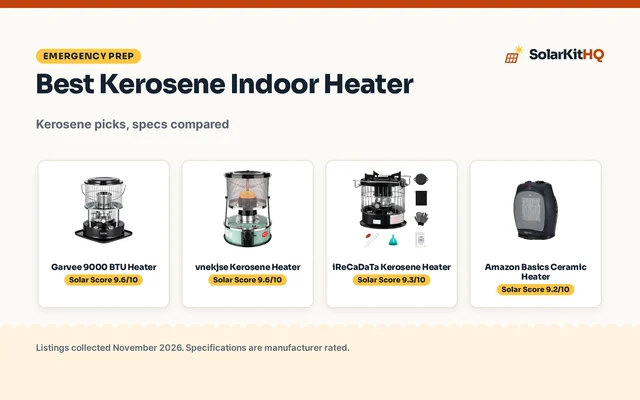
Output is the first cost driver, because it decides the size of burner, tank and body. Radiant heater and stove models from usofrint, Makamsui and toxaaiwr state 9,000 BTU, and the AHUAWA states 9,000 to 10,000 BTU for spaces up to 200 to 500 square feet. These are non-electric units with a control knob for flame height, a carry handle and, on the AHUAWA, a flat top for boiling water.
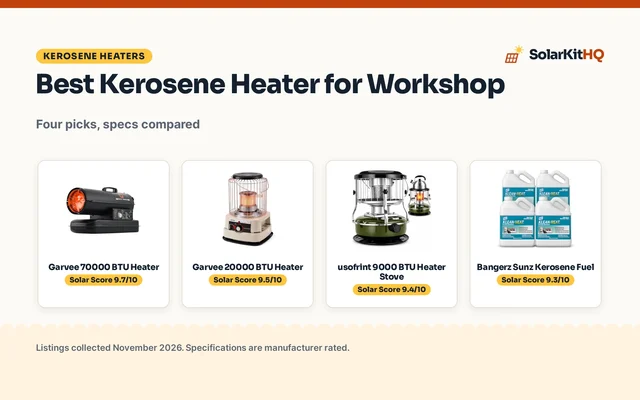
The convection class sits above them. The Dyna-Glo WK95C8 (on Amazon) states 23,800 BTU in its title figures and heating capacity up to 1,000 square feet, with no electricity needed. Forced air torpedo models from BILT HARD and CAMMOO state 85,000 BTU for up to 2,200 square feet. A price that looks high for a 9,000 BTU unit may be ordinary for an 85,000 BTU unit, so match the class before you compare tags. For the small class, see our best kerosene heaters for camping.
Step 2: Check the tank and stated burn time
Tank size decides how often you refill, and bigger tanks cost more to build and ship. The radiant models state tanks of 4.5L (1.19 gallon) from usofrint and Makamsui, 4.6 liters from toxaaiwr, and 1.4 gallon from AHUAWA. Stated burn times run 16 to 21 hours for the 4.5L models, 18 to 22 hours for the 4.6 liter model, and up to 20 hours for the 1.4 gallon model. The forced air models state a 5 gallon fuel capacity with run time up to 9 hours. Fuel use is part of the running cost too: the toxaaiwr states 0.2 to 0.24L per hour, and the BILT HARD states 0.6 gallons to operate. See our best kerosene fuel for heaters for the fuel side of the bill.
Step 3: Count the controls and certifications
Controls and stated certifications are the next cost drivers. The forced air models state a thermostat with a setting range of 40 to 110 degrees F, self-diagnostics, an indicator lamp and a cord wrap. The CAMMOO states ETL certification, overheat protection that shuts the unit down at 176 degrees F, a flame-sensing control, wheels and a 3.3 ft cord. The BILT HARD models state CSA certification for multi-fuel use, including kerosene, filtered diesel and fuel oil, with K1 kerosene recommended. The radiant models state simpler controls: a knob for flame height, adjustable height on the AHUAWA and Makamsui, and a protective safety net and anti-tip base on the AHUAWA. Each stated feature is something you are paying for, so decide which ones your space needs. Our best kerosene heaters with thermostat guide covers the thermostat class.
Step 4: Factor in weight, size and warranty
Size and weight affect both the purchase price and how you move the heater. The radiant models state weights of 13.23 pounds for the usofrint and 4.4 kg for the toxaaiwr, in bodies around 13 by 13 by 18 inches. The Dyna-Glo convection heater states 28.0 pounds. The forced air models state 31.94 pounds, 32.2 pounds and 49.0 pounds, in bodies around 30 inches long. Warranty terms stated here are 1 year for the BILT HARD and CAMMOO forced air (on Amazon) models. A longer stated warranty is part of what a higher price buys, so check the term on the exact model before you decide.
Ways to keep the total cost down
- Buy the output class your space needs: a 9,000 BTU radiant unit for one room costs less to buy and run than an 85,000 BTU forced air unit.
- Match the tank to your refill routine using the stated burn times, from 16 to 22 hours on the small tanks to up to 9 hours on the 5 gallon tanks.
- Skip controls you will not use, such as wheels or multi-fuel capability, and keep the ones you need, such as a thermostat for a workshop.
- Read our guide on how to light a kerosene heater and the checks in can I use a kerosene heater indoors before you buy for indoor use.
FAQ: power away from the grid
What size kerosene heater do I need for one room?
The radiant class states 9,000 BTU for spaces of about 161 to 215 square feet, and the AHUAWA states 9,000 to 10,000 BTU for up to 200 to 500 square feet. Match the stated area figure to your room.
How long does a kerosene heater run on one tank?
Stated burn times here run 16 to 21 hours for the 4.5L radiant models, 18 to 22 hours for the 4.6 liter model, up to 20 hours for the 1.4 gallon model, and up to 9 hours for the 5 gallon forced air models.
Do kerosene heaters need electricity?
The radiant and convection models here state no electricity needed, with manual ignition and a control knob. The forced air models state a thermostat, self-diagnostics and a cord, so check the exact model before you rely on it in an outage.
What warranty do kerosene heaters come with?
The forced air models compared here state a 1 year warranty from BILT HARD and CAMMOO. Check the stated term on the exact model you are quoted, because it is part of what the price covers.
Related solar guides
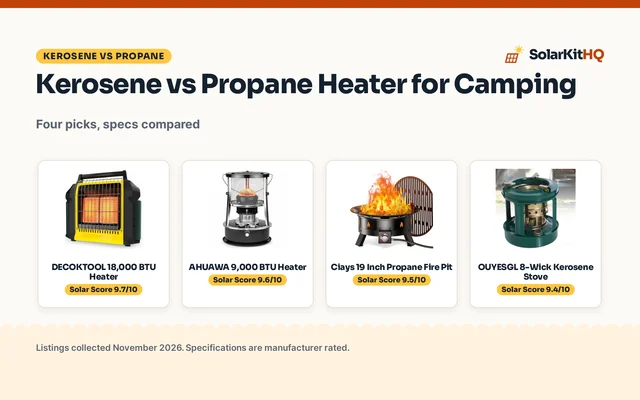
See the best kerosene indoor heaters, the best portable kerosene heaters, the kerosene vs propane heater for camping comparison and the best kerosene heaters with blower.