On this page
A flat battery in a parked car or a dead phone on a trail makes the question urgent, and how much is a small solar panel depends on what you ask it to charge. A tiny panel that keeps a security camera topped up costs far less than a folding panel that charges phones and power banks, and the gap comes from watts, cell type, controller and build, not from the brand name alone. The steps below show how to work out what you need, so you can judge any listing on its figures.
SolarKitHQ earns a commission when you buy through links on this page, at no extra cost to you. As an Amazon Associate I earn from qualifying purchases. Affiliate disclosure.
We may earn a commission on qualifying purchases, at no extra cost to you. Prices and specifications change; check the listing before buying.
The quick answer
The price follows the watts. The listings here run from a 1.8W SUNAPEX trickle maintainer (on Amazon) at 1.2 pounds to a 30W Griplier folding panel (on Amazon) at 1.54 lbs, with 2W and 6W camera panels, a 5W USB panel, a 10W folding charger and 20W trickle maintainer kits in between. More watts, a smarter controller, a tougher build and a longer warranty all push the price up, so the first step is to work out the watts your load needs. Use the solar charger calculator to size your panel.
Step 1: Work out the watts you need
Match the panel to the load. A 2W VUEBEE panel (on Amazon) or a 6W gulisot panel (on Amazon) feeds a rechargeable security camera through a Micro USB or USB-C port. A 5W YESSZ panel (on Amazon) powers cameras, cell phones, USB fans and night lights. A 10W FlexSolar charger feeds phones, small power banks, tablets, USB fans, flashlights and smartwatches through a 5V USB-A port. A 20W Voltset or SOLPERK kit maintains a 12V battery in a car, boat, RV or trailer. A 30W Griplier panel charges smartphones, power banks, cameras and tablets through USB, Type-C and DC ports.
| Panel | Watts | Output | Use |
|---|---|---|---|
| SUNAPEX 1.8W | 1.8 | 12V, controller | Battery maintainer |
| VUEBEE 2W | 2 | USB-C / Micro USB | Security cameras |
| YESSZ 5W | 5 | 5V USB | Cameras, phones, fans |
| gulisot 6W | 6 | 5V USB | Security cameras |
| FlexSolar 10W | 10 | 5V USB-A | Phones, power banks, tablets |
| Voltset 20W | 20 | 12V, MPPT controller | Battery maintainer |
| SOLPERK 20W | 20 | 12V, MPPT controller | Battery maintainer |
| Griplier 30W | 30 | USB-C / USB-A / DC | Phones, tablets, power banks |
The table shows the ladder: watts climb from 1.8 to 30, and the use moves from a single camera to a 12V battery to phones, tablets and power banks. Each step up the ladder costs more, so buy the watts you need and no more.
Step 2: Check the cell type and efficiency
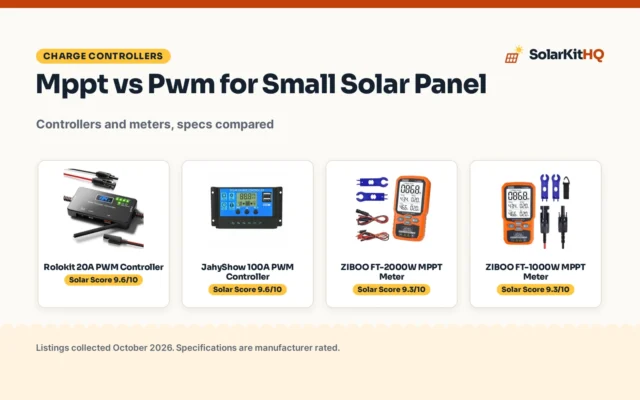
Monocrystalline cells cost more than older cell types, and the listings here all use them. The Voltset lists A+ monocrystalline panels with 20 to 30 percent faster charging for 12V batteries. The SOLPERK lists monocrystalline A+ cells with a cell efficiency of 21 percent to 30 percent, and a 10A controller with 30 percent higher charging efficiency. The FlexSolar lists a conversion rate up to 24 percent with ETFE film lamination, and the Griplier lists an efficiency of up to 23 percent with an ETFE protective film. Efficiency moves the price, and the listing’s percentage is the one to compare. See MPPT versus PWM for a small solar panel for the controller side of the same question.
Step 3: Weigh the controller and the build
A controller stops the panel overcharging the battery. The Voltset lists a smart charge controller with multi-layer protection against overcharge, over-discharge, short circuit and reverse polarity, and an IP67 code. The SOLPERK lists a smart MPPT controller with three-stage charging and a 360 degree adjustable mounting bracket, plus an IP67 code. The SUNAPEX lists a built-in controller that prevents overcharging and stops charging when the battery is full. Build moves the price too: the SOLPERK lists a low-iron tempered glass surface and a corrosion-resistant aluminum frame, with a wind pressure figure of 2400Pa and a snow load figure of 5400Pa, and the Voltset lists marine-grade construction that withstands -40°F to 185°F. The VUEBEE and gulisot camera panels list a temperature range from -5°F to 120°F.
Step 4: Check the size, weight and warranty
Small panels are bought to carry, so size and weight matter. The FlexSolar folds to 6.3 by 4.8 by 1 inch and weighs 0.44 lbs, with 2 carabiners for a backpack. The Griplier folds to 8.49 by 8.9 by 0.7 inches and weighs 1.54 lbs. The SOLPERK measures 15.0 by 13.2 by 0.7 inches and weighs 3.0 pounds, and the Voltset weighs 4.0 pounds. The VUEBEE measures 5.3 by 3.3 by 0.2 inches and comes as a 2 pack with a 7.2FT cable, and the gulisot comes with a 10 ft charging cable and a 360 degree adjustable bracket. Warranty terms in the listings run from a 1 year warranty on the Voltset, FlexSolar and SUNAPEX to a 1-year after-sales service on the SOLPERK.
What pushes the price up
Watts push the price up first: the listings run from 1.8W to 30W, and a 30W folding panel with USB-C, USB-A and DC ports costs more than a 2W camera panel with a single cable. A smart MPPT controller adds cost over a bare panel: the Voltset and SOLPERK kits both include one, and the SOLPERK adds a 360 degree adjustable mounting bracket and a full set of mounting accessories. A tougher build adds cost too: the SOLPERK lists tempered glass and an aluminum frame with a lifespan of up to 25 years, the Voltset lists a 25 year lifespan with corrosion-resistant materials, and the SUNAPEX lists a lifespan of up to 10 years. Longer life and more accessories cost more, and the listing’s figures are the ones to compare.
How much is a small solar panel: the short version
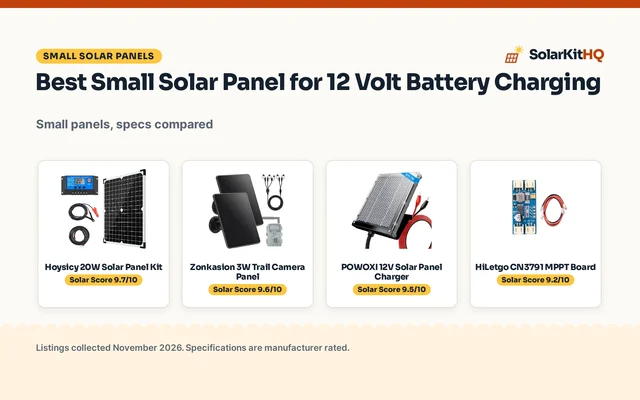
Work out the watts your load needs, pick the output it takes, then compare listings at that size. A 2W or 6W panel suits a security camera, a 5W or 10W panel suits phones and small power banks, and a 20W kit suits a 12V battery in a car, boat or RV. A 30W folding panel suits phones, tablets and power banks on a trip. The price follows that ladder, with a smarter controller, a tougher build and a longer warranty each adding cost. For the wider choice, see the best small solar panels for 12 volt battery charging.
FAQ: power away from the grid
Can a small solar panel charge a phone?
Yes, if it has a USB output. The FlexSolar 10W lists a 5V USB-A port for phones, tablets and small power banks, and the Griplier 30W lists USB, Type-C and DC ports for smartphones, power banks, cameras and tablets. The Voltset and SOLPERK 20W kits feed 12V batteries, not phones.
What does a 20W solar panel charge?
A 12V battery. The Voltset and SOLPERK 20W kits are trickle maintainers for 12V rechargeable batteries in cars, boats, RVs and trailers, with a smart MPPT controller. They are not phone chargers, and the FlexSolar 10W or Griplier 30W suit phones instead.
How long do small solar panels last?
The Voltset lists a 25 year lifespan with corrosion-resistant materials, the SOLPERK lists a lifespan of up to 25 years, and the SUNAPEX lists a lifespan of up to 10 years. Mounting, weather and care move the real figure, and the listing’s lifespan figure is the one to compare.
Can a small solar panel work in cloudy weather?
The SUNAPEX listing says its panel provides output even in cloudy conditions, and the gulisot listing says its 6W panel works in cloudy and rainy weather. Output falls with less sun, and a panel with a higher wattage figure gives more headroom.