On this page
How to boost cell phone signal starts with finding where the signal is strongest outside, then placing an outdoor antenna there and letting a booster carry that signal indoors. A booster can only amplify a signal that already reaches the property, so the work begins with a walk around the outside of the home or RV with the phone in hand. This guide walks through the checks in order, from the no-cost fixes to the gear.
SolarKitHQ earns a commission when you buy through links on this page, at no extra cost to you. As an Amazon Associate I earn from qualifying purchases. Affiliate disclosure.
The quick answer
Walk outside, watch the bars at each side of the building, and note the strongest spot, since that is where the outdoor antenna belongs. If the phone shows a usable signal somewhere outside, a cell phone booster with an outdoor antenna and an indoor antenna can carry that signal into the rooms where calls drop. If the carrier signal is faint everywhere outside and the home Wi-Fi is solid, use a Wi-Fi extender or Wi-Fi calling instead.
Step 1: Find the strongest signal outside
Stand at each side of the home, RV or cabin and watch the bars, then repeat the check at the far end of the property. The bars outside decide what a booster can do indoors: the Nstcell maker states about 800 sq ft with 1 to 2 bars outside, about 3,000 sq ft with 3 to 4 bars, and the full 7000 sq ft with 5 bars. Mark the strongest spot, since the outdoor antenna goes there.
Step 2: Try the no-cost fixes first
Before buying gear, turn on Wi-Fi calling so calls and texts ride the home network where the carrier signal is weak, and move the phone near a window facing the strongest outdoor signal. Keep the phone out of a thick case while checking. If calls stay clear on Wi-Fi calling but drop off the network, the carrier signal is the weak link and a booster is the next step.
Step 3: Place the outdoor antenna high
Mount the outdoor antenna at the strongest-signal spot found in Step 1, as high as practical, then run the cable to the booster unit. The Nstcell kit uses an outdoor log-periodic antenna with 2 indoor panel antennas, and the maker states the outdoor and indoor antennas need about 32 ft of separation, with the power off while installing or adjusting them.
Step 4: Match the booster to the rooms
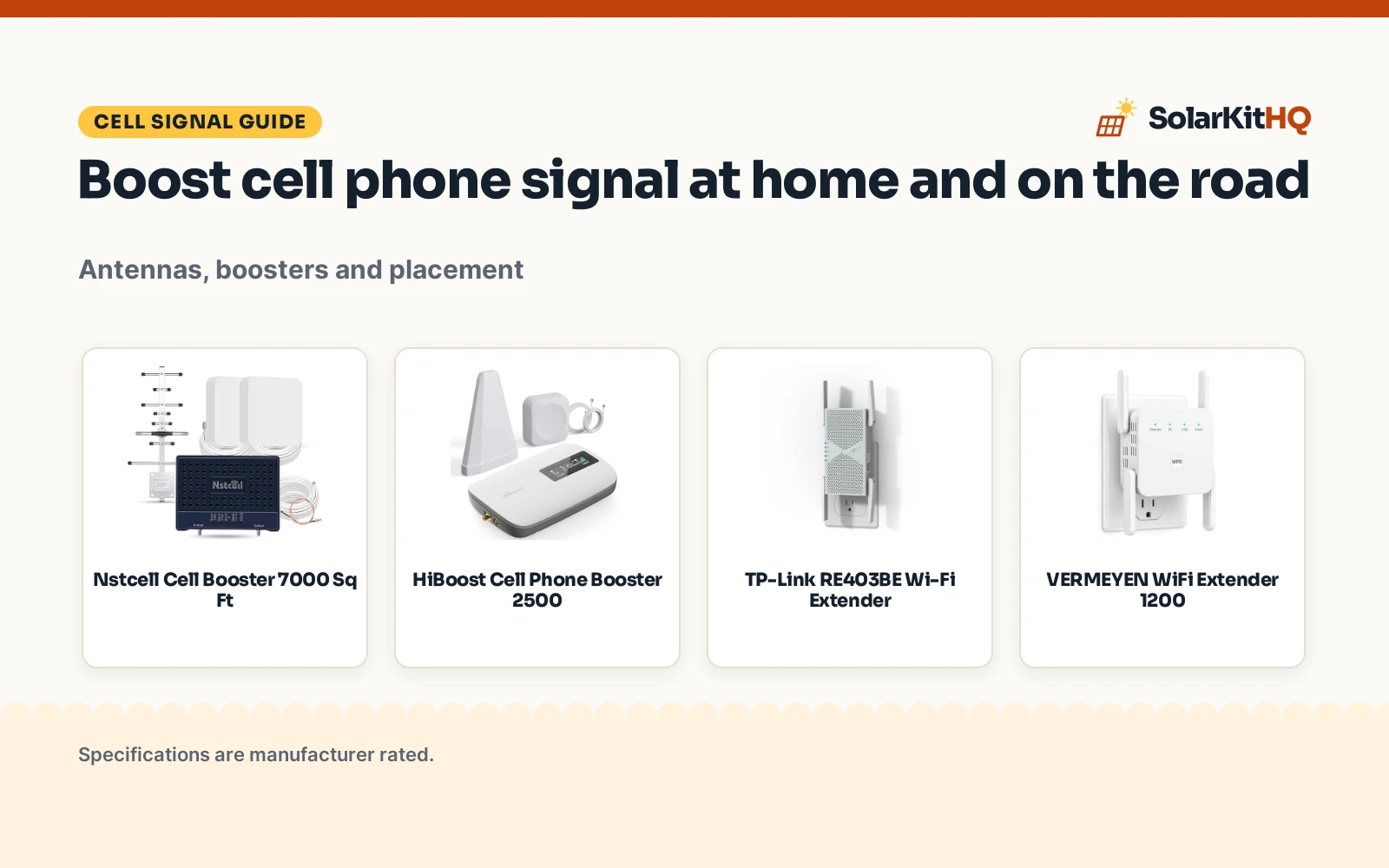
Pick the booster by the rooms it must cover and the bars outside. The Nstcell booster (on Amazon) covers 3 to 5 rooms and up to 7000 sq ft, with a maximum gain of 70 dB and a maximum output of 17 dBm, while the HiBoost booster (on Amazon) lists 62 dB of gain and 2500 sq ft. A Wi-Fi extender is a different tool: the TP-Link RE403BE (on Amazon) stretches an existing home network across up to 2800 sq ft for up to 64 devices, but the maker states it extends coverage rather than raising speed, so it helps weak Wi-Fi and not a faint carrier signal. See the cell signal booster vs Wi-Fi extender comparison when the choice is unclear.
How to boost cell phone signal with the right gear
The gear below covers Step 3 and Step 4: the outdoor antenna and booster that carry a weak outdoor signal indoors, and the Wi-Fi extender for far rooms.
| # | Product | Solar Score | Buy |
|---|---|---|---|
| 1 |  Nstcell Cell Booster 7000 Sq Ft | 9.7/10 | Buy on Amazon |
| 2 |  HiBoost 2500 Sq Ft Booster | 9.7/10 | Buy on Amazon |
| 3 |  TP-Link RE403BE Wi-Fi Extender | 9.6/10 | Buy on Amazon |
| 4 |  VERMEYEN WiFi Extender | 9.5/10 | Buy on Amazon |

Nstcell Cell Booster 7000 Sq Ft
A cell phone booster with an outdoor antenna and 2 indoor panel antennas that lifts 5G and 4G LTE voice, text and data across up to 7000 sq ft.
Pros
- 70 dB maximum gain and 17 dBm maximum output stated
- FCC and IC certification stated
- 2 indoor panel antennas cover 3 to 5 rooms
- 3 year manufacturer warranty stated
Cons
- Needs a usable outdoor signal; it will not work where no signal reaches the outdoor antenna
- Coverage falls to about 800 sq ft with only 1 to 2 bars outside
- Outdoor and indoor antennas need about 32 ft of separation
- 5G use is limited to DSS bands carriers have deployed in existing 4G bands
Detailed Review
The maker lists an outdoor log-periodic antenna with 2 indoor panel antennas, a maximum gain of 70 dB and a maximum output of 17 dBm, and states coverage of up to 7000 sq ft across 3 to 5 rooms. Coverage runs about 800 sq ft with 1 to 2 bars outside, about 3,000 sq ft with 3 to 4 bars and the full 7000 sq ft with 5 bars. It boosts 5G and 4G LTE voice, text and data for all US carriers and states FCC and IC certification with a 3 year manufacturer warranty.
Who it's for: homeowners and rural households with a weak but present outdoor signal. Who should skip it: anyone with no usable signal at the outdoor antenna spot.
Its Solar Score of 9.7/10 comes from performance 30/35, build 21/25, value 21/25, safety 8/10 and warranty 4/5: 84 of 100 points, placed on our 9.2 to 9.8 scale.
Key Specifications
| Coverage | Up to 7000 sq ft, 3 to 5 rooms |
|---|---|
| Gain | 70 dB maximum |
| Output | 17 dBm maximum |
| Antennas | Outdoor log-periodic, 2 indoor panel |
Taken from the seller's listing on 25 November 2026. Capacity and output figures are rated by the manufacturer.
Safety and Warranty
What this listing states. FCC and IC certified stated, so safety scores 8 of 10. 3 Years Manufacturer warranty stated. It does not say everything a buyer needs, such as who pays return shipping, so warranty scores 4 of 5. See How We Pick.
Follow the manual. Connect and use the product as the maker describes, stay within every stated rating, and read the manual before first use.
This is general buying information, not professional advice. Follow each product manual and local rules, and see our Safety Disclaimer.

HiBoost 2500 Sq Ft Booster
A 62dB booster for up to 2500 sq ft with an HD display, app support and FCC approval for all major US carriers.
Pros
- 62dB maximum gain with automatic gain adjustment
- Covers up to 2500 sq ft, listed for 2 to 3 rooms
- HD display and SignalSupervisor app for signal checks
- FCC approved with a 3-year manufacturer warranty stated
Cons
- 2500 sq ft is less than the 7000 sq ft the HXSDplus states
- 62dB gain is lower than the 72dB the ZORIDA states
- Listed for 2 to 3 rooms, so a larger home is outside its stated coverage
- Bands listed are 12, 13, 17, 5, 2/25 and 4, so other bands are outside its scope
Detailed Review
The listing states coverage of up to 2500 sq ft for 2 to 3 rooms in a home, office, rural areas and basements, with a maximum gain of 62dB and automatic gain adjustment. It supports 5G, 4G and 3G on bands 12, 13, 17, 5, 2/25 and 4, and lists Verizon, AT&T, T-Mobile, Sprint, US Cellular and Straight Talk. An HD display and the SignalSupervisor app show signal strength and help find the best outdoor signal location, and the maker states FCC approval with FCC ID OWWF115705SR. The warranty is stated as 3 years with lifetime technical support.
Who it's for: rural homeowners who want a display and app-guided setup for a home or office of up to 2500 sq ft. Who should skip it: anyone whose home needs more than 2 to 3 rooms covered, or whose carrier uses bands outside the listed set.
Its Solar Score of 9.7/10 comes from performance 30/35, build 21/25, value 21/25, safety 8/10 and warranty 4/5: 84 of 100 points, placed on our 9.2 to 9.8 scale.
Key Specifications
| Coverage | Up to 2500 sq ft |
|---|---|
| Max gain | 62dB |
| Bands | 12, 13, 17, 5, 2/25, 4 |
| Display | HD display and SignalSupervisor app |
Taken from the seller's listing on 20 November 2026. Capacity and output figures are rated by the manufacturer.
Safety and Warranty
What this listing states. FCC approved, FCC ID OWWF115705SR stated, so safety scores 8 of 10. 3-year manufacturer warranty stated. It does not say everything a buyer needs, such as who pays return shipping, so warranty scores 4 of 5. See How We Pick.
Follow the manual. Connect and use the product as the maker describes, stay within every stated rating, and read the manual before first use.
This is general buying information, not professional advice. Follow each product manual and local rules, and see our Safety Disclaimer.

TP-Link RE403BE Wi-Fi Extender
A Wi-Fi 7 dual-band range extender rated at 6.3 Gbps total that stretches an existing home network across up to 2800 sq ft for up to 64 devices.
Pros
- Wi-Fi 7 with MLO, 160 MHz channels and 4K-QAM with a Wi-Fi 7 router
- 6.3 Gbps total bandwidth: up to 5764 Mbps on 5 GHz and 574 Mbps on 2.4 GHz
- 2.5 Gbps Ethernet port for a wired device
- Covers up to 2800 sq ft for up to 64 devices
Cons
- No 6 GHz band support; it works on 2.4 GHz and 5 GHz only
- Extends coverage rather than raising speed; the maker states it is not to increase speed
- Needs a Wi-Fi 7 router to use MLO and the Wi-Fi 7 feature set
- 2 year warranty is shorter than the 3 year term on the Nstcell booster in this group
Detailed Review
The maker lists a Wi-Fi 7 dual-band extender with 6-stream operation, up to 5764 Mbps on the 5 GHz band and up to 574 Mbps on the 2.4 GHz band, for 6.3 Gbps total, plus MLO, 160 MHz channels and 4K-QAM with a Wi-Fi 7 router. Four antennas with beamforming cover up to 2800 sq ft for up to 64 devices, and a 2.5 Gbps Ethernet port serves a wired device. The maker states EasyMesh support, setup through the Tether app, and a 2 year manufacturer warranty, and notes the unit does not support the 6 GHz band.
Who it's for: homes with a Wi-Fi 7 router where the signal fades in far rooms. Who should skip it: anyone whose phone signal is weak because the carrier signal is faint.
Its Solar Score of 9.6/10 comes from performance 29/35, build 21/25, value 20/25, safety 5/10 and warranty 3/5: 78 of 100 points, placed on our 9.2 to 9.8 scale.
Key Specifications
| Speed | Up to 6.3 Gbps total |
|---|---|
| Coverage | Up to 2800 sq ft, 64 devices |
| Bands | 2.4 GHz and 5 GHz, no 6 GHz band |
| Port | 2.5 Gbps Ethernet |
Taken from the seller's listing on 25 November 2026. Capacity and output figures are rated by the manufacturer.
Safety and Warranty
What this listing states. CISA Secure-by-Design pledge signatory stated, so safety scores 5 of 10. 2 Year Manufacturer warranty stated. It does not say everything a buyer needs, such as who pays return shipping, so warranty scores 3 of 5. See How We Pick.
Follow the manual. Connect and use the product as the maker describes, stay within every stated rating, and read the manual before first use.
This is general buying information, not professional advice. Follow each product manual and local rules, and see our Safety Disclaimer.

VERMEYEN WiFi Extender
A dual-band WiFi extender with 1200 Mbps total speed, coverage up to 5000 sq. ft. for 35 devices and Repeater and AP modes.
Pros
- 300 Mbps on 2.4 GHz and 867 Mbps on 5 GHz, for about 1200 Mbps in total
- Coverage up to 5000 sq. ft. for 35 devices
- Repeater and AP modes with an Ethernet port
- 180-day return or replacement warranty is stated
Cons
- No antenna count is stated
- Setup runs through WPS or a browser address, with no app stated
- No WiFi version is stated
- 180-day warranty is shorter than the 2 year terms here
Detailed Review
VERMEYEN lists this extender with dual-band speeds of up to 300 Mbps on 2.4 GHz and up to 867 Mbps on 5 GHz, for a total rate of about 1200 Mbps, covering up to 5000 sq. ft. and 35 devices. It offers Repeater and AP modes, an Ethernet port for wired devices, setup by WPS button or by joining the extender network and visiting 192.168.11.1, and a reset that restores factory settings when held for 10 seconds. The maker gives two warranty figures, 180 days and 1 year; check before ordering.
Who it's for: a camper who wants 5000 sq. ft. of coverage with a simple Repeater or AP setup. Who should skip it: anyone who wants a 2 year warranty or a stated antenna count.
Its Solar Score of 9.5/10 comes from performance 28/35, build 19/25, value 19/25, safety 4/10 and warranty 2/5: 72 of 100 points, placed on our 9.2 to 9.8 scale.
Key Specifications
| Speed | About 1200 Mbps total |
|---|---|
| Coverage | 5000 sq. ft., 35 devices |
| Modes | Repeater, AP |
| Warranty | 180 days |
Taken from the seller's listing on 20 November 2026. Capacity and output figures are rated by the manufacturer.
Safety and Warranty
What this listing states. Network security features stated, so safety scores 4 of 10. 180-day return or replacement warranty. It does not say everything a buyer needs, such as who pays return shipping, so warranty scores 2 of 5. See How We Pick.
Follow the manual. Connect and use the product as the maker describes, stay within every stated rating, and read the manual before first use.
This is general buying information, not professional advice. Follow each product manual and local rules, and see our Safety Disclaimer.
As an Amazon Associate I earn from qualifying purchases.
FAQ: power away from the grid
Can a cell phone booster create signal where there is none?
No. A booster amplifies the signal that reaches the outdoor antenna, and the Nstcell maker notes it will not work if no signal is available to boost at the outdoor antenna location. If every side of the property shows no service, Wi-Fi calling is the fallback.
How much area can a cell phone booster cover?
It depends on the signal outside. With the Nstcell booster, the maker states about 800 sq ft with 1 to 2 bars outside, about 3,000 sq ft with 3 to 4 bars, and up to 7000 sq ft with 5 bars, across 3 to 5 rooms.
What is the difference between a cell phone booster and a Wi-Fi extender?
A cell phone booster takes the carrier signal from an outdoor antenna and repeats it indoors, while a Wi-Fi extender stretches an existing home Wi-Fi network into far rooms. The TP-Link RE403BE is a Wi-Fi extender rated at 6.3 Gbps total that extends coverage rather than raising speed. See the best cell signal boosters for home for booster picks.
How far apart should the indoor and outdoor antennas be?
The Nstcell maker states about 32 ft of separation between the outdoor antenna and the indoor antenna, with the power off while installing or adjusting antennas.
Will a cell phone booster work with 5G?
The Nstcell booster supports 5G and 4G LTE voice, text and data for all US carriers, including Verizon 5G Nationwide data. The maker notes 5G support covers the 5G carriers have deployed in existing 4G bands through DSS, so check that 5G service is available in the existing 4G band first.
Related solar guides
See every RV and Off-Grid Connectivity guide and all Emergency Prep guides.
More picks: best cell signal boosters for campers, best cell boosters for off-grid cabins, best cell boosters for vehicles and best RV Wi-Fi boosters for boondocking.