On this page
A generator that cranks slowly or clicks and stays silent on the morning it is needed usually has a flat starter battery, and how to charge a generator battery comes down to a small charger, the right clips on the right terminals and time for the charge to finish. The battery is a standard lead-acid starter battery, much like a lawn mower or motorcycle battery, and the chargers that suit it are the same trickle chargers and maintainers sold for cars and boats. The steps below use the figures the reference chargers state.
SolarKitHQ earns a commission when you buy through links on this page, at no extra cost to you. As an Amazon Associate I earn from qualifying purchases. Affiliate disclosure.
The quick answer: how to charge a generator battery
Charge a generator battery with a 12V lead-acid charger or maintainer, matched to the battery voltage and type. Connect the red clip to the positive terminal and the black clip to the negative terminal, plug the charger into an outlet, and let the charge stages run until the charger shows full or drops to float. A 1.5A charger suits overnight charging and storage, a 6A charger finishes faster, and a maintainer can stay connected between uses to keep the battery ready. The generator itself runs outdoors only, far from doors and windows, because of carbon monoxide, and the battery charges with the generator off.
Step 1: Find the battery and check its voltage
Open the generator battery cover and read the label on the battery. Most generator starter batteries are 12V lead-acid, and the chargers in the reference listings cover 6V and 12V lead-acid types, including SLA, AGM, GEL, VRLA, WET, flooded and deep-cycle batteries. The Schumacher SC1355 detects the voltage on its own for 6V and 12V batteries, so there is no switch to set, while the Unocho 1.5A charger (on Amazon) is made for 6V and 12V lead-acid batteries and the HECHOBO and FOVAL chargers (on Amazon) are made for 12V only. Match the charger to the label: a 12V charger on a 6V battery, or the reverse, will not charge it right. Check the terminals for corrosion and clean them before clipping on, since a dirty terminal can block the charge.
Step 2: Pick the charger size
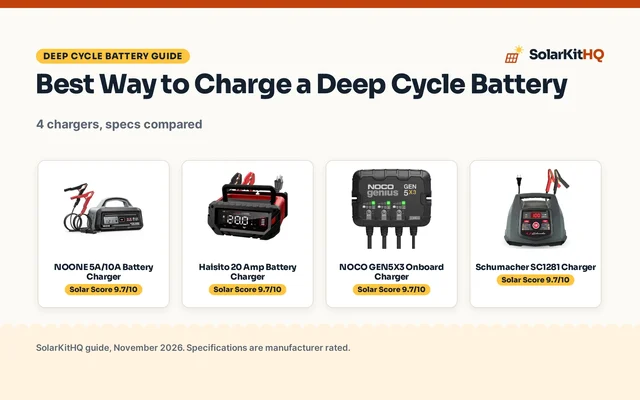
The amp figure sets how fast the battery fills. A 1A or 1.5A trickle charger, such as the FOVAL 1A or the Unocho and Schumacher 1.5A units, suits overnight charging and long storage, while a 2A charger, such as the HECHOBO, adds a little speed for the same 12V batteries. A 6A charger, such as the COREBOX, finishes faster and adds a 7-stage program with pulse maintenance, plus temperature compensation for hot and cold weather. A maintainer is not a jump starter: the HECHOBO listing states that it is a battery maintainer and trickle charger, not a jump starter, and it holds no battery of its own. Use a maintainer to keep a healthy battery ready, and a larger charger to bring a flat battery back.
| Charger | Amps | Volts | Stages | Warranty |
|---|---|---|---|---|
| Unocho 1.5A | 1.5A | 6V/12V | 5-stage | 1-year |
| Schumacher SC1355 | 1.5A | 6V/12V | 3-in-1 | 1-year |
| HECHOBO 2A | 2A | 12V | Desulfator | 1-year |
| FOVAL 1A, 4-pack | 1A | 12V | 4-step | 18 months |
| COREBOX 6A | 6A | 12V | 7-stage | 2-year |
The table uses the figures the listings state. Higher amps charge faster, but the battery type and the charger stages matter as much as the amp figure.
Step 3: Connect the charger
Work with the generator off and the charger unplugged while making the connections. Clip the red lead to the positive terminal and the black lead to the negative terminal, and check that the clips grip the metal, not the plastic around it. The Unocho kit includes detachable alligator clips and ring terminal connectors with an SAE quick disconnect, and the Schumacher kit includes quick-connect battery clamps and quick-connect ring connectors, so the leads can stay on the battery between charges. The FOVAL charger gives 102 inches of cable, and the COREBOX gives 7 ft, so the charger can sit clear of the generator while it works. Plug the charger into an outlet only after the clips are on, and keep the charger dry and clear of fuel.
Step 4: Let the stages run
A smart charger does not push one steady current; it steps through stages. The Unocho 1.5A runs 5 stages: battery detection, soft start, bulk charge, absorption and float maintenance. The FOVAL 1A runs 4 steps: initialization, bulk charge, absorption and float. The COREBOX 6A runs 7 stages: desulfation, soft start, bulk charge, analysis, recondition, float and pulse maintenance. The charger shows the state on LEDs: on the FOVAL, green means power, green with red means charging and green with yellow means fully charged. The Unocho adds a 72-hour safety timer and an inline 10A fuse, and the COREBOX shuts down on its own when the battery is full. Leave the charger alone until it shows full or float; unplugging mid-charge leaves the battery part done.
Step 5: Keep the battery ready between uses
A generator battery goes flat in storage, so a maintainer earns its keep between outages. The Unocho charger is made to maintain battery readiness during daily use or seasonal storage, and the Schumacher unit is made to keep starts reliable after storage, with a desulfation mode that helps bring a sulfated battery back. The COREBOX charger (on Amazon) states 8 charging protections, including reverse connection, overcurrent, overload, overheating and short circuit protection, plus temperature compensation for hot and cold weather. Leave a maintainer connected through the float stage, check the clips now and then, and top up the charge before the storm season rather than during it. If the battery will not hold a charge at all, the COREBOX listing warns that its repair mode cannot fix a totally dead battery, and the battery itself needs replacing.
FAQ: power away from the grid
Can I charge a generator battery with a car battery charger?
Yes, if the charger matches the battery voltage and type. Generator starter batteries are 12V lead-acid, and the reference chargers cover 6V and 12V lead-acid types, including SLA, AGM and GEL. Use the 12V setting on a charger that covers 6V and 12V, and check the label before clipping on.
How long does it take to charge a generator battery?
It depends on the battery size, how flat it is and the charger amps, and the listings give no one time for every battery. A 1.5A trickle charger suits overnight charging, while a 6A charger finishes faster; the charger LEDs or the float stage show when the battery is full.
Can I leave a trickle charger on a generator battery?
Yes, with a maintainer made for the job. The Unocho, Schumacher and COREBOX chargers are made to maintain a battery during storage, and the Unocho adds a 72-hour safety timer with an inline 10A fuse. Check the clips and the charger now and then, and unplug it if the battery gets hot.
What does the desulfation mode do?
Desulfation is a charge mode that helps break down sulfate buildup on a battery that has sat unused, and the Schumacher, HECHOBO and COREBOX listings state a desulfation mode. It can help a weak battery, but it cannot fix a totally dead battery, as the COREBOX listing warns.
Why does my generator battery keep going flat?
A battery that keeps going flat may have a bad cell, a drain on the generator, or terminals too corroded to take a charge. Clean the terminals, charge the battery fully on a maintainer, and check whether it holds the charge; a battery that will not hold a charge needs replacing.
Related solar guides
See every Battery Chargers and Maintainers guide and all Batteries and Charging guides.
More picks: propane generator maintenance, do generators run on propane, deep cycle RV batteries and best portable power stations for home backup.