On this page
The panels on the roof look fine from the ground, but the battery bank stops filling by midday and the lights dim earlier each evening. How to check a solar panel starts with the label on the back of the panel and a multimeter in hand: read the open-circuit voltage and the short-circuit current in full sun, and compare each reading with the label. The steps below show how to take the readings and what they mean.
SolarKitHQ earns a commission when you buy through links on this page, at no extra cost to you. As an Amazon Associate I earn from qualifying purchases. Affiliate disclosure.
How to check a solar panel, step by step
Checking a panel means comparing what it produces in full sun with what its label promises. The label gives open-circuit voltage and short-circuit current, and the multimeter reads each figure from the panel leads. A panel that reads near its label figures in full sun is doing its job; a panel that reads far below them, or reads nothing at all, has a fault to chase. Work in full sun, keep the meter leads on the panel leads only, and read the manual for the meter before starting.
Step 1: Read the panel label
The label on the back of the panel lists open-circuit voltage, short-circuit current and maximum power, and those figures are the baseline for every check that follows. Write the figures down before touching the meter, and note the panel wattage as well. A label that is faded or missing leaves no baseline, so use the manual or the maker listing for the same panel to get the figures.
Step 2: Measure open-circuit voltage
Set the meter to DC voltage, in a range above the panel open-circuit voltage, and touch the leads to the panel leads in full sun with nothing else connected. The reading should sit near the label open-circuit voltage. A reading far below the label figure points to shading, a dirty panel face or a damaged cell string, so check the panel face and the sky before blaming the panel. The AstroAI 6000 (on Amazon) and the Klein MM325 read up to 600V AC/DC, which covers the open-circuit voltage of the panels these meters are used with. See the solar panel maintenance guide for keeping the panel face clean.
Step 3: Measure short-circuit current
Set the meter to DC current, in a range above the panel short-circuit current, and touch the leads to the panel leads in full sun. The reading should sit near the label short-circuit current. A reading far below the label figure on a clear day points to shading or a panel fault, while a reading near the label figure means the panel is producing. The Klein MM325 reads 10A DC current, and the AstroAI 6000 reads AC/DC current with True RMS, so each covers the short-circuit current check.
The meters for this job
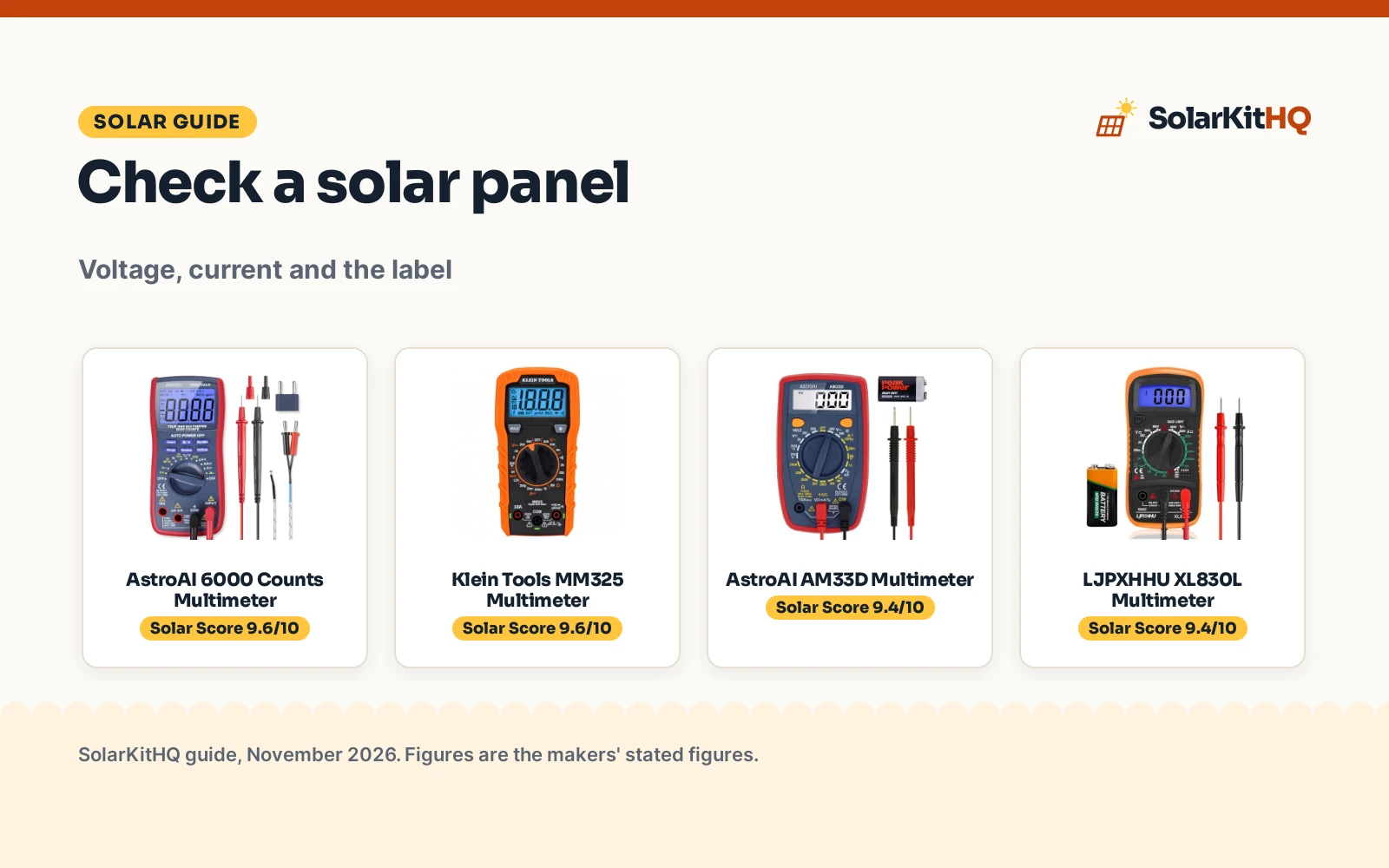
The voltage and current checks above need a meter that reads DC voltage and DC current, with a display that is easy to read in sunlight. The meters below cover those checks, from a basic 2000-count manual meter to a True RMS auto-ranging meter.
| # | Product | Solar Score | Buy |
|---|---|---|---|
| 1 |  AstroAI 6000 Counts Multimeter | 9.6/10 | Buy on Amazon |
| 2 |  Klein Tools MM325 Multimeter | 9.6/10 | Buy on Amazon |
| 3 |  AstroAI AM33D Multimeter | 9.4/10 | Buy on Amazon |
| 4 |  LJPXHHU XL830L Multimeter | 9.4/10 | Buy on Amazon |

AstroAI 6000 Counts Multimeter
A True RMS 6000-count auto-ranging meter that reads AC/DC voltage and current, capacitance and temperature for the full panel check.
Pros
- True RMS and auto-ranging for AC current and voltage
- Measures capacitance, frequency, duty cycle, resistance, diode, continuity and temperature
- F400mA/600V and F10A/600V fuse tubes stated
- Auto shut-off, data hold and kickstand included
Cons
- No warranty term is stated
- No battery check mode is stated
- No audible continuity buzzer is stated
- No lead-alert feature is stated
Detailed Review
The listing states a True RMS 6000-count auto-ranging multimeter that measures AC/DC current, AC/DC voltage, capacitance, frequency, duty cycle, resistance, diode, continuity and temperature. It has data hold, a large backlit LCD, auto shut-off and a kickstand, plus a double ceramic fuse with F400mA/600V and F10A/600V fuse tubes. The support team responds within 24 hours. No warranty term is stated.
Who it's for: owners who want a meter for voltage, current, capacitance and temperature checks on a panel and a battery bank. Who should skip it: anyone who needs a stated warranty term or a battery check mode.
Its Solar Score of 9.6/10 comes from performance 32/35, build 21/25, value 20/25, safety 8/10 and warranty 0/5: 81 of 100 points, placed on our 9.2 to 9.8 scale.
Key Specifications
| Counts | 6000 counts, True RMS |
|---|---|
| Measures | AC/DC voltage and current, capacitance, frequency, temperature |
| Fuses | F400mA/600V and F10A/600V |
| Features | Auto-ranging, data hold, auto shut-off, kickstand |
Figures as published on the retailer listing, collected 12 November 2026. Performance figures are manufacturer rated.
Safety and Warranty
What this listing states. Double ceramic fuse, anti-burn and overload protection, with F400mA/600V and F10A/600V fuse tubes stated, so safety scores 8 of 10. No warranty term, so warranty scores zero. See How We Pick.
Panels make voltage in daylight. Keep connectors covered until you connect them, check the panel's stated open circuit voltage and current against your controller or power station input limits, and use cables rated for the current. Roof and permanent mounts belong to a qualified installer.
This is general buying information, not professional advice. Follow each product manual and local rules, and see our Safety Disclaimer.

Klein Tools MM325 Multimeter
A manual-ranging 600V meter with lead-alert LEDs and a battery check mode for panel voltage and battery checks.
Pros
- Measures AC/DC voltage up to 600V, 10A DC current and 2MΩ resistance
- Lead-alert LEDs show proper lead placement
- Battery check mode checks if batteries are working
- Backlit LCD, lead holders and kickstand
Cons
- Manual-ranging, not auto-ranging
- No warranty term is stated in the listing
- Magnetic hanger is optional, not included
- No capacitance or temperature measurement is stated
Detailed Review
The listing states a manual-ranging multimeter that measures AC/DC voltage up to 600V, 10A DC current and 2MΩ resistance, with continuity, diode and battery checks. Lead-alert LEDs show proper lead placement, and the backlit LCD, lead holders and kickstand are included, with an optional magnetic hanger. The warranty description points to the manufacturer website, with no term stated.
Who it's for: owners who want lead-alert placement checks and a battery check mode in a manual meter. Who should skip it: anyone who wants auto-ranging or a stated warranty term.
Its Solar Score of 9.6/10 comes from performance 29/35, build 21/25, value 20/25, safety 7/10 and warranty 0/5: 77 of 100 points, placed on our 9.2 to 9.8 scale.
Key Specifications
| Voltage | 600V AC/DC |
|---|---|
| Current | 10A DC |
| Resistance | 2MΩ |
| Features | Lead-alert LEDs, battery check, backlit LCD |
Figures as published on the retailer listing, collected 12 November 2026. Performance figures are manufacturer rated.
Safety and Warranty
What this listing states. Lead-alert LEDs show proper lead placement stated, so safety scores 7 of 10. No warranty term, so warranty scores zero. See How We Pick.
Panels make voltage in daylight. Keep connectors covered until you connect them, check the panel's stated open circuit voltage and current against your controller or power station input limits, and use cables rated for the current. Roof and permanent mounts belong to a qualified installer.
This is general buying information, not professional advice. Follow each product manual and local rules, and see our Safety Disclaimer.
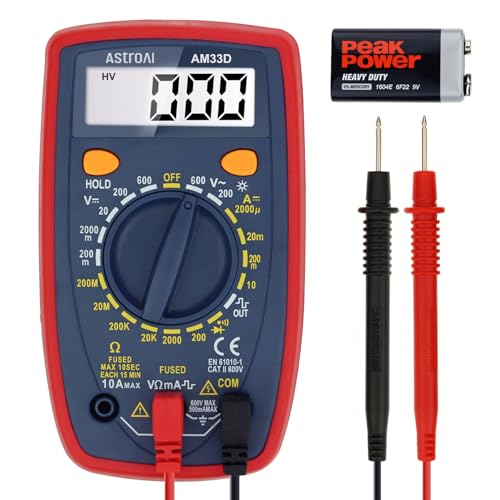
AstroAI AM33D Multimeter
A 2000-count manual meter that reads DC voltage for the open-circuit check and DC current for the short-circuit check, with data hold and a continuity buzzer.
Pros
- Measures AC/DC voltage, DC current, resistance, continuity and diode
- Data hold and continuity buzzer included
- Backlit LCD display for dimly lit areas
- 3 year warranty by AstroAI stated
Cons
- Cannot measure all AC current or below 100mV AC voltage
- Manual rotary switch must be set before each measurement
- No True RMS or auto-ranging is stated
Detailed Review
The listing states a 2000-count digital multimeter that measures AC/DC voltage, DC current, resistance, continuity and diode, with a backlit LCD, data hold and a continuity buzzer. The title says 2000 counts, but the bullets describe a display with a 1999 count, and the listing warns it cannot measure all AC current or below 100mV AC voltage. It has a double fuse, a silicone cover and low battery indication, and the support team responds within 24 hours. The warranty is 3 years by AstroAI.
Who it's for: owners who want a basic manual meter for voltage and current checks on a panel. Who should skip it: anyone who needs auto-ranging, True RMS or full AC current measurement.
Its Solar Score of 9.4/10 comes from performance 23/35, build 18/25, value 19/25, safety 7/10 and warranty 3/5: 70 of 100 points, placed on our 9.2 to 9.8 scale.
Key Specifications
| Counts | 2000 counts |
|---|---|
| Measures | AC/DC voltage, DC current, resistance, continuity, diode |
| Display | Backlit LCD with data hold |
| Warranty | 3 year warranty by AstroAI |
Figures as published on the retailer listing, collected 12 November 2026. Performance figures are manufacturer rated.
Safety and Warranty
What this listing states. Double fuse, anti-burn and overload protection stated, so safety scores 7 of 10. 3 Year Warranty by AstroAI stated. It does not say everything a buyer needs, such as who pays return shipping, so warranty scores 3 of 5. See How We Pick.
Panels make voltage in daylight. Keep connectors covered until you connect them, check the panel's stated open circuit voltage and current against your controller or power station input limits, and use cables rated for the current. Roof and permanent mounts belong to a qualified installer.
This is general buying information, not professional advice. Follow each product manual and local rules, and see our Safety Disclaimer.

LJPXHHU XL830L Multimeter
A 2000-count meter with a 2.7 inch backlit display that reads voltage, current, resistance and continuity for the panel checks.
Pros
- Measures AC/DC voltage, DC current, resistance, continuity, diode and batteries
- 2.7 inch large backlit LCD display
- Overload protection on all ranges stated
- 9V battery, leads and user manual included
Cons
- 2 year coverage is shorter than the 3 year warranty on the AstroAI AM33D
- No auto-ranging or True RMS is stated
- No capacitance or temperature measurement is stated
- No magnetic hanger is stated, so hands-free use needs the fold-out stand
Detailed Review
The listing states a 2000-count digital multimeter that measures AC/DC voltage, DC current, resistance, continuity, diode and batteries, with a 2.7 inch backlit LCD display, data hold and an audible continuity sensor. It has overload protection on all ranges, double insulation, a removable rubber cover and a fold-out stand, and the box includes a 9V battery, leads and a user manual. The coverage runs 2 years.
Who it's for: beginners who want a large backlit display and 2 year coverage for household and car checks. Who should skip it: anyone who needs auto-ranging, True RMS, capacitance or temperature measurement.
Its Solar Score of 9.4/10 comes from performance 23/35, build 19/25, value 20/25, safety 7/10 and warranty 2/5: 71 of 100 points, placed on our 9.2 to 9.8 scale.
Key Specifications
| Counts | 2000 counts |
|---|---|
| Display | 2.7 inch backlit LCD |
| Measures | AC/DC voltage, DC current, resistance, continuity, diode |
| Battery | 9V battery included |
Figures as published on the retailer listing, collected 12 November 2026. Performance figures are manufacturer rated.
Safety and Warranty
What this listing states. Overload protection on all ranges and double insulation stated, so safety scores 7 of 10. 2 year coverage stated. It does not say everything a buyer needs, such as who pays return shipping, so warranty scores 2 of 5. See How We Pick.
Panels make voltage in daylight. Keep connectors covered until you connect them, check the panel's stated open circuit voltage and current against your controller or power station input limits, and use cables rated for the current. Roof and permanent mounts belong to a qualified installer.
This is general buying information, not professional advice. Follow each product manual and local rules, and see our Safety Disclaimer.
As an Amazon Associate I earn from qualifying purchases.
Ways to keep the checks honest
- Check in full sun, with the panel face clean and nothing shading it.
- Read the label figures first, and write the meter readings next to them.
- Use the data hold feature to freeze a reading before moving the meter.
- Check the meter battery and the leads before starting: the AM33D shows a low battery indication, and the LJPXHHU includes a 9V battery in the box.
FAQ: power away from the grid
What voltage should a solar panel read in full sun?
It should read near the open-circuit voltage on its label. The label figure is the baseline, so compare the meter reading with it rather than with a figure from another panel.
Can a multimeter check a solar panel without disconnecting it?
No. Disconnect the panel from the controller and the battery before measuring, so the meter reads the panel alone and not the rest of the system.
What does a low current reading mean on a solar panel?
It means the panel is producing less than its label short-circuit current. Check for shading and a dirty panel face first, then check the leads and the meter range before deciding the panel is at fault.
Is True RMS needed to check a solar panel?
No. A basic meter reads DC voltage and DC current, which is what the panel checks need. True RMS and auto-ranging, as on the AstroAI 6000, make the readings easier to take, and the Klein MM325 adds lead-alert LEDs that show proper lead placement.
Related solar guides
See the DIY solar panel kits, the best solar panel mounting kits, the solar panel maintenance and the solar generator calculator.