On this page
At first light the screen glows with arches, blobs and a hard line along the bottom, and learning how to read a fish finder turns that clutter into a map of what sits under the boat. The arches are fish, the thick line is the bottom, and the color and shape of each return show whether it is weed, timber, rock or open water. Depth runs down the side of the screen, and the marks that stay put from pass to pass are the structure worth fishing. The steps below explain each part of the picture, using fish finders with CHIRP, ClearVu and Down Imaging sonar.
SolarKitHQ earns a commission when you buy through links on this page, at no extra cost to you. As an Amazon Associate I earn from qualifying purchases. Affiliate disclosure.
The quick answer
Read a fish finder screen from the top down: the top edge is the surface, the numbers down the side are depth, and the strong line near the bottom is the lake or sea bed. Fish show as arches or marks in the water column, while timber, brush, rock and bridge pilings show as thicker, uneven returns on or near the bottom. Color palettes help tell fish apart from structure, and Down Imaging sharpens the view below the boat. Mark the spots that hold fish, then return to them.
Step 1: Learn the parts of the screen
Every fish finder screen shows the same parts, so learn them once and any unit makes sense. The surface sits at the top, depth runs down the side, and the bottom shows as a solid line that rises and falls with the lake or sea bed. Between them lies the water column, where fish arches and bait marks appear. A bigger screen shows more of that picture at once: the finders here range from a compact 3.5-inch display to a 9-inch display, and the 3.5-inch unit shows its picture in a 1.9 by 2.9 inch area. Screen size is a fit choice too: a small console suits a compact unit.
Step 2: Read fish arches and returns
Fish show as arches as they pass through the sonar beam. CHIRP sonar sends a continuous sweep of frequencies, which gives a wider range of information and crisper fish arches with better target separation, so close fish show as separate marks. ClearVu scanning sonar gives near-photographic images with detailed representations of objects, structure and fish, Down Imaging gives a clear view of what is happening below the boat, with timber, brush, bridge pilings and rocks in sharp detail. Dual Beam sonar lets the angler choose a narrow beam for detail or a wide beam for generous coverage, and vivid scanning sonar color palettes make fish and structure easier to tell apart.
Step 3: Mark spots with GPS and waypoints
Seeing fish is only half the job; the other half is finding the same spot again. A waypoint map lets the angler view, mark and navigate to locations such as brush piles, stumps and docks, High-sensitivity GPS marks waypoints, creates routes and shows the boat speed, and Quickdraw Contours mapping draws the contours of the water being fished. Wi-Fi links the finder to the ActiveCaptain app on a compatible smartphone to transfer waypoints, receive smart notifications. See the best fish finders with maps for units that pair sonar with chart detail.
Step 4: Match the finder to the water
Depth range decides whether a finder suits the water being fished. The compact Garmin finder reaches a maximum depth of 1,600 feet in freshwater and 750 feet in saltwater, The same finder comes in 3.5, 5 and 7 inch display sizes, so the screen can match the console. For cold water, a built-in flasher shows sonar data in the classic flasher format and suits ice fishing or vertical jigging. Power is simple on most boats, since the compact unit draws 0.23 ampere at 12 volt, See the best fish finder power cables for longer runs.
Gear for learning how to read a fish finder
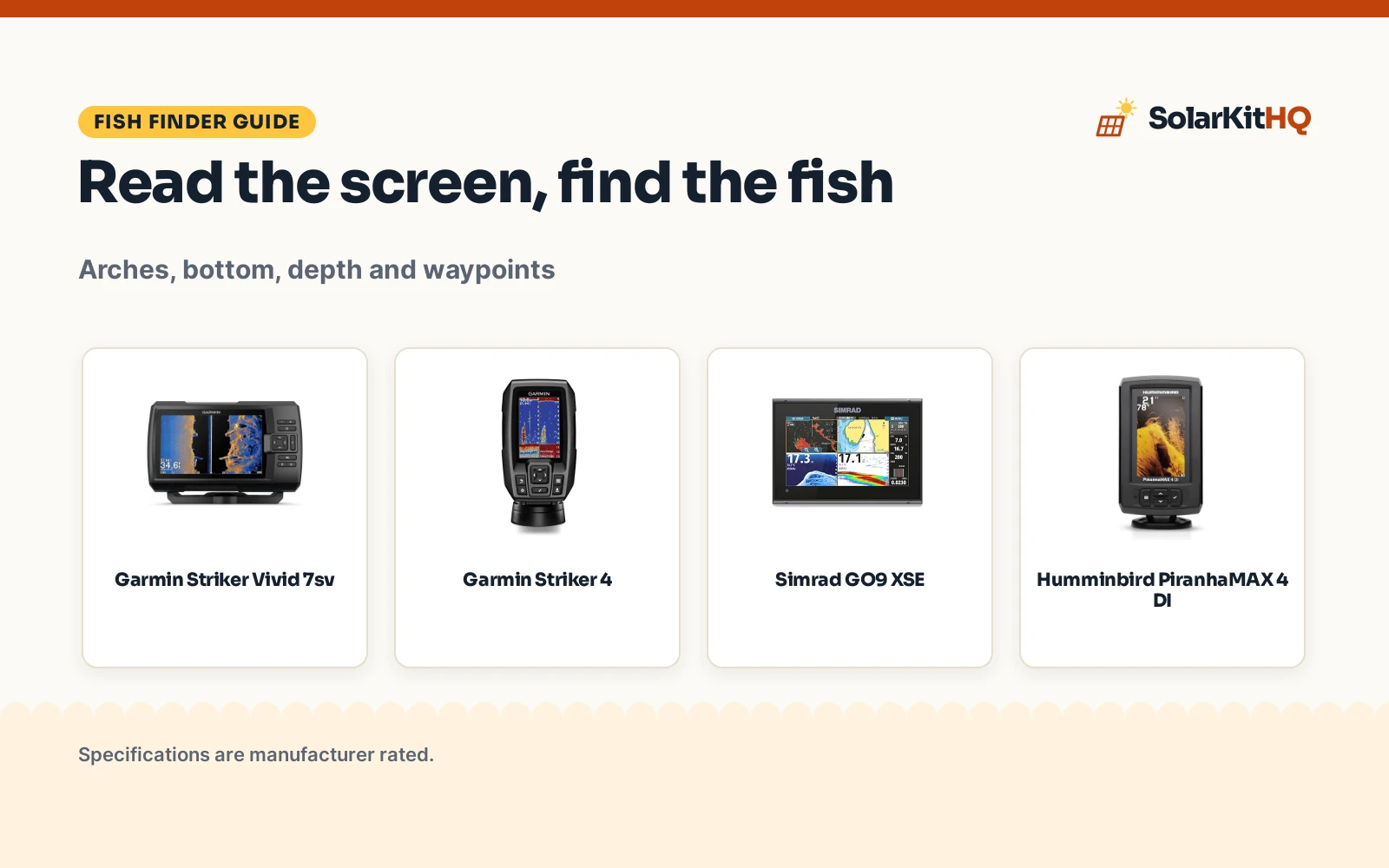
The steps above need a screen that shows arches, bottom and structure clearly, so the four finders below are the gear for this guide, ranked by their Solar Scores.
| # | Product | Solar Score | Buy |
|---|---|---|---|
| 1 |  Garmin Striker Vivid 7sv | 9.6/10 | Buy on Amazon |
| 2 |  Garmin Striker 4 | 9.6/10 | Buy on Amazon |
| 3 |  Simrad GO9 XSE HDI Transducer | 9.6/10 | Buy on Amazon |
| 4 |  Humminbird PiranhaMAX 4 DI | 9.5/10 | Buy on Amazon |

Garmin Striker Vivid 7sv
A 7-inch color fishfinder with vivid sonar palettes, CHIRP traditional, ClearVu and SideVu scanning, GPS mapping and Wi-Fi.
Pros
- Vivid scanning sonar color palettes make fish and structure easier to tell apart
- CHIRP traditional, ClearVu and SideVu scanning cover below and beside the boat
- Quickdraw Contours mapping with high-sensitivity GPS for waypoints and routes
- Wi-Fi links to the ActiveCaptain app for waypoint transfer and smart notifications
Cons
- Heaviest pick here at 5.4 pounds
- 7-inch screen needs more console space than the compact units
- Wi-Fi and app features add setup steps a simple sounder does not need
- Suits larger boats better than small kayaks and jon boats
Detailed Review
Garmin lists a 7-inch color fishfinder with vivid scanning sonar color palettes, CHIRP traditional sonar plus CHIRP ClearVu and CHIRP SideVu scanning sonars, high-sensitivity GPS, built-in Quickdraw Contours mapping and Wi-Fi for the ActiveCaptain app. The box holds the GT52HW-TM transducer, a power and data cable, a 12-pin to dual 4-pin transducer adapter cable, a tilt and swivel mount, hardware and documentation. The unit weighs 5.4 pounds and measures 11.4 by 8.9 by 8.2 inches, and Garmin states a 2 year limited warranty.
Who it's for: anglers who want a large color screen with side scanning, mapping and app links for marking and returning to spots. Who should skip it: boat owners with a small console, where the 7-inch screen takes more room than a compact finder.
Its Solar Score of 9.6/10 comes from performance 33/35, build 22/25, value 22/25, safety 0/10 and warranty 3/5: 80 of 100 points, placed on our 9.2 to 9.8 scale.
Key Specifications
| Display | 7-inch color |
|---|---|
| Sonar | CHIRP traditional, ClearVu and SideVu |
| Transducer | GT52HW-TM included |
| Weight | 5.4 pounds |
Taken from the seller's listing on 25 November 2026. Capacity and output figures are rated by the manufacturer.
Safety and Warranty
What this listing states. This product does not plug in or run on a battery, so safety is not part of its score. 2 year limited warranty stated. It does not say everything a buyer needs, such as who pays return shipping, so warranty scores 3 of 5. See How We Pick.
Follow the manual. Connect and use the product as the maker describes, stay within every stated rating, and read the manual before first use.
This is general buying information, not professional advice. Follow each product manual and local rules, and see our Safety Disclaimer.

Garmin Striker 4
A compact 3.5-inch GPS fishfinder with CHIRP and ClearVu sonar, a waypoint map and a built-in flasher.
Pros
- CHIRP sonar gives crisper fish arches with better target separation
- ClearVu scanning shows near-photographic detail of objects, structure and fish
- Waypoint map marks brush piles, stumps and docks for return trips
- Built-in flasher suits ice fishing and vertical jigging
Cons
- 3.5-inch display is the smallest screen here, with a 1.9 by 2.9 inch viewing area
- Saltwater depth is rated to 750 feet, below the 1,600-foot freshwater figure
- 1-year limited warranty is shorter than the 2-year term on the 7-inch pick
- Small screen suits small consoles, not large helms
Detailed Review
Garmin lists a 3.5-inch GPS fishfinder with CHIRP sonar, ClearVu scanning, a keyed interface and a waypoint map, in 3.5, 5 and 7 inch display sizes. Maximum depth is 1,600 feet in freshwater and 750 feet in saltwater, current draw is 0.23 ampere at 12 volt, and the water rating is IPX7. The display area is 1.9 by 2.9 inches, the unit weighs 0.5 pounds, and Garmin states a 1-year limited warranty.
Who it's for: anglers who want a compact, simple finder with CHIRP arches, a waypoint map and a flasher for ice fishing. Who should skip it: buyers who want side scanning, a large color screen or a longer warranty term.
Its Solar Score of 9.6/10 comes from performance 29/35, build 21/25, value 20/25, safety 5/10 and warranty 2/5: 77 of 100 points, placed on our 9.2 to 9.8 scale.
Key Specifications
| Display | 3.5-inch, 1.9 x 2.9 in |
|---|---|
| Max depth | 1,600 ft freshwater, 750 ft saltwater |
| Water rating | IPX7 |
| Current draw | 0.23 A at 12 V |
Taken from the seller's listing on 25 November 2026. Capacity and output figures are rated by the manufacturer.
Safety and Warranty
What this listing states. IPX7 water rating stated, so safety scores 5 of 10. 1-year limited warranty stated. It does not say everything a buyer needs, such as who pays return shipping, so warranty scores 2 of 5. See How We Pick.
Follow the manual. Connect and use the product as the maker describes, stay within every stated rating, and read the manual before first use.
This is general buying information, not professional advice. Follow each product manual and local rules, and see our Safety Disclaimer.

Simrad GO9 XSE HDI Transducer
A 9-inch chartplotter and fish finder with an 83/200 kHz HDI transducer, CHIRP sonar, DownScan, GPS and C-MAP charts.
Pros
- 83/200 kHz HDI transducer with CHIRP sonar and DownScan Imaging
- C-MAP DISCOVER chart card included with vector charts and tides
- Built-in GPS with Wi-Fi and NMEA 2000 for system integration
- Listed weight of 3.0 pounds is the lowest of the two Simrad listings
Cons
- No SideScan imaging stated, unlike the Active Imaging listing
- Warranty term is 2 years, shorter than the Uniden listing
- Display mirroring needs a smartphone or tablet
- 9-inch display needs helm space: the listing gives 10.35 by 3.54 by 7.24 inches
Detailed Review
The listing states a 9-inch chartplotter and fish finder with an 83/200 kHz HDI transducer, built-in CHIRP sonar and DownScan Imaging, plus a C-MAP DISCOVER card with vector charts, custom depth shading, tides and currents, and high-resolution bathymetric contours. Built-in GPS, Wi-Fi and NMEA 2000 are stated, and the display can mirror to a smartphone or tablet. The maker lists the weight at 3.0 pounds and the dimensions at 10.35 by 3.54 by 7.24 inches, with a 2 Year warranty.
Who it's for: boaters who want charts, GPS and CHIRP sonar on a 9-inch display without SideScan. Who should skip it: anglers who want SideScan detail, or anyone who needs a handheld radio for contact and distress calls.
Its Solar Score of 9.6/10 comes from performance 30/35, build 21/25, value 20/25, safety 6/10 and warranty 1/5: 78 of 100 points, placed on our 9.2 to 9.8 scale.
Key Specifications
| Display | 9-inch |
|---|---|
| Sonar | 83/200 kHz HDI, CHIRP and DownScan |
| Charts | C-MAP DISCOVER included |
| Weight | 3.0 pounds |
Taken from the seller's listing on 20 November 2026. Capacity and output figures are rated by the manufacturer.
Safety and Warranty
What this listing states. Built-in GPS and radar capability stated, so safety scores 6 of 10. 2 Year warranty stated. It does not say everything a buyer needs, such as who pays return shipping, so warranty scores 1 of 5. See How We Pick.
Follow the manual. Connect and use the product as the maker describes, stay within every stated rating, and read the manual before first use.
This is general buying information, not professional advice. Follow each product manual and local rules, and see our Safety Disclaimer.

Humminbird PiranhaMAX 4 DI
A 4.3-inch color fish finder with Down Imaging, Dual Beam sonar, Fish ID+ and depth alarms.
Pros
- Down Imaging shows timber, brush, bridge pilings and rocks in sharp detail
- Dual Beam sonar switches between a narrow beam for detail and a wide beam for coverage
- Fish ID+, fish alarms, depth alarms and zoom are built in
- 4.3-inch color LCD with a redesigned, easy-to-use interface
Cons
- 4.3-inch display is smaller than the 7-inch pick, so structure shows at a smaller scale
- 1 year Manufacturer warranty is shorter than the 2-year term on the 7-inch pick
- Down Imaging and Dual Beam look below the boat only
- 3.6 by 3.9 by 6.8 inch case needs more console depth than the compact pick
Detailed Review
Humminbird lists a 4.3-inch color LCD with Down Imaging, Dual Beam sonar, Fish ID+, fish alarms, depth alarms and zoom. The box holds the PiranhaMAX 4 DI fish finder, a tilt and swivel mount and an XNT 9 DI T transom-mount transducer. The unit measures 3.6 by 3.9 by 6.8 inches, and Humminbird states a 1 year Manufacturer warranty.
Who it's for: anglers who want a clear view below the boat with Down Imaging and alarms. Who should skip it: buyers who want CHIRP arches, side scanning or GPS mapping.
Its Solar Score of 9.5/10 comes from performance 28/35, build 20/25, value 21/25, safety 0/10 and warranty 2/5: 71 of 100 points, placed on our 9.2 to 9.8 scale.
Key Specifications
| Display | 4.3-inch color LCD |
|---|---|
| Sonar | Down Imaging and Dual Beam |
| Transducer | XNT 9 DI T transom-mount included |
| Size | 3.6 x 3.9 x 6.8 in |
Taken from the seller's listing on 25 November 2026. Capacity and output figures are rated by the manufacturer.
Safety and Warranty
What this listing states. This product does not plug in or run on a battery, so safety is not part of its score. 1 year Manufacturer warranty stated. It does not say everything a buyer needs, such as who pays return shipping, so warranty scores 2 of 5. See How We Pick.
Follow the manual. Connect and use the product as the maker describes, stay within every stated rating, and read the manual before first use.
This is general buying information, not professional advice. Follow each product manual and local rules, and see our Safety Disclaimer.
As an Amazon Associate I earn from qualifying purchases.
Ways to get a clearer picture
- Use Down Imaging on structure: switch to Down Imaging over timber, brush, pilings and rocks, where its sharp detail beats a plain sonar view.
- Let the alarms watch: Fish ID+, fish alarms, depth alarms and zoom flag fish and depth changes while the angler watches the rod.
- Pick a palette that separates: vivid scanning sonar color palettes make fish and structure easier to tell apart.
- Mark what you find: drop a waypoint on every brush pile, stump and dock that holds fish.
FAQ: power away from the grid
What do the arches on a fish finder mean?
Arches are fish shown by the sonar return. CHIRP sonar sends a continuous sweep of frequencies, which creates crisper fish arches with better target separation, so close fish show as separate arches.
What is the difference between CHIRP and Down Imaging?
CHIRP sends a continuous sweep of frequencies for a wider range of information and crisper fish arches, while Down Imaging gives a clear view of what is happening below the boat, with timber, brush, bridge pilings and rocks in sharp detail.
How deep can a fish finder read?
It depends on the unit. The compact Garmin finder is rated to a maximum depth of 1,600 feet in freshwater and 750 feet in saltwater, so check the stated depth against the water you fish before choosing.
Is GPS needed on a fish finder?
No, but it helps. A waypoint map lets the angler view, mark and navigate to brush piles, stumps and docks, and high-sensitivity GPS adds routes and boat speed.
Can a fish finder help with ice fishing?
Yes. The compact Garmin finder has a built-in flasher that shows sonar data in the classic flasher format, and the maker calls it ideal for ice fishing or vertical jigging.
Related solar guides
See the best fish finders for bottom fishing, the best fish finders with maps, the best fish finder mounts for a jon boat and the best fish finder power cables.