On this page
How to recharge a lithium battery the right way? Match the charger to the battery chemistry and voltage, connect it as the manual says and let the charger run its stages to a full charge. This page covers 12V LiFePO4 packs. The steps below walk through the routine, and the gear section names the chargers that handle each part.
SolarKitHQ earns a commission when you buy through links on this page, at no extra cost to you. As an Amazon Associate I earn from qualifying purchases. Affiliate disclosure.
How to recharge a lithium battery: the quick answer
Use a charger made for lithium batteries, set it to the battery voltage and let it run its charging stages to a full charge. A lithium charger follows the battery through its stages and stops on its own when the battery is full. Not every charger can wake a battery whose BMS has cut off: only chargers that list a wake-up mode, such as the KAISAL and OptiMate chargers (on Amazon) here, claim that job, and the PZ.P listing states no wake-up mode and gives no sign it can charge a battery that is fully dead. A charger with a maintainer mode can keep a stored battery ready.
Step 1: Match the charger to the battery
This page covers 12V LiFePO4 packs, so the routine below is written for them. Follow it in order:
- Check the chemistry and the voltage on the battery label and on the charger label. A charger made for lead acid batteries will not charge a lithium battery the same way, so do not connect one that does not list lithium or LiFePO4.
- Connect the charger to the battery in the order the manual gives. The KAISAL charger (on Amazon) lists 3 connection methods: an SB-50 Anderson plug, M8 terminals and alligator clips.
- Set the current the manual allows for your battery, as described in Step 2.
- Watch the indicator while the battery charges. Check what each light means in the manual before you rely on it.
- Stop when the battery is full. The charger should end the charge on its own, and the KAISAL listing states it stops after 15 hours of continuous charging.
- Keep the charger ventilated while it runs, with air around it and away from heat.
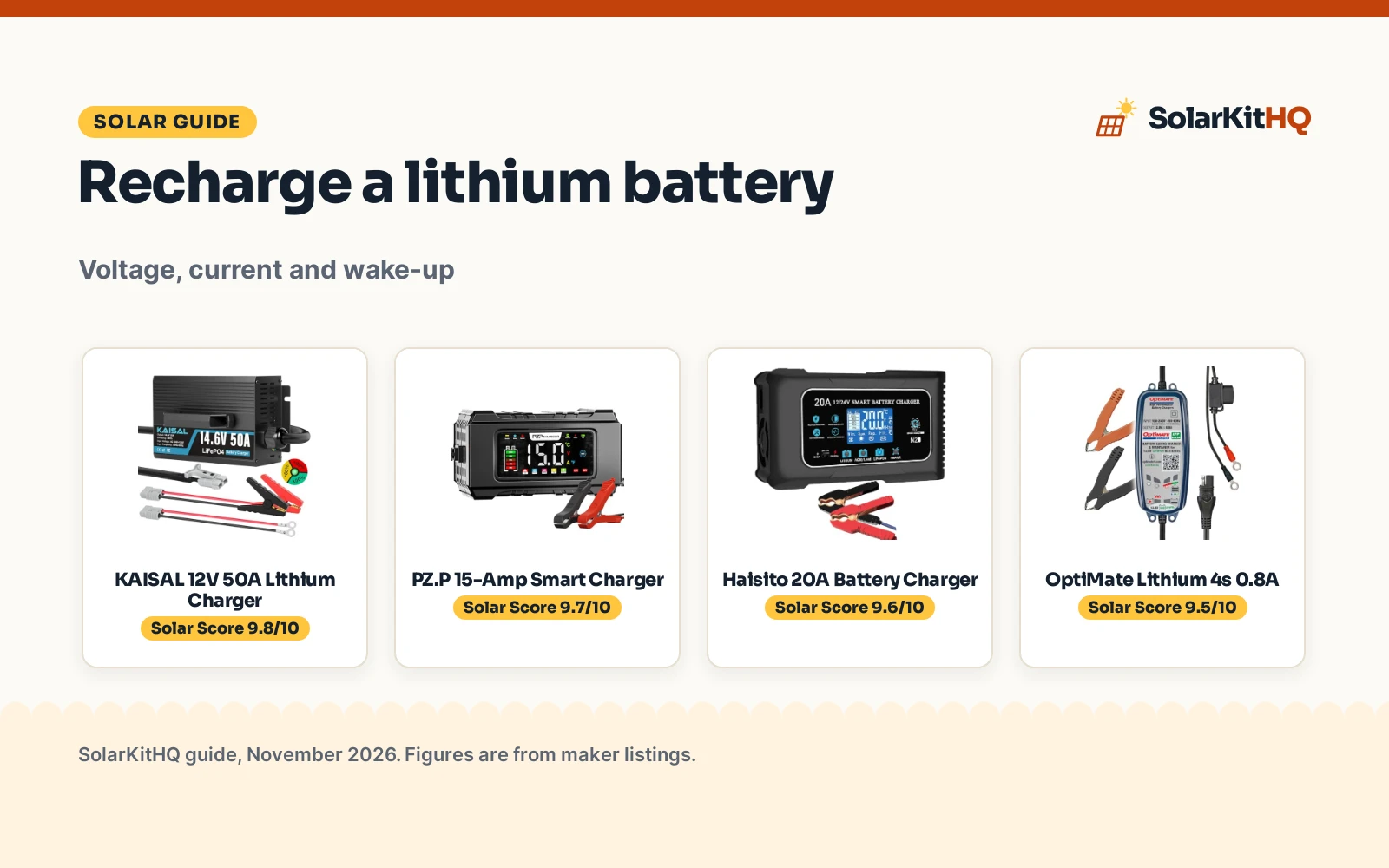
The KAISAL charger is made for 12V and 12.8V LiFePO4 batteries at 14.6V and 50 amps, the OptiMate charger is made for 12.8V lithium batteries at 0.8 amps, the Haisito charger (on Amazon) covers 12V and 24V batteries from 2Ah to 200Ah, and the PZ.P charger (on Amazon) covers 12V and 24V batteries at 15 amps. Check the manual before charging in cold or heat: the Haisito listing states a working range whose figures disagree with each other, and the KAISAL, OptiMate and PZ.P listings state no charging temperature range. See the lithium vs lead acid charger guide for the differences.
Step 2: Pick the charging current
Pick a current the battery can take. The KAISAL charger runs at 50 amps, and the maker states that it fills a 12.8V 200Ah battery in 4 hours. That is the maker’s figure from the listing, not a typical result, and it does not account for losses or the slower final stage. The Haisito charger offers 3 current levels from 12V/5A to 12V/20A, and the OptiMate charger runs at 0.8 amps for slow maintenance charging. A higher current fills the battery sooner, while a smaller current suits a small battery or a long storage charge. Set the current before you start, and let the charger run its stages. See the 12 amp vs 20 amp battery charger guide for current sizes.
Step 3: Wake a sleeping battery and watch the charge
When a lithium battery has sat unused and its BMS has cut off, the charger needs a wake-up mode to restart it, and not every charger has one. The KAISAL charger lists 0V wake-up for a battery after BMS cut-off, and the OptiMate charger lists a BMS wake-up mode that wakes a battery out of sleep mode. The Haisito charger lists a forced charging mode that starts with a long press of the button for 5 seconds. The PZ.P listing states none of these. Watch the indicator while the battery charges: the KAISAL charger lists a 3-color indicator with green for standby and fully charged, red flash for normal charging and yellow flash for small-current charging.
The gear for how to recharge a lithium battery
The recharge needs a charger matched to the battery voltage and chemistry, the wake-up needs a 0V or BMS mode, and storage needs a maintainer: the chargers below cover those parts, ranked by their scores.
| # | Product | Solar Score | Buy |
|---|---|---|---|
| 1 |  KAISAL 12V 50A Lithium Charger | 9.8/10 | Buy on Amazon |
| 2 |  PZ.P 15A Smart Charger | 9.7/10 | Buy on Amazon |
| 3 |  Haisito 20A Battery Charger | 9.6/10 | Buy on Amazon |
| 4 |  OptiMate Lithium 4s 0.8A | 9.5/10 | Buy on Amazon |

KAISAL 12V 50A Lithium Charger
A 14.6V 50-amp charger with 0V wake-up, 8 protection functions and 3 connectors for 12.8V LiFePO4 batteries.
Pros
- Maker states 4 hours to fill a 12.8V 200Ah battery at 50 amps
- 0V wake-up resets a LiFePO4 battery after BMS cut-off
- 3 connectors: SB-50 Anderson plug, M8 terminals and alligator clips
- 9 ft cable and a cooling fan in an aluminum alloy shell
Cons
- 3-color indicator lists 4 states, with green used for both standby and fully charged
- No maintainer mode is stated for batteries that sit unused
- No smaller current setting is stated for small batteries
- No trickle charging stage is stated
Detailed Review
The listing states a 14.6V 50-amp charger for 12V and 12.8V LiFePO4 batteries, with 3-stage charging, an efficiency of up to 94%, a 90 to 120 Vac input and 3 connectors: an SB-50 Anderson plug, M8 terminals and alligator clips. It lists 0V wake-up for a battery after BMS cut-off, 8 protection functions, a 9 ft cable, a cooling fan and an aluminum alloy shell, and FCC, ETL, CE and ROHS certification. The maker states that a 12.8V 200Ah battery fills in 4 hours, a claim from the listing and not a typical result, and that the charger stops on its own after 15 hours of continuous charging. The listing calls the indicator 3-color but lists 4 states, with green used for both standby and fully charged.
Who it's for: owners with a 12.8V LiFePO4 battery in an RV, boat or solar setup who want fast charging and 0V wake-up. Who should skip it: owners with a small battery who need a smaller current setting.
Its Solar Score of 9.8/10 comes from performance 33/35, build 24/25, value 22/25, safety 9/10 and warranty 3/5: 91 of 100 points, placed on our 9.2 to 9.8 scale.
Key Specifications
| Output | 14.6V 50A for 12.8V LiFePO4 |
|---|---|
| Charging | 3-stage, up to 94% efficiency |
| Connectors | SB-50 Anderson plug, M8 terminals, alligator clips |
| Cable | 9 ft |
Taken from the seller's listing on 10 November 2026. Capacity and output figures are rated by the manufacturer.
Safety and Warranty
What this listing states. FCC, ETL, CE and ROHS certification and 8 protection functions stated, so safety scores 9 of 10. 3-year product service stated. It does not say everything a buyer needs, such as who pays return shipping, so warranty scores 3 of 5. See How We Pick.
Match the charger. Use a charger mode that matches your battery's stated chemistry and voltage, connect in the order the manual gives, and keep it ventilated and dry.
This is general buying information, not professional advice. Follow each product manual and local rules, and see our Safety Disclaimer.

PZ.P 15A Smart Charger
A 12V 15-Amp and 24V 8-Amp smart charger and maintainer with 9-stage charging, a color screen and an 18-month warranty, for LiFePO4 and lead-acid batteries.
Pros
- 12V 15-Amp and 24V 8-Amp charging for LiFePO4 and lead-acid types
- 9-stage charging with trickle and float mode after full charge
- Color screen showing voltage, current, temperature and charge percentage
- 18-month warranty stated
Cons
- Cannot activate or charge totally dead batteries, as the listing states
- No item weight stated in the spec table
- 24V current of 8-Amp is lower than the 12V 15-Amp figure
- Screen and 9 stages add complexity for a reader who wants a simple maintainer
Detailed Review
The PZ.P example lists 12V 15-Amp and 24V 8-Amp charging for LiFePO4 and lead-acid batteries, including AGM, GEL, SLA and Flooded types, for cars, trucks, SUVs, motorcycles, lawn mowers and boats as the listing states. It lists 9-stage charging with a switch to trickle and float mode after full charge, pulse repair, a color screen showing voltage, current, temperature and charge percentage, a 6.7ft charging cable, and a stated temperature range of 14°F to 82°F. Its protections include temperature compensation, reverse polarity protection, overcurrent protection, overvoltage protection and short-circuit prevention, and its warranty is 18 months.
Who it's for: a reader with 12V or 24V LiFePO4 or lead-acid vehicle or marine batteries who wants staged charging and a screen. Who should skip it: a reader who needs to charge totally dead batteries, since the listing states it cannot activate them, or a reader who wants a small-cell charger, since this example lists no small-cell sizes.
Its Solar Score of 9.7/10 comes from performance 30/35, build 21/25, value 20/25, safety 8/10 and warranty 3/5: 82 of 100 points, placed on our 9.2 to 9.8 scale.
Key Specifications
| Current | 12V 15-Amp, 24V 8-Amp |
|---|---|
| Stages | 9-stage |
| Screen | Color LED screen |
| Dimensions | 7.88 x 3.74 x 3.55 inches |
Figures as published on the retailer listing, collected 2 November 2026. Performance figures are manufacturer rated.
Safety and Warranty
What this listing states. Reverse polarity protection, overcurrent protection and temperature compensation, so safety scores 8 of 10. 18-month warranty. It does not say everything a buyer needs, such as who pays return shipping, so warranty scores 3 of 5. See How We Pick.
Match the charger. Use a charger mode that matches your battery's stated chemistry and voltage, connect in the order the manual gives, and keep it ventilated and dry.
This is general buying information, not professional advice. Follow each product manual and local rules, and see our Safety Disclaimer.
Haisito 20A Battery Charger
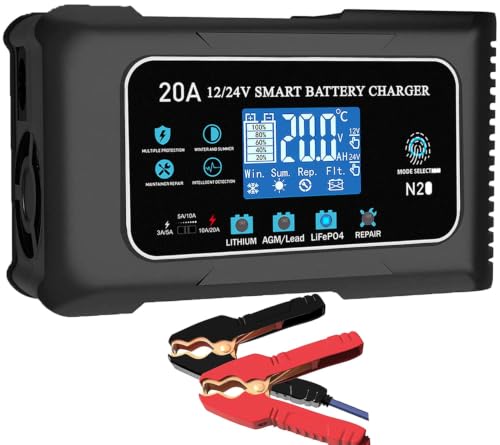
A 12V and 24V 20-amp charger with 7 stages, 3 current levels and a forced charging mode for lithium and lead acid batteries.
Pros
- 20-amp charging on 12V and 10-amp on 24V
- 3 current levels from 12V/5A to 12V/20A
- 7-stage charging with trickle charge and pulse repair for the final charge
- Forced charging mode for a battery whose voltage reads too low
Cons
- No warranty term is stated
- Temperature range pairs 40°C with a Fahrenheit figure that does not match it
- The listed model name is a sentence about repair, not a model number
- No cable length is stated
Detailed Review
The listing states a 12V and 24V charger with 20 amps on 12V and 10 amps on 24V, 7 charging stages, 3 current levels from 12V/5A to 12V/20A, and coverage for 2Ah to 200Ah batteries with a 110V to 240V input. It lists trickle charging, pulse repair, a temperature sensor and protection against low voltage, overvoltage, short circuit, overcurrent and electrostatic spark. The forced charging mode starts with a long press of the button for 5 seconds. The listing states the working range as -10°C (14°F) to 40°C (10°F), but the figures at the top of the range do not agree with each other, so check the manual before charging in cold or heat.
Who it's for: owners with 12V or 24V lithium, lead acid, AGM or GEL batteries who want a charger and maintainer in the same unit. Who should skip it: owners who want a stated warranty or a stated cable length before buying.
Its Solar Score of 9.6/10 comes from performance 30/35, build 21/25, value 21/25, safety 8/10 and warranty 0/5: 80 of 100 points, placed on our 9.2 to 9.8 scale.
Key Specifications
| Output | 12V 20A, 24V 10A |
|---|---|
| Stages | 7-stage with trickle charge and pulse repair |
| Battery size | 2Ah to 200Ah |
| Input | 110V to 240V |
Taken from the seller's listing on 10 November 2026. Capacity and output figures are rated by the manufacturer.
Safety and Warranty
What this listing states. Low voltage, overvoltage, short circuit, overcurrent, spark and temperature protection stated, so safety scores 8 of 10. No warranty term, so warranty scores zero. See How We Pick.
Match the charger. Use a charger mode that matches your battery's stated chemistry and voltage, connect in the order the manual gives, and keep it ventilated and dry.
This is general buying information, not professional advice. Follow each product manual and local rules, and see our Safety Disclaimer.

OptiMate Lithium 4s 0.8A
An 8-step 12.8V 0.8-amp charger and maintainer with a BMS wake-up mode for lithium batteries.
Pros
- BMS wake-up mode wakes a lithium battery out of sleep mode
- 8-step charging for 12.8V lithium batteries
- 3 year warranty stated
- Made as a sealed battery charger and maintainer
Cons
- 0.8-amp output is slow for recharging a large battery
- No protection list beyond BMS protection is stated
- No input voltage is stated
- No cable length or connector type is stated
Detailed Review
The listing states an 8-step 12.8V 0.8-amp charger and maintainer, model TM-471, with a BMS wake-up mode that wakes a lithium battery with integrated BMS protection out of sleep mode. The listing also gives a size of 8.0 by 6.0 by 3.0 inches and a 3 year warranty. It carries no charging figures beyond the 0.8-amp output and the 12.8V figure, so there is little else to compare.
Who it's for: owners with a small lithium battery who want a maintainer with a BMS wake-up mode. Who should skip it: owners who need fast charging for a large battery.
Its Solar Score of 9.5/10 comes from performance 23/35, build 20/25, value 19/25, safety 7/10 and warranty 3/5: 72 of 100 points, placed on our 9.2 to 9.8 scale.
Key Specifications
| Output | 12.8V 0.8A |
|---|---|
| Steps | 8-step |
| Model | TM-471 |
| Size | 8.0 by 6.0 by 3.0 inches |
Taken from the seller's listing on 10 November 2026. Capacity and output figures are rated by the manufacturer.
Safety and Warranty
What this listing states. BMS wake-up mode with integrated BMS protection stated, so safety scores 7 of 10. 3 year warranty stated. It does not say everything a buyer needs, such as who pays return shipping, so warranty scores 3 of 5. See How We Pick.
Match the charger. Use a charger mode that matches your battery's stated chemistry and voltage, connect in the order the manual gives, and keep it ventilated and dry.
This is general buying information, not professional advice. Follow each product manual and local rules, and see our Safety Disclaimer.
As an Amazon Associate I earn from qualifying purchases.
FAQ: power away from the grid
Can I recharge a lithium battery with a lead acid charger?
Use a charger made for lithium batteries. The KAISAL and OptiMate chargers are made for lithium and LiFePO4 batteries, with charging stages and a wake-up mode that a lead acid charger does not list. A lead acid charger may not wake a sleeping BMS or stop at the right voltage, so match the charger to the chemistry.
How long does it take to recharge a lithium battery?
It depends on the battery size and the charging current. The KAISAL maker states 4 hours for a 12.8V 200Ah battery at 50 amps, which is the maker’s claim and not a typical result, while the OptiMate charger runs at 0.8 amps and suits slow maintenance charging. A larger battery or a smaller current means a longer charge.
What does 0V wake-up do?
It restarts a lithium battery whose BMS has cut off after the battery sat unused, and only chargers that list it can do this. The KAISAL charger lists 0V wake-up for a battery after BMS cut-off, and the OptiMate charger lists a BMS wake-up mode for the same job. The Haisito charger lists a forced charging mode that starts with a long press of the button for 5 seconds.
Do lithium battery chargers need air around them while they run?
Yes. The KAISAL charger lists a cooling fan and an aluminum alloy shell for heat dissipation, and it stops on its own after 15 hours of continuous charging. Give the charger air around it while it runs, and keep it away from heat.
Is it safe to charge a lithium battery in cold or hot weather?
Check the manual first. The Haisito listing states a working range of -10°C (14°F) to 40°C (10°F), but the figures do not agree, and the KAISAL, OptiMate and PZ.P listings state no charging temperature range.
Related solar guides
See the best 12V lithium batteries for camping, the best lithium battery chargers, the best 3 bank marine lithium battery chargers and the battery chargers and maintainers guides.