On this page
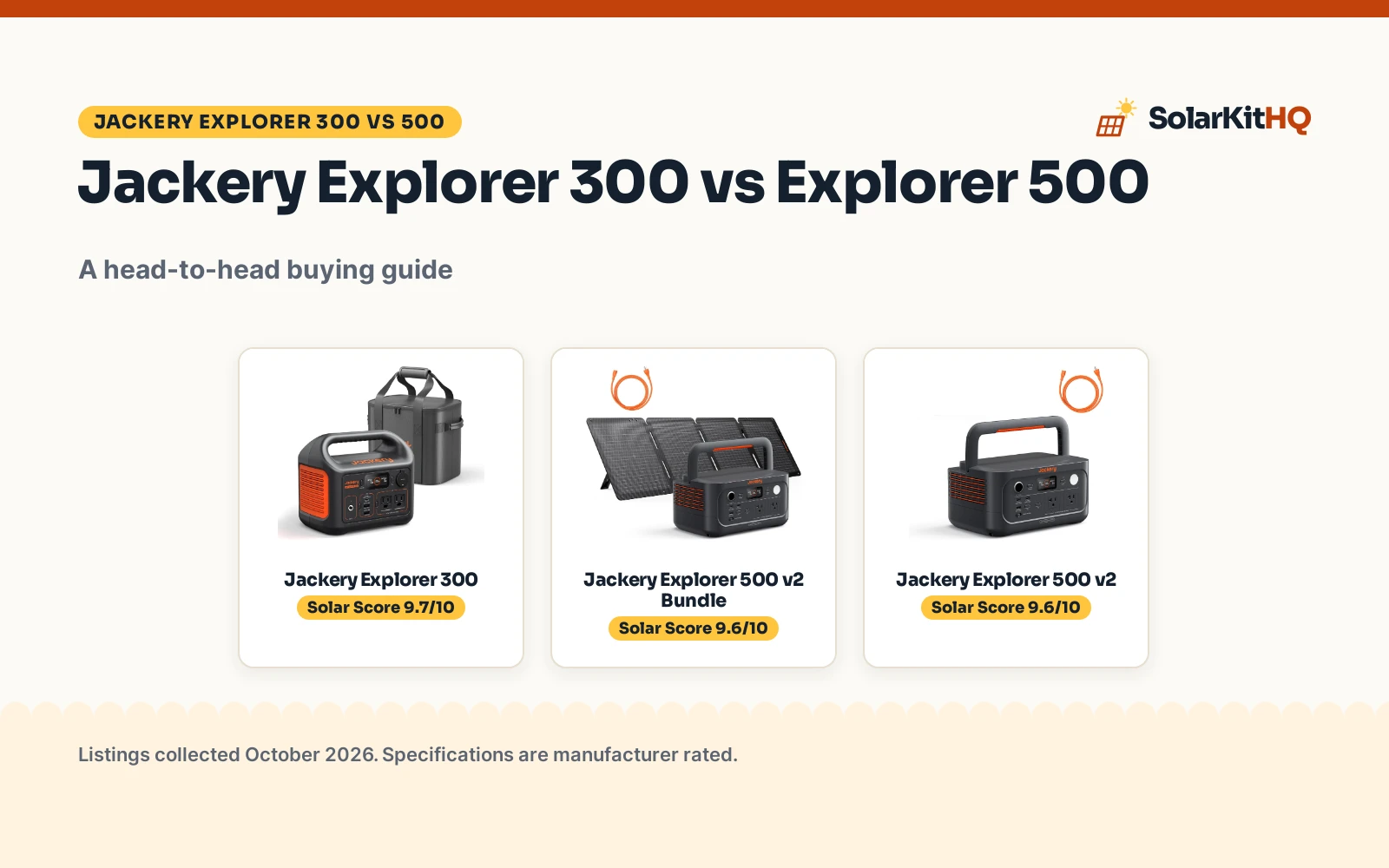
The power goes out at dinner time, the fridge is warming, and the question is suddenly urgent: jackery explorer 300 vs explorer 500, which one should you buy? Our short verdict: pick the Explorer 500 side if you want the larger stated figures, 512Wh, 500W rated power and 1000W surge, and pick the Explorer 300 side if you want the lighter unit, with 292Wh, 300W rated output and a stated 7.5 lbs. This page compares two Explorer 500 side listings, the station on its own and bundled with a 100W solar panel, against the Explorer 300 side, and walks through what to check before you choose.
SolarKitHQ earns a commission when you buy through links on this page, at no extra cost to you. As an Amazon Associate I earn from qualifying purchases. Affiliate disclosure.
Jackery 300 vs 500: side by side
| Listing | Solar Score | Side | Stated AC output | Stated weight | Amazon |
|---|---|---|---|---|---|
| Jackery Explorer 500 v2 Bundle | 9.6/10 | Explorer 500 side | 500 W continuous, 1000 W surge | 14 lbs in title (19.3 pounds in spec table) | View on Amazon |
| Jackery Explorer 500 v2 | 9.6/10 | Explorer 500 side | 500 W continuous, 1000 W surge | 14 lbs in title (13.3 pounds in spec table) | View on Amazon |
| Jackery Explorer 300 | 9.6/10 | Explorer 300 side | 300 W rated, 600 W peak surge | 7.5 lbs in bullets (7.1 pounds in spec table) | View on Amazon |
Specifications are manufacturer rated as listed, collected 22 October 2026.
What separates the two sides
The model names put the 300 below the 500 in the Jackery line-up, and the listings back that up in three places: how much power each side can output at once, how much energy the battery holds, and how much the unit weighs. The Explorer 500 v2 listing states 500W rated power with a 1000W surge and 512Wh. The bundle listing states the same station figures and adds a 100W solar panel, while its spec table lists 19.3 pounds against 14 lbs in the title. The Explorer 300 listing states 300W rated output with a 600W peak surge and 292Wh. On weight, the 500 v2 title states 14 lbs and the 300 bullets state 7.5 lbs, though each spec table lists a slightly different figure.
Power and battery
Start with the two figures every station listing should state: continuous AC output in watts, and battery capacity in watt-hours. The Explorer 500 v2 listing states 500W rated power and 1000W surge, and the Explorer 300 listing states 300W rated output and 600W peak surge. Treat surge as headroom for motor startup, not as running power. Both sides use LiFePO4 chemistry. The 500 v2 listing states a rating of 6,000 charge cycles, and the 300 listing states over 4,000 charge cycles before reaching 70% capacity. The two cycle claims are worded differently, so cycle life alone does not settle the comparison. Each listing also gives two capacity figures: 512Wh and 518Wh on the 500 side, 292Wh and 293Wh on the 300 side. We rely on the title and bullets.
Protection and carrying
Stations live hard lives: truck beds, campsite tables, porch floors during outages. Look for what the listing states about the shell, the conditions it claims to handle, and any water or dust protection code it names. None of the three listings names a safety certification or an IP rating, so the certification line stays empty for all three. The Explorer 300 package includes a carrying bag, and its bullets describe an integrated handle. The Explorer 500 v2 title states a 14 lbs unit. The bundle package adds a 100W solar panel. Count the AC outlets, USB ports and DC outputs in the listing before anything else. The 500 v2 bullets state two pure sine wave AC outlets, while its spec table lists one total outlet. The 300 bullets state 2 AC outlets, a 100W USB-C PD port, 2 USB-A ports and a 120W car port.
What to check before you buy
Read the title and the bullets first, then the spec table, and trust the title and bullets when they disagree. Watch for a listing that names a different brand or model than the headline promises, and for a listing that turns out to be an accessory rather than the station itself. A warranty counts only when it states a concrete term: the Explorer 500 v2 listings state a 5 year manufacturer warranty, and the Explorer 300 listing states a 2 year manufacturer warranty. When the figures you need are missing, the listing is incomplete, not the product.
The picks
| # | Product | Solar Score | Buy |
|---|---|---|---|
| 1 |  Jackery Explorer 300 | 9.7/10 | Buy on Amazon |
| 2 |  Jackery Explorer 500 v2 Bundle | 9.6/10 | Buy on Amazon |
| 3 |  Jackery Explorer 500 v2 | 9.6/10 | Buy on Amazon |

Jackery Explorer 300
A 292Wh LiFePO4 portable power station with 300W rated output and 600W surge, six-device outlets and a 2 year manufacturer warranty.
Pros
- 292Wh LiFePO4 with over 4,000 cycles to 70 percent stated
- 300W rated with 600W peak surge
- 2 AC, 100W USB-C PD, 2 USB-A and 120W car port
- 2 year manufacturer warranty with carrying bag in the box
Cons
- Bullets say 292Wh while the spec table says 293Wh
- Bullets say 7.5 lbs while the spec table says 7.1 pounds
- 48 hours of runtime stated without a load
- No certification mark is stated
Detailed Review
The listing states the Jackery Explorer 300 portable power station with 292Wh of LiFePO4 battery, a 300W rated output with 600W peak surge, 2 AC outlets, a 100W USB-C PD port, 2 USB-A ports and a 120W car port for six devices. It claims over 4,000 charge cycles before reaching 70 percent capacity, framed as more than 11 years of service life, and 17 percent lighter than the industry average at 7.5 lbs. It reaches 80 percent capacity in about 2.8 hours with a 100W solar panel or in 7.5 hours with a 40W panel, measures 9.1 by 5.2 by 7.8 inches, and the box holds the station, a carrying bag, an AC adapter, a car charger cable and a user manual. The warranty description reads 2 year manufacturer.
Who it's for: anyone shopping for a compact LiFePO4 station with stated cycle life and a bag in the box. Who should skip it: anyone who needs a stated certification mark, or a charger or case for a different model.
Its Solar Score of 9.7/10 comes from performance 33/35, build 21/25, value 20/25, safety 7/10 and warranty 3/5: 84 of 100 points, placed on our 9.2 to 9.8 scale.
Key Specifications
| Capacity | 292Wh, LiFePO4 |
|---|---|
| Output | 300W rated, 600W surge |
| Outlets | 2 AC, 100W USB-C PD, 2 USB-A, 120W car port |
| Cycle life | Over 4,000 cycles to 70 percent |
| Solar charging | 80 percent in 2.8 hours on 100W panel |
| Size | 9.1 x 5.2 x 7.8 in |
| Weight | 7.5 lbs |
Figures as published on the retailer listing, collected 22 October 2026. Performance figures are manufacturer rated.
Safety and Warranty
What this listing states. LiFePO4 chemistry with 4,000-cycle claim stated, so safety scores 7 of 10. 2 year manufacturer. It does not say everything a buyer needs, such as who pays return shipping, so warranty scores 3 of 5. See How We Pick.
Power station limits. Stay within the stated continuous output and solar input limits, keep the unit ventilated and dry, charge within the stated temperature range, and never connect it to home wiring except through equipment a licensed electrician installs.
This is general buying information, not professional advice. Follow each product manual and local rules, and see our Safety Disclaimer.

Jackery Explorer 500 v2 Bundle
A 512Wh, 500W LiFePO4 station bundled with a 100W solar panel, the second Explorer 500 side listing in this comparison.
Pros
- Listing states 512Wh capacity, 500W rated power and 1000W surge, given separately
- Package includes a 100W solar panel alongside the station
- LiFePO4 battery stated as rated for 6,000 charge cycles
- Spec table states a 5 year manufacturer warranty
Cons
- Title states 14 lbs while the spec table lists 19.3 pounds
- Listing gives both 512Wh and 518Wh for capacity
- Panel and station ship in separate packages, per the listing note
- No UL, ETL or IP rating is stated
Detailed Review
The title and bullets state 512Wh, 500W rated power, 1000W surge, a LiFePO4 battery rated for 6,000 cycles and two pure sine wave AC outlets, plus a 100W solar panel in the package. The spec table disagrees on weight: it lists 19.3 pounds against 14 lbs in the title, and it gives 518Wh in the item type name against 512Wh in the title and bullets, so we trust the title and bullets. The maker claims a 0 to 80 percent charge in 52 minutes from an AC wall outlet.
Who it's for: shoppers who want the Explorer 500 side with a panel in the package. Who should skip it: anyone who needs a stated safety certification or a single-package delivery.
Its Solar Score of 9.6/10 comes from performance 30/35, build 20/25, value 21/25, safety 0/10 and warranty 4/5: 75 of 100 points, placed on our 9.2 to 9.8 scale.
Key Specifications
| Capacity | 512Wh |
|---|---|
| AC output | 500 watts, 1000 watts surge |
| Panel | 100W solar panel included |
| Warranty | 5 year manufacturer |
Figures as published on the retailer listing, collected 22 October 2026. Performance figures are manufacturer rated.
Safety and Warranty
What this listing states. No UL, FCC or battery management statement is stated, so safety scores zero. 5 year manufacturer. It does not say everything a buyer needs, such as who pays return shipping, so warranty scores 4 of 5. See How We Pick.
Power station limits. Stay within the stated continuous output and solar input limits, keep the unit ventilated and dry, charge within the stated temperature range, and never connect it to home wiring except through equipment a licensed electrician installs.
This is general buying information, not professional advice. Follow each product manual and local rules, and see our Safety Disclaimer.

Jackery Explorer 500 v2
A 512Wh LiFePO4 portable power station with 500W output, two AC outlets and a 10ms UPS, per the listing.
Pros
- 6000 charge cycles stated, the most here
- 10ms UPS with bypass charging stated
- 0-80% in 52 minutes on AC stated
- 14 pounds stated, the lighter unit here
Cons
- 500W continuous output, below the 1000 v2's 1500W
- 512Wh with no expansion stated
- Solar panels sold separately, per the listing
- Spec table lists 1 outlet against two AC outlets in the bullets
Detailed Review
The listing states a 512Wh LiFePO4 power station with 500W rated power, 1000W surge and two pure sine wave AC outlets. It states 6000 charge cycles, 0-80% in 52 minutes on AC, a 10ms UPS, 28 dB operation, 14 pounds and 11.8 by 7.6 by 9.5 inches, with an AC cable and manual in the box and a 5-year manufacturer warranty. The spec table lists 1 total power outlet against the two AC outlets in the bullets, and 13.3 pounds against 14 pounds; trust the bullets on both.
Who it's for: campers and outage prep on a smaller scale who want a light 512Wh station with UPS backup. Who should skip it: anyone who needs more than 500W continuous.
Its Solar Score of 9.6/10 comes from performance 29/35, build 21/25, value 21/25, safety 5/10 and warranty 4/5: 80 of 100 points, placed on our 9.2 to 9.8 scale.
Key Specifications
| Capacity | 512Wh LiFePO4 |
|---|---|
| Output | 500W (1000W surge) |
| Outlets | 2 AC, pure sine wave |
| Charge | 0-80% in 52 min AC |
Figures as published on the retailer listing, collected 21 October 2026. Performance figures are manufacturer rated.
Safety and Warranty
What this listing states. 10ms UPS stated, so safety scores 5 of 10. 5 year manufacturer warranty stated. It does not say everything a buyer needs, such as who pays return shipping, so warranty scores 4 of 5. See How We Pick.
Power station limits. Stay within the stated continuous output and solar input limits, keep the unit ventilated and dry, charge within the stated temperature range, and never connect it to home wiring except through equipment a licensed electrician installs.
This is general buying information, not professional advice. Follow each product manual and local rules, and see our Safety Disclaimer.
As an Amazon Associate I earn from qualifying purchases.
How we scored them
The Solar Score weighs performance, build, value, safety and warranty. For power stations, safety means the protections each listing names, such as stated certifications, battery management features and weather protection codes. All three listings state a manufacturer warranty, so all three earn warranty points, with the longer stated term earning more. None names a safety certification, so none earns safety points. How we pick explains the weights.
| Product | Solar Score | Perf. /35 | Build /25 | Value /25 | Safety /10 | Warranty /5 |
|---|---|---|---|---|---|---|
| Jackery Explorer 500 v2 Bundle | 9.6 | 30 | 20 | 21 | 0 | 4 |
Scores run from 9.2 to 9.8: each product’s point total is placed on that range, so more points always means a higher score.
How to choose the best jackery explorer 300 vs explorer 500
Choose the Explorer 500 side if you want the larger figures stated up front: 512Wh, 500W rated power and 1000W surge, with a LiFePO4 battery rated for 6,000 charge cycles and a 5 year manufacturer warranty. The bundle listing adds a 100W solar panel to the same station figures. Choose the Explorer 300 side if a lighter unit matters more: its bullets state 7.5 lbs, 292Wh and 300W rated output, and the package includes a carrying bag. If you want to see how the 500 compares upward instead, see the jackery explorer 500 vs explorer 1000; for panels to pair with either side, see the best solar panel for jackery explorer 500.
| If you need | Look at |
|---|---|
| Stated 500W output and 1000W surge | The Explorer 500 v2 |
| A 100W panel in the package | The Explorer 500 v2 bundle |
| The lighter stated weight and a carrying bag in the package | The Explorer 300 |
| The longer stated warranty | The Explorer 500 v2, 5 year manufacturer |
| A stated safety certification | None of the listings states one |
Sizing Notes
- Match the station’s continuous AC output to the combined watts of the loads you plan to run at once.
- Match the battery capacity in watt-hours to how long those loads need to run between charges.
- Match any solar panel’s voltage and watts to the solar input range the station listing states.
- Check the stated weight and dimensions against where the station will live, from campsite to closet shelf.
Frequently Asked Questions
What is the main difference between the Jackery Explorer 300 and 500?
The 500 is the larger step in the line-up. The Explorer 500 v2 listing states 512Wh, 500W rated power and 1000W surge, while the Explorer 300 listing states 292Wh, 300W rated output and 600W peak surge.
Can these stations charge from solar panels?
The Explorer 500 v2 listing states that the station supports solar panels, sold separately, and 12V car charging. The Explorer 300 listing says a solar panel is optional and pairs it with Jackery panels. The bundle listing includes a 100W solar panel in the package. Confirm the panel input range before buying other panels.
How do I size a station to my loads?
Add up the watts of everything you plan to run at once and compare that with the station’s stated continuous output, then compare the run time you need with the stated battery capacity.
Is the bigger station always the better buy?
No. More capacity usually means more size and weight, so a bigger station you leave at home helps less than a smaller one you actually carry. Match the station to the loads, not to the headline number.
What does the warranty cover on these listings?
The Explorer 500 v2 listings state a 5 year manufacturer warranty and the Explorer 300 listing states a 2 year manufacturer warranty. Read the maker’s terms for what each covers, since the listings give only the length.
Related guides
See our Jackery Explorer 500 vs Explorer 1000: Which One Should You Buy?. Also see our Best Solar Panel for Jackery Explorer 500: 4 Compared. Also see our Best Solar Panel for Jackery: 4 Compared by Spec. Also see our EcoFlow Delta 2 vs Jackery Explorer 1000: Which to Buy?. Also see our Portable Power Station vs Power Bank: Which One Should You Buy?.