On this page
Marine battery charger repair starts with the charger, the cables and the battery, in that order. Most faults on a boat come from a dead outlet, a corroded connection, a wrong battery type setting or a battery that has dropped too low to wake, and each of those has a fix that costs nothing before parts enter the picture. The steps below walk through the checks in order, then the gear section shows the onboard chargers that cover each step.
SolarKitHQ earns a commission when you buy through links on this page, at no extra cost to you. As an Amazon Associate I earn from qualifying purchases. Affiliate disclosure.
Marine battery charger repair: the quick answer
Work through the fault in order: power, connections, battery type, then the battery itself. Check that the charger has power and the LED display shows a charge stage, clean the terminals and confirm the connections sit firm, match the battery type setting to the battery on the boat, and wake a low battery with a Force Start mode when the charger offers one. When the charger shows no LED, no output and no response to those checks, the fault sits inside the unit, and a replacement charger is the repair. The table below maps each fault to the check that finds it.
| Fault | Check first | Gear that covers it | Amazon |
|---|---|---|---|
| No LED display | Outlet, cord and connections | Any onboard charger with an LED display | |
| Charger runs but the battery stays flat | Battery type setting | A charger with per-bank type selection | |
| Dead lithium battery | Force Start recovery mode | FORM Fusion 10X4 | |
| Flooded battery losing capacity | Equalization cleaning cycle | Minn Kota MK-110PCL |
Step 1: Check power and connections
Start at the outlet and work toward the battery. A charger with no LED display has a power problem before it has a charger problem, so confirm the outlet and the cord, then look at the terminals and connections. Corrosion on a terminal acts like a break in the wire: clean the terminals and check that the connections sit firm. The LED indicators on these chargers report charge stage, maintenance mode, error notifications and full charge completion, so a dark display points at power while an error light points at the battery or the connection.
Step 2: Match the battery type setting
A charger set to the wrong chemistry will not charge the battery in front of it, so check the setting before assuming the charger has failed. Each charging bank takes its own battery type selection, and the types named across these chargers are 12V AGM, flooded lead-acid, gel and lithium LiFePO4. See marine battery types for how each chemistry differs. Set the bank to the battery it serves, and check the setting again after any power cut. When the boat carries mixed chemistries, a multi-bank charger lets each bank run its own type: the 4-bank unit here adjusts voltage and current automatically for each bank, while the 2-bank unit distributes unused amps to the bank that needs them.
Step 3: Wake a dead battery
A battery that has sat through storage can drop too low for a normal charge, and the charger will sit idle rather than force current into it. The fix is a recovery mode: the 4-bank unit here offers a Force Start mode that revives low-voltage and sleep-mode lithium batteries with a timed low-amp boost, then switches to full charging automatically. For flooded lead-acid batteries, the equalization mode cleans and protects with every charge, and a push-button activation triggers a fuller cleaning cycle. See battery charger maintenance for keeping the unit in shape between trips. Check the battery type first: a recovery mode built for lithium does not suit lead-acid. Give the charger time to finish the boost before judging the result.
Step 4: Know when the charger is done
Some faults end in replacement, and knowing the line saves a season of patching. When the charger shows no LED, takes no charge from a known good outlet and answers none of the steps above, the fault sits inside the unit: a failed charger is a part to replace, not a part to open. Heat damage, a cracked case or a smell of burning mark the same line, and a charger that has been in saltwater or high humidity without protection has likely reached it too. The gear section below names onboard chargers that cover the repair steps above, with the banks, current and protection each states.
The gear: onboard chargers for the repair steps
Each charger below handles a step above: the 4-bank unit covers Force Start recovery and storage maintenance, the 2-bank unit covers fast charging with a clear LED gauge, the 1-bank unit covers equalization and temperature compensation, and the 3-bank unit covers basic onboard charging for several batteries.
| # | Product | Solar Score | Buy |
|---|---|---|---|
| 1 |  FORM Fusion 10X4 | 9.7/10 | Buy on Amazon |
| 2 |  NOCO GEN5X3 | 9.7/10 | Buy on Amazon |
| 3 |  Minn Kota MK-110PCL | 9.6/10 | Buy on Amazon |
| 4 |  ProMariner ProSport HD | 9.6/10 | Buy on Amazon |
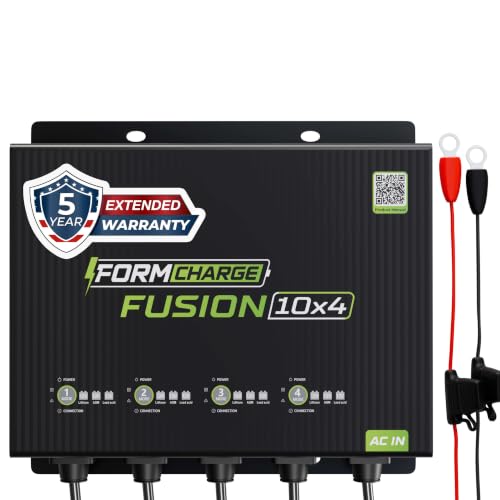
FORM Fusion 10X4
4-bank 12V onboard charger with 40A total, Force Start for dead lithium batteries and a maintenance mode for storage.
Pros
- 40A total with 10A per bank across 4 banks
- Force Start mode revives low-voltage and sleep-mode lithium batteries
- Maintenance mode switches to trickle charging after batteries are full
- IP67 protection with WeatherShield internal coating
Cons
- 17.5 pounds, the heaviest unit in this group
- 24-month warranty is shorter than the 3 year term on the Minn Kota
- 9.8 by 10.9 inch case needs a wide mounting spot
- 40A total suits a 4-bank setup, so a boat with fewer batteries pays for banks it does not use
Detailed Review
The maker lists a 4-bank 12V onboard charger with 40A total and 10A per bank, IP67 protection with a WeatherShield internal coating, automatic voltage and current adjustment, a maintenance mode that switches to trickle charging after batteries are full, and a Force Start mode that revives low-voltage and sleep-mode lithium batteries with a timed low-amp boost. It suits lithium LiFePO4, AGM and deep cycle batteries, carries a 24-month warranty, and measures 9.8 by 10.9 by 2.4 inches at 17.5 pounds.
Who it's for: boat owners with several batteries who want Force Start recovery and a maintenance mode for storage. Who should skip it: owners with fewer batteries, who will not use 4 banks, and owners who want the longest warranty term here.
Its Solar Score of 9.7/10 comes from performance 30/35, build 22/25, value 21/25, safety 9/10 and warranty 3/5: 85 of 100 points, placed on our 9.2 to 9.8 scale.
Key Specifications
| Banks | 4-bank, 40A total, 10A per bank |
|---|---|
| Voltage | 12V |
| Protection | IP67, WeatherShield coating |
| Size | 9.8 x 10.9 x 2.4 in, 17.5 lb |
Taken from the seller's listing on 14 November 2026. Capacity and output figures are rated by the manufacturer.
Safety and Warranty
What this listing states. IP67 protection and WeatherShield internal coating stated, with automatic voltage and current adjustment, so safety scores 9 of 10. 24-month warranty stated. It does not say everything a buyer needs, such as who pays return shipping, so warranty scores 3 of 5. See How We Pick.
Match the charger. Use a charger mode that matches your battery's stated chemistry and voltage, connect in the order the manual gives, and keep it ventilated and dry.
This is general buying information, not professional advice. Follow each product manual and local rules, and see our Safety Disclaimer.

NOCO GEN5X3
A 12V 15A 3-bank onboard charger with per-bank modes, an IP68 rating and a 3-year warranty.
Pros
- 3-bank 15A, 5A per bank stated
- IP68 rating stated
- Per-bank modes: 12V, AGM, lithium, repair
- 3-year warranty stated
Cons
- 6.1lbs, the heaviest here
- 15A total across 3 banks
- 240V input per the specs
- Not for 24V, per the specs
Detailed Review
The listing states a 12V 15A 3-bank onboard charger with 5A per bank, selectable 12V/AGM/lithium/repair modes per bank, an IP68 rating, a thermal sensor for temperature compensation, charging from 1V and Force Mode to 0V, 72-inch cables with 3/8-inch eyelets, 6.1lbs at 10.08 by 8.86 by 5.63 inches, CEC/FCC/UL compliance, and a 3-year warranty.
Who it's for: boats and RVs with three batteries to charge at once. Who should skip it: anyone who needs 24V.
Its Solar Score of 9.7/10 comes from performance 33/35, build 24/25, value 20/25, safety 6/10 and warranty 3/5: 86 of 100 points, placed on our 9.2 to 9.8 scale.
Key Specifications
| Current | 15A, 5A per bank |
|---|---|
| Banks | 3 |
| Rating | IP68 |
| Modes | 12V, AGM, lithium, repair |
Figures as published on the retailer listing, collected 20 October 2026. Performance figures are manufacturer rated.
Safety and Warranty
What this listing states. IP68 rating, CEC, FCC and UL stated, so safety scores 6 of 10. 3-year warranty stated. It does not say everything a buyer needs, such as who pays return shipping, so warranty scores 3 of 5. See How We Pick.
Match the charger. Use a charger mode that matches your battery's stated chemistry and voltage, connect in the order the manual gives, and keep it ventilated and dry.
This is general buying information, not professional advice. Follow each product manual and local rules, and see our Safety Disclaimer.

Minn Kota MK-110PCL
1-bank 10 amp onboard charger with temperature compensation, battery equalization and LED indicators for 12V AGM, flooded, gel and lithium LiFePO4 batteries.
Pros
- Battery type selection covers 12V AGM, flooded, gel and lithium LiFePO4
- Automatic temperature compensation adjusts for ambient temperature and low-line voltage
- Battery equalization cleans and protects flooded lead-acid batteries with every charge
- 3 year manufacturer warranty
Cons
- 1 bank covers a battery at a time
- 10 amps is the lowest total current in this group
- Full equalization cleaning needs a push-button activation
- Suits 12V batteries only
Detailed Review
The maker lists a 1-bank 10 amp onboard charger with battery type selection for 12V AGM, flooded lead-acid, gel and lithium LiFePO4, microprocessor-based multi-stage charging with digital control, automatic temperature compensation, battery equalization with a push-button activation for a fuller cleaning cycle, and LED indicators for charge stage, maintenance mode, error notifications and full charge completion. It carries a 3 year manufacturer warranty and measures 16.0 by 5.13 by 9.88 inches at 6.3 pounds.
Who it's for: boat owners with a 12V battery who want equalization for flooded lead-acid and a long warranty. Who should skip it: owners with several batteries, who need more banks.
Its Solar Score of 9.6/10 comes from performance 28/35, build 20/25, value 20/25, safety 7/10 and warranty 4/5: 79 of 100 points, placed on our 9.2 to 9.8 scale.
Key Specifications
| Banks | 1 bank, 10 amps |
|---|---|
| Voltage | 12V |
| Battery types | AGM, flooded, gel, LiFePO4 |
| Size | 16.0 x 5.13 x 9.88 in, 6.3 lb |
Taken from the seller's listing on 14 November 2026. Capacity and output figures are rated by the manufacturer.
Safety and Warranty
What this listing states. Shock-resistant and vibration-resistant design built for harsh marine environments, with LED error notifications stated, so safety scores 7 of 10. 3 year manufacturer warranty stated. It does not say everything a buyer needs, such as who pays return shipping, so warranty scores 4 of 5. See How We Pick.
Match the charger. Use a charger mode that matches your battery's stated chemistry and voltage, connect in the order the manual gives, and keep it ventilated and dry.
This is general buying information, not professional advice. Follow each product manual and local rules, and see our Safety Disclaimer.

ProMariner ProSport HD
2-bank 20A onboard charger with Distributed-On-Demand charging, an LED status display and IP67 protection for lithium, flooded, AGM and gel batteries.
Pros
- Distributed-On-Demand sends unused charging amps to the battery that needs them
- 20A across 2 banks, above the 10 amp units here
- LED status display with a completion gauge and battery type indication
- IP67 protection and a tri-surface heat sink design for cooling
Cons
- No warranty term is stated
- 2 banks cover fewer batteries than the 4-bank unit here
- 8.64 pounds is heavier than the 6.3 pound Minn Kota
- No equalization mode for flooded lead-acid batteries
Detailed Review
The maker lists a 2-bank 20A onboard charger with IP67 protection, Distributed-On-Demand charging that sends unused amps to the battery that needs them, microprocessor-controlled multi-stage charging, a tri-surface heat sink design for cooling, and an expanded LED display with a completion status gauge, multi-stage mode indication, System Check OK, individual battery status and battery type indication. It suits lithium, flooded, AGM and gel batteries, replaces the older Gen 3 ProSport 20, and measures 16.4 by 8.7 by 6.3 inches at 8.64 pounds.
Who it's for: boat owners who want 20A charging across 2 banks and a clear LED completion gauge. Who should skip it: owners who need a stated warranty term or an equalization mode for flooded batteries.
Its Solar Score of 9.6/10 comes from performance 30/35, build 21/25, value 20/25, safety 8/10 and warranty 0/5: 79 of 100 points, placed on our 9.2 to 9.8 scale.
Key Specifications
| Banks | 2-bank, 20A |
|---|---|
| Protection | IP67 |
| Charging | Distributed-On-Demand, multi-stage |
| Size | 16.4 x 8.7 x 6.3 in, 8.64 lb |
Taken from the seller's listing on 14 November 2026. Capacity and output figures are rated by the manufacturer.
Safety and Warranty
What this listing states. IP67 protection stated, with a tri-surface heat sink design for cooling, so safety scores 8 of 10. No warranty term, so warranty scores zero. See How We Pick.
Match the charger. Use a charger mode that matches your battery's stated chemistry and voltage, connect in the order the manual gives, and keep it ventilated and dry.
This is general buying information, not professional advice. Follow each product manual and local rules, and see our Safety Disclaimer.
As an Amazon Associate I earn from qualifying purchases.
FAQ: power away from the grid
Can a marine battery charger be repaired?
Most faults are fixed without parts: power, connections, battery type and a low battery cover the common causes. When the charger shows no LED and answers none of those checks, the unit itself has failed, and replacement is the repair. A charger with heat damage or a cracked case is also done.
Why does a marine charger show no lights?
No lights point at power first: the outlet, the cord and the connections. When power is confirmed and the display stays dark, the fault sits inside the unit. An error light is different: it points at the battery or the connection, and the LED indicators on these chargers name the charge stage, maintenance mode and error state.
How do I wake a dead lithium marine battery?
Use a Force Start mode when the charger offers one: the 4-bank unit here revives low-voltage and sleep-mode lithium batteries with a timed low-amp boost, then switches to full charging automatically. Match the battery type setting to lithium first, and check the voltage before attempting to charge.
What does equalization do for a marine battery?
Equalization cleans and protects flooded lead-acid batteries with every charge, and a push-button activation triggers a fuller cleaning cycle to extend battery life. It applies to flooded lead-acid batteries, so set the battery type first and do not run it on a lithium bank.
Do marine chargers need a special mode for lithium?
Yes. Each bank needs a battery type selection, and the types named across these chargers are 12V AGM, flooded lead-acid, gel and lithium LiFePO4. A charger without a lithium mode will not charge a lithium battery correctly, so match the mode to the battery before charging.
Related solar guides
See every battery chargers and maintainers guide, the best LiFePO4 battery chargers for a boat, the best 3-bank marine lithium battery chargers and the best battery chargers for a boat.