On this page
The lights go out at dinner time and the house goes quiet, with a phone at low charge and no outlet in reach. An RV roof at dusk holds the same question in a smaller space: how does power keep flowing when the grid is out of reach. The parts of a solar power system answer that question as a set: panels that catch sunlight, a charge controller that guards the battery, a battery bank that stores power, an inverter that turns stored power into household power, and the wiring and mounts that hold the set together. This guide names each part, explains what it does, and shows how the parts fit together, using the figures the makers state in their listings.
SolarKitHQ earns a commission when you buy through links on this page, at no extra cost to you. As an Amazon Associate I earn from qualifying purchases. Affiliate disclosure.
Parts of a solar power system at a glance
A solar power system has a set of parts that depend on each other: panels, a charge controller, a battery bank, an inverter, and wiring with mounts. The table below lists each part with the figures the makers state in the listings for this guide. See the solar panels hub for the panel guides on this site.
| Part | Job | Figures the makers state |
|---|---|---|
| Solar panels | Turn sunlight into DC power | 195W, 200W, 370W and 590W panels in the listings |
| Charge controller | Guards the battery from panel power | 60A, 80A, 100A and 140A MPPT controllers in the listings |
| Battery bank | Stores power for use after dark | 12.8V, 24V, 48V and 51.2V LiFePO4 batteries in the listings |
| Inverter | Turns battery DC into household AC | 2000W, 3000W, 3500W, 5000W, 6500W and 10000W units in the listings |
| Wiring and mounts | Carry power and hold panels in place | 50-foot 10-gauge cables and Z-bracket mounts in the listings |
Solar panels: where the power starts
Solar panels sit at the front of the system: they turn sunlight into DC power and feed the rest of the set. The listings in this guide name 195W N-type bifacial panels, 200W mono panels, 370W mono panels and 590W mono panels. ECO-WORTHY lists 25% conversion efficiency for its 195W N-type bifacial panels. The 195W panels measure 58.86 x 26.18 x 1.18 inches, with tempered glass and corrosion-resistant aluminum, and an IP68 code. The makers state daily figures under 4 hours of sunlight: 3.12 kWh for the 800W kit, 4.68 kWh for the 1170W kit, and 8.8 kWh for the 6500W kit. Panel life in the listings runs to a 30-year lifespan and a service life of up to 25 years. See the solar panel types guide for rigid, flexible and bifacial panels, and the solar panel size chart for dimensions.
The charge controller: guarding the battery
The charge controller sits between the panels and the battery, and its job is to guard the battery from panel power that would overcharge it. The listings name MPPT controllers at 60A, 80A, 100A and 140A, with dual MPPT controllers in the 10kW inverter. The 5000W inverter lists 5500W of PV input. Match the controller to the panels and the battery it serves: read the amp figure and the PV input in the listing before choosing. See the solar charge controller size guide for the figures to match.
The battery bank: storing power for later
The battery bank stores power from the panels so the system can run loads after dark. The listings name LiFePO4 batteries at 12.8V, 24V, 48V and 51.2V, with capacities of 50Ah, 100Ah, 280Ah and 314Ah. Stored energy in the listings runs from 2.56 kWh in the 48V 50Ah battery to 32.2 kWh in the 10kW kit, with 4.02 kWh in the 800W kit and 7.168 kWh in the 780W kit between them. The batteries list a battery management system, with low-temperature protection in the 800W kit and a PACE 200A battery management system in the 10kW kit. Cycle life in the listings runs to more than 4000 deep cycles and over 7,000 deep cycles, with a 15-year lifespan for the SunGoldPower batteries. Bluetooth and Wi-Fi monitoring appear in the listings. See the LiFePO4 vs lead-acid battery guide for how the battery types compare.
The inverter: turning battery power into household power
The inverter turns battery DC power into household AC power for the loads. The listings name inverters from 2000W in the 800W kit to 10,000W continuous in the 10kW kit, with 3000W, 3500W, 5000W and 6500W units between them. Pure sine wave output is stated for the 2000W unit, the 5000W unit in the 2340W kit, and the 10,000W unit. Continuous and surge watts stay separate in the listings: the 3500W inverter lists 7000W of surge power, and the 10kW inverter lists 10,000W continuous and up to 20,000W peak output. Output voltage runs from 110V and 120V to 120V/240V split-phase. The 3500W inverters list 20ms UPS changeover, and the 3000W inverter lists changeover within 10ms. The SunGoldPower inverters list UL1741 by ETL. See the inverter types guide and the inverter size guide for matching output to loads.
Wiring, mounts and breakers: holding the system together
Wiring carries power between the parts, mounts hold the panels, and breakers guard the circuits. The SunGoldPower kits list 50-foot 10-gauge solar extension cables with IP68 connectors on each end, and 6 sets of Z-bracket mounts. The 6500W kit lists a 25A breaker for the PV side and a 200A breaker for the battery, and the 10kW kit lists dual breakers with its battery management system. Mounts in the listings suit RVs, boats, rooftops and farms. Cables and mounts come with the kits in the listings. See the solar panel connector types guide for connectors, and the solar panel stand size guide for mounts.
How the parts fit together
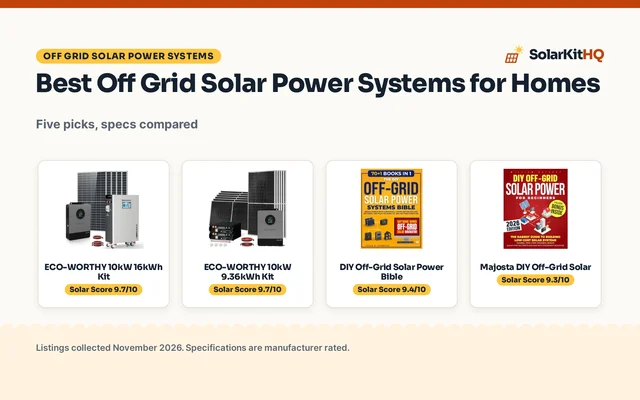
Power moves through the set in order: panels make DC power, the charge controller guards the battery as it charges, the battery stores power, and the inverter turns stored power into household AC for the loads. The ECO-WORTHY 800W kit pairs 4 x 195W panels with a 12.8V 314Ah battery, a 60A MPPT controller and a 2000W inverter, with 4.02 kWh of storage and 3.12 kWh per day under 4 hours of sunlight. The 1170W kit pairs 6 x 195W panels with a 48V 50Ah battery and a 3500W inverter, with 2.56 kWh of storage and 4.68 kWh per day under 4 hours of sunlight. The 6500W kit pairs 6 x 370W panels with a 51.2V 100Ah battery and a 6500W inverter, with 8.8 kWh per day under 4 hours of sunlight. The 10kW kit listing says to hire a professional installer, and any connection to home wiring belongs to a licensed electrician.
FAQ: power away from the grid
What are the parts of a solar power system?
Solar panels, a charge controller, a battery bank, an inverter, and wiring with mounts. Panels make DC power, the controller guards the battery, the battery stores power, the inverter turns stored power into household AC, and wiring and mounts carry power and hold panels in place.
What size battery do the kits in this guide use?
The listings name 12.8V 314Ah, 12.8V 280Ah, 48V 50Ah, 48V 100Ah, 51.2V 100Ah and 48V 314Ah batteries. Stored energy runs from 2.56 kWh to 32.2 kWh in the listings.
How much power can the panels in these kits make in a day?
The makers state daily figures under 4 hours of sunlight: 3.12 kWh for the 800W kit, 3.2 kWh for the 780W kit, 4.68 kWh for the 1170W and 1200W kits, 9.36 kWh for the 2340W kit, 4.8 kWh for the 5000W SunGoldPower kit, 8.8 kWh for the 6500W kit, and up to 39.36 kWh for the 10kW kit. Figures vary with sunlight, so read the listing for the kit in hand.
What does a charge controller do?
It sits between the panels and the battery and guards the battery from panel power that would overcharge it. The listings name MPPT controllers at 60A, 80A, 100A and 140A, with dual MPPT controllers in the 10kW inverter.
Can a solar power system run household appliances?
The kits list air conditioners, TVs, refrigerators, coffee makers, microwaves and other 110V and 120V devices, and the 10kW kit lists 120V/240V split-phase output at 10,000W continuous. Match the loads to the inverter’s stated continuous watts.
Related solar guides
See the solar panels hub, the solar panel types guide, the solar charge controller size guide and the inverter types guide.