On this page
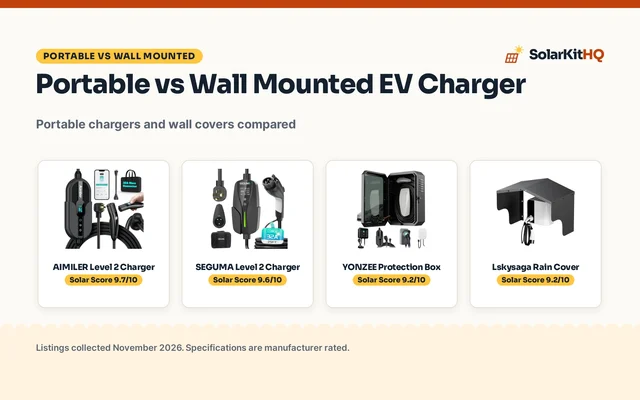
You pull into a dark garage with a charging cable coiled on the floor and a plug resting where boots and tires pass. For portable vs wall mount ev charger, pick portable when you need to move the charger between places or plug in away from home, and pick wall mount when the car parks in the same spot and you want the cable stored on the wall. The gear compared here does not include a portable charger unit or a wall mount charger unit. It covers wall holders that store the cable and plug, so the charger choice below rests on fit and storage rather than charging speed.
SolarKitHQ earns a commission when you buy through links on this page, at no extra cost to you. As an Amazon Associate I earn from qualifying purchases. Affiliate disclosure.
The quick answer
Choose portable if you rent, park in changing spots, travel with the charger, or want to plug in without fixing gear to a wall. Choose wall mount if you park at home in a steady spot, want the cable off the floor, and want the plug parked in the same place after each drive. A holder does not charge the car. The charger and the vehicle control charging, while the holder keeps the cable and plug tidy, dry, and clear of the floor. See portable EV chargers for movable units and Level 2 EV chargers for fixed home units.
What portable means for home charging
A portable charger travels with the car or moves between outlets at home, at work, or at a rental. That helps when wall space is tight, when permission to drill is lacking, or when parking changes. The trade off is storage. A loose cable picks up dirt, gets stepped on, and leaves the plug exposed to bumps. A wall holder can give the portable cable a fixed parking spot between trips, as long as the holder fits the plug type stated by the maker.
Check the plug type before you buy a holder. The holders below are stated for SAE J1772 plugs, and the Nexoroot hook is also stated for Tesla holders. If your plug differs, a J1772 dock will not seat the plug as intended. The guide to NACS vs J1772 EV chargers explains plug types in plain terms.
What wall mount means for home charging
A wall mount setup fixes the charging spot. The cable hangs on the wall, the plug sits in a dock, and the floor stays clear for walking and parking. That suits a garage or carport where the car returns to the same place and the cable would otherwise cross a walkway. A plug in home charger needs a suitable outlet or circuit, and a licensed electrician should install or check the outlet. No wiring steps are given here. For indoor and outdoor placement, see indoor vs outdoor EV chargers.
Wall holders differ in shape. A dock grips the plug body, a hook carries coiled cable, and a flush mount keeps cable close to the wall in narrow space. Steel hooks and plastic docks below are stated for indoor and outdoor use, but mounting surface, screw fit, and plug fit still decide whether a holder works in your space.
Choosing a portable vs wall mount ev charger for your garage
Start with where the car parks
If the car parks in a fixed bay with wall space beside it, wall storage keeps cable short and tidy. If parking changes or wall space is shared, portable charging with a simple hook may fit better. Match your wall area to the holder size stated by the maker. The LZSTEC holder is stated at 8.86 inches by 4.5 inches by 3.35 inches, the MECMO combo at 9.4 inches by 2.6 inches by 2.2 inches, and the Nexoroot hook at 4.09 inches by 1.57 inches by 5.7 inches. Dimensions for the Anina holder are Not stated.
Match the plug and the cable
Each holder below is stated for J1772 plugs. The Anina holster is stated for all J1772 charger connectors, the MECMO holder for SAE J1772 type 1 connectors, and the LZSTEC dock for J1772 handles. Cable weight matters for hooks. The MECMO maker lists a maximum weight capacity of 60 pounds and states that 25M long EV cables can be coiled on the deep J hook. Other holders state no weight capacity, so heavy or stiff cables need care and a check against the maker guidance.
Decide how much wall hardware you want
A hook alone is the lightest wall change. A dock plus hook holds plug and cable together. A flush mount keeps gear close to the wall where doors or bins pass close by. Included hardware varies, so read the parts stated for each holder before drilling. If you rent or cannot drill, portable charging without wall hardware remains cleaner. For broader home units, see home EV chargers.
Cable holders for either setup
These holders store cable and plug. They do not add charging power and they do not change charging speed. Each entry repeats only facts stated for that holder.
LZSTEC flush mount holder
The maker lists a low profile flush mount design that keeps the J1772 handle and cable close to the wall, with a side mounted layout to reduce protrusion in narrow garages. The arc shaped U hook is stated to support the cord without sharp edges, and the dock is molded from PA plastic while the hook uses rust resistant steel. Included parts are stated as 1 U hook, 1 J1772 dock, 4 tapping screws, 4 expand plugs, 4 machine screws, and 4 flange nuts. The maker lists weight at 0.625 pounds and a warranty stated as 1 Year Manufacturer.
MECMO dock and J hook combo
The maker lists a J1772 nozzle holster dock and J hook combination that can be used apart for mounting flexibility. The hook is stated as 304 stainless steel with a smooth surface, and the dock as thick plastic. The maker lists a maximum weight capacity of 60 pounds. Weight is stated at 0.9 pounds. The maker states weather resistant materials for indoor or outdoor use and screw mounting with holes drilled for the dock.
Anina J1772 holster
The maker lists a holster for J1772 plugs made of PA material, with a larger cap and edge stated to help keep rain and dust away from the plug. The plug clicks into place and the holster locks to the nozzle, as stated by the maker. The holder is stated to fix to flat surfaces with tools provided and to keep the cable off the ground with a smooth curved shape. Weight and dimensions are Not stated.
Nexoroot J hook
The maker lists a wide J hook in carbon steel with a rust resistant coating and non slip rubber coating to hold cable and hang the plug. An elastic cord strap is stated to hold the plug against bumps. Included parts are stated as two stainless steel screws. Weight is stated at 0.49 pounds. This is a hook without a molded plug dock, so the plug hangs rather than seats in a holster.
FAQ: power away from the grid
Does a wall holder charge the car?
No. A holder stores the cable and plug between sessions. Charging comes from the charger and the vehicle, and holder choice affects storage, plug protection, and floor clearance only.
Will a J1772 holder fit every EV plug?
Fit depends on plug type. The holders here are stated for SAE J1772 plugs, and the Nexoroot hook is also stated for Tesla holders. Check your plug type against the maker statement before ordering.
Can a portable charger use a wall holder at home?
Yes, if the plug type matches and the cable weight suits the hook. The MECMO maker lists a maximum weight capacity of 60 pounds, while other holders state no capacity, so match cable weight with care.
Are these holders stated for outdoor use?
The makers state indoor and outdoor use for these holders, with steel, PA plastic, and weather resistant materials as listed for each model. Mounting surface and screw fit still matter, so follow the maker guidance for your wall.
Related solar guides
See portable EV chargers, Level 2 EV chargers, home EV chargers, and every home EV charger guide.