On this page
A dead battery at a campsite at dusk and a boat that will not start at the dock are the same trouble in different places: the battery has to fit the job, not just the voltage. The short answer on rv battery vs marine battery is that the RV examples here run on lithium, while the marine example is an AGM battery built to start an engine and run electronics. Pick the RV side when the load is a house bank or a jump starter for the road, and pick the marine side when the battery must crank a boat engine and keep gear running on the water. We compared what each listing states: capacity, cranking figures, protections, cycle claims and warranty terms.
SolarKitHQ earns a commission when you buy through links on this page, at no extra cost to you. As an Amazon Associate I earn from qualifying purchases. Affiliate disclosure.
RV battery vs marine battery: side by side
| RV battery vs marine battery | PUPVWMHB 12V 320Ah LiFePO4 | NOCO Boost GB70 Jump Starter | Mighty Max MM-G24M Marine | Amazon |
|---|---|---|---|---|
| Type | 12V LiFePO4 deep cycle | 12V lithium jump starter | 12V AGM dual-purpose | |
| Capacity | 320Ah, 4096Wh | Not stated | 90Ah | |
| Starting figure | Not stated | 2000A peak, 40 starts per charge | 550 CCA, 700 MCA | |
| Weight | 59 lb | 5.0 lb | 52.20 lb | |
| Protection stated | 200A BMS, temperature cutoffs | Spark-proof, reverse polarity | Spill-proof, ABS shell | |
| Cycle claim | 4000+ at 100% depth of discharge | Not stated | 700 at 50% depth of discharge | |
| Monitoring | Bluetooth app | Not stated | Not stated | |
| Warranty | 5 years | 1 year | 2 years |
These specs are rated by the maker and quoted from each listing on 4 November 2026.
Capacity and cranking
The gap is in what each listing measures. The PUPVWMHB example states 320Ah and 4096Wh, which describes a house bank, while the Mighty Max example states 90Ah with 550 CCA and 700 MCA, which describes starting and deep discharge in one battery. The NOCO example states neither capacity nor cranking in amp-hours: it states 2000A peak power and up to 40 starts per charge, which describes a portable jump starter, not a house battery. Do not compare the NOCO peak figure with a CCA figure: the listings state different measures, and the NOCO listing gives no CCA.
Protection and monitoring
Only the PUPVWMHB example states a battery management system: a built-in 200A BMS with protection against overcharge, over-discharge, overcurrent and short circuit, plus temperature protection that cuts off charging at 32°F and above 158°F. The NOCO example states spark-proof and reverse polarity protection with an IP65-rated housing, and the PUPVWMHB example also states an IP65 rating with CE and RoHS certification. The Mighty Max example states a spill-proof, maintenance-free AGM design in a rugged ABS shell, with no BMS and no stated temperature limits. Only the PUPVWMHB example states phone monitoring: a Bluetooth app that shows voltage, current and capacity.
Cycles and warranty
The cycle claims need their conditions. The PUPVWMHB example states 4000+ cycles at 100% depth of discharge, 6000 cycles at 80% and 15000 cycles at 60%, so the headline figure only applies at the shallowest discharge. The Mighty Max example states 700 cycles at 50% depth of discharge, and the NOCO example states no cycle figure at all. Warranties run the same way: 5 years on the PUPVWMHB example, 1 year on the NOCO example, and 2 years on the Mighty Max example per its bullets, while its spec table states 1 year. Use the bullets figure when you compare.
What the listings leave unclear
The PUPVWMHB title claims up to 15000 cycles without naming the discharge depth, while the bullets tie that figure to 60% depth of discharge. The Mighty Max bullets and spec table disagree on weight and warranty, and the spec table lists 9.13 inches where the bullets list 8.63 inches with a 9.38 inch total height. The NOCO listing states no amp-hour capacity and no cycle figure, so it cannot be ranked as a house battery on those measures. None of the three listings states a UL listing.
Three examples
| # | Product | Solar Score | Buy |
|---|---|---|---|
| 1 |  PUPVWMHB 12V 320Ah LiFePO4 | 9.7/10 | Buy on Amazon |
| 2 |  NOCO Boost GB70 Jump Starter | 9.6/10 | Buy on Amazon |
| 3 |  Mighty Max MM-G24M Marine | 9.5/10 | Buy on Amazon |

PUPVWMHB 12V 320Ah LiFePO4
A 12V 320Ah LiFePO4 battery with a built-in 200A BMS, Bluetooth app monitoring and a 5-year warranty.
Pros
- 4096Wh from a 12V 320Ah LiFePO4 battery at 59 pounds
- Built-in 200A BMS with overcharge, over-discharge, overcurrent and short circuit protection
- Bluetooth app shows voltage, current and capacity on a phone
- 5-year warranty stated
Cons
- No cranking figure is stated
- Charging stops below 32°F, which limits cold weather charging
- 13.58 by 7.48 by 9.64 inches needs a large tray
Detailed Review
The listing states a 12V 320Ah LiFePO4 battery with 4096Wh, a built-in 200A BMS with protection against overcharge, over-discharge, overcurrent and short circuit, temperature protection that cuts off charging at 32°F and above 158°F, Bluetooth monitoring of voltage, current and capacity through a phone app, an IP65 rating, CE and RoHS certification, and a 5-year warranty. The battery weighs 59 pounds and measures 13.58 by 7.48 by 9.64 inches, and it can connect in parallel and in series. The title claims up to 15000 cycles while the bullets state 4000+ cycles at 100% depth of discharge, 6000 cycles at 80% and 15000 cycles at 60%, so compare on the lower figure at full discharge.
Who it's for: RV owners who want a large LiFePO4 house battery with app monitoring and the longest warranty here. Who should skip it: anyone who needs a stated cranking figure or a battery that charges below 32°F.
Its Solar Score of 9.7/10 comes from performance 32/35, build 22/25, value 21/25, safety 9/10 and warranty 3/5: 87 of 100 points, placed on our 9.2 to 9.8 scale.
Key Specifications
| Capacity | 12V, 320Ah, 4096Wh |
|---|---|
| BMS | 200A |
| Cycles | 4000+ at 100% depth of discharge |
| Size | 13.58 x 7.48 x 9.64 in |
Figures as published on the retailer listing, collected 4 November 2026. Performance figures are manufacturer rated.
Safety and Warranty
What this listing states. 200A BMS with overcharge, over-discharge, overcurrent and short circuit protection, temperature cutoffs, IP65, CE and RoHS stated, so safety scores 9 of 10. 5-year warranty stated. It does not say everything a buyer needs, such as who pays return shipping, so warranty scores 3 of 5. See How We Pick.
Battery safety. Charge with a charger and settings that match the stated chemistry, fuse the positive lead as the manual directs, cover terminals, keep within the stated temperature range, and never charge a damaged battery.
This is general buying information, not professional advice. Follow each product manual and local rules, and see our Safety Disclaimer.

NOCO Boost GB70 Jump Starter
A 12V lithium jump starter with 2000A peak power, a built-in power bank and a 400-lumen LED flashlight.
Pros
- 2000A peak power with up to 40 starts per charge
- Spark-proof and reverse polarity protection stated
- Built-in power bank for phones and tablets
- 400-lumen LED flashlight with 7 light modes, including SOS and strobe
Cons
- No capacity in amp-hours or watt-hours is stated
- No cycle life figure is stated
- Covers engines only up to 8.0L gas and 6.0L diesel
- 1-year warranty, shorter than the other two listings
Detailed Review
The listing states a 12V lithium jump starter with 2000A peak power, up to 40 starts per charge on engines up to 8.0L gas and 6.0L diesel, spark-proof and reverse polarity protection, an integrated power bank for smartphones and tablets, a 400-lumen LED flashlight with 7 light modes including SOS and strobe, and a rugged IP65-rated housing with rubberized over-molding. It weighs 5.0 pounds, measures 2.8 by 6.0 by 8.8 inches, recharges in 6 hours over USB-C, and carries a 1-year warranty. The box includes heavy-duty clamps, a USB-C charging cable and a microfiber storage bag.
Who it's for: RV owners who want portable starting power and a power bank in one small unit. Who should skip it: anyone shopping for a deep cycle house battery with a stated amp-hour capacity.
Its Solar Score of 9.6/10 comes from performance 28/35, build 21/25, value 20/25, safety 7/10 and warranty 1/5: 77 of 100 points, placed on our 9.2 to 9.8 scale.
Key Specifications
| Peak current | 2000A |
|---|---|
| Starts per charge | Up to 40 |
| Light | 400-lumen LED, 7 modes |
| Weight | 5.0 lb |
Figures as published on the retailer listing, collected 4 November 2026. Performance figures are manufacturer rated.
Safety and Warranty
What this listing states. Spark-proof and reverse polarity protection, IP65-rated housing stated, so safety scores 7 of 10. 1-year warranty stated. It does not say everything a buyer needs, such as who pays return shipping, so warranty scores 1 of 5. See How We Pick.
Battery safety. Charge with a charger and settings that match the stated chemistry, fuse the positive lead as the manual directs, cover terminals, keep within the stated temperature range, and never charge a damaged battery.
This is general buying information, not professional advice. Follow each product manual and local rules, and see our Safety Disclaimer.
Mighty Max MM-G24M Marine
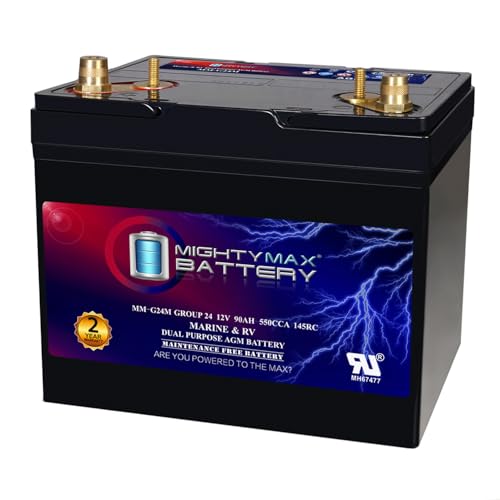
A 12V 90Ah dual-purpose AGM marine battery with 550 CCA, 700 MCA and a two-year limited warranty per its bullets.
Pros
- 90Ah deep cycle capacity with 550 CCA and 700 MCA for starting
- 145 RC stated for running electronics and gear
- Spill-proof, maintenance-free AGM design in a rugged ABS shell
- Dual-purpose: starts the engine and runs electronics and gear for hours
Cons
- No BMS or app monitoring is stated
- No charging or discharging temperature figures are stated
Detailed Review
The listing states a 12V 90Ah Group Size 24M deep cycle marine AGM battery with dual-purpose starting and deep discharge, 550 CCA, 700 MCA and 145 RC, up to 700 cycles at 50% depth of discharge, and a maintenance-free, spill-proof design in a rugged ABS shell that resists impacts and heat. The bullets state a weight of 52.20 pounds and a two-year limited warranty, while the spec table states 54.4 pounds and a 1 year manufacturers warranty; trust the bullets on both figures. The battery measures 10.25 by 6.63 by 8.63 inches with a 9.38 inch total height, while the spec table lists 9.13 inches for the same dimension, which matches neither bullets figure.
Who it's for: boaters who want one battery that starts the engine and runs electronics, with a spill-proof AGM design. Who should skip it: anyone who wants a BMS, app monitoring or a stated lithium cycle life.
Its Solar Score of 9.5/10 comes from performance 27/35, build 20/25, value 20/25, safety 4/10 and warranty 1/5: 72 of 100 points, placed on our 9.2 to 9.8 scale.
Key Specifications
| Capacity | 12V, 90Ah |
|---|---|
| Cranking | 550 CCA, 700 MCA |
| Reserve | 145 RC |
| Weight | 52.20 lb |
Figures as published on the retailer listing, collected 4 November 2026. Performance figures are manufacturer rated.
Safety and Warranty
What this listing states. Spill-proof maintenance-free AGM design in an impact- and heat-resistant ABS shell stated, so safety scores 4 of 10. 2-year limited warranty stated. It does not say everything a buyer needs, such as who pays return shipping, so warranty scores 1 of 5. See How We Pick.
Battery safety. Charge with a charger and settings that match the stated chemistry, fuse the positive lead as the manual directs, cover terminals, keep within the stated temperature range, and never charge a damaged battery.
This is general buying information, not professional advice. Follow each product manual and local rules, and see our Safety Disclaimer.
As an Amazon Associate I earn from qualifying purchases.
Where the points went
The Solar Score weighs performance, build, value, safety and warranty. For RV and marine batteries, safety means a battery management system, stated protections or a spill-proof design; the PUPVWMHB example states the fullest protection set, the NOCO example states spark-proof and reverse polarity protection, and the Mighty Max example states a spill-proof AGM design. All three state a warranty term, from 1 year to 5 years. How we pick explains the weights.
| Product | Solar Score | Perf. /35 | Build /25 | Value /25 | Safety /10 | Warranty /5 |
|---|---|---|---|---|---|---|
| PUPVWMHB 12V 320Ah LiFePO4 | 9.7 | 32 | 22 | 21 | 9 | 3 |
| NOCO Boost GB70 Jump Starter | 9.6 | 28 | 21 | 20 | 7 | 1 |
| Mighty Max MM-G24M Marine | 9.5 | 27 | 20 | 20 | 4 | 1 |
Every total is translated into a figure between 9.2 and 9.8 with a linear formula; ranking by points and ranking by score always agree.
Rv Battery vs Marine Battery: Which Should You Choose?
Choose the RV side if the job is a house bank or portable starting power: the PUPVWMHB example suits a large LiFePO4 bank with app monitoring, and the NOCO example suits a glove box or emergency kit as a jump starter and power bank. Choose the marine side if one battery must both start a boat engine and run electronics: the Mighty Max example states 550 CCA, 700 MCA and 145 RC in a spill-proof AGM case. Check the tray size, the charging settings and the warranty term before switching chemistries.
| If you need | Look at |
|---|---|
| Largest stated capacity | PUPVWMHB 12V 320Ah LiFePO4, 320Ah and 4096Wh |
| Portable starting power | NOCO Boost GB70 Jump Starter, 2000A peak |
| One battery for starting and deep discharge | Mighty Max MM-G24M Marine, 550 CCA and 700 MCA |
| Longest stated warranty | PUPVWMHB 12V 320Ah LiFePO4, 5 years |
Sizing Notes
- Match the battery voltage and chemistry to every charging source: all three listings state 12V, but only the PUPVWMHB example states a 200A BMS and only the Mighty Max example states CCA and MCA figures.
- Check the tray: the PUPVWMHB example measures 13.58 by 7.48 by 9.64 inches, the Mighty Max example 10.25 by 6.63 by 8.63 inches with a 9.38 inch total height, and the NOCO example 2.8 by 6.0 by 8.8 inches.
- Keep the continuous draw under the 200A BMS limit stated on the PUPVWMHB example; the other two listings state no BMS figure.
- Match the warranty term to how long you plan to keep the battery: 5 years on the PUPVWMHB example, 2 years on the Mighty Max example per its bullets, and 1 year on the NOCO example.
FAQ: power away from the grid
Can a marine battery work in an RV?
The Mighty Max listing describes use on the water, on the road and off the grid, and it states dual-purpose starting and deep discharge with 90Ah, 550 CCA and 700 MCA. Check the tray size and the charging settings against your RV before switching chemistries.
What protection does the PUPVWMHB battery state?
A built-in 200A BMS with protection against overcharge, over-discharge, overcurrent and short circuit, temperature protection that cuts off charging at 32°F and above 158°F, and IP65, CE and RoHS.
Is the NOCO GB70 a house battery?
No. The listing describes a jump starter with 2000A peak power, up to 40 starts per charge, a power bank and a 400-lumen LED flashlight. It is the portable starting example here, not a deep cycle house battery.
Which listing states the longest warranty?
The PUPVWMHB example at 5 years, then the Mighty Max example at 2 years per its bullets, then the NOCO example at 1 year.
Do these listings state a cycle life?
The PUPVWMHB example states 4000+ cycles at 100% depth of discharge, 6000 cycles at 80% and 15000 cycles at 60%. The Mighty Max example states 700 cycles at 50% depth of discharge. The NOCO example states no cycle figure.
Related solar guides
See every Deep Cycle and RV Batteries guide and all Batteries and Charging guides. Also see our best dual purpose marine battery. Also see our best rv battery for boondocking. Also see our group 24 vs group 27 rv battery. Also see our lifepo4 vs agm battery for rv. Also see our best battery box for rv.