On this page
The short answer on shortwave vs ham radio: pick shortwave if you want to listen to broadcasts, weather and distant stations on a receiver that never transmits, and pick ham radio if you want two-way contact with other operators. We compared two shortwave receivers and one DMR ham transceiver on what each maker states, plus one book about ham radio that is not a radio at all. The shortwave pair wins on stated band coverage and simple listening; the ham example is the only pick here that transmits.
SolarKitHQ earns a commission when you buy through links on this page, at no extra cost to you. As an Amazon Associate I earn from qualifying purchases. Affiliate disclosure.
Shortwave vs ham radio: side by side
| Shortwave vs Ham Radio | Radioddity GD-168 | C. Crane CC Skywave 2 | XHDATA D226 | Wiley Ham Radio For Dummies | Amazon |
|---|---|---|---|---|---|
| Side | Ham radio | Shortwave | Shortwave | Ham radio (book) | |
| Two-way transmit stated | Yes, TX and RX stated | Not stated | Not stated | Not stated | |
| Bands stated | Dual band DMR | AM, FM, shortwave, NOAA, aviation | AM, FM, shortwave | Not stated | |
| Power stated | 1800mAh and 2600mAh batteries | 2 AA batteries | Rechargeable or 2 AA | Not stated | |
| Warranty stated | 18 Months | 1 Year Limited | 1 Year | Not stated |
Figures in this table are the manufacturer’s ratings as listed, captured 20 November 2026.
Receive only vs two-way
This is the core split. The XHDATA D226 and C. Crane CC Skywave 2 examples are receivers: their makers state reception of AM, FM and shortwave broadcasts, news, music and talk programs, with no transmit feature stated. The Radioddity GD-168 example is a dual band two way radio: its maker states TX and RX noise reduction, contacts and talk groups, which are features for sending as well as receiving. If you only want to listen, a shortwave receiver matches that job. If you want to talk back, only the ham example here states that ability.
Bands and stated coverage
Band figures belong to each example, not to a whole side. The XHDATA D226 example states AM 520 to 1730 kHz, FM 64 to 108 MHz and SW 5.6 to 22 MHz. The C. Crane CC Skywave 2 example states shortwave 2300 to 26100 kHz, plus AM, FM, NOAA Weather with Alert and VHF Aviation band, with 400 memories stated. The Radioddity GD-168 example states dual band DMR operation with up to 500K contacts and 10,000 talk groups, and states satellite communication support. Neither side states the other side’s figures, so compare the stated bands against the stations or contacts you want.
Power and portability
The XHDATA D226 example states a built-in rechargeable battery with USB-C charging, or 2 AA batteries when no charging source is available, at 5 by 1.18 by 2.95 inches with a rear stand and flashlight. The C. Crane CC Skywave 2 example runs on 2 AA alkaline batteries with stated run time of 70 hours on earbuds or 60 hours on the built-in speaker, at 6.0 oz without batteries. The Radioddity GD-168 example includes 1800mAh and 2600mAh batteries and states USB-C charging and programming. Stated run time appears only on the Skywave 2 example, so the other listings leave run time unclear.
What the listings leave unclear
One ham-side item is not a radio. The Wiley Ham Radio For Dummies example is a book: its stated figures are book dimensions, weight and a release date, with no bands, transmit power or battery stated. It can sit beside a radio as reading, but it receives and transmits nothing. The GD-168 listing states an FCC ID and DMR features but leaves transmit power in watts unstated in the text here, so this page does not call the ham side stronger on power.
Four examples
| # | Product | Solar Score | Buy |
|---|---|---|---|
| 1 |  Radioddity GD-168 | 9.6/10 | Buy on Amazon |
| 2 |  C. Crane CC Skywave 2 | 9.5/10 | Buy on Amazon |
| 3 |  XHDATA D226 | 9.4/10 | Buy on Amazon |
| 4 |  Wiley Ham Radio For Dummies | 9.2/10 | Buy on Amazon |

Radioddity GD-168
A dual band DMR two way ham radio with up to 500K contacts and 10,000 talk groups stated, plus TX and RX noise reduction and USB-C charging.
Pros
- Dual band two way operation with TX and RX stated
- Up to 500K contacts and 10,000 talk groups stated
- 1800mAh and 2600mAh batteries included
- FCC ID stated by the maker
Cons
- Transmit power in watts not stated
- No shortwave broadcast bands stated
- No NOAA Weather band stated
- Programming setup needed for contacts and talk groups
Detailed Review
The maker states a dual band DMR two way radio holding up to 500K contacts and 10,000 talk groups, with a 1.77 inch color TFT screen, TX and RX noise reduction, satellite communication support and USB-C charging and programming. The package includes 1800mAh and 2600mAh batteries, a Type-C cable, standard and long-range 15 inch antennas, belt clip, charging base and power adapter, and the maker states an FCC ID.
Who it's for: an operator who wants two-way DMR contact with large stated contact and talk group storage. Who should skip it: a listener who only wants AM, FM and shortwave broadcasts.
Its Solar Score of 9.6/10 comes from performance 29/35, build 20/25, value 20/25, safety 4/10 and warranty 3/5: 76 of 100 points, placed on our 9.2 to 9.8 scale.
Key Specifications
| Type | Dual band DMR two way radio |
|---|---|
| Contacts | Up to 500K stated |
| Talk groups | 10,000 stated |
| Batteries | 1800mAh and 2600mAh included |
Taken from the seller's listing on 20 November 2026. Capacity and output figures are rated by the manufacturer.
Safety and Warranty
What this listing states. FCC ID T4K-D168UV stated by the maker, so safety scores 4 of 10. 18 Months Warranty & Lifetime Support. It does not say everything a buyer needs, such as who pays return shipping, so warranty scores 3 of 5. See How We Pick.
Follow the manual. Connect and use the product as the maker describes, stay within every stated rating, and read the manual before first use.
This is general buying information, not professional advice. Follow each product manual and local rules, and see our Safety Disclaimer.

C. Crane CC Skywave 2
A portable travel receiver covering AM, FM, shortwave, NOAA Weather with Alert and VHF Aviation, with 400 memories and stated run time on AA batteries.
Pros
- Shortwave 2300 to 26100 kHz stated
- NOAA Weather with Alert and aviation band stated
- 400 memories with direct frequency entry stated
- 70 hours run time on earbuds stated
Cons
- Receive only, no transmit stated
- Runs on 2 AA batteries, not included
- No rechargeable battery stated
- AC adapter is optional, not included
Detailed Review
The maker states full range AM, FM, NOAA Weather with Alert, shortwave 2300 to 26100 kHz and VHF Aviation reception in a digitally tuned receiver with 400 memories, direct frequency entry and a clock with alarm. Stated run time is 70 hours on earbuds or 60 hours on the built-in speaker from 2 AA alkaline batteries, at 6.0 oz without batteries, and a shortwave antenna jack is included for an external antenna.
Who it's for: a traveler or emergency listener who wants the widest stated band coverage here. Who should skip it: anyone who wants to transmit, since no transmit feature is stated.
Its Solar Score of 9.5/10 comes from performance 30/35, build 21/25, value 20/25, safety 0/10 and warranty 3/5: 74 of 100 points, placed on our 9.2 to 9.8 scale.
Key Specifications
| Bands | AM, FM, shortwave, NOAA, aviation |
|---|---|
| Shortwave range | 2300 to 26100 kHz stated |
| Memories | 400 stated |
| Run time | 70 hours earbuds, 60 hours speaker stated |
Taken from the seller's listing on 20 November 2026. Capacity and output figures are rated by the manufacturer.
Safety and Warranty
What this listing states. This product does not plug in or run on a battery, so safety is not part of its score. 1 Year Limited Parts and Labor Warranty. It does not say everything a buyer needs, such as who pays return shipping, so warranty scores 3 of 5. See How We Pick.
Follow the manual. Connect and use the product as the maker describes, stay within every stated rating, and read the manual before first use.
This is general buying information, not professional advice. Follow each product manual and local rules, and see our Safety Disclaimer.
XHDATA D226
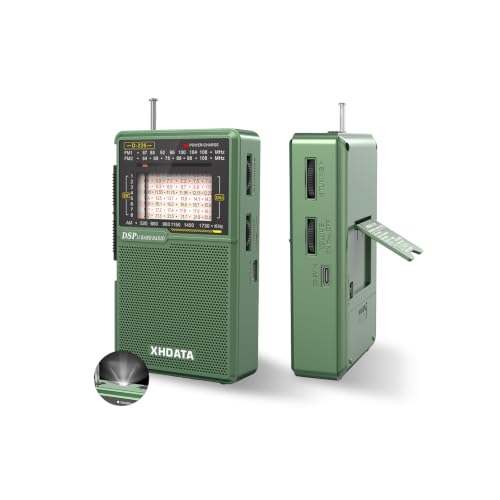
A portable AM, FM and shortwave receiver with USB-C rechargeable power or AA batteries, a large dial, rear stand, flashlight and headphone jack.
Pros
- AM, FM and shortwave reception stated
- USB-C charging or 2 AA batteries stated
- Flashlight and rear stand stated
- Large easy-read frequency panel stated
Cons
- Receive only, no transmit stated
- Shortwave range stated narrower than Skywave 2
- AA batteries not included
- No NOAA Weather band stated
Detailed Review
The maker states AM 520 to 1730 kHz, FM 64 to 108 MHz and SW 5.6 to 22 MHz reception in a portable radio measuring 5 by 1.18 by 2.95 inches, with a built-in rechargeable battery charged by USB-C or 2 AA batteries when no charging source is available. A rear stand, flashlight, built-in speaker and 3.5 mm headphone jack are stated, with a large frequency panel and simple tuning control.
Who it's for: a home or outdoor listener who wants simple AM, FM and shortwave reception with two power options. Who should skip it: anyone who wants NOAA Weather alerts or two-way contact.
Its Solar Score of 9.4/10 comes from performance 26/35, build 19/25, value 20/25, safety 0/10 and warranty 2/5: 67 of 100 points, placed on our 9.2 to 9.8 scale.
Key Specifications
| Bands | AM, FM, shortwave |
|---|---|
| Shortwave range | 5.6 to 22 MHz stated |
| Power | USB-C rechargeable or 2 AA |
| Size | 5 by 1.18 by 2.95 inches stated |
Taken from the seller's listing on 20 November 2026. Capacity and output figures are rated by the manufacturer.
Safety and Warranty
What this listing states. No safety listing, protection or rating is stated, so safety scores zero. 1 Year. It does not say everything a buyer needs, such as who pays return shipping, so warranty scores 2 of 5. See How We Pick.
Follow the manual. Connect and use the product as the maker describes, stay within every stated rating, and read the manual before first use.
This is general buying information, not professional advice. Follow each product manual and local rules, and see our Safety Disclaimer.

Wiley Ham Radio For Dummies
A book about ham radio, included on the ham side as reading only, with book dimensions and weight stated and no radio features stated.
Pros
- Book format for learning ham radio basics
- Single item, no batteries or charging needed
- Stated dimensions fit a shelf or bag
- Covers the ham side topic in print
Cons
- Not a radio, receives and transmits nothing
- No bands or frequencies stated
- No power or battery stated
- No warranty term stated
Detailed Review
This item is a book titled Ham Radio For Dummies, with stated dimensions of 7.3 by 1.1 by 9.2 inches, a stated weight of 2.31 pounds and a release date of 2021-04-02. No bands, transmit power, battery or radio features are stated, because the item is reading material rather than equipment.
Who it's for: a new ham operator who wants a book beside a radio. Who should skip it: anyone shopping for a radio to listen or transmit with.
Its Solar Score of 9.2/10 comes from performance 6/35, build 10/25, value 6/25, safety 0/10 and warranty 0/5: 22 of 100 points, placed on our 9.2 to 9.8 scale.
Key Specifications
| Type | Book |
|---|---|
| Dimensions | 7.3 by 1.1 by 9.2 inches |
| Weight | 2.31 pounds stated |
| Release date | 2021-04-02 stated |
Taken from the seller's listing on 20 November 2026. Capacity and output figures are rated by the manufacturer.
Safety and Warranty
What this listing states. This product does not plug in or run on a battery, so safety is not part of its score. No warranty term, so warranty scores zero. See How We Pick.
Follow the manual. Connect and use the product as the maker describes, stay within every stated rating, and read the manual before first use.
This is general buying information, not professional advice. Follow each product manual and local rules, and see our Safety Disclaimer.
As an Amazon Associate I earn from qualifying purchases.
Where the points went
The Solar Score weighs performance, build, value, safety and warranty. For radios, safety means certifications the maker actually states; only the Radioddity example states an FCC ID here, so the shortwave pair scores zero on that line. Three of the four items state a warranty term, and the book states none. How we pick explains the weights.
| Product | Solar Score | Perf. /35 | Build /25 | Value /25 | Safety /10 | Warranty /5 |
|---|---|---|---|---|---|---|
| Radioddity GD-168 | 9.6 | 29 | 20 | 20 | 4 | 3 |
| C. Crane CC Skywave 2 | 9.5 | 30 | 21 | 20 | 0 | 3 |
| XHDATA D226 | 9.4 | 26 | 19 | 20 | 0 | 2 |
| Wiley Ham Radio For Dummies | 9.2 | 6 | 10 | 6 | 0 | 0 |
The Solar Score runs on a 9.2 minimum and a 9.8 maximum, and the weighted point total is placed on that line in proportion, so more points can only raise it.
Shortwave vs ham radio: which should you choose?
Choose shortwave if you want to listen: broadcasts, NOAA Weather with Alert on the Skywave 2 example, or simple AM, FM and shortwave reception on the XHDATA example. Choose ham radio if you want two-way contact: the GD-168 example states dual band DMR operation, contacts, talk groups and TX and RX noise reduction. Choose the book only as reading to go with a radio, never as the radio itself. See our best handheld ham radio picks and best crank shortwave radio picks for wider lists on each side.
| If you need | Look at |
|---|---|
| Listening only, widest stated bands | C. Crane CC Skywave 2, shortwave 2300 to 26100 kHz stated |
| Simple AM, FM and shortwave listening | XHDATA D226, USB-C charging and AA option stated |
| Two-way DMR contact | Radioddity GD-168, 500K contacts stated |
| Reading about ham radio | Wiley Ham Radio For Dummies, a book, not a radio |
Sizing Notes
- Match the stated bands to your goal: broadcast and weather reception on the shortwave examples, dual band DMR contact on the GD-168 example.
- Check power as stated: USB-C charging plus 2 AA batteries on the XHDATA example, 2 AA batteries on the Skywave 2 example, 1800mAh and 2600mAh batteries on the GD-168 example.
- Compare stated run time only where stated: 70 hours on earbuds or 60 hours on speaker for the Skywave 2 example.
- Keep the book in its place: it states no bands, power or battery, so pair it with a radio rather than instead of one.
FAQ: power away from the grid
Is a shortwave radio the same as a ham radio?
No. The shortwave examples here are receivers for listening to broadcasts, while the ham example is a two way radio with TX and RX features stated for sending and receiving.
Which side states the widest shortwave coverage here?
The C. Crane CC Skywave 2 example states shortwave 2300 to 26100 kHz, while the XHDATA D226 example states SW 5.6 to 22 MHz. The ham example states dual band DMR operation instead of shortwave broadcast bands.
Can a shortwave receiver transmit?
Neither shortwave example here states a transmit feature. Both state reception of AM, FM and shortwave broadcasts, and the Skywave 2 example adds NOAA Weather and VHF Aviation reception.
Is Ham Radio For Dummies a radio?
No. It is a book, with book dimensions and weight stated and no bands, power or battery stated. It belongs beside a ham radio as reading, not in place of one.
Related solar guides
See every Emergency Radios and Communication guide and all Emergency Prep guides.
More picks: best handheld ham radio, best crank shortwave radio and best emergency radio with shortwave.