On this page
Picture a campsite at dusk, the phone dead, the map gone, and the nearest outlet a drive away: that is the moment solar power bank vs portable charger is really about. A solar bank carries a small panel for slow backup power in the sun, while a portable charger carries a battery that refills fast from a wall outlet before you leave. We compared solar banks and portable chargers in this guide, and the short version is that the sun is a backup, not a charger, while the wall outlet is the fast refill.
SolarKitHQ earns a commission when you buy through links on this page, at no extra cost to you. As an Amazon Associate I earn from qualifying purchases. Affiliate disclosure.
The quick answer
A solar power bank suits trips where the sun is the only refill, because its panel adds power in direct sun. YELOMIN states that a full solar recharge may require dozens of hours of effective sunlight, so the panel is a backup, not the main charging method. A portable charger suits daily carry and travel, because it refills from a wall outlet: the AIFENG pack recharges in about 2.5 hours through its foldable AC plug or about 2 hours with a PD20W USB-C adapter, and the VRURC and AIFENG packs both state 22.5W fast charging, with compatible devices reaching up to 50% in about 30 minutes. For raw capacity, the YELOMIN solar bank lists 38800mAh, the VRURC portable charger lists 20000mAh, the AIFENG lists 10000mAh, and the TRKOY magnetic pack lists 5000mAh.
How the two differ
The core difference is the refill. A solar power bank carries a panel that turns sunlight into a trickle of charge, while a portable charger carries only a battery and a cable or plug, and depends on a wall outlet or a USB-C source. That difference drives everything else: capacity, speed, size and the extras in the box.
| Feature | Solar power bank | Portable charger |
|---|---|---|
| Main refill | Built-in solar panel in direct sun | Wall outlet or USB-C |
| Capacity in this guide | 38800mAh | 5000mAh to 20000mAh |
| Charging speed | Slow, supplemental only | Up to 22.5W fast charging |
| Extra gear | LED flashlight, carabiner | Built-in cables, AC plug |
Capacity alone can mislead. The YELOMIN solar bank lists 38800mAh, the largest figure here, yet its own maker guidance treats the panel as a supplement, so the big number is backup power you carry, not power you can refill on the trail. The portable chargers list smaller capacities, 5000mAh to 20000mAh, and refill from an outlet in hours, so their capacity is usable again the next morning. See the 5000mAh vs 20000mAh solar power banks for how capacity lines up across sizes.
The gear we compared
The packs below are in ranked order, with the strongest all-round portable charger at the top and the solar bank in the middle, since its panel is a backup rather than a main charger.
VRURC 20000mAh Portable Charger. The VRURC pack lists 20000mAh, 22.5W fast charging and 4 built-in cables, Type-C, Phone, Micro USB and USB Type-A, plus two extra ports, one USB and one Type-C, so it charges several devices without a separate cable. The maker states up to 50% in 30 minutes and 3 to 4 full phone charges, and the 19mm body is stated as 33% thinner than the old version. It measures 6.14 by 2.75 by 0.75 inches and carries a 3-year warranty.
AIFENG 10000mAh Portable Charger. The AIFENG pack lists 10000mAh in a body stated as 45% smaller than average power banks, with built-in USB-C and USB-A cables and a foldable AC plug, so it recharges straight from a wall outlet. It charges up to 4 devices at once, recharges in about 2.5 hours through the AC plug or about 2 hours with a PD20W USB-C adapter, and supports pass-through charging, so a phone can charge while the pack recharges. The maker states up to 2 charges for iPhone 18 series devices and 1.5 charges for Samsung Galaxy S26+ devices, with 22.5W fast charging that reaches up to 50% in about 30 minutes on compatible devices. It measures 3.66 by 2.36 by 1.26 inches, weighs 7.05 oz and carries 3-year care.
YELOMIN 38800mAh Solar Power Bank. The YELOMIN bank lists 38800mAh, the largest capacity in this guide, with 2 USB-A outputs and a USB-C input/output port, so it covers 3 outputs across phones and other devices. Its built-in panel slowly adds small amounts of power in direct sun, and the maker states that a full solar recharge may require dozens of hours of effective sunlight, so charge by USB-C before trips. It also carries two LED flashlights with Steady, SOS and Strobe modes, a carabiner for clipping to a backpack, and port covers that help shield the connections from dust and everyday splashes. It weighs 9.9 oz, measures 5.9 by 2.95 by 0.98 inches and carries a 12-month warranty.
TRKOY 5000mAh Magnetic Portable Charger. The TRKOY pack lists 5000mAh in a slim magnetic body that snaps onto MagSafe-compatible iPhones, with a stated 15N magnetic hold, a weight of 120g and a thickness of 11.8mm. It charges wirelessly or through USB-C, and supports wired and wireless charging at the same time, so two devices can charge together. The maker states up to one full charge for an iPhone 16, and the pack includes a cooling chip with overcharge, overheat, over-voltage, over-current and short-circuit prevention. It measures 3.93 by 2.66 by 0.46 inches and carries 3-year care.
How to choose solar power bank vs portable charger
Match capacity to the trip
Start with how many charges the trip needs. A 5000mAh pack gives up to one full charge for an iPhone 16, a 10000mAh pack covers up to 2 charges for iPhone 18 series devices, and a 20000mAh pack covers 3 to 4 full phone charges, so longer trips without an outlet call for the larger packs. The 38800mAh solar bank holds the most power of the 4, and suits a trip where the panel tops it up between uses rather than a daily commute. See what a portable charger is and how a portable charger works for the basics.
Check how it refills
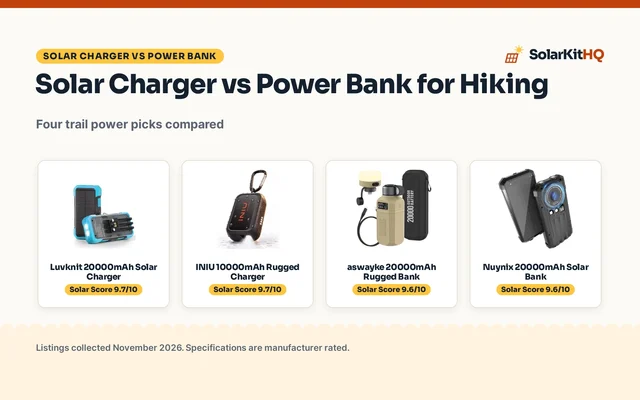
Refill speed decides whether the pack is ready again tomorrow. The AIFENG pack recharges in about 2.5 hours from a wall outlet, while the YELOMIN solar bank depends on direct sun and may need dozens of hours of effective sunlight for a full recharge, so a solar bank is a poor pick when every night ends near an outlet and a strong pick when no outlet is in reach for days. See the solar charger vs power bank for hiking guide for trail use.
Weigh size against capacity
Size and weight track capacity in this set. The TRKOY pack weighs 120g and measures 11.8mm thick, the smallest carry here, while the YELOMIN bank weighs 9.9 oz and the VRURC pack measures 6.14 by 2.75 by 0.75 inches. A pocket pack suits daily carry, and a larger pack suits a bag or a campsite where the extra capacity earns its size. See how long a portable charger lasts before deciding how much capacity to carry.
FAQ: power away from the grid
Can a solar power bank charge a phone from sunlight alone?
It can add power in direct sun, but slowly. YELOMIN states that its panel adds small amounts of power and that a full solar recharge may require dozens of hours of effective sunlight, so charge the bank by USB-C before a trip and treat the panel as a backup.
How many phone charges does a 20000mAh portable charger hold?
The VRURC pack states 3 to 4 full phone charges from its 20000mAh battery, while the AIFENG 10000mAh pack states up to 2 charges for iPhone 18 series devices.
What does 22.5W fast charging mean here?
Both the VRURC and AIFENG packs state 22.5W fast charging, and both state that compatible devices reach up to 50% in about 30 minutes. The figure is the maker’s stated output, not a promise for every phone.
Which one should you take camping?
Take the solar bank when the trip runs past the reach of outlets: the YELOMIN pack pairs its 38800mAh battery with a solar panel, two LED flashlights and a carabiner. Take a portable charger when an outlet is in reach each night: the VRURC 20000mAh pack recharges from a wall outlet and covers 3 to 4 full phone charges.
Related solar guides
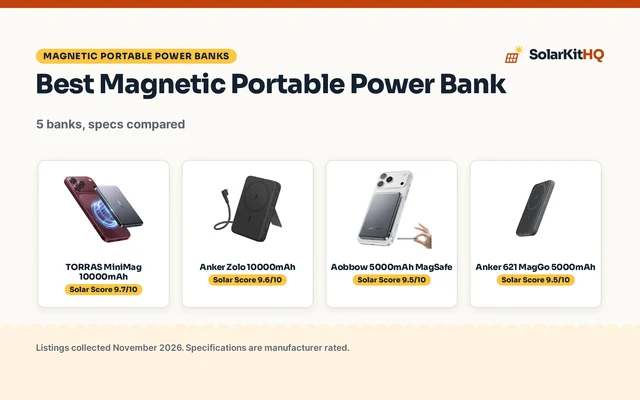
See the 5000mAh vs 20000mAh solar power banks, the solar charger vs power bank for hiking, the how long a portable charger lasts and the best magnetic portable power banks.