On this page
At a campsite at dusk, with a dead phone and a panel still catching the last light, the question stops being abstract: what is a PWM controller? A PWM controller is a charge controller that sits between a solar panel and a battery, switching the panel connection on and off so the battery charges in stages. This guide explains how those stages work, when a PWM controller fits a setup, and what the controllers in this guide state about their own specs.
SolarKitHQ earns a commission when you buy through links on this page, at no extra cost to you. As an Amazon Associate I earn from qualifying purchases. Affiliate disclosure.
What Is a PWM Controller?
A PWM controller connects a solar panel to a battery and manages the flow between them. The listings in this guide describe 3 charge stages: bulk, absorption and float on one controller, and bulk, boost and float on another. In the opening stage the battery takes a full charge, then the controller eases the flow as the battery fills, and in the float stage it holds the battery at a safe level with a small maintenance charge.
The controllers in this guide state protection against overcurrent, short circuits, reverse polarity, overvoltage and overheating, with open circuits and anti-backflow listed on one model and reverse current on another. Several of the listings state LCD screens that show voltage, charging current and mode, and USB ports for charging a phone or a small device. A built-in memory on one controller keeps its settings after a power outage, so there is no need to program it again.
When to Use a PWM Controller
A PWM controller fits a small off-grid setup where the panel and the battery work at the same voltage. The listings in this guide describe garden lights, sheds, small trailers, boat battery maintenance, gate openers and chicken coop lights, and one listing calls its controller a beginner-friendly fit for mini DIY projects. For a small 12V setup, one listing supports panels up to 120W, and the same controller supports up to 240W on a 24V system. A larger 30A controller in this guide accepts up to 100V from the panels and covers 360W on a 12V system, rising to 1440W on a 48V system.
Battery type matters as much as size. The listings in this guide cover open, AGM and gel lead-acid batteries, and lithium types including Li-ion and LiFePO4. One listing notes that lithium batteries need manual mode selection, with B2 for Li-ion and B3 for LiFePO4, and that its default setting is for lead-acid batteries. Another lists user, flooded, AGM, gel, LiFePO4 and lithium types together, so check the listing for the battery type you own before choosing.
PWM Controllers in This Guide
The controllers below handle the charging step: each one sits between the panel and the battery and manages the stages described above.
| # | Product | Solar Score | Buy |
|---|---|---|---|
| 1 |  PowMr 30A PWM Controller | 9.7/10 | Buy on Amazon |
| 2 |  Renogy 30A Adventurer Flush | 9.7/10 | Buy on Amazon |
| 3 |  EtnalSolar 10A PWM Controller | 9.6/10 | Buy on Amazon |
| 4 |  Dawnice 30A PWM Controller | 9.4/10 | Buy on Amazon |

PowMr 30A PWM Controller
A 30A controller that manages charging for 12V, 24V, 36V and 48V systems and accepts up to 100V from the panels.
Pros
- Auto-detects 12V, 24V, 36V and 48V battery systems
- Accepts up to 100V PV input, with 360W at 12V rising to 1440W at 48V
- Three charge stages: bulk, boost and float
- Fits AGM, gel, flooded, lead-acid and lithium batteries
Cons
- No warranty term is stated
- No dimensions or weight are stated
- USB output is 5V and 2A only
- No timer function is stated
Detailed Review
The listing states a 30A PWM controller that auto-detects 12V, 24V, 36V and 48V systems, with a maximum PV input voltage of 100V and a maximum input power of 360W at 12V, 720W at 24V, 1080W at 36V and 1440W at 48V. It lists 3 charge stages, bulk, boost and float, compatibility with user, flooded, AGM, gel, LiFePO4 and lithium battery types, two USB ports with 5V and 2A output, and protection against overcharge, overload, short circuit and reverse current. The listing repeats overcharge protection twice in the protection list.
Who it's for: owners building a 12V to 48V system who want one controller that covers a wide voltage range. Who should skip it: owners of a small 12V setup who only need a 10A controller for a single panel.
Its Solar Score of 9.7/10 comes from performance 32/35, build 21/25, value 21/25, safety 8/10 and warranty 0/5: 82 of 100 points, placed on our 9.2 to 9.8 scale.
Key Specifications
| Current | 30A |
|---|---|
| System voltage | 12V, 24V, 36V, 48V auto |
| Max PV input | 100V, 360W to 1440W |
| USB output | 2 ports, 5V, 2A |
Figures as published on the retailer listing, collected 12 November 2026. Performance figures are manufacturer rated.
Safety and Warranty
What this listing states. Overcharge, overload, short circuit and reverse current protection stated, so safety scores 8 of 10. No warranty term, so warranty scores zero. See How We Pick.
Stay under the input limit. Keep your panels' combined open circuit voltage, with cold weather margin, under the controller's stated maximum PV input, connect the battery first unless the manual says otherwise, and fuse both sides as the manual directs.
This is general buying information, not professional advice. Follow each product manual and local rules, and see our Safety Disclaimer.

Renogy 30A Adventurer Flush
A 30A PWM controller for 12V/24V systems with an LCD display and a flush mount design.
Pros
- 12V/24V system detection with 30A PWM charging across lithium, AGM, gel and flooded batteries
- Backlit LCD for status updates plus self-diagnostics stated
- Flush mount design with a surface kit included
- Negative ground compatibility stated, with overcharging and short circuit protection
Cons
- No PV input figure stated
- No USB port stated
- No IP code stated
- Flush mounting means fitting the controller into a wall opening
Detailed Review
The listing states a 30A PWM controller with automatic detection of 12V/24V systems, a backlit LCD, DC Home App monitoring through BT-1 compatibility, a flush mount design with a surface kit included, temperature compensation from -4°F to 140°F, negative ground compatibility, protection against overcharging and short circuits, and a 2-year material and workmanship warranty.
Who it's for: RV owners who want an LCD display and a flush wall fit with a surface kit as a fallback. Who should skip it: owners who need a stated PV input figure or a USB port.
Its Solar Score of 9.7/10 comes from performance 29/35, build 21/25, value 20/25, safety 8/10 and warranty 4/5: 82 of 100 points, placed on our 9.2 to 9.8 scale.
Key Specifications
| System | 12V/24V |
|---|---|
| Display | LCD |
| Weight | 0.6 pounds |
| Size | 6.56 x 4.5 x 1.9 inches |
Figures as published on the retailer listing, collected 1 November 2026. Performance figures are manufacturer rated.
Safety and Warranty
What this listing states. Negative ground compatibility with overcharging and short circuit protection stated, so safety scores 8 of 10. 2-year material and workmanship warranty. It does not say everything a buyer needs, such as who pays return shipping, so warranty scores 4 of 5. See How We Pick.
Stay under the input limit. Keep your panels' combined open circuit voltage, with cold weather margin, under the controller's stated maximum PV input, connect the battery first unless the manual says otherwise, and fuse both sides as the manual directs.
This is general buying information, not professional advice. Follow each product manual and local rules, and see our Safety Disclaimer.

EtnalSolar 10A PWM Controller
A 10A controller that manages charging for small 12V and 24V setups, with a backlit LCD, an adjustable timer and two USB ports.
Pros
- Three charge stages: bulk, absorption and float
- Supports up to 120W at 12V and 240W at 24V
- Built-in power-off memory keeps settings after an outage
- Protection covers overcurrent, short circuit, reverse polarity, open circuits, overvoltage, overheating and anti-backflow
Cons
- Lithium batteries need manual mode selection
- No warranty term is stated
- Only 10A, so it suits small panels only
- Default setting is for lead-acid batteries
Detailed Review
The listing states a 10A PWM controller with auto-detected 12V or 24V systems, 3-stage charging in bulk, absorption and float, and support for up to 120W at 12V and 240W at 24V. It lists a backlit LCD showing voltage, charging current and mode, an adjustable timer, two 5V and 2A USB ports, built-in power-off memory, and compatibility with open, AGM and gel lead-acid batteries plus lithium. The listing states lithium batteries need manual selection of B2 for Li-ion or B3 for LiFePO4 before connecting solar panels, and that the battery must be connected first, then the solar panel, then the load.
Who it's for: beginners wiring a small off-grid setup for garden lights, a shed or a trailer. Who should skip it: owners planning a larger array, who will need a 30A controller and a higher PV input limit.
Its Solar Score of 9.6/10 comes from performance 29/35, build 21/25, value 21/25, safety 9/10 and warranty 0/5: 80 of 100 points, placed on our 9.2 to 9.8 scale.
Key Specifications
| Current | 10A |
|---|---|
| System voltage | 12V/24V auto |
| Max panel | 120W at 12V, 240W at 24V |
| Size | 2.76 x 1.18 x 5.31 in |
Figures as published on the retailer listing, collected 12 November 2026. Performance figures are manufacturer rated.
Safety and Warranty
What this listing states. Overcurrent, short circuit, reverse polarity, open circuit, overvoltage, overheating and anti-backflow protection stated, so safety scores 9 of 10. No warranty term, so warranty scores zero. See How We Pick.
Stay under the input limit. Keep your panels' combined open circuit voltage, with cold weather margin, under the controller's stated maximum PV input, connect the battery first unless the manual says otherwise, and fuse both sides as the manual directs.
This is general buying information, not professional advice. Follow each product manual and local rules, and see our Safety Disclaimer.
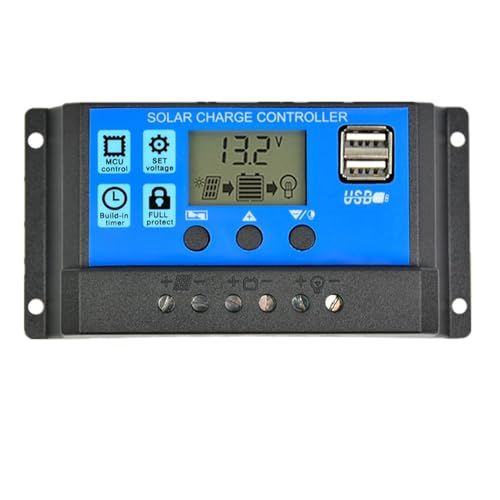
Dawnice 30A PWM Controller
A 30A controller that manages charging for 12V and 24V systems with an adjustable LCD display, dual USB ports and a timer setting.
Pros
- 30A current for 12V and 24V systems
- Adjustable LCD display stated
- Dual USB port stated
- Timer setting stated
Cons
- Title says both PWM and MPPT, which cannot both describe one controller
- No battery types are stated
- No protection list is stated
- No warranty term is stated
Detailed Review
The listing states a 30A PWM controller with 12V and 24V auto operation, an adjustable LCD display, a dual USB port and a timer setting, in a case measuring 5.28 by 0.78 by 2.76 inches. The title calls it both PWM and MPPT, which do not describe the same charging method, so the listing contradicts itself on the controller type. No battery types, protection list or warranty term is stated.
Who it's for: owners of a 12V or 24V setup who want a 30A controller with a display and USB charging. Who should skip it: owners who need a stated battery list or a stated protection list before buying.
Its Solar Score of 9.4/10 comes from performance 27/35, build 19/25, value 19/25, safety 0/10 and warranty 0/5: 65 of 100 points, placed on our 9.2 to 9.8 scale.
Key Specifications
| Current | 30A |
|---|---|
| System voltage | 12V/24V auto |
| Display | Adjustable LCD |
| Size | 5.28 x 0.78 x 2.76 in |
Figures as published on the retailer listing, collected 12 November 2026. Performance figures are manufacturer rated.
Safety and Warranty
What this listing states. No protection feature or safety listing is stated, so safety scores zero. No warranty term, so warranty scores zero. See How We Pick.
Stay under the input limit. Keep your panels' combined open circuit voltage, with cold weather margin, under the controller's stated maximum PV input, connect the battery first unless the manual says otherwise, and fuse both sides as the manual directs.
This is general buying information, not professional advice. Follow each product manual and local rules, and see our Safety Disclaimer.
As an Amazon Associate I earn from qualifying purchases.
How to Choose the Best PWM Controller
Match the amps to the panel
Start with the panel watts and the system voltage. A 10A controller in this guide supports up to 120W on a 12V system and up to 240W on a 24V system, while a 30A controller supports 360W on a 12V system and up to 1440W on a 48V system. Pick a controller whose stated limits cover the panel you own.
Match the voltage to the battery
Controllers in this guide auto-detect 12V or 24V systems, and one auto-detects 12V, 24V, 36V and 48V. Check that the controller lists the voltage your battery uses, and remember the wiring order the listings state: battery first, then the solar panel, then the load. See the MPPT vs PWM charge controller comparison if you are weighing the two types.
Check the battery list and the protections
Read the battery list before buying: some controllers need a manual setting for lithium, and the default setting on one listing is for lead-acid batteries. Compare the protection lists too, since the listings in this guide state overcurrent, short circuit, reverse polarity, overvoltage, overheating and anti-backflow protection in different combinations. See the best PWM charge controllers for a 12V battery for more options.
FAQ: power away from the grid
What does a PWM controller do?
It sits between a solar panel and a battery and manages charging in stages, bulk, absorption and float on one listing in this guide, so the battery charges in a controlled way. It also guards the system: the listings state protection against overcurrent, short circuits, reverse polarity and overvoltage.
Can a PWM controller charge a lithium battery?
Yes, on the listings that state it. One controller in this guide works with Li-ion and LiFePO4 batteries but needs manual selection of B2 for Li-ion or B3 for LiFePO4 before the solar panels are connected, and its default setting is for lead-acid batteries. Another lists lithium and LiFePO4 among its supported types, so check the listing for the battery type you own.
What size PWM controller do I need for a small setup?
Match the controller to the panel watts and the system voltage. A 10A controller in this guide supports up to 120W on a 12V system and up to 240W on a 24V system. For a larger array, a 30A controller in this guide supports 360W on a 12V system and up to 1440W on a 48V system.
Do I connect the battery or the panel first?
The battery first. Two listings in this guide state the same order: battery first, then the solar panel, then the load, and one warns that connecting in the wrong order can damage the controller.
Related solar guides
See the MPPT vs PWM charge controller comparison, the best PWM charge controllers for a 12V battery, the best charge controllers for a tiny house and every charge controller guide.