On this page
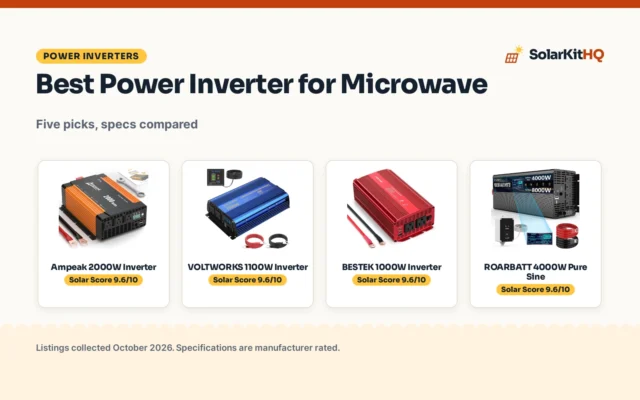
What size inverter to run a microwave is the question that decides whether dinner heats up or the inverter shuts down when the campsite goes quiet at dusk. A microwave is a hungry load: it draws far more power from the wall than the cooking watts on the door suggest, and it pulls a short spike when the magnetron starts. This guide shows how to read the label, size the inverter with headroom, and check the battery bank behind it.
SolarKitHQ earns a commission when you buy through links on this page, at no extra cost to you. As an Amazon Associate I earn from qualifying purchases. Affiliate disclosure.
The quick answer
Read the input watts on the microwave label, not the cooking watts on the door, and size the inverter above that figure with room for the startup spike. A pure sine wave inverter suits a microwave, since the controls and the magnetron expect clean AC. Then check the battery bank: the bank must feed the inverter for the whole run, and the cable between bank and inverter must match the inverter manual. See the size of inverter for solar power guide for the same sizing logic on other loads.
Step 1: Read the label, not the door
The cooking watts on the door say how much power goes into the food, not how much the microwave draws from the wall. The label on the back or inside the door gives the input watts, which is the figure the inverter must cover, and it is always higher than the cooking watts. Find the label before shopping for an inverter: the input watts are the starting point for every other choice in this guide.
If the label gives amps instead of watts, use the input watts from the manual rather than guessing: the manual states the figure the inverter must cover, and a guess that lands low leaves the microwave starved. A label that states neither figure is a sign to check the maker manual before buying anything.
| Microwave | What the label shows | Inverter note |
|---|---|---|
| Small countertop | Lowest input watts of the classes | Smallest inverter that covers the label |
| Mid-size countertop | Middle of the range | Mid-size inverter with surge headroom |
| Large or convection | Highest input watts of the classes | Largest inverter, pure sine wave |
These are broad classes, not hard lines. The label on the microwave is the figure that matters, so read it first and use the class only as a rough guide to what to expect.
Step 2: Allow for surge
A microwave pulls a short spike of extra power when the magnetron starts, on top of the steady draw while it cooks. The inverter must cover the spike as well as the steady draw, or it shuts down each time the microwave kicks in. Check the surge figure on the inverter listing, and leave headroom above the label input watts: an inverter that only just covers the steady draw has nothing left for the spike.
Too little headroom shows up at once: the inverter alarms or shuts down as the microwave starts, or the microwave runs but the food stays cold because the power sags. Either sign means the inverter is too small for the spike, not that the microwave is at fault. Size for the spike, and the steady draw takes care of itself.
Step 3: Pick pure sine wave
Microwaves run on pure sine wave AC, which is the smooth wave the grid supplies. A modified sine wave inverter can make a microwave run rough and hot, and it can confuse the electronic controls, so the pure sine wave model is the right call for this load even though it costs more than a modified sine wave model of the same size. See the inverter types guide for the difference in plain terms.
Step 4: Check the battery bank
The inverter is only the middle of the chain: the battery bank feeds it, and the cable carries the current between them. A microwave draws a heavy current for a short run, so the bank must hold enough charge for the whole cooking time, and the cable gauge must match the inverter manual. A bank that is low on charge sags sooner under a heavy load, so charge the bank before cooking and keep the run short. See the best inverters for a refrigerator if the same inverter must also run a fridge.
The cable between bank and inverter carries the full current of the load, so its gauge must match the inverter manual: a thin cable starves the inverter and heats up under load, while a cable of the right gauge stays cool and lets the inverter deliver what the label asks for. Keep the cable run short and the connections tight, and check the manual for the gauge it calls for before ordering.
Ways to make it work
- Run the microwave on its own: turn off other big loads while it runs, so the inverter serves one hungry load at a time.
- Heat food in short bursts: heat in short bursts with a pause between them, so the battery bank recovers between runs.
- Keep the bank charged: keep the battery bank charged before cooking, since a low bank sags sooner under a heavy load.
- Keep the run short: for camping and vans, a small microwave on a short run beats a large one on a long run.
What size inverter to run a microwave in an RV
An RV microwave runs the same way as one at home, with one difference: the battery bank is the only source, so the bank and the cable matter as much as the inverter. Size the inverter from the label input watts with surge headroom, pick pure sine wave, and check that the bank holds enough charge for the run. A small microwave suits a small bank, while a large microwave wants a bank with charge to spare. See the RV power inverter troubleshooting guide if a fitted setup gives trouble.
FAQ: power away from the grid
Can I run a microwave from a power inverter?
Yes, if the inverter continuous output covers the input watts on the microwave label and the surge figure covers the startup spike. Use a pure sine wave inverter, and check that the battery bank holds enough charge for the run.
Why does the inverter shut down when the microwave starts?
The startup spike is the usual cause: the surge figure on the inverter is too small for the spike, or the battery bank sags under the sudden load. Check the input watts on the microwave label against the surge figure on the inverter listing, and size for the spike.
Do I need a pure sine wave inverter for a microwave?
Yes, for any microwave with electronic controls. Pure sine wave AC runs the magnetron and the controls the way the maker intended, while a modified sine wave can make the microwave run rough and hot.
Can I run a microwave and a fridge from one inverter?
Add the input watts of the microwave to the running watts of the fridge, and size the inverter above the sum with room for the surge when each one starts. In practice it is often simpler to run them one at a time, so the inverter serves one hungry load at a time.
Related solar guides
See the inverter types, the size of inverter for solar power, the how to use an inverter, the best inverters for a refrigerator guide and every Controllers and Inverters guide.