On this page
For a small battery that needs topping up, a 12v panel fits the job, while a 24v panel fits a larger battery bank that runs at the higher voltage, and the 12v vs 24v solar panel comparison below shows where the listings actually differ. The 24v SUNER POWER examples state built-in MPPT charge control and a long list of protections, while the 12v examples state simpler charging without a built-in controller. A buyer who already runs a 24v battery should pick the 24v side, and a buyer who maintains a 12v battery should pick the 12v side.
SolarKitHQ earns a commission when you buy through links on this page, at no extra cost to you. As an Amazon Associate I earn from qualifying purchases. Affiliate disclosure.
12v vs 24v: side by side
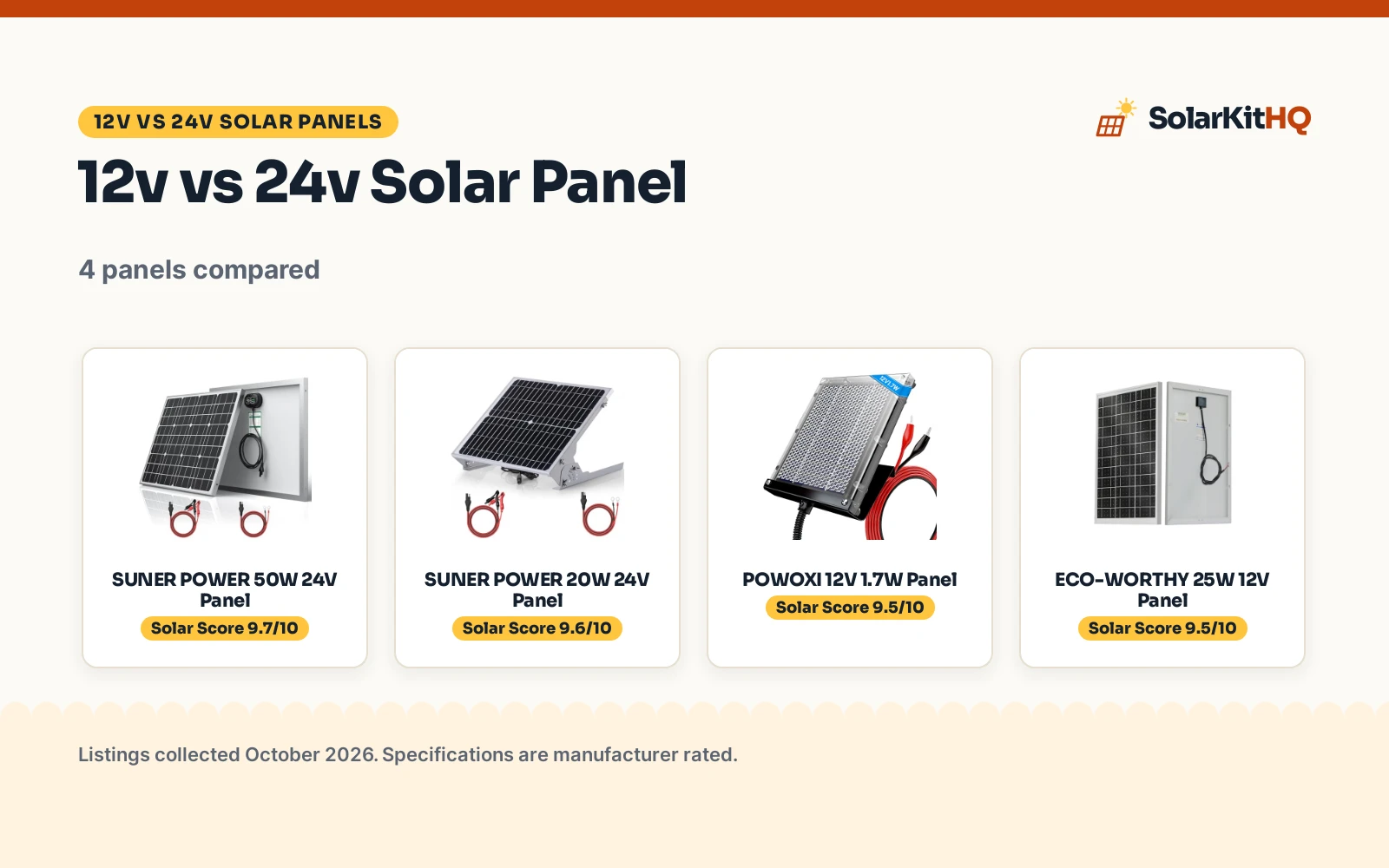
| 12v vs 24v solar panel | SUNER POWER 50W 24V Panel | SUNER POWER 20W 24V Panel | POWOXI 12V 1.7W Panel | ECO-WORTHY 25W 12V Panel | Amazon |
|---|---|---|---|---|---|
| Side | 24v solar panel | 24v solar panel | 12v | 12v | |
| Panel watts | 50W | 20W | 1.7W | 25W | |
| Battery voltage | 24V | 24V | 12V | 12V | |
| Charge control | Built-in MPPT | Built-in MPPT | Not stated | Not stated | |
| Weather code | Not stated | Not stated | IP65 | Not stated | |
| Warranty | Not stated | 1 Year | 1 Year | Not stated | |
| Panel size | 26.4 x 20.7 x 1.0 inches | 16.5 x 13.2 x 0.7 inches | 7.28 x 5.91 x 2.24 inches | 16.5 x 12.6 x 0.7 inches |
All numbers here are manufacturer claims from the listings, not our measurements (2 November 2026).
Panel watts and daily output
Panel watts differ more between listings than between sides. The SUNER POWER 50W example states 50W, while the SUNER POWER 20W example states 20W. The ECO-WORTHY example states 25W and up to 100Wh per day under 4 hours of full sunshine. The POWOXI example states 1.7W with no daily output figure in watt-hours stated. A watt figure alone does not state daily output, because only the ECO-WORTHY example states a daily output figure in watt-hours.
Charge control and protections
The SUNER POWER 50W example states built-in MPPT control with up to 99% tracking efficiency and up to 98% conversion efficiency. The SUNER POWER 20W example states the same built-in MPPT control figures. The SUNER POWER examples state 3-stage charging with Bulk, Absorption and Float stages, plus 3 battery modes for 24V, 24V AGM and 24V Lithium batteries. The SUNER POWER examples state protections for over-charge, over-discharge, over-voltage, over-current, over-load, short circuit, reverse polarity and over-temperature. The ECO-WORTHY example states connection to a charge controller through an extension cable, with no built-in controller stated. The POWOXI example states no charge controller. The SUNER POWER 50W example states it will not work with 12V batteries, so voltage matching matters before choosing a panel from the 24v side.
Size and mounting
The SUNER POWER 50W example measures 26.4 inches by 20.7 inches by 1.0 inches. The SUNER POWER 20W example measures 16.5 inches by 13.2 inches by 0.7 inches. The ECO-WORTHY example measures 16.5 inches by 12.6 inches by 0.7 inches, weighs 3.1 pounds and states pre-drilled holes for mounting. The POWOXI example measures 7.28 inches by 5.91 inches by 2.24 inches, weighs 0.95 pounds and states an aluminum bracket angled at 45 degrees. Size alone does not state mounting ease, because the listings state different mounting details for each panel.
What the listings leave unclear
The ECO-WORTHY example states no warranty term and no IP code, so protection and coverage cannot be judged from that listing. The SUNER POWER 50W example states no warranty term. The SUNER POWER 20W example states a 1 Year Warranty. The POWOXI example states no charge controller and no daily output figure, so its charging performance cannot be compared on those figures. The SUNER POWER 20W example states no weight figure in its spec table. Where a figure is missing, the listing leaves it unclear, rather than showing a win for the other side.
The examples
| # | Product | Solar Score | Buy |
|---|---|---|---|
| 1 |  SUNER POWER 50W 24V Panel | 9.7/10 | Buy on Amazon |
| 2 |  SUNER POWER 20W 24V Panel | 9.6/10 | Buy on Amazon |
| 3 |  POWOXI 12V 1.7W Panel | 9.5/10 | Buy on Amazon |
| 4 |  ECO-WORTHY 25W 12V Panel | 9.5/10 | Buy on Amazon |

SUNER POWER 50W 24V Panel
A 50W 24V solar panel stating built-in MPPT charge control, 3-stage charging and 8 listed protections, with charge level indicators and 3 battery modes.
Pros
- 50W panel with built-in MPPT control, up to 99% tracking efficiency and up to 98% conversion efficiency stated
- 3-stage charging with Bulk, Absorption and Float stages
- 3 battery modes for 24V, 24V AGM and 24V Lithium batteries
- Charge level indicators showing 25%, 50%, 75% and 100% charge stages
Cons
- No warranty term is stated in the listing
- Panel measures 26.4 inches by 20.7 inches by 1.0 inches, the largest panel size in the comparison
- Designed for 24V batteries only and will not work with 12V batteries
- Utilization improvement of 20%-30% is stated as approximate, not as a measured output figure
Detailed Review
The listing states a 50W 24V panel with built-in MPPT control, 3-stage charging, 3 battery modes and charge level indicators, plus a list of protections covering over-charge, over-discharge, over-voltage, over-current, over-load, short circuit, reverse polarity and over-temperature. The listing also states the panel is specifically designed for 24V batteries and will not work with 12V batteries, so voltage matching matters for this example.
Who it's for: a buyer with a 24V battery who wants built-in MPPT control and listed protections. Who should skip it: a buyer with a 12V battery or a buyer who needs a stated warranty term.
Its Solar Score of 9.7/10 comes from performance 33/35, build 21/25, value 21/25, safety 9/10 and warranty 0/5: 84 of 100 points, placed on our 9.2 to 9.8 scale.
Key Specifications
| Panel watts | 50W |
|---|---|
| Battery voltage | 24V |
| Charge control | Built-in MPPT |
| Dimensions | 26.4 x 20.7 x 1.0 inches |
Figures as published on the retailer listing, collected 2 November 2026. Performance figures are manufacturer rated.
Safety and Warranty
What this listing states. Over-charge, over-discharge, over-voltage, over-current, over-load, short circuit, reverse polarity and over-temperature protections, so safety scores 9 of 10. No warranty term, so warranty scores zero. See How We Pick.
Panels make voltage in daylight. Keep connectors covered until you connect them, check the panel's stated open circuit voltage and current against your controller or power station input limits, and use cables rated for the current. Roof and permanent mounts belong to a qualified installer.
This is general buying information, not professional advice. Follow each product manual and local rules, and see our Safety Disclaimer.

SUNER POWER 20W 24V Panel
A 20W 24V solar panel stating built-in MPPT charge control, 3-stage charging and 8 listed protections, with a 1 Year Warranty stated.
Pros
- 20W panel with built-in MPPT control, up to 99% tracking efficiency and up to 98% conversion efficiency stated
- 3-stage charging with Bulk, Absorption and Float stages
- 3 battery modes for 24V, 24V AGM and 24V Lithium batteries
- 1 Year Warranty stated in the listing
Cons
- Lower panel watts than the 50W example in the comparison
- Utilization improvement of 20%-30% is stated as approximate, not as a measured output figure
- No weight figure is stated in the spec table
- No mounting hardware detail is stated in the listing
Detailed Review
The listing states a 20W 24V panel with built-in MPPT control, 3-stage charging, 3 battery modes and charge level indicators, plus the same list of protections as the 50W example. The listing states a 1 Year Warranty, which the 50W example does not state.
Who it's for: a buyer with a 24V battery who wants built-in MPPT control with a stated warranty term. Who should skip it: a buyer with a 12V battery or a buyer who needs higher panel watts than 20W.
Its Solar Score of 9.6/10 comes from performance 28/35, build 21/25, value 21/25, safety 9/10 and warranty 1/5: 80 of 100 points, placed on our 9.2 to 9.8 scale.
Key Specifications
| Panel watts | 20W |
|---|---|
| Battery voltage | 24V |
| Charge control | Built-in MPPT |
| Dimensions | 16.5 x 13.2 x 0.7 inches |
Figures as published on the retailer listing, collected 2 November 2026. Performance figures are manufacturer rated.
Safety and Warranty
What this listing states. Over-charge, over-discharge, over-voltage, over-current, over-load, short circuit, reverse polarity and over-temperature protections, so safety scores 9 of 10. 1 Year Warranty. It does not say everything a buyer needs, such as who pays return shipping, so warranty scores 1 of 5. See How We Pick.
Panels make voltage in daylight. Keep connectors covered until you connect them, check the panel's stated open circuit voltage and current against your controller or power station input limits, and use cables rated for the current. Roof and permanent mounts belong to a qualified installer.
This is general buying information, not professional advice. Follow each product manual and local rules, and see our Safety Disclaimer.

POWOXI 12V 1.7W Panel
A 12V 1.7W solar panel battery charger stating an IP65 code, a 95% light-transmitting cover and a stainless steel flex-conduit for feeder batteries.
Pros
- IP65 code with a cover stating 95% light transmittance
- Stainless steel flex-conduit protecting the charger cables from wear and bending
- Aluminum bracket angled at 45 degrees for sunlight absorption
- 1 Year Manufacturer warranty stated in the listing
Cons
- No daily output figure in watt-hours is stated in the listing
- No charge controller is stated in the listing
- Panel size is limited to 7.28 inches by 5.91 inches by 2.24 inches
- Alligator clip length is only 3.3FT
Detailed Review
The listing states a 12V 1.7W panel with an IP65 code, a 95% light-transmitting polycarbonate cover, a stainless steel flex-conduit and an aluminum bracket angled at 45 degrees. The listing states compatibility with 12V rechargeable batteries for camps and deer feeders, with a 3.3FT alligator clip for battery connection.
Who it's for: a buyer who maintains a 12V feeder battery outdoors. Who should skip it: a buyer who needs a panel for a larger battery bank or a stated charge controller.
Its Solar Score of 9.5/10 comes from performance 23/35, build 20/25, value 20/25, safety 7/10 and warranty 1/5: 71 of 100 points, placed on our 9.2 to 9.8 scale.
Key Specifications
| Panel watts | 1.7W |
|---|---|
| Battery voltage | 12V |
| Weather code | IP65 |
| Dimensions | 7.28 x 5.91 x 2.24 inches |
Figures as published on the retailer listing, collected 2 November 2026. Performance figures are manufacturer rated.
Safety and Warranty
What this listing states. IP65 weather protection, so safety scores 7 of 10. 1 Year Manufacturer. It does not say everything a buyer needs, such as who pays return shipping, so warranty scores 1 of 5. See How We Pick.
Panels make voltage in daylight. Keep connectors covered until you connect them, check the panel's stated open circuit voltage and current against your controller or power station input limits, and use cables rated for the current. Roof and permanent mounts belong to a qualified installer.
This is general buying information, not professional advice. Follow each product manual and local rules, and see our Safety Disclaimer.

ECO-WORTHY 25W 12V Panel
A 25W monocrystalline solar panel stating up to 100Wh per day under 4 hours of full sunshine, a 21% conversion rate and charging for a 12V battery.
Pros
- 25W monocrystalline panel with up to 100Wh per day under 4 hours of full sunshine
- 21% conversion rate with high-transparency tempered glass and monocrystalline cells
- Dimensions of 16.5 inches by 12.6 inches by 0.7 inches with pre-drilled holes for mounting
- Extension cable of 39.3 inches for connection to a charge controller or 12V DC load
Cons
- No warranty term is stated in the listing
- No IP code is stated in the listing
- No built-in charge controller is stated in the listing
- Daily output figure depends on 4 hours of full sunshine, which the listing states as the condition
Detailed Review
The listing states a 25W panel for charging a 12V battery, with up to 100Wh per day under 4 hours of full sunshine, a 21% conversion rate, tempered glass and a corrosion-resistant aluminum frame. The listing also states wind loads of 2400Pa and snow loads of 5400Pa, with a junction box and pre-drilled holes for mounting.
Who it's for: a buyer with a 12V battery who wants a plain 25W panel with a stated daily output figure. Who should skip it: a buyer who needs a stated warranty term, a stated IP code or a built-in charge controller.
Its Solar Score of 9.5/10 comes from performance 29/35, build 21/25, value 21/25, safety 0/10 and warranty 0/5: 71 of 100 points, placed on our 9.2 to 9.8 scale.
Key Specifications
| Panel watts | 25W |
|---|---|
| Daily output | 100Wh per day |
| Conversion rate | 21% |
| Dimensions | 16.5 x 12.6 x 0.7 inches |
Figures as published on the retailer listing, collected 2 November 2026. Performance figures are manufacturer rated.
Safety and Warranty
What this listing states. No UL, TÜV or IEC listing and no weather rating is stated, so safety scores zero. No warranty term, so warranty scores zero. See How We Pick.
Panels make voltage in daylight. Keep connectors covered until you connect them, check the panel's stated open circuit voltage and current against your controller or power station input limits, and use cables rated for the current. Roof and permanent mounts belong to a qualified installer.
This is general buying information, not professional advice. Follow each product manual and local rules, and see our Safety Disclaimer.
As an Amazon Associate I earn from qualifying purchases.
Where the points went
The Solar Score weighs performance, build, value, safety and warranty. For a panel, safety means protections and weather codes the listing actually states; a panel that states no protection scores zero on that line, whatever its watts. 2 of the 4 panels state a warranty term, and 1 of the 4 panels states an IP code. How we pick explains the weights.
| Product | Solar Score | Perf. /35 | Build /25 | Value /25 | Safety /10 | Warranty /5 |
|---|---|---|---|---|---|---|
| SUNER POWER 50W 24V Panel | 9.7 | 33 | 21 | 21 | 9 | 0 |
| SUNER POWER 20W 24V Panel | 9.6 | 28 | 21 | 21 | 9 | 1 |
| POWOXI 12V 1.7W Panel | 9.5 | 23 | 20 | 20 | 7 | 1 |
| ECO-WORTHY 25W 12V Panel | 9.5 | 29 | 21 | 21 | 0 | 0 |
Scores start at 9.2 for the lowest totals and top out at 9.8. In between, a kit’s position follows its weighted points one to one in order.
12v vs 24v solar panel: which should you choose?
Pick the 12v side for a 12V battery: the ECO-WORTHY example charges a 12V battery, and the POWOXI example maintains a 12V feeder battery. Pick the 24v side for a 24V battery: the SUNER POWER examples state charging for 24V batteries, with selectable modes for 24V, 24V AGM and 24V Lithium. Do not mix voltages: the SUNER POWER 50W example states it will not work with 12V batteries.
| If you need | Look at |
|---|---|
| A panel for a 12V battery | ECO-WORTHY 25W 12V Panel with 100Wh per day under 4 hours of full sunshine |
| A maintainer for a 12V feeder battery | POWOXI 12V 1.7W Panel with an IP65 code and a 45-degree bracket |
| A 24V panel with a warranty stated | SUNER POWER 20W 24V Panel with a 1 Year Warranty stated |
| The highest panel watts in the comparison | SUNER POWER 50W 24V Panel with 50W and built-in MPPT control |
Sizing Notes
- Match the panel to the battery it charges: the ECO-WORTHY example is a 25W panel for charging a 12V battery.
- Match charge control to the battery: the SUNER POWER 50W example states built-in MPPT control with modes for 24V, 24V AGM and 24V Lithium batteries.
- Match panel size to mounting space: the SUNER POWER 20W example measures 16.5 inches by 13.2 inches by 0.7 inches.
- Check the cable length for the mounting spot: the ECO-WORTHY example states an extension cable of 39.3 inches.
FAQ: power away from the grid
Can a 24V panel charge a 12V battery?
The SUNER POWER 50W example states it will not work with 12V batteries, so a 24V panel should be matched to a 24V battery.
Which panels here state a built-in MPPT controller?
The SUNER POWER 50W example and the SUNER POWER 20W example each state a built-in MPPT charge controller.
What daily output does the ECO-WORTHY panel state?
The listing states up to 100Wh per day under 4 hours of full sunshine.
Which panels state a warranty term?
The POWOXI example states 1 Year Manufacturer. The SUNER POWER 20W example states 1 Year Warranty.
Related solar guides
See every Rigid and Flexible Panels guide and all Solar Panels and Kits guides.
More picks: monocrystalline vs polycrystalline solar panel, mppt vs pwm for small solar panel, roof mount vs wall mount solar panel and series vs parallel solar panels.