On this page
The listings behind 24v vs 48v solar system do not contain two systems. They contain the two ends of one: on the 24V side, a 50W panel kit with a 10A PWM controller for keeping a 24V battery charged; on the 48V side, a 314Ah LiFePO4 battery holding 16.07kWh, with no panel, controller or inverter at all. So this comparison reads the voltage question through what each listing actually supplies. A 24V setup here means a small maintenance kit for vehicles and boats. A 48V setup here means whole-home storage that still needs panels and an inverter built around it. We compared stated capacity, function, protection and warranty, using only what each listing publishes.
SolarKitHQ earns a commission when you buy through links on this page, at no extra cost to you. As an Amazon Associate I earn from qualifying purchases. Affiliate disclosure.
Compare the picks
| Spec | ECO-WORTHY Powermega 48V | SOLPERK 50W 24V Panel Kit |
|---|---|---|
| What it is | LiFePO4 storage battery | Panel kit with controller |
| Rating | 314Ah, 16.07kWh | 50W panel, 10A PWM |
| System role | Stores energy | Charges a 24V battery |
| Certifications | UL 1973 | IP67 panel, IP65 controller |
| Warranty | 10 Year Manufacturer | Not stated |
Specifications are manufacturer rated as listed, collected 22 October 2026. One listing generates a trickle of power; the other stores a household’s worth. Neither is a complete system.
The picks: 24v vs 48v solar system

ECO-WORTHY Powermega 48V
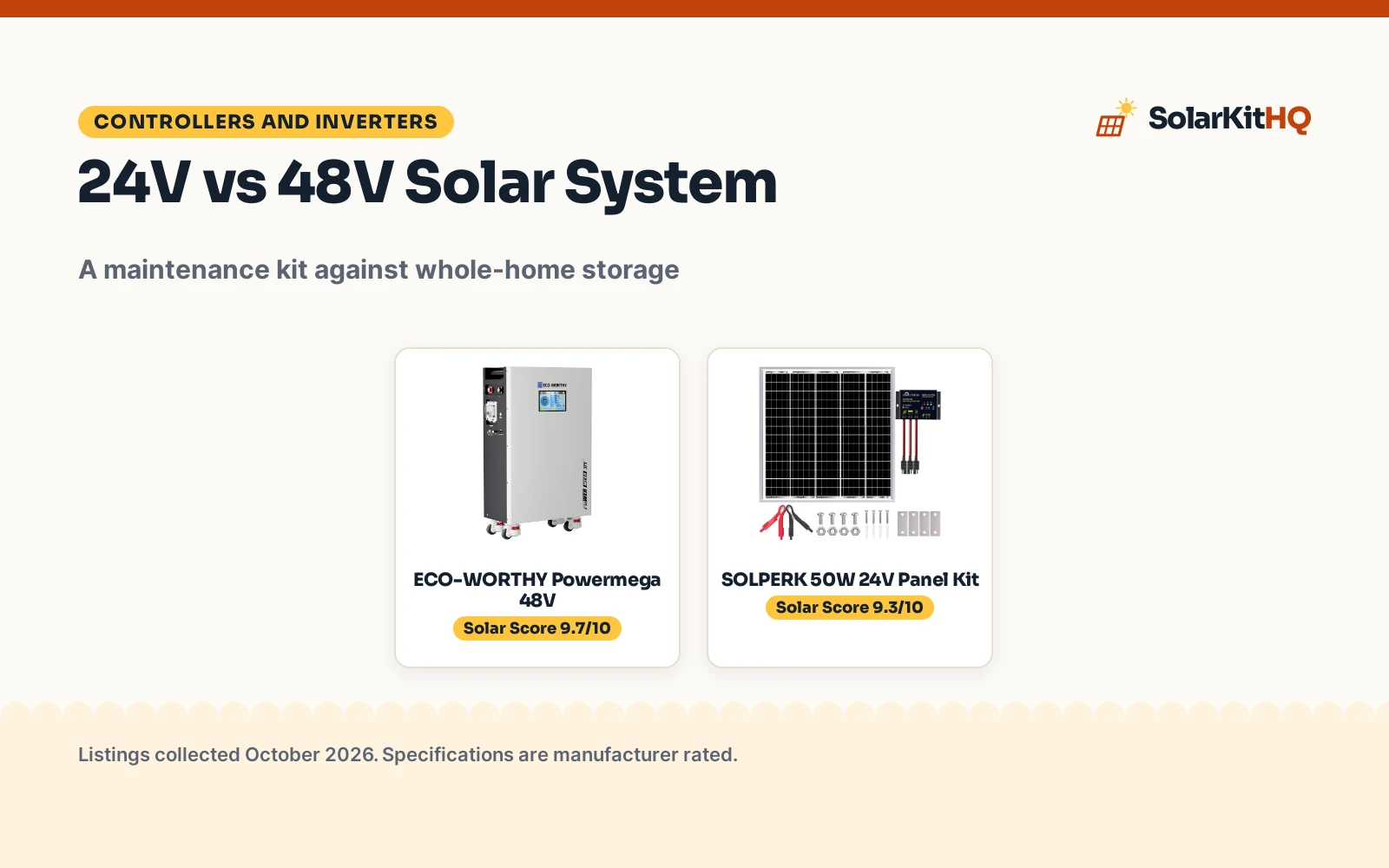
The ECO-WORTHY Powermega 48V 314Ah LiFePO4 battery, a 16.07kWh storage unit with a 200A active balancing BMS, breakers and a 7 inch touchscreen.
Pros
- 16.07kWh in one unit
- Parallels up to 15 units
- 200A active balancing BMS
- Aerosol fire protection built in
Cons
- Battery only, no panels or inverter
- 293.2 pounds, truck delivery
- 51.2V nominal, not 48V even
- No charger included
Detailed Review
The listing states a 48V 314Ah LiFePO4 battery delivering 16.07kWh at 51.2V nominal, UL 1973 certified with a 10-year warranty, a 200A smart BMS with active cell balancing, an external two-pole circuit breaker, integrated aerosol fire-suppression modules, a 7 inch HD touchscreen with WiFi and Bluetooth monitoring, RS485 and CAN ports, and parallel expansion up to 15 units reaching 241kWh. It weighs 293.2 pounds and ships on a pallet by truck. As the 48V side of this comparison it is storage only: no panel, no controller and no inverter is included, so a system still has to be built around it.
Who it's for: off-grid and whole-home backup builds that need serious storage with certified safety and room to expand. Who should skip it: anyone wanting a small ready-to-run kit, or a 24V system, which this battery does not serve.
Its Solar Score of 9.7/10 comes from performance 33/35, build 22/25, value 16/25, safety 9/10 and warranty 5/5: 85 of 100 points, placed on our 9.2 to 9.8 scale.
Key Specifications
| Capacity | 314Ah, 16.07kWh |
|---|---|
| Voltage | 51.2V nominal |
| BMS | 200A, active balancing |
| Weight | 293.2 pounds |
Figures as published on the retailer listing, collected 22 October 2026. Performance figures are manufacturer rated.
Safety and Warranty
What this listing states. UL 1973, so safety scores 9 of 10. 10 Year Manufacturer, so warranty scores 5 of 5. See How We Pick.
Stay under the input limit. Keep your panels' combined open circuit voltage, with cold weather margin, under the controller's stated maximum PV input, connect the battery first unless the manual says otherwise, and fuse both sides as the manual directs.
This is general buying information, not professional advice. Follow each product manual and local rules, and see our Safety Disclaimer.

SOLPERK 50W 24V Panel Kit
The SOLPERK solar panel kit 50W 24V, a monocrystalline panel with an intelligent 10A PWM controller and alligator clips, for charging 24V batteries.
Pros
- Complete trickle kit in the box
- 10A PWM controller included
- IP67 panel rating
- Pre-drilled frame, adjustable mounts
Cons
- 50W is maintenance scale only
- No battery or inverter included
- No warranty term stated
- PWM, not MPPT
Detailed Review
The listing states a 50W monocrystalline panel for 24V battery systems with a conversion rate of up to 30%, an intelligent 10A PWM controller with overcharge, over-discharge, over-voltage and short-circuit protection, an IP67 rating on the panel and IP65 on the controller, pre-drilled holes with adjustable mounts, alligator clips in the box, and support for LiFePO4, AGM and GEL batteries across RV, boat, marine and tractor use. It also states 24/7 customer service and a 1-year after-sales service, which is service cover rather than a stated warranty term, so warranty scores zero.
Who it's for: keeping a 24V battery topped up on a vehicle, boat or fence line with a complete small kit. Who should skip it: anyone building household power; 50W maintains a battery, it does not run a home.
Its Solar Score of 9.3/10 comes from performance 19/35, build 16/25, value 18/25, safety 8/10 and warranty 0/5: 61 of 100 points, placed on our 9.2 to 9.8 scale.
Key Specifications
| Panel | 50W monocrystalline |
|---|---|
| Controller | 10A PWM |
| Ratings | IP67 panel, IP65 controller |
| Output | 24 volts DC |
Figures as published on the retailer listing, collected 22 October 2026. Performance figures are manufacturer rated.
Safety and Warranty
What this listing states. IP67 panel, IP65 controller, so safety scores 8 of 10. No warranty term, so warranty scores zero. See How We Pick.
Stay under the input limit. Keep your panels' combined open circuit voltage, with cold weather margin, under the controller's stated maximum PV input, connect the battery first unless the manual says otherwise, and fuse both sides as the manual directs.
This is general buying information, not professional advice. Follow each product manual and local rules, and see our Safety Disclaimer.
As an Amazon Associate I earn from qualifying purchases.
How we scored them
The Solar Score weighs performance, build, value, safety and warranty. The battery dominates on stated substance: UL 1973 certification, a 200A active balancing BMS, breakers, aerosol fire protection and a 10-year manufacturer warranty against the panel kit’s IP ratings and a 1-year after-sales service that states no warranty term. That gap reflects what the two products are, a certified storage unit against a small charging kit, more than any quality verdict on the kit itself. Read the scores as a map of scope: the 48V side is the foundation of a large system, the 24V side is a complete answer to a small one.
| Product | Solar Score | Perf. /35 | Build /25 | Value /25 | Safety /10 | Warranty /5 |
|---|---|---|---|---|---|---|
| ECO-WORTHY Powermega 48V | 9.7 | 33 | 22 | 16 | 9 | 5 |
| SOLPERK 50W 24V Panel Kit | 9.3 | 19 | 16 | 18 | 8 | 0 |
Scores run from 9.2 to 9.8: each product’s point total is placed on that range, so more points always means a higher score.
What the voltage choice really decides
In the listings’ own terms, the difference is scale. The 24V kit outputs 24 volts DC at 50W through a 10A controller: enough to maintain LiFePO4, AGM or GEL batteries on an RV, boat, tractor or fence line, which is exactly the work its listing describes. The 48V battery stores 16.07kWh at 51.2V nominal and parallels up to 15 units for 241kWh, aimed at outages, off-grid systems and whole-home backup. A buyer choosing between 24V and 48V is really choosing between those two jobs, tending a battery or banking a household’s energy, and the equipment on each side of this page matches its job completely and the other job not at all. Voltage match still rules every connection: the kit charges 24V batteries only, and the battery serves 48V systems only.
Safety and support, as stated
The battery carries the deeper safety file: UL 1973 certification, genuine Grade A cells per its listing, a 200A BMS plus an external two-pole breaker against over-current and short circuits, and aerosol fire-suppression modules aimed at thermal runaway, with a 10-year warranty behind the unit. The panel kit’s protections sit in its controller: overcharge, over-discharge, over-voltage and short-circuit protection, an IP67 rating on the panel and IP65 on the controller, and 24/7 customer service with a 1-year after-sales service. Neither listing overstates its side: the kit never claims household output, and the battery never claims to include the rest of a system. The voltage-family question at the inverter level is covered in the 12V vs 24V inverter comparison.
Sizing Notes
- Keeping a 24V battery alive on a vehicle, boat or fence: the SOLPERK kit is the complete pick.
- Banking energy for outages or off-grid living: the ECO-WORTHY battery is the foundation, with panels and an inverter still to buy.
- Running a home from the 50W kit: outside its stated job by a wide margin.
- Mixing voltages: neither product crosses over; the kit is 24V only and the battery is 48V only.
Frequently Asked Questions
Is 24V or 48V better for a solar system?
These listings frame it as scale: the 24V side is a 50W maintenance kit for vehicle and boat batteries, the 48V side is 16.07kWh of storage for outages and off-grid homes. The better voltage is the one your loads and battery bank are built on.
Does the ECO-WORTHY battery include panels or an inverter?
No. It is a battery with a BMS, breakers, monitoring and ports. Panels, a controller and an inverter are separate purchases.
What can the SOLPERK 50W kit actually run?
Its listing aims it at charging and maintaining 24V batteries, LiFePO4, AGM and GEL, for RV, car, boat, marine, tractor and fence use. It is a charger kit, not a household supply.
How much can the 48V battery expand?
Up to 15 units in parallel, reaching 241kWh per its listing, with a 200A active balancing BMS in each unit.
Related guides
See every controllers and inverters guide.
More picks: browse inverter vs UPS and solar light bulbs.