On this page
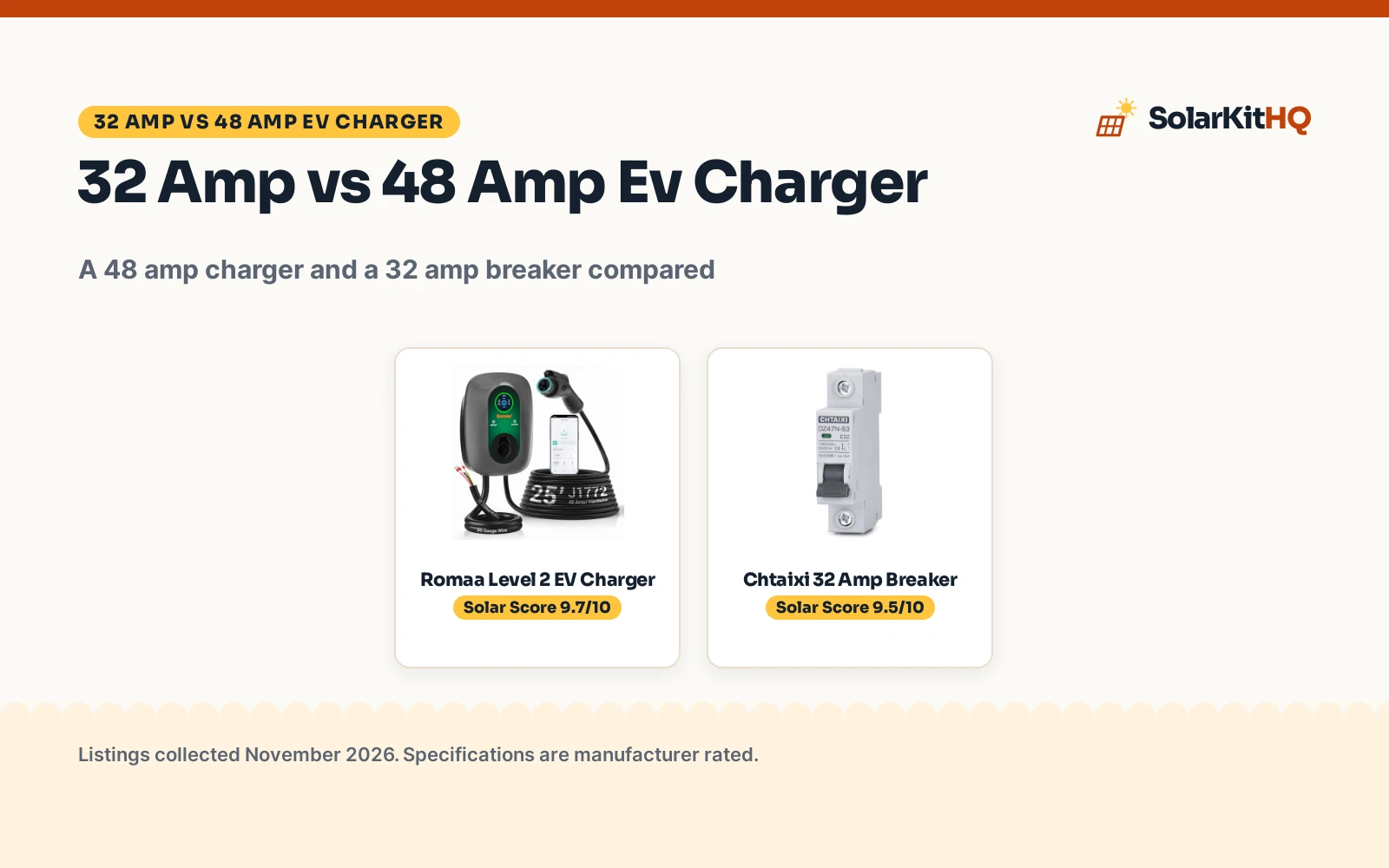
The question behind 32 amp vs 48 amp ev charger is a practical one: the car sits in the driveway at dusk, the day ahead needs a full battery, and the charger on the wall has to deliver. There is no 32 amp EV charger among the two examples: the 32 amp example is a Chtaixi miniature circuit breaker, a protection device for an AC circuit, not a charger. The only charger here is the Romaa Level 2 EV Charger at 48 amps and 11.5 kW on 240V, with a WiFi app, a 25 ft cable and a 2-year warranty. A buyer who wants to charge a car at home picks the Romaa side; a buyer who needs a 32 amp protection device for an AC circuit picks the Chtaixi breaker for that job, not for charging.
SolarKitHQ earns a commission when you buy through links on this page, at no extra cost to you. As an Amazon Associate I earn from qualifying purchases. Affiliate disclosure.
32 amp vs 48 amp ev charger: side by side
| EV Charger | Solar Score | Amps | Voltage | Charging power | Cable length |
|---|---|---|---|---|---|
| Romaa Level 2 EV Charger | 9.7/10 | 48 Amp | 240V | 11.5 kW | 25 ft |
| Chtaixi 32 Amp Breaker | 9.5/10 | 32 Amp | 120V/240V | Not stated | Not stated |
All numbers here are manufacturer claims from the listings, not our measurements (21 November 2026).
What the amp figure means
Amps and kilowatts describe how fast the Romaa charges: the maker rates it at 48 amps and 11.5 kW on 240V, and states that a typical 65 kWh battery goes from 10% to 80% in about 4 hours, with the actual time depending on the vehicle onboard charger capacity and settings. The Chtaixi breaker is rated at 32 amps too, but that figure is a protection rating for an AC circuit, not charging power: the maker describes it as a miniature circuit breaker that protects a 120V/240V AC circuit from overload and short circuit damage, and gives no charging power, no cable and no connector.
That difference decides the comparison. The Romaa pairs its 48 amp rating with 11.5 kW, while the Chtaixi pairs its 32 amp rating with a thermal magnetic trip and a Curve C magnetic trip range of 5 to 10 times rated current. The Romaa is the side that charges a car; the Chtaixi is the side that guards a circuit. Neither figure can be read across to the other product: the breaker states no kilowatts, and the charger states no trip curve.
Controls and monitoring
The Romaa carries the controls for home charging: a WiFi app for monitoring from a phone, with charging status in real time, energy usage history, charging schedules and notifications when charging is complete, plus scheduled charging that starts the car automatically when plugged in. A built-in color touchscreen, a 3 inch LCD smart display, shows charging status, power level, session time, energy delivered and any error codes, so the charger can be read without a phone.
The Chtaixi carries a different kind of control: a color indicator on the shell, screw clamp wires and a 35mm DIN rail mount, with control and isolation as stated functions alongside protection. It states no app, no display and no schedule: its job is to sit in a circuit and trip on overload or short circuit, not to manage a charging session.
Outdoor use and fit
The Romaa is built for a fixed spot indoors or out: a NEMA Type 4 and IP66 rated enclosure, a wall-mounted hardwired design, and a 25 ft cable that reaches a car parked in a garage, driveway or carport. The box includes a mounting plate, screws, installation tools and a manual, plus a 24-inch power input cord. The maker recommends professional electrician installation.
The Chtaixi is far smaller: 2.95 by 0.7 by 3.15 inches, a 1-pole device for 120V/240V AC circuits, with a 35mm DIN rail mount and screw clamp wires. The maker lists applications in solar AC systems, RV and home circuits, and other AC systems. It states no cable length, no connector and no enclosure rating, so its fit is judged on the circuit it protects, not on a parking spot.
What the listings leave unclear
The 32 amp side leaves the charging question open: the Chtaixi states no charging power, no connector, no cable and no charge time, because it is a breaker and not a charger. A buyer who wants a 32 amp charger finds no such product here, and the comparison cannot say how a 32 amp charger would perform from these examples.
The 48 amp side leaves some questions open too: the Romaa states a charge time of about 4 hours for a typical 65 kWh battery from 10% to 80%, and states that the actual time depends on the vehicle onboard charger capacity and settings. It states a 2-year warranty and ETL listing, while the Chtaixi states no warranty term and no certification, so warranty and certification can be compared only on the Romaa side.
Two examples

Romaa Level 2 EV Charger
A hardwired 48 amp Level 2 EV charger with a J1772 connector, WiFi app, a 25 ft cable and a 3 inch display, rated at 11.5 kW on 240V.
Pros
- 48 amp charging at up to 11.5 kW on 240V, per the maker
- WiFi app with schedules, energy history and charge notifications
- 25 ft cable and a 3 inch display showing status and energy delivered
- ETL Listed with ground fault, temperature and overcurrent protection stated
Cons
- Hardwired install, with professional electrician installation recommended
- Tesla and NACS vehicles need an adapter, which is not included
- The stated 4 hour charge time covers a typical 65 kWh battery, not every vehicle
- It needs a fixed wall spot
Detailed Review
The maker rates the Romaa at 48 amps and 11.5 kW on 240V, hardwired, with a J1772 connector and a 25 ft cable. A typical 65 kWh battery goes from 10% to 80% in about 4 hours, per the maker, with the actual time depending on the vehicle onboard charger capacity and settings. A WiFi app gives charging status in real time, energy usage history, charging schedules and notifications, and a 3 inch color touchscreen shows charging status, power level, session time, energy delivered and error codes. The enclosure is NEMA Type 4 and IP66 rated, the charger is ETL Listed and FCC Part 15 compliant, and the stated protections include ground fault protection, temperature monitoring, over-voltage, under-voltage, overcurrent and short-circuit protection. The box includes a mounting plate, screws, installation tools and a manual, plus a 24-inch power input cord, and the maker recommends professional electrician installation. A 2-year manufacturer warranty is stated.
Who it's for: a buyer who wants a hardwired 48 amp home charger with an app, a display and a long cable for a J1772 vehicle. Who should skip it: a buyer who needs a plug-in charger, a Tesla or NACS driver without an adapter, or anyone whose vehicle onboard charger cannot use the stated 48 amps.
Its Solar Score of 9.7/10 comes from performance 30/35, build 21/25, value 21/25, safety 9/10 and warranty 4/5: 85 of 100 points, placed on our 9.2 to 9.8 scale.
Key Specifications
| Amps | 48 Amp |
|---|---|
| Power | 11.5 kW at 240V |
| Cable | 25 ft |
| Display | 3 inch LCD |
Taken from the seller's listing on 21 November 2026. Capacity and output figures are rated by the manufacturer.
Safety and Warranty
What this listing states. ETL Listed, FCC Part 15 compliant, IP66 and NEMA Type 4 enclosure, ground fault, temperature, over-voltage, under-voltage, overcurrent and short-circuit protection stated, so safety scores 9 of 10. 2-year manufacturer warranty stated. It does not say everything a buyer needs, such as who pays return shipping, so warranty scores 4 of 5. See How We Pick.
Match the charger. Use a charger mode that matches your battery's stated chemistry and voltage, connect in the order the manual gives, and keep it ventilated and dry.
This is general buying information, not professional advice. Follow each product manual and local rules, and see our Safety Disclaimer.

Chtaixi 32 Amp Breaker
A 32 amp 1-pole AC miniature circuit breaker with thermal magnetic trip and a 35mm DIN rail mount, rated 120V/240V.
Pros
- Magnetic trip range of 5 to 10 times rated current, per the maker
- Silver alloy contacts and a flame retardant shell
- Protects AC circuits from overload and short circuit damage
- Compact at 2.95 by 0.7 by 3.15 inches with a 35mm DIN rail mount
Cons
- It is a circuit breaker, not an EV charger, so it cannot charge a vehicle
- Single pole only, for 120V/240V AC circuits
- No warranty term is stated
- Mounts only on a 35mm DIN rail
Detailed Review
The maker describes the Chtaixi as a 32 amp 1-pole AC miniature circuit breaker for 120V/240V circuits, with a thermal magnetic trip and a Curve C magnetic trip range of 5 to 10 times rated current. Silver alloy contacts, a flame retardant shell and a color indicator are stated, and the device protects an AC circuit from overload and short circuit damage, with control and isolation as stated functions. The maker lists applications in solar AC systems, RV and home circuits, and other AC systems, with screw clamp wires and a 35mm DIN rail mount. Its stated size is 2.95 by 0.7 by 3.15 inches. It is a breaker, not an EV charger: it states no charging power, no cable, no connector and no charge time.
Who it's for: a buyer who needs a 32 amp protection device for a 120V/240V AC circuit in a solar AC system, an RV or a home circuit. Who should skip it: anyone shopping for an EV charger, since this device cannot charge a vehicle.
Its Solar Score of 9.5/10 comes from performance 28/35, build 20/25, value 20/25, safety 7/10 and warranty 0/5: 75 of 100 points, placed on our 9.2 to 9.8 scale.
Key Specifications
| Amps | 32 Amp |
|---|---|
| Voltage | 120V/240V |
| Trip | Thermal magnetic, Curve C |
| Mount | 35mm DIN rail |
Taken from the seller's listing on 21 November 2026. Capacity and output figures are rated by the manufacturer.
Safety and Warranty
What this listing states. Thermal magnetic trip, overload and short circuit protection, flame retardant shell stated, so safety scores 7 of 10. No warranty term, so warranty scores zero. See How We Pick.
Match the charger. Use a charger mode that matches your battery's stated chemistry and voltage, connect in the order the manual gives, and keep it ventilated and dry.
This is general buying information, not professional advice. Follow each product manual and local rules, and see our Safety Disclaimer.
As an Amazon Associate I earn from qualifying purchases.
Where the points went
The Solar Score weighs performance, build, value, safety and warranty. For a charger, safety means the protections and certifications the maker states, such as ETL listing, ground fault protection and temperature monitoring; for the breaker, safety means the thermal magnetic trip and the flame retardant shell. Only the Romaa states a warranty term, a 2-year warranty, so only the Romaa earns warranty points. How we pick explains the weights.
| Product | Solar Score | Perf. /35 | Build /25 | Value /25 | Safety /10 | Warranty /5 |
|---|---|---|---|---|---|---|
| Romaa Level 2 EV Charger | 9.7 | 30 | 21 | 21 | 9 | 4 |
| Chtaixi 32 Amp Breaker | 9.5 | 28 | 20 | 20 | 7 | 0 |
Scores start at 9.2 for the lowest totals and top out at 9.8. In between, a kit’s position follows its weighted points one to one in order.
How to choose the best 32 amp vs 48 amp ev charger
Start with the charger, not the breaker
If the job is charging a car, the choice is already made: the Romaa is the only charger here, and the Chtaixi cannot charge a vehicle. The breaker belongs in a different decision, about protecting an AC circuit in a solar AC system, an RV or a home circuit. Keep the two jobs apart and the comparison stays clear.
Match amps and power to the vehicle
The Romaa states 48 amps and 11.5 kW, and the maker states that a typical 65 kWh battery goes from 10% to 80% in about 4 hours, with the actual time depending on the vehicle onboard charger capacity. Match those stated figures to what the vehicle onboard charger accepts, and read the charge time as a typical-battery figure, not a promise for every car. Our best 48 amp EV charger roundup compares more chargers at this amp level, and the 40 amp vs 48 amp EV charger comparison covers the next step down.
Check the cable, connector and display
The Romaa states a 25 ft cable, a J1772 connector and a 3 inch display, with a WiFi app for schedules and energy history. The J1772 connector fits the vehicles the maker names, from the Chevrolet Bolt EUV to the Porsche Taycan, while Tesla and NACS vehicles need an adapter that is not included. A 25 ft cable suits a car parked in a garage, driveway or carport; measure the run from the wall to the parking spot against that stated length.
Plan the install
The Romaa is hardwired and wall-mounted, and the maker recommends professional electrician installation. The box includes a mounting plate, screws, installation tools and a manual, plus a 24-inch power input cord. A plug-in charger is a different fit: see home EV charger vs portable EV charger for that comparison.
Sizing Notes
- Match the Romaa 48 amp rating and 11.5 kW figure against what the vehicle onboard charger accepts; the maker states charge time depends on the onboard charger.
- Match the 25 ft cable against the distance from the wall to where the car parks.
- Match the J1772 connector against the vehicle inlet; Tesla and NACS vehicles need an adapter that is not included.
- Match the Chtaixi 32 amp rating and 120V/240V rating against the AC circuit it protects; it is a breaker, not a charger.
- Match the stated enclosure ratings, NEMA Type 4 and IP66, against indoor or outdoor placement.
FAQ: power away from the grid
Can a 32 amp circuit breaker charge an EV?
No. The Chtaixi 32 amp example is a miniature circuit breaker that protects an AC circuit from overload and short circuit damage. It states no charging power, cable or connector, so it cannot charge a vehicle.
How fast does the Romaa 48 amp charger state it charges?
The maker rates it at 48 amps and 11.5 kW on 240V, and states that a typical 65 kWh battery goes from 10% to 80% in about 4 hours. The actual time depends on the vehicle onboard charger capacity and settings.
Does the Romaa charger work with a Tesla?
The Romaa uses a J1772 connector and the maker states Tesla and NACS vehicles require an adapter, which is not included. The J1772 connector fits the vehicles the maker names, including the Ford Mustang Mach-E and the Hyundai IONIQ 5.
Can the Romaa charger be used outdoors?
The maker states it suits indoor garage installation and outdoor use, with a NEMA Type 4 and IP66 rated enclosure. The 25 ft cable reaches a car in a garage, driveway or carport.
What comes with the Romaa charger?
The maker states the package includes the EV charging station, mounting plate, installation hardware and tools, user manual, and a 2-year manufacturer warranty.
Does the Romaa charger need a licensed electrician?
The maker recommends professional electrician installation for the hardwired connection. The charger is hardwired at 48 amps on 240V.
Related solar guides
See every Home EV Chargers guide and all Batteries and Charging guides.
More picks: best value home EV charger, best EV charger for Tesla, 20 amp vs 30 amp EV charger.