On this page
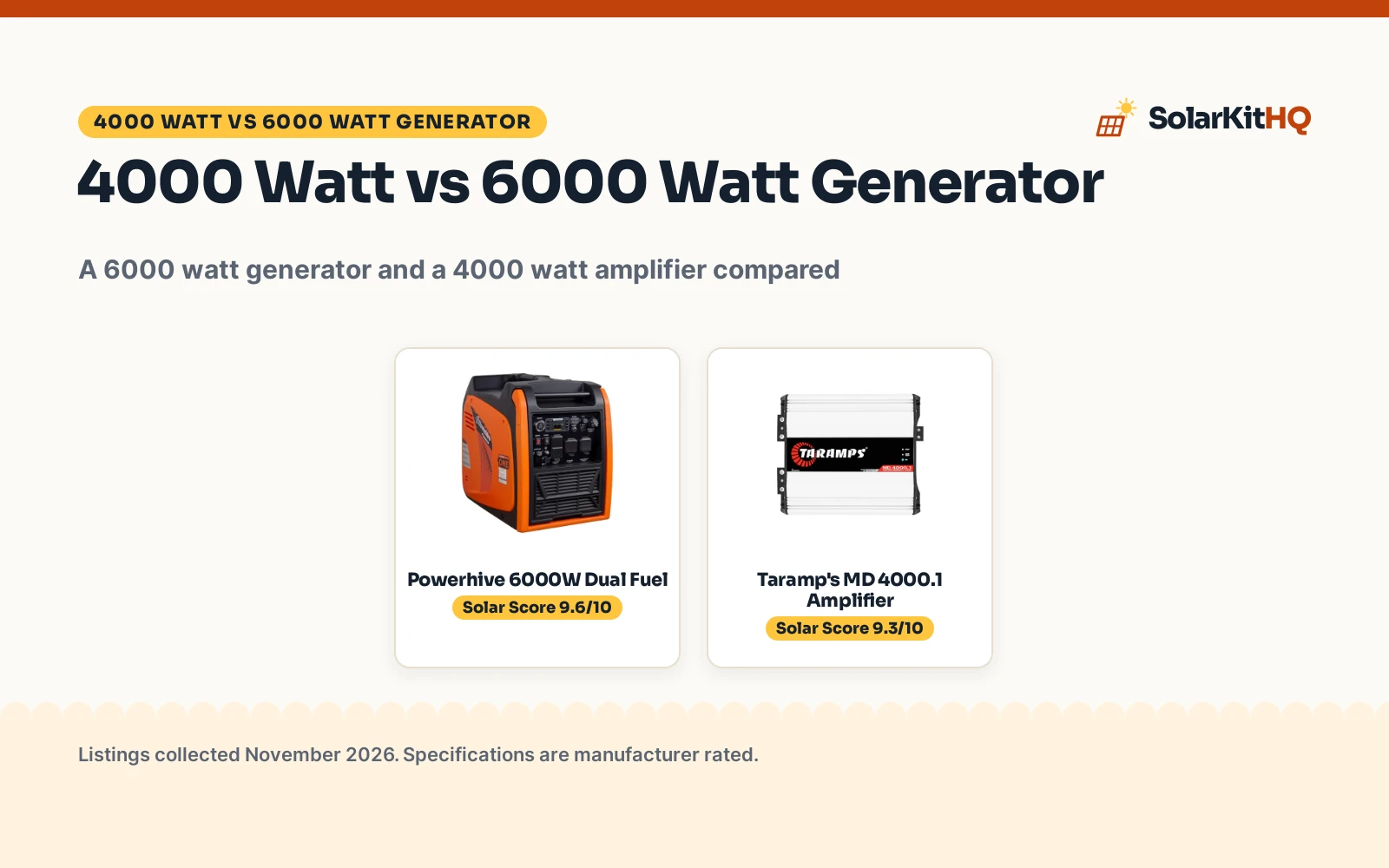
The lights go out at dinner time, the fridge hums to a stop, and the question is how much power you need to keep the essentials running until the grid comes back. This is 4000 watt vs 6000 watt generator, and the honest start is that the 4000 watt example here is a car audio amplifier, not a generator, so the only generator in this comparison is the 6000 watt Powerhive. If you need generator power, pick the 6000 watt side; the 4000 watt amplifier belongs in a car audio build, not at a campsite or beside a house in an outage.
SolarKitHQ earns a commission when you buy through links on this page, at no extra cost to you. As an Amazon Associate I earn from qualifying purchases. Affiliate disclosure.
4000 watt vs 6000 watt generator: side by side
| Generator | Solar Score | Peak watts | Running watts | Fuel | Run time | Noise |
|---|---|---|---|---|---|---|
| Powerhive 6000W Dual Fuel | 9.6/10 | 6000 peak watts | 5500 running watts | Gas and propane | Up to 16 hours | 69 dB from 23 feet |
| Taramp’s MD 4000.1 Amplifier | 9.3/10 | Not stated | Not stated | Not stated | Not stated | Not stated |
These specs are rated by the maker and quoted from each listing on 19 November 2026.
What the 4000 watt side actually is
The 4000 watt example in this comparison is the Taramp’s MD 4000.1, a monoblock digital amplifier for car audio systems, rated at 4000W RMS at 1 Ohm. It powers subwoofers, woofers, midbass and midrange drivers, with variable crossover controls, adjustable bass boost and a Smart Cooler. None of those figures is a generator figure: RMS watts describe audio output to speakers, while the Powerhive states peak and running watts for household loads, so the watt figures do not compare directly. The amplifier states no fuel type, no fuel tank, no run time and no outlets, since it is built for a car audio system, not for backup power.
What the 6000 watt generator states
The Powerhive is the only generator in this comparison, a dual fuel portable inverter generator with a 312cc 4-stroke gasoline engine. The maker lists 6000 peak watts and 5500 running watts, and states that it runs on gas or propane. A 3.1-gallon fuel tank gives up to 8 hours at 50% load and 15 to 16 hours at 25% load, and noise is stated as low as 69 dB from 23 feet, with ECO mode adjusting engine speed to match the load. Low-oil shutdown, overload protection and circuit breakers are stated. Fuel generators run outdoors only, far from doors and windows, because of carbon monoxide.
What the comparison leaves unclear
With no 4000 watt generator in this comparison, the article cannot say which wattage suits a given load, since only the 6000 watt side states peak and running watts. The Powerhive states no warranty term, and it states no separate wattage for propane, so a buyer comparing fuels has just those watt figures to work from. The Taramp’s states its size at 10.63 by 8.98 by 2.76 inches and its weight at 6.35 pounds, but those figures describe an amplifier for a car audio build, not a generator for a campsite or a house.
The kits we chose

Powerhive 6000W Dual Fuel
A dual fuel portable inverter generator with 6000 peak watts and 5500 running watts, a 312cc engine and up to 16 hours of run time.
Pros
- 6000 peak watts and 5500 running watts stated
- Runs on gas or propane
- Up to 16 hours of run time stated, with 8 hours at 50% load
- Low-oil shutdown, overload protection and circuit breakers stated
Cons
- No warranty term is stated
- Noise stated as 69 dB from 23 feet
- 17.7 by 18.5 by 19.9 inches, so it needs storage space
- 3.1-gallon tank gives 8 hours at 50% load, so long outages need refueling
Detailed Review
The maker lists a dual fuel portable inverter generator with a 312cc 4-stroke gasoline engine, 6000 peak watts and 5500 running watts. A 3.1-gallon fuel tank gives up to 8 hours at 50% load and 15 to 16 hours at 25% load. Noise is stated as low as 69 dB from 23 feet, and ECO mode adjusts engine speed to match the load. Low-oil shutdown, overload protection and circuit breakers are stated. The unit measures 17.7 by 18.5 by 19.9 inches and weighs 94.8 pounds. No warranty term is stated.
Who it's for: homeowners and RV owners who want a dual fuel generator with 6000 peak watts for home backup, camping or tailgating. Who should skip it: anyone who needs a 4000 watt generator, since this comparison has no 4000 watt generator.
Its Solar Score of 9.6/10 comes from performance 30/35, build 21/25, value 21/25, safety 8/10 and warranty 0/5: 80 of 100 points, placed on our 9.2 to 9.8 scale.
Key Specifications
| Peak watts | 6000 |
|---|---|
| Running watts | 5500 |
| Fuel | Gas and propane |
| Weight | 94.8 lb |
Taken from the seller's listing on 19 November 2026. Capacity and output figures are rated by the manufacturer.
Safety and Warranty
What this listing states. Low-oil shutdown, overload protection and circuit breakers stated, so safety scores 8 of 10. No warranty term, so warranty scores zero. See How We Pick.
Follow the manual. Connect and use the product as the maker describes, stay within every stated rating, and read the manual before first use.
This is general buying information, not professional advice. Follow each product manual and local rules, and see our Safety Disclaimer.

Taramp's MD 4000.1 Amplifier
A 4000W RMS monoblock car audio amplifier with crossover controls, bass boost and protection against thermal, voltage, short-circuit and low-impedance faults.
Pros
- 4000W RMS at 1 Ohm stated
- Variable crossover: 10Hz-90Hz HPF and 90Hz-10kHz LPF
- Adjustable 35Hz-55Hz bass boost up to +10dB
- Smart Cooler plus thermal, voltage, short-circuit and low-impedance protection stated
Cons
- Not a generator: a car audio amplifier, so it gives no backup power
- 4000W RMS is audio output, not generator output, so the watts do not compare
- Built for car audio systems, not for home, RV or campsite power
- No fuel tank, outlets or run time, so it cannot power household loads
Detailed Review
The maker lists a 4000W RMS monoblock amplifier at 1 Ohm, with a 10Hz to 10kHz response, variable crossover controls of 10Hz to 90Hz HPF and 90Hz to 10kHz LPF, adjustable bass boost of 35Hz to 55Hz up to +10dB, and a Smart Cooler with thermal, voltage, short-circuit and low-impedance protection. It measures 10.63 by 8.98 by 2.76 inches, weighs 6.35 pounds, and carries a 1-year manufacturer warranty. It is built to power subwoofers, woofers, midbass and midrange drivers in car audio systems, not to generate household power.
Who it's for: car audio builders who want a 4000W RMS monoblock amplifier with crossover and bass boost controls. Who should skip it: anyone shopping for a generator, since this amplifier gives no backup power.
Its Solar Score of 9.3/10 comes from performance 21/35, build 18/25, value 15/25, safety 5/10 and warranty 3/5: 62 of 100 points, placed on our 9.2 to 9.8 scale.
Key Specifications
| Power | 4000W RMS at 1 Ohm |
|---|---|
| Response | 10Hz-10kHz |
| Size | 10.63 x 8.98 x 2.76 in |
| Weight | 6.35 lb |
Taken from the seller's listing on 19 November 2026. Capacity and output figures are rated by the manufacturer.
Safety and Warranty
What this listing states. Smart Cooler plus thermal, voltage, short-circuit and low-impedance protection stated, so safety scores 5 of 10. 1 Year Manufacturer Warranty stated. It does not say everything a buyer needs, such as who pays return shipping, so warranty scores 3 of 5. See How We Pick.
Follow the manual. Connect and use the product as the maker describes, stay within every stated rating, and read the manual before first use.
This is general buying information, not professional advice. Follow each product manual and local rules, and see our Safety Disclaimer.
As an Amazon Associate I earn from qualifying purchases.
Where the points went
The Solar Score weighs performance, build, value, safety and warranty. For generators, safety means low-oil shutdown, overload protection, circuit breakers or another protection the listing names; the Powerhive states these, and the Taramp’s states thermal, voltage, short-circuit and low-impedance protection. Only the Taramp’s states a warranty term: 1 year, while the Powerhive states no term. How we pick explains the weights.
| Product | Solar Score | Perf. /35 | Build /25 | Value /25 | Safety /10 | Warranty /5 |
|---|---|---|---|---|---|---|
| Powerhive 6000W Dual Fuel | 9.6 | 30 | 21 | 21 | 8 | 0 |
| Taramp’s MD 4000.1 Amplifier | 9.3 | 21 | 18 | 15 | 5 | 3 |
Every total is translated into a figure between 9.2 and 9.8 with a linear formula; ranking by points and ranking by score always agree.
How to choose the best 4000 watt vs 6000 watt generator
Start with the job: backup power or car audio
If the job is backup power for a home, an RV or a campsite, the Powerhive is the only pick here that qualifies, since it is the only generator in this comparison. If the job is a car audio build, the Taramp’s is the pick, with 4000W RMS at 1 Ohm for subwoofers, woofers, midbass and midrange drivers. Buying the amplifier for backup power would leave you with no generator at all.
Read watts as the maker states them
Generator watts come as a pair: the Powerhive states 6000 peak watts and 5500 running watts, and the running figure is the one to match against the loads you plan to run. Amplifier watts are different: the Taramp’s states 4000W RMS at 1 Ohm for speakers, and RMS audio watts do not convert to generator watts. Compare peak watts with peak watts and running watts with running watts, and do not mix the kinds of figures.
Check fuel, run time and noise
The Powerhive runs on gas or propane, with a 3.1-gallon tank, up to 8 hours at 50% load and 15 to 16 hours at 25% load. Noise is stated as low as 69 dB from 23 feet, and ECO mode adjusts engine speed to match the load. The Taramp’s states no fuel, run time or noise figures. For the cabin case, see the solar panel vs generator for cabin guide, and for fuel choice, the diesel vs dual fuel generator comparison.
| If you need | Look at |
|---|---|
| Backup power for home, RV or campsite | Powerhive 6000W Dual Fuel, 6000 peak watts |
| A car audio amplifier | Taramp’s MD 4000.1 Amplifier, 4000W RMS at 1 Ohm |
| Longest stated run time | Powerhive 6000W Dual Fuel, up to 16 hours |
| A stated warranty term | Taramp’s MD 4000.1 Amplifier, 1 year |
Sizing Notes
- Match the 5500 running watts and 6000 peak watts of the Powerhive against the loads you plan to run.
- Check the fuel: the Powerhive runs on gas or propane, and its 3.1-gallon tank gives 8 hours at 50% load.
- Match the 69 dB noise figure from 23 feet against the distance to neighbors and sleeping areas.
- The Taramp’s amplifier is a 1 Ohm car audio part, so match its 4000W RMS rating to speakers, not to household loads.
- Check the warranty terms stated: 1 year for the Taramp’s, and no term stated for the Powerhive.
FAQ: power away from the grid
Is a 4000 watt amplifier the same as a 4000 watt generator?
No. The Taramp’s MD 4000.1 is a car audio amplifier rated at 4000W RMS for speakers, while a generator is rated in peak and running watts for household loads. The watt figures measure different jobs.
Which should I pick, a 4000 watt or a 6000 watt generator?
This comparison has only one generator, the 6000 watt Powerhive, so pick the 6000 watt side if you need generator power. There is no 4000 watt generator in this comparison to pick instead.
How long does the Powerhive run on a tank of fuel?
The maker states up to 8 hours at 50% load and 15 to 16 hours at 25% load from its 3.1-gallon tank.
What fuel does the Powerhive use?
Gas or propane. The maker lists it as a dual fuel portable inverter generator, with a 312cc 4-stroke gasoline engine.
Related solar guides
See every Inverter and Dual Fuel Generators guide and all Power Stations and Generators guides. Also see our best inverter generator for RV camping. Also see our best inverter generator for tailgating. Also see our best inverter generator for food truck. Also see our solar panel vs generator for well pump. Also see our generator wattage calculator.
More related guides (11)
- what is the most quiet generator
- how long generators last
- can generators get wet
- best generator for whole house
- best generator for van life
- best generator for boat
- best generator for preppers
- RV generator vs battery bank for boondocking
- generator cord vs extension cord
- how to clean a generator carburetor
- best generator for long term use