On this page
When the lights go out at dinner time, the fridge, a few lamps and a phone charger decide what the house actually needs from a generator. In a 2500 watt vs 3500 watt inverter generator choice, the Champion example suits a reader who wants dual fuel, a lighter unit and a longer stated warranty, while the All Power America example suits a reader who wants more running watts and an RV-ready outlet. This article compares the two listings on running watts, starting watts, fuel, run time, noise, weight, outlets and warranty, using only what each listing states.
SolarKitHQ earns a commission when you buy through links on this page, at no extra cost to you. As an Amazon Associate I earn from qualifying purchases. Affiliate disclosure.
2500 watt vs 3500 watt inverter generator: side by side
| Model | Solar Score | Running watts | Fuel | Weight | Warranty |
|---|---|---|---|---|---|
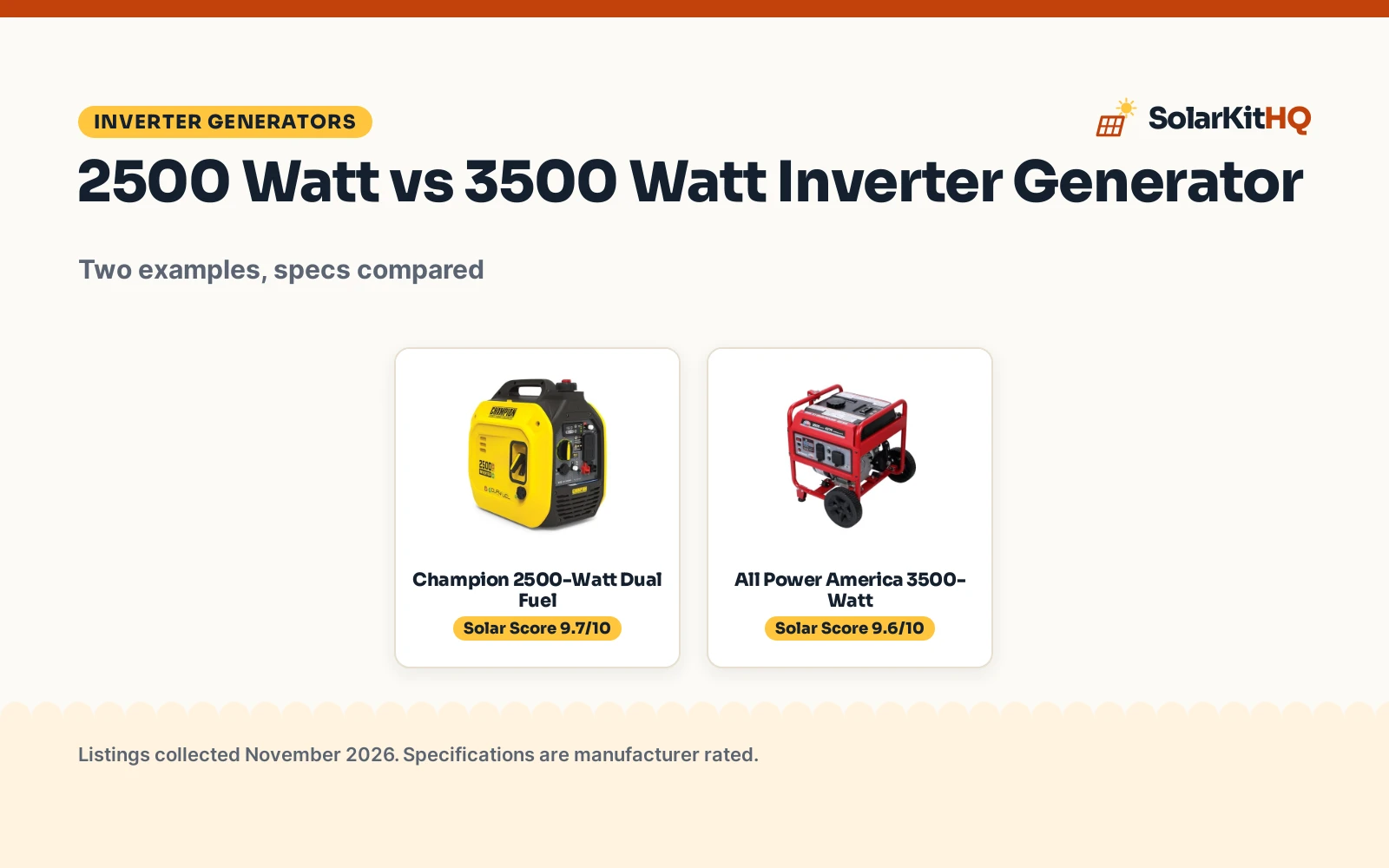
| Champion 2500-Watt Dual Fuel | 9.7/10 | 1850 on gasoline, 1665 on propane | Gasoline or propane | 43.2 pounds | 3-year limited |
| All Power America 3500-Watt | 9.6/10 | 3500 | Gasoline | 73.85 pounds | 1-year manufacturer |
These specs are rated by the maker and quoted from each listing on 4 November 2026.
Running watts and starting watts
The gap in running watts is the clearest difference. The Champion example gives 2500 starting watts and 1850 running watts on gasoline, and 1665 running watts on propane. The All Power America example gives 3500 running watts and 4375 peak watts. Both listings state running watts clearly, so this side can be compared directly: the All Power America example gives more running watts on either Champion fuel. Keep starting watts and running watts separate: starting watts cover the surge when a motor starts, while running watts cover continuous load.
Fuel and run time
Fuel is the second difference. The Champion example runs on gasoline or propane right out of the box, with up to 11.5 hours on gasoline and up to 25 hours on propane. The All Power America example runs on gasoline from a 3-gallon tank, with up to 8.5 hours at 50% load. The run time figures cannot be compared directly, because the Champion figures state no load level while the All Power America figure is tied to 50% load. A reader who wants propane has only the Champion example in this pair.
Noise, weight and size
Noise is where the listings part ways. The Champion example states 53 dBA from 23 feet. The All Power America listing states no dBA figure, although its title calls it quiet, so noise cannot be compared on numbers here. Weight and size can be compared: the Champion example weighs 43.2 pounds and measures 17.6 by 12.8 by 18.1 inches, while the All Power America example weighs 73.85 pounds and measures 23.0 by 20.3 by 21.9 inches. The Champion example is the lighter and smaller unit on the stated figures.
Outlets and safety features
Outlets decide what each unit can feed. The Champion example gives a covered 120V 15.4A household duplex outlet with clean electricity at less than 3% THD, plus a 12V regulated automotive-style outlet. The All Power America example gives one 20 Amp 120V plug and one RV-ready 30 Amp outlet, with rubber covers on all outlets. For safety features, the Champion example gives a CO Shield auto shutoff system, and the All Power America example gives a CO sensor. Neither listing states a UL, ETL or CSA listing, so no certification is claimed for either unit.
What the listings leave unclear
Three gaps deserve a note. The All Power America listing states no dBA noise figure, so its quiet claim cannot be checked against the Champion figure of 53 dBA from 23 feet. The Champion run time figures state no load level, so they cannot be set against the All Power America figure at 50% load. The Champion listing gives no tank size in gallons, while the All Power America listing gives a 3-gallon tank, so fuel capacity cannot be compared in gallons. The All Power America title calls the unit lightweight, yet its listed weight of 73.85 pounds is higher than the Champion example at 43.2 pounds.
Two examples

Champion 2500-Watt Dual Fuel
A dual fuel portable inverter generator with 2500 starting watts, 1850 running watts on gasoline and 1665 running watts on propane, plus a CO Shield auto shutoff system.
Pros
- Runs on gasoline or propane right out of the box
- Noise stated at 53 dBA from 23 feet
- Covered 120V 15.4A household duplex outlet with clean electricity at less than 3% THD, plus a 12V outlet
- 3-year limited warranty stated
Cons
- Running watts fall to 1665 on propane, from 1850 on gasoline
- Parallel kit is optional and sold separately, not included
- 43.2 pounds stated
- Run time figures state no load level, so they cannot be set against the All Power America figure at 50% load
Detailed Review
The listing states a dual fuel portable inverter generator with 2500 starting watts, 1850 running watts on gasoline and 1665 running watts on propane, up to 11.5 hours run time on gasoline and up to 25 hours on propane, and noise at 53 dBA from 23 feet. It gives a covered 120V 15.4A household duplex outlet with clean electricity at less than 3% THD, a 12V regulated automotive-style outlet, a CO Shield auto shutoff system, dimensions of 17.6 by 12.8 by 18.1 inches, a weight of 43.2 pounds and a 3-year limited warranty. Title, bullets and spec table agree on the 2500-watt class and the 3-year warranty term.
Who it's for: readers who want dual fuel and a lighter generator with a 3-year warranty. Who should skip it: readers who need 3500 running watts or an RV-ready 30 Amp outlet.
Its Solar Score of 9.7/10 comes from performance 30/35, build 21/25, value 21/25, safety 8/10 and warranty 4/5: 84 of 100 points, placed on our 9.2 to 9.8 scale.
Key Specifications
| Running watts | 1850 on gasoline, 1665 on propane |
|---|---|
| Starting watts | 2500 |
| Noise | 53 dBA from 23 feet |
| Weight | 43.2 pounds |
Figures as published on the retailer listing, collected 4 November 2026. Performance figures are manufacturer rated.
Safety and Warranty
What this listing states. CO Shield auto shutoff system, so safety scores 8 of 10. 3-year limited warranty. It does not say everything a buyer needs, such as who pays return shipping, so warranty scores 4 of 5. See How We Pick.
Follow the manual. Connect and use the product as the maker describes, stay within every stated rating, and read the manual before first use.
This is general buying information, not professional advice. Follow each product manual and local rules, and see our Safety Disclaimer.

All Power America 3500-Watt
A gas-powered portable inverter generator with 3500 running watts and 4375 peak watts, a 3-gallon fuel tank and an RV-ready 30 Amp outlet.
Pros
- 3500 running watts and 4375 peak watts stated
- RV-ready 30 Amp outlet plus a 20 Amp 120V plug
- 3-gallon fuel tank with up to 8.5 hours run time at 50% load
- Rubber covers on all outlets stated
Cons
- Noise in dBA is Not stated in the listing
- 1-year manufacturer warranty, shorter than the Champion example at 3 years
- 73.85 pounds stated
- Run time is stated only at 50% load, so full-load run time is unclear
Detailed Review
The listing states a gas-powered portable inverter generator with 3500 running watts and 4375 peak watts, a 208cc 4-Stroke OHV engine, a 3-gallon fuel tank, up to 8.5 hours run time at 50% load, one 20 Amp 120V plug, one RV-ready 30 Amp outlet, rubber covers on all outlets and a CO sensor. Dimensions are 23.0 by 20.3 by 21.9 inches, weight is 73.85 pounds and the warranty is 1 year manufacturer. Title, bullets and spec table agree on the 3500 running watts, the 4375 peak watts and the 1-year warranty term.
Who it's for: readers who need 3500 running watts and an RV-ready 30 Amp outlet for home backup or camping. Who should skip it: readers who want dual fuel, a stated dBA noise figure, or a 3-year warranty.
Its Solar Score of 9.6/10 comes from performance 32/35, build 20/25, value 20/25, safety 7/10 and warranty 2/5: 81 of 100 points, placed on our 9.2 to 9.8 scale.
Key Specifications
| Running watts | 3500 |
|---|---|
| Peak watts | 4375 |
| Fuel tank | 3 gallons |
| Weight | 73.85 pounds |
Figures as published on the retailer listing, collected 4 November 2026. Performance figures are manufacturer rated.
Safety and Warranty
What this listing states. CO sensor and rubber outlet covers, so safety scores 7 of 10. 1-year manufacturer warranty. It does not say everything a buyer needs, such as who pays return shipping, so warranty scores 2 of 5. See How We Pick.
Follow the manual. Connect and use the product as the maker describes, stay within every stated rating, and read the manual before first use.
This is general buying information, not professional advice. Follow each product manual and local rules, and see our Safety Disclaimer.
As an Amazon Associate I earn from qualifying purchases.
Where the points went
The Solar Score weighs performance, build, value, safety and warranty. For inverter generators, safety means a CO shutoff or sensor and outlet covers the listing names; both listings name such features. Both listings state a warranty term, at 3 years and 1 year. How we pick explains the weights.
| Product | Solar Score | Perf. /35 | Build /25 | Value /25 | Safety /10 | Warranty /5 |
|---|---|---|---|---|---|---|
| Champion 2500-Watt Dual Fuel | 9.7 | 30 | 21 | 21 | 8 | 4 |
| All Power America 3500-Watt | 9.6 | 32 | 20 | 20 | 7 | 2 |
Every total is translated into a figure between 9.2 and 9.8 with a linear formula; ranking by points and ranking by score always agree.
2500 watt vs 3500 watt inverter generator: which should you choose?
Choose the 2500 watt side if dual fuel, a stated noise figure and a longer warranty matter most, and choose the 3500 watt side if running watts and an RV-ready outlet matter most. The Champion example suits a reader who wants gasoline or propane in a lighter unit, while the All Power America example suits a reader who wants 3500 running watts for home backup or camping. Check the run time conditions before deciding, since the two listings state run time differently.
| If you need | Look at |
|---|---|
| Dual fuel | Champion 2500-Watt Dual Fuel |
| 3500 running watts | All Power America 3500-Watt |
| RV-ready 30 Amp outlet | All Power America 3500-Watt |
| Stated 53 dBA noise figure | Champion 2500-Watt Dual Fuel |
| 3-year warranty | Champion 2500-Watt Dual Fuel |
Sizing Notes
- Match running watts to the loads you plan: the Champion example gives 1850 running watts on gasoline and 1665 on propane, and the All Power America example gives 3500 running watts.
- Match the outlet to the load: the Champion example gives a covered 120V 15.4A household duplex outlet and a 12V outlet, and the All Power America example gives a 20 Amp 120V plug and a 30 Amp RV-ready outlet.
- Match fuel to the run you need: the Champion example runs on gasoline or propane, and the All Power America example runs on gasoline with a 3-gallon tank.
- Check weight and case size against where the unit will sit: 43.2 pounds and 17.6 by 12.8 by 18.1 inches for the Champion example, and 73.85 pounds and 23.0 by 20.3 by 21.9 inches for the All Power America example.
Fuel generators run outdoors only, far from doors and windows, because of carbon monoxide.
FAQ: power away from the grid
Is a 3500 watt inverter generator stronger than a 2500 watt one?
On running watts, yes in this pair. The All Power America example gives 3500 running watts, while the Champion example gives 1850 running watts on gasoline and 1665 on propane. Starting watts also differ: 4375 peak watts for the All Power America example against 2500 starting watts for the Champion example.
Can the Champion generator run on propane?
Yes. The Champion example runs on gasoline or propane right out of the box, with 1665 running watts and up to 25 hours run time on propane.
Which generator is lighter?
The Champion example, at 43.2 pounds, against the All Power America example at 73.85 pounds. Both weights come from the spec tables.
What outlets does each generator offer?
The Champion example gives a covered 120V 15.4A household duplex outlet and a 12V regulated automotive-style outlet. The All Power America example gives one 20 Amp 120V plug and one RV-ready 30 Amp outlet.
How long does each generator run?
The Champion example gives up to 11.5 hours on gasoline and up to 25 hours on propane, with no load level stated. The All Power America example gives up to 8.5 hours at 50% load. Because the conditions differ, the two run time figures cannot be compared directly.
Related solar guides
See every Inverter and Dual Fuel Generators guide and all Power Stations and Generators guides.
More picks: gas generator vs inverter generator, inverter generator for long run time, dual fuel vs gas generator.