On this page
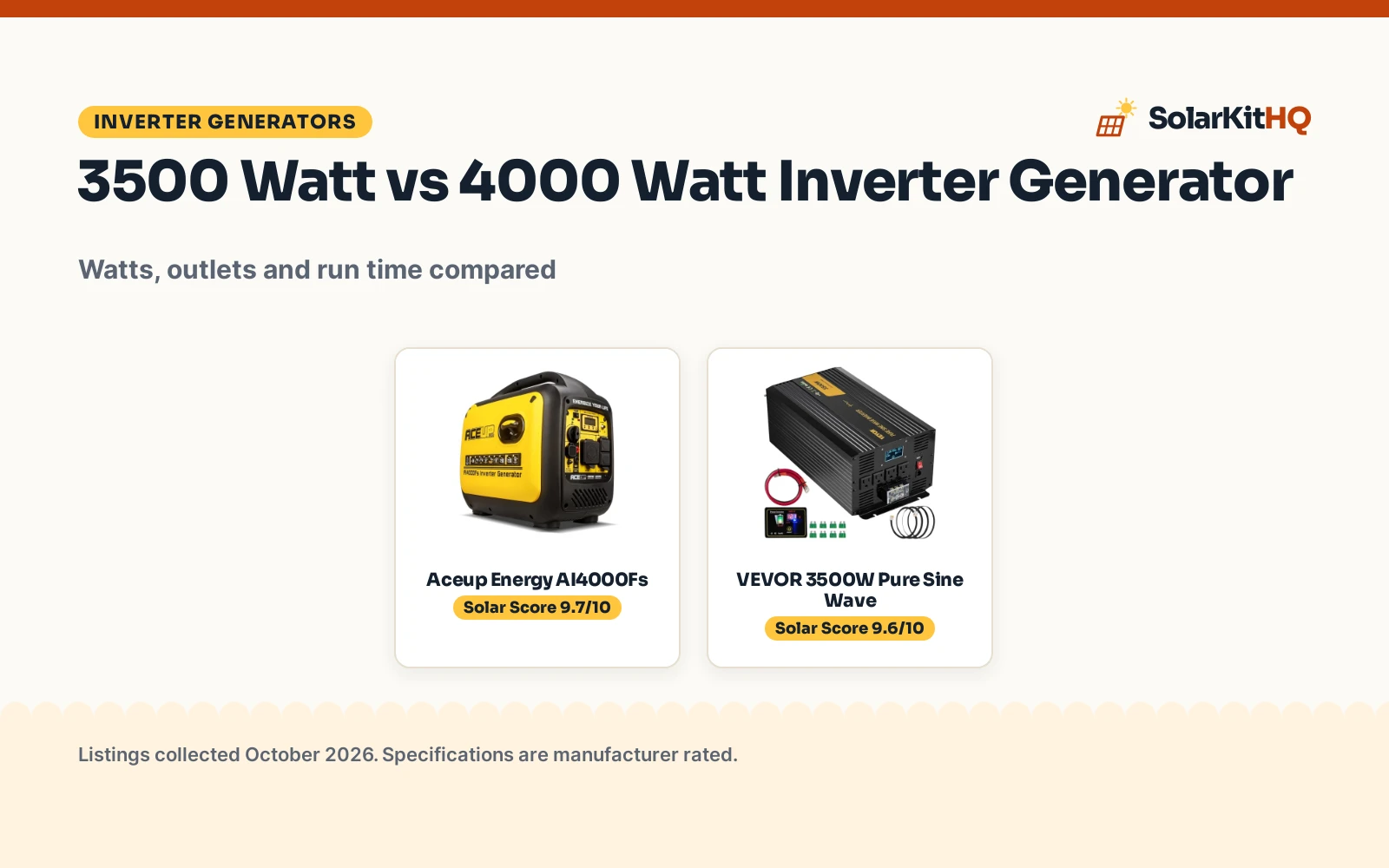
The lights go out at dinner time, the fridge starts warming, and the campsite at dusk leaves a dead phone with nowhere to charge. The short answer on 3500 watt vs 4000 watt inverter generator: pick the 4000-watt Aceup Energy generator when you need a standalone gas unit with outlets and run time, and pick the 3500-watt VEVOR inverter when you already have a 12V battery bank and need AC power from it. We compared the listings on what each states: watts, outlets, noise, weight, protections and warranty.
SolarKitHQ earns a commission when you buy through links on this page, at no extra cost to you. As an Amazon Associate I earn from qualifying purchases. Affiliate disclosure.
3500 watt vs 4000 watt inverter generator: side by side
| Inverter | Solar Score | Rated Watts | Peak / Surge | Outlets | Warranty |
|---|---|---|---|---|---|
| Aceup Energy AI4000Fs | 9.7/10 | 3200 rated watts | 4000 peak watts | 120V AC 20A, RV, USB | 2-year limited |
| VEVOR 3500W Pure Sine Wave | 9.6/10 | 3500W continuous | 7000W surge | 4 AC outlets, 1 USB | Not stated |
We copied each rating from the seller’s listing as the brand states it; data date 5 November 2026.
Watts and power source
The headline figures sit close: the VEVOR inverter lists 3500W continuous with 7000W surge, and the Aceup Energy generator lists 3200 rated watts with 4000 peak watts. The gap that matters is the source: the Aceup Energy generator burns fuel from a 1.32 gallon tank and runs up to 7.2 hours at 25% load, while the VEVOR inverter converts 12V DC to 120V AC and runs only as long as the battery behind it. A fuel generator runs outdoors only, far from doors and windows, because of carbon monoxide. Compare continuous watts with continuous watts and peak watts with peak watts, and keep each figure with the listing that states it.
Outlets and controls
The Aceup Energy generator gives a 120V AC 20A outlet, a dedicated RV receptacle and a USB charger port, plus a smart digital panel that shows voltage, runtime, fuel level, Hz and wattage, and a 3-in-1 control knob that combines fuel shutoff, start/stop and choke. The VEVOR inverter gives 4 AC outlets with GFCI, 1 USB port, an LCD display that shows input voltage, frequency, output voltage, battery power, product power, product waveform and working status, and a remote controller on a 9.8 ft cable. The VEVOR also provides 8 x 50A fuses and 2 x battery cables. Count the outlets your loads need before you pick a side, and check the plug shapes against the receptacles each listing names.
Noise, weight and run time
The Aceup Energy generator states 59 dB in eco mode at 23 feet under 25% load, and it weighs 50.7 pounds at 20.0 x 11.8 x 18.8 inches. The VEVOR inverter states 20 to 40 dB of noise and weighs 16.0 pounds at 19.7 x 11.4 x 9.1 inches. The Aceup Energy generator states run time of up to 7.2 hours at 25% load; the VEVOR inverter states no run time, since its run time comes from the battery it connects to. The Aceup Energy generator is also parallel ready, so linking 2 units gives up to 6400W, with the parallel kit sold separately.
What the listings leave unclear
The Aceup Energy title says 149cc while the bullets say 146cc, so the engine size is unclear, and the listing leaves the parallel kit as a separate purchase. The VEVOR listing states no warranty term, no outlet amperage and no run time figure. Neither listing states a UL listing: the VEVOR names CE, FCC, RoHS and PSE certification, and the Aceup Energy listing states EPA compliance. Read the title, bullets and spec table against each other before you buy, and keep each figure with the listing that states it.
The kits we chose

Aceup Energy AI4000Fs
A 4000 peak watt gas inverter generator with 3200 rated watts, a 1.32 gallon tank, a 59 dB eco mode and a 2-year limited warranty.
Pros
- 4000 peak watts, 3200 rated watts
- Runs up to 7.2 hours at 25% load on a 1.32 gallon tank
- 59 dB in eco mode at 23 feet under 25% load
- 2-year limited warranty stated
Cons
- Parallel kit sold separately
- 50.7 pounds, the heavier listing here
- Recoil start only, no electric start is stated
Detailed Review
Aceup Energy lists 4000 peak watts and 3200 rated watts from a 4-stroke OHV engine, with a 1.32 gallon fuel tank, up to 7.2 hours of run time at 25% load, and 60Hz output. The listing gives a 120V AC 20A outlet, a dedicated RV receptacle, a USB charger port, parallel-ready design for linking 2 units for up to 6400W, and clean power with THD below 3%. The LCD shows voltage, runtime, fuel level, Hz and wattage, and a low-oil LED shutoff and Eco mode are stated. The title says 149cc while the bullets say 146cc, so the engine size is unclear. A 2-year limited warranty is stated.
Who it's for: homeowners and campers who need a standalone gas generator with household outlets, an RV receptacle and stated run time. Who should skip it: anyone who wants AC power from a 12V battery bank, where an inverter like the VEVOR fits instead.
Its Solar Score of 9.7/10 comes from performance 30/35, build 21/25, value 20/25, safety 8/10 and warranty 3/5: 82 of 100 points, placed on our 9.2 to 9.8 scale.
Key Specifications
| Rated watts | 3200 |
|---|---|
| Peak watts | 4000 |
| Fuel tank | 1.32 gallon |
| Noise | 59 dB eco mode |
Figures as published on the retailer listing, collected 5 November 2026. Performance figures are manufacturer rated.
Safety and Warranty
What this listing states. EPA compliant with a low-oil LED shutoff stated, so safety scores 8 of 10. A 2-year limited warranty is stated. It does not say everything a buyer needs, such as who pays return shipping, so warranty scores 3 of 5. See How We Pick.
Inverter limits. Stay within the stated continuous watts (surge watts last only a moment), use the cable size and fuse the manual gives, ventilate it, and never connect an inverter to home wiring yourself; that is work for a licensed electrician.
This is general buying information, not professional advice. Follow each product manual and local rules, and see our Safety Disclaimer.

VEVOR 3500W Pure Sine Wave
A 3500W continuous, 7000W surge pure sine wave inverter that converts 12V DC to 120V AC, with 4 AC outlets, a USB port and a remote controller.
Pros
- 3500W continuous, 7000W surge
- 88% efficiency stated
- 4 AC outlets and 1 USB port
- Remote controller with a 9.8 ft cable
Cons
- Needs a 12V DC source; it is not a standalone generator
- No warranty term is stated
- No run time is stated
- Outlet amperage is not stated
Detailed Review
VEVOR lists a 3500W continuous, 7000W surge pure sine wave inverter that converts 12V DC to 120V AC, with 4 AC outlets, 1 USB port, an LCD display and a remote controller on a 9.8 ft cable. The listing states 88% efficiency, an aluminum alloy shell, CE, FCC, RoHS and PSE certification, overheat and over-load protection, and a temperature-controlled cooling fan that rotates when the internal temperature reaches 113°F. It weighs 16.0 pounds and measures 19.7 x 11.4 x 9.1 inches. The listing states no warranty term, and it needs a 12V DC source, so it is an inverter for a battery bank, not a fuel generator.
Who it's for: RV, van and cabin owners with a 12V battery bank who need clean AC power for sensitive electronics. Who should skip it: anyone who needs a standalone generator with fuel and run time, where the Aceup Energy generator fits instead.
Its Solar Score of 9.6/10 comes from performance 29/35, build 21/25, value 20/25, safety 9/10 and warranty 0/5: 79 of 100 points, placed on our 9.2 to 9.8 scale.
Key Specifications
| Continuous | 3500W |
|---|---|
| Surge | 7000W |
| Input / Output | 12V DC to 120V AC |
| Efficiency | 88% |
Figures as published on the retailer listing, collected 5 November 2026. Performance figures are manufacturer rated.
Safety and Warranty
What this listing states. CE, FCC, RoHS and PSE certification with overheat and over-load protection stated, so safety scores 9 of 10. No warranty term, so warranty scores zero. See How We Pick.
Inverter limits. Stay within the stated continuous watts (surge watts last only a moment), use the cable size and fuse the manual gives, ventilate it, and never connect an inverter to home wiring yourself; that is work for a licensed electrician.
This is general buying information, not professional advice. Follow each product manual and local rules, and see our Safety Disclaimer.
As an Amazon Associate I earn from qualifying purchases.
Where the points went
The Solar Score weighs performance, build, value, safety and warranty. For inverters and inverter generators, safety means stated certifications and protections: the VEVOR states CE, FCC, RoHS and PSE certification with overheat and over-load protection, and the Aceup Energy generator states EPA compliance with a low-oil LED shutoff. Only the Aceup Energy generator states a warranty term, a 2-year limited warranty. How we pick explains the weights.
| Product | Solar Score | Perf. /35 | Build /25 | Value /25 | Safety /10 | Warranty /5 |
|---|---|---|---|---|---|---|
| Aceup Energy AI4000Fs | 9.7 | 30 | 21 | 20 | 8 | 3 |
| VEVOR 3500W Pure Sine Wave | 9.6 | 29 | 21 | 20 | 9 | 0 |
We place weighted points on a scale whose ends are 9.2 and 9.8. Because the mapping is straight, a unit with more points never shows less.
3500 watt vs 4000 watt inverter generator: which should you choose?
Choose the 4000-watt side when you need a standalone gas generator: the Aceup Energy generator carries its own fuel, outlets and run time, and it suits home backup and RV camping with no battery bank in place. Choose the 3500-watt side when you already run a 12V battery bank, RV or solar system: the VEVOR inverter turns that stored DC power into 120V AC for sensitive electronics, with no fuel and no exhaust to manage. Do not compare them on watts alone: the Aceup Energy generator lists 3200 rated watts from fuel, and the VEVOR lists 3500W continuous from a battery, so match the machine to the power source you already have.
| If you need | Look at |
|---|---|
| Standalone gas power with run time | Aceup Energy AI4000Fs, 3200 rated watts, up to 7.2 hours at 25% load |
| AC power from a 12V battery bank | VEVOR 3500W Pure Sine Wave, 3500W continuous, 7000W surge |
| Quiet operation | Aceup Energy AI4000Fs, 59 dB eco mode; VEVOR, 20 to 40 dB |
| Stated warranty | Aceup Energy AI4000Fs, 2-year limited |
Sizing Notes
- Match the inverter’s 12V DC input to the battery bank it connects to, and the generator’s 120V AC output to the loads it runs.
- Compare rated watts against the loads you plan, and keep surge watts separate from continuous watts.
- Check the outlets: the Aceup Energy generator lists a 120V AC 20A outlet, an RV receptacle and a USB port, while the VEVOR lists 4 AC outlets and 1 USB port.
- Size the fuel tank and run time together: the Aceup Energy generator lists up to 7.2 hours at 25% load on a 1.32 gallon tank.
- Use the fuses and cables the listing provides: the VEVOR lists 8 x 50A fuses and 2 x battery cables.
FAQ: power away from the grid
Is 4000 watts enough for home backup?
The Aceup Energy generator lists 4000 peak watts and 3200 rated watts, so match the rated watts to the loads you plan to run, and keep surge watts separate.
Does the VEVOR inverter need a battery?
Yes. It converts 12V DC to 120V AC, so it needs a 12V DC source such as a battery bank, and it states no run time of its own.
How loud is the Aceup Energy generator?
The listing states 59 dB in eco mode at 23 feet under 25% load.
Can I link Aceup Energy generators in parallel?
The listing states a parallel-ready design for linking 2 units for up to 6400W, with the parallel kit sold separately.
Which listing states a warranty?
Only the Aceup Energy generator states a warranty term, a 2-year limited warranty. The VEVOR listing states no warranty term.
What outlets does each listing provide?
The Aceup Energy generator lists a 120V AC 20A outlet, an RV receptacle and a USB charger port. The VEVOR inverter lists 4 AC outlets with GFCI and 1 USB port.
Related solar guides
See every Inverter and Dual Fuel Generators guide and all Power Stations and Generators guides. Also see our best portable power station for camping. Also see our best solar panel kit for rv. Also see our gas generator vs inverter generator. Also see our solar generator vs portable inverter generator.
More picks: browse portable power stations, home backup power stations and solar generators.