On this page
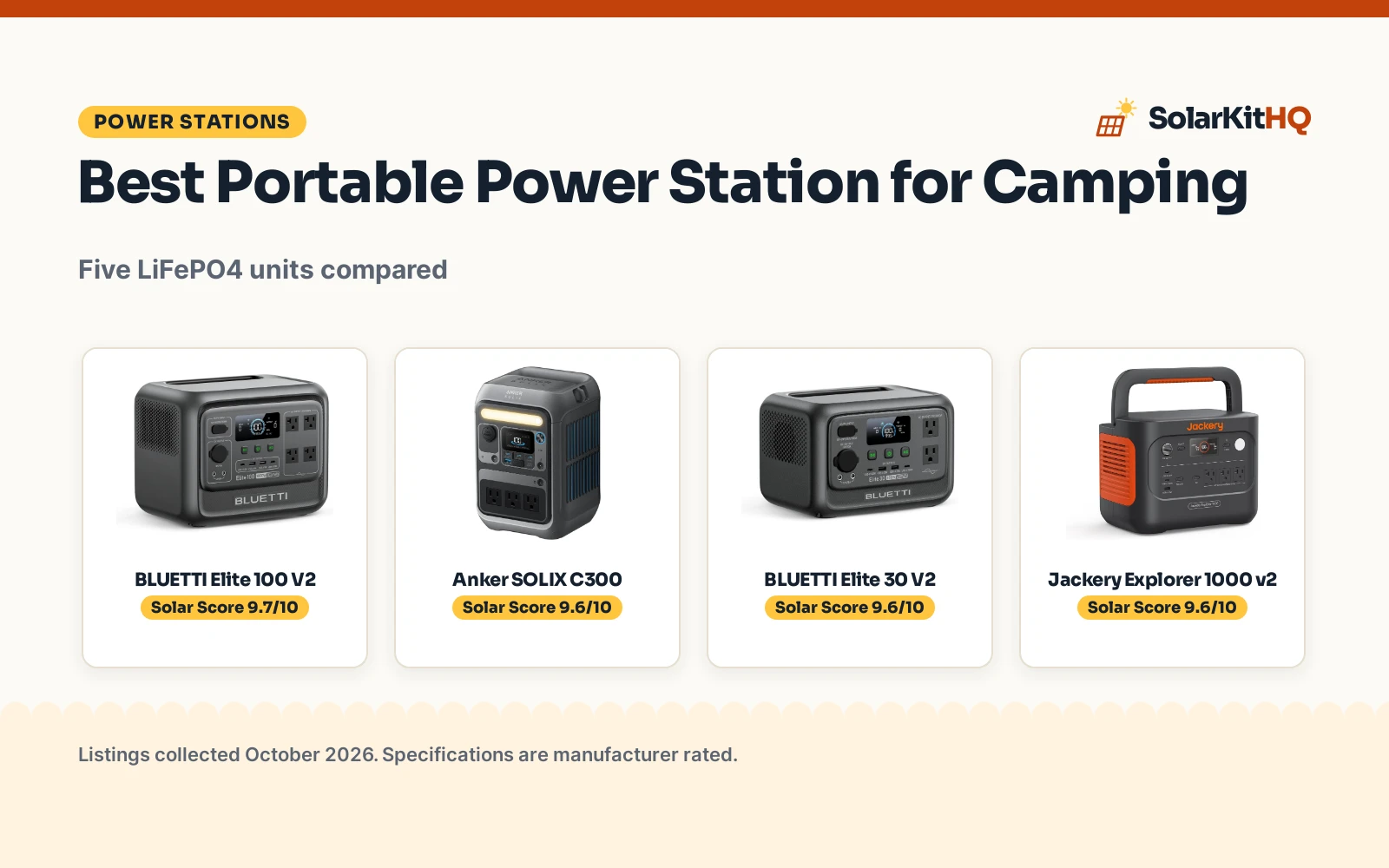
The best portable power station for camping is the one whose watt-hours cover your lights, phones and cooler between charges and whose weight you will actually carry from the car. We compared five LiFePO4 units from BLUETTI, Anker and Jackery on capacity, continuous and surge watts, outlets, weight and the warranty each listing states. Two hold about 1,000Wh for fridge camping, and three hold about 290Wh for lighter trips.
SolarKitHQ earns a commission when you buy through links on this page, at no extra cost to you. As an Amazon Associate I earn from qualifying purchases. Affiliate disclosure.
Quick picks
 Best Overall BLUETTI Elite 100 V2: 1024Wh, 1800W rated AC and a 60-month warranty description Check price on Amazon
 Best Small Unit Anker SOLIX C300: 288Wh, eight ports and a 5-year warranty stated Check price on Amazon
 Most Output for Its Size BLUETTI Elite 30 V2: 600W continuous from 288Wh at 9.4 pounds Check price on Amazon
 Big Camp Fridge Pick Jackery Explorer 1000 v2: 1070Wh and 1500W AC for a camp fridge Check price on Amazon
 Lightest Here Jackery Explorer 300: 292Wh at 7.5 pounds with a 100W USB-C port Check price on Amazon
The picks
| # | Product | Solar Score | Buy |
|---|---|---|---|
| 1 | BLUETTI Elite 100 V2 | 9.7/10 | Buy on Amazon |
| 2 | Anker SOLIX C300 | 9.6/10 | Buy on Amazon |
| 3 | BLUETTI Elite 30 V2 | 9.6/10 | Buy on Amazon |
| 4 | Jackery Explorer 1000 v2 | 9.6/10 | Buy on Amazon |
| 5 | Jackery Explorer 300 | 9.5/10 | Buy on Amazon |

BLUETTI Elite 100 V2
A 1024Wh LiFePO4 unit with 1800W rated AC output, 11 ports and a 60-month warranty description.
Pros
- 1024Wh capacity and 1800W rated AC output stated
- 11 ports listed in the bullets
- 1200W AC charging to 80% in roughly 45 minutes stated
- Warranty description of 60 months
Cons
- 25 pounds is heavy for walk-in campsites
- Spec table lists 4 power outlets, the bullets list 11 ports
- No safety certification is stated
- No solar input limit is stated on the listing
Detailed Review
The listing states 1024Wh of LiFePO4 capacity, 1800W rated AC output with 2700W in Power Lifting mode and a 3600W surge in the title, 11 ports, 1200W AC charging to 80% in roughly 45 minutes, a 10ms UPS switchover, a 30dB silent mode, Wi-Fi and Bluetooth app control and over 4,000 cycles to 80%. It weighs 25 pounds and measures 12.6 by 8.5 by 9.8 inches, and the box includes AC and solar charging cables. The spec table's 4 power outlets conflicts with the 11 ports in the bullets; count on the bullets and check the port layout photo.
Who it's for: car campers and RV owners who want enough capacity for a camp fridge and lights over a weekend. Who should skip it: backpackers and anyone carrying gear far from the car.
Its Solar Score of 9.7/10 comes from performance 34/35, build 24/25, value 22/25, safety 0/10 and warranty 3/5: 83 of 100 points, placed on our 9.2 to 9.8 scale.
Key Specifications
| Capacity | 1024Wh LiFePO4 |
|---|---|
| AC output | 1800W rated, 3600W surge |
| Weight | 25 lb |
| Size | 12.6 x 8.5 x 9.8 in |
Figures as published on the retailer listing, collected 19 October 2026. Performance figures are manufacturer rated.
Safety and Warranty
What this listing states. No UL, FCC or battery management statement is stated, so safety scores zero. Warranty description of 60 months stated. It does not say everything a buyer needs, such as who pays return shipping, so warranty scores 3 of 5. See How We Pick.
Power station limits. Stay within the stated continuous output and solar input limits, keep the unit ventilated and dry, charge within the stated temperature range, and never connect it to home wiring except through equipment a licensed electrician installs.
This is general buying information, not professional advice. Follow each product manual and local rules, and see our Safety Disclaimer.

Anker SOLIX C300
A compact 288Wh LiFePO4 unit with three AC outlets, two 140W USB-C ports and a stated 5-year warranty.
Pros
- Eight ports, including two 140W two-way USB-C ports
- Wall recharge to 80% in 50 minutes stated
- 5-year warranty stated
- 6.46 by 6.34 by 9.45 inch footprint
Cons
- 300W AC total across three outlets
- Not compatible with Anker PS30, PS200 or PS400 panels, per the listing
- Spec table lists 230 volts for a US unit
- Shoulder strap sold separately
Detailed Review
The listing states 288Wh of LiFePO4 capacity, 300W output with a 600W surge, three AC outlets sharing 300W, a 120W car socket, two 140W USB-C ports, a 15W USB-C port and a 12W USB-A port. It recharges to 80% in 50 minutes from a wall outlet, recommends a 100W or 60W Anker panel, and says it is not compatible with the Anker SOLIX PS30, PS200 or PS400 panels. A 5-year warranty is stated. The spec table lists 230 volts and 4.13 kg, which do not match the rest of a US listing, so weight is unclear.
Who it's for: campers who mostly charge phones, laptops, cameras and lights and want a small box. Who should skip it: anyone planning to run a camp fridge or a kettle off AC.
Its Solar Score of 9.6/10 comes from performance 32/35, build 22/25, value 22/25, safety 0/10 and warranty 3/5: 79 of 100 points, placed on our 9.2 to 9.8 scale.
Key Specifications
| Capacity | 288Wh LiFePO4 |
|---|---|
| AC output | 300W, 600W surge |
| USB-C | 2 x 140W, 1 x 15W |
| Size | 6.46 x 6.34 x 9.45 in |
Figures as published on the retailer listing, collected 19 October 2026. Performance figures are manufacturer rated.
Safety and Warranty
What this listing states. No UL, FCC or battery management statement is stated, so safety scores zero. 5-year warranty stated. It does not say everything a buyer needs, such as who pays return shipping, so warranty scores 3 of 5. See How We Pick.
Power station limits. Stay within the stated continuous output and solar input limits, keep the unit ventilated and dry, charge within the stated temperature range, and never connect it to home wiring except through equipment a licensed electrician installs.
This is general buying information, not professional advice. Follow each product manual and local rules, and see our Safety Disclaimer.

BLUETTI Elite 30 V2
A 288Wh LFP unit that states 600W continuous AC output, 1500W Power Lifting and a 60-month warranty description.
Pros
- 600W continuous AC output from a 288Wh unit
- 9.4 pounds stated
- 380W wall charging, adjustable to 200W
- Warranty description of 60 months
Cons
- Power Lifting mode at 1500W is for resistive loads, not a surge rating
- No safety certification is stated
- No solar input limit is stated on the listing
- No solar charging cable listed in the box
Detailed Review
The listing states 288Wh of LFP capacity, 600W continuous output and a 1500W Power Lifting mode, a 10ms UPS switchover, 380W or 200W adjustable wall charging, solar and car charging, and standby draw of 4.5W. It weighs 9.4 pounds in the bullets and 9.5 pounds in the spec table, measures 9.8 by 7 by 6.6 inches, and pairs with BLUETTI's PV60L panel. The box lists AC and car charging cables, a user manual and the unit.
Who it's for: campers who want more AC output than a typical 300W box at a similar weight. Who should skip it: buyers who need a solar cable included or a stated solar input limit before buying a panel.
Its Solar Score of 9.6/10 comes from performance 32/35, build 22/25, value 22/25, safety 0/10 and warranty 3/5: 79 of 100 points, placed on our 9.2 to 9.8 scale.
Key Specifications
| Capacity | 288Wh LFP |
|---|---|
| AC output | 600W, 1500W Power Lifting |
| Weight | 9.4 lb |
| Wall charging | 380W or 200W |
Figures as published on the retailer listing, collected 19 October 2026. Performance figures are manufacturer rated.
Safety and Warranty
What this listing states. No UL, FCC or battery management statement is stated, so safety scores zero. Warranty description of 60 months stated. It does not say everything a buyer needs, such as who pays return shipping, so warranty scores 3 of 5. See How We Pick.
Power station limits. Stay within the stated continuous output and solar input limits, keep the unit ventilated and dry, charge within the stated temperature range, and never connect it to home wiring except through equipment a licensed electrician installs.
This is general buying information, not professional advice. Follow each product manual and local rules, and see our Safety Disclaimer.

Jackery Explorer 1000 v2
A 1070Wh LiFePO4 unit with 1500W AC output, a 3000W surge peak and three pure sine wave AC ports.
Pros
- 1070Wh capacity and 1500W AC output stated
- Three pure sine wave AC ports
- One hour full charge in app emergency mode, 1.7 hours by default
- Over 70% capacity after 4,000 cycles stated
Cons
- Solar charging works only with Jackery panels, per the listing
- No warranty term is stated in a readable form
- 23.8 pounds
- No safety certification is stated
Detailed Review
The listing states 1,070Wh of LFP capacity, 1,500W AC output with a 3,000W surge peak, three pure sine wave AC ports, two USB-C ports, one USB-A port, a DC car port and LED lights. It charges from 0% to 100% in one hour with emergency charging turned on in the Jackery App and defaults to 1.7 hours, keeps over 70% capacity after 4,000 cycles, and weighs 23.8 pounds. It also states the unit is compatible only with Jackery solar panels for solar charging, which narrows your panel choice.
Who it's for: campers who want a large battery for a fridge and already own or plan to buy Jackery panels. Who should skip it: anyone who wants to pair a third-party panel.
Its Solar Score of 9.6/10 comes from performance 34/35, build 24/25, value 22/25, safety 0/10 and warranty 0/5: 80 of 100 points, placed on our 9.2 to 9.8 scale.
Key Specifications
| Capacity | 1070Wh LFP |
|---|---|
| AC output | 1500W, 3000W surge |
| Weight | 23.8 lb |
| Solar | Jackery panels only |
Figures as published on the retailer listing, collected 19 October 2026. Performance figures are manufacturer rated.
Safety and Warranty
What this listing states. No UL, FCC or battery management statement is stated, so safety scores zero. No warranty term, so warranty scores zero. See How We Pick.
Power station limits. Stay within the stated continuous output and solar input limits, keep the unit ventilated and dry, charge within the stated temperature range, and never connect it to home wiring except through equipment a licensed electrician installs.
This is general buying information, not professional advice. Follow each product manual and local rules, and see our Safety Disclaimer.

Jackery Explorer 300
A 292Wh LiFePO4 unit at 7.5 pounds with two AC outlets, a 100W USB-C PD port and a 120W car port.
Pros
- 7.5 pounds, the lightest unit here
- 100W USB-C PD port
- Over 4,000 cycles to 70% capacity stated
- Maker states 80% in about 2.8 hours from a 100W panel
Cons
- Two AC outlets only
- 300W rated output
- Warranty listed only as 3+2 with no units
- Solar panel not included
Detailed Review
The listing states 292Wh of LiFePO4 capacity, 300W rated output with a 600W peak surge, two AC outlets, a 100W USB-C PD port, two USB-A ports and a 120W car port, over 4,000 cycles before reaching 70% capacity and a weight of 7.5 pounds. The maker says it reaches 80% in about 2.8 hours with a 100W panel. The spec table lists 7.1 pounds, and the warranty description reads only 3+2 without units, so we treat the term as not stated.
Who it's for: campers who carry their power station from the car to the site and charge small devices. Who should skip it: anyone who needs more than two AC outlets.
Its Solar Score of 9.5/10 comes from performance 30/35, build 22/25, value 22/25, safety 0/10 and warranty 0/5: 74 of 100 points, placed on our 9.2 to 9.8 scale.
Key Specifications
| Capacity | 292Wh LiFePO4 |
|---|---|
| AC output | 300W, 600W surge |
| Weight | 7.5 lb |
| USB-C | 100W PD |
Figures as published on the retailer listing, collected 19 October 2026. Performance figures are manufacturer rated.
Safety and Warranty
What this listing states. No UL, FCC or battery management statement is stated, so safety scores zero. No warranty term, so warranty scores zero. See How We Pick.
Power station limits. Stay within the stated continuous output and solar input limits, keep the unit ventilated and dry, charge within the stated temperature range, and never connect it to home wiring except through equipment a licensed electrician installs.
This is general buying information, not professional advice. Follow each product manual and local rules, and see our Safety Disclaimer.
As an Amazon Associate I earn from qualifying purchases.
Compare the picks
| Power station | Solar Score | Capacity | AC output | Weight | Warranty | Amazon |
|---|---|---|---|---|---|---|
| BLUETTI Elite 100 V2 | 9.7/10 | 1024Wh | 1800W rated, 3600W surge | 25 lb | 60 months | View on Amazon |
| Anker SOLIX C300 | 9.6/10 | 288Wh | 300W, 600W surge | Not consistent | 5 years | View on Amazon |
| BLUETTI Elite 30 V2 | 9.6/10 | 288Wh | 600W, 1500W lifting | 9.4 lb | 60 months | View on Amazon |
| Jackery Explorer 1000 v2 | 9.6/10 | 1070Wh | 1500W, 3000W surge | 23.8 lb | Not stated | View on Amazon |
| Jackery Explorer 300 | 9.5/10 | 292Wh | 300W, 600W surge | 7.5 lb | Not stated | View on Amazon |
Specifications are manufacturer rated as listed, collected 19 October 2026.
How we scored them
The Solar Score weighs performance, build, value, safety and warranty. For a power station, safety means a certification or battery protection the listing actually names; none of these five listings states a UL, ETL or FCC mark, so all score zero on that line. Three of the five state a warranty term. How we pick explains the weights.
| Product | Solar Score | Perf. /35 | Build /25 | Value /25 | Safety /10 | Warranty /5 |
|---|---|---|---|---|---|---|
| BLUETTI Elite 100 V2 | 9.7 | 34 | 24 | 22 | 0 | 3 |
| Anker SOLIX C300 | 9.6 | 32 | 22 | 22 | 0 | 3 |
| BLUETTI Elite 30 V2 | 9.6 | 32 | 22 | 22 | 0 | 3 |
| Jackery Explorer 1000 v2 | 9.6 | 34 | 24 | 22 | 0 | 0 |
| Jackery Explorer 300 | 9.5 | 30 | 22 | 22 | 0 | 0 |
Scores run from 9.2 to 9.8: each product’s point total is placed on that range, so more points always means a higher score.
How to choose the best portable power station for camping
Pick a size class first
These units fall into two groups. The BLUETTI Elite 100 V2 (1024Wh) and Jackery Explorer 1000 v2 (1070Wh) weigh 25 and 23.8 pounds. The Anker SOLIX C300 (288Wh), BLUETTI Elite 30 V2 (288Wh) and Jackery Explorer 300 (292Wh) weigh under 10 pounds. Add up the watt-hours your devices list, then choose the class with room to spare.
Continuous watts decide what runs
Surge figures last a moment. What matters for a cooler, a fan or a coffee maker is the continuous rating: 1800W for the Elite 100 V2, 1500W for the Explorer 1000 v2, 600W for the Elite 30 V2 and 300W for the C300 and Explorer 300. Check your device’s label watts against those numbers.
| Power station | Continuous AC | Surge or lifting |
|---|---|---|
| BLUETTI Elite 100 V2 | 1800W | 3600W surge, 2700W lifting |
| Jackery Explorer 1000 v2 | 1500W | 3000W surge |
| BLUETTI Elite 30 V2 | 600W | 1500W lifting |
| Anker SOLIX C300 | 300W | 600W surge |
| Jackery Explorer 300 | 300W | 600W surge |
Plan the solar side before you buy
None of these listings states a solar input limit in watts or volts, so confirm it in the manual before you buy a panel. Two listings narrow the choice: the Explorer 1000 v2 works only with Jackery panels, and the C300 is not compatible with the Anker PS30, PS200 or PS400. Our portable solar panel guides cover the panel side.
Read the warranty line
Both BLUETTI listings give a 60-month warranty description and Anker states 5 years. The Jackery listings do not give a readable term, so check the maker’s warranty page before you buy.
Sizing Notes
- Match each device’s label watts to the continuous AC rating, not the surge figure.
- Compare your daily watt-hour estimate with the stated capacity, and leave room because inverter and cold-weather losses cut usable energy.
- Check the solar input limit in the manual before you choose a panel, and match the connector type.
- Count the outlets you need at once: the Explorer 300 has two AC outlets, the C300 three.
Frequently Asked Questions
Which of these power stations has the most capacity?
The Jackery Explorer 1000 v2 at 1,070Wh, followed by the BLUETTI Elite 100 V2 at 1,024Wh.
Which is the lightest?
The Jackery Explorer 300 at 7.5 pounds stated, then the BLUETTI Elite 30 V2 at 9.4 pounds.
Do these use LiFePO4 batteries?
Yes. All five listings state LiFePO4 or LFP chemistry, and the Jackery and BLUETTI listings state 4,000 or more cycles.
Can I use any solar panel with the Jackery Explorer 1000 v2?
No. The listing states it is compatible only with Jackery solar panels for solar charging.
Related guides
See every Portable Power Stations guide and all Power Stations and Generators guides. For panels, see the best solar panel kit for RV. Also see our LiFePO4 vs AGM battery for RV. Also see our best portable power station with solar panels for camping. Also see our best portable power station for a campervan. Also see our best portable power station for a projector. Also see our best portable power station for a shed. Also see our best lifepo4 battery for inverter. Also see our best inverter charger for van. Also see our best portable power station for astrophotography. Also see our best portable power station for coffee maker. Also see our best portable power station for dj. Also see our best solar power bank for bikepacking. Also see our best portable power station for hiking. Also see our best portable power station for off grid living. Also see our best portable power station for pitching machine. Also see our portable power station vs power bank. Also see our solar power bank vs power bank. Also see our ecoflow delta 2 vs ecoflow river 2. Also see our jackery explorer 500 vs explorer 1000. Also see our anker solix c300 vs ecoflow river 2. Also see our 1000 watt vs 2000 watt solar generator. Also see our jackery explorer 300 vs explorer 500. Also see our anker solix c1000 vs ecoflow delta 3. Also see our bluetti ac180 vs ac200max. Also see our ecoflow delta 3 vs ecoflow river 3 plus. Also see our 5000mah vs 10000mah solar power bank. Also see our best portable power station for wifi router. Also see our bluetti eb3a vs ecoflow river 2. Also see our best portable power station for cold weather. Also see our bluetti eb70 vs ecoflow delta 2. Also see our best portable power station for off grid camping. Also see our anker solix c300 vs c2000. Also see our best portable power station for power tools. Also see our anker solix c1000 vs ecoflow delta 2. Also see our anker solix c300 vs jackery explorer 300. Also see our anker solix c1000 vs f2000. Also see our anker solix c300 vs ecoflow river 3 plus. Also see our jackery explorer 240 vs 300. Also see our anker solix c300 vs c1000 gen 2. Also see our best portable power station for nursery. Also see our bluetti elite 30 v2 vs elite 100 v2. Also see our solar garden lights vs solar string lights. Also see our ecoflow delta 2 max vs explorer 2000 v2. Also see our bluetti elite 100 v2 vs anker solix c1000. Also see our best solar charger for truck drivers. Also see our best portable power station for landscaping. Also see our solix c1000 gen 2 vs ecoflow delta 3. Also see our best solar charger for electric fence under 150. Also see our best 1500wh power station for camping. Also see our solar vs ac charging portable power station. Also see our ecoflow delta 3 plus vs jackery 1000 v2. Also see our power station usb. Also see our power station bag. Also see our solar phone case vs solar power bank. Also see our goal zero yeti 1500x vs ecoflow delta 2. Also see our power station 2400w. Also see our jackery explorer 2000 v2 vs 2000 pro. Also see our bluetti eb70 vs ecoflow delta 3. Also see our bluetti eb3a vs ecoflow river 2 pro. Also see our dji power 1000 vs ecoflow delta 3. Also see our power station suitcase. Also see our dji power 1000 vs bluetti ac180. Also see our solar generator vs ups. Also see our solar generator vs gas generator home backup. Also see our power station usb type c. Also see our best portable power station for electric fence. Also see our best portable power station for desktop computer. Also see our jackery explorer 2000 pro vs ecoflow delta pro. Also see our ecoflow river 3 plus vs jackery 1000 v2. Also see our dji power 1000 vs goal zero yeti 1000. Also see our best 1500wh power station for rv. Also see our best 1000wh power station for rv. Also see our jackery explorer 2000 v2 vs 3000 pro. Also see our bluetti elite 100 v2 vs jackery explorer 2000 v2. Also see our best portable power station for alarm system. Also see our bluetti elite 100 v2 vs ecoflow delta 2. Also see our anker solix c300 vs ecoflow delta 3. Also see our best solar power bank for overlanding. Also see our jackery solar generator 300 vs ecoflow delta 3. Also see our jackery explorer 300 vs ecoflow delta 3. Also see our best portable power station for rice cooker. Also see our ecoflow delta 3 classic vs delta 3 plus. Also see our best solar power bank for digital nomads. Also see our dji power 2000 vs ecoflow delta pro 3. Also see our ecoflow delta 2 vs jackery explorer 300. Also see our best solar charger for garmin inreach. Also see our bluetti ac300 vs ecoflow delta 2 max. Also see our bluetti elite 100 v2 vs jackery explorer 1000. Also see our bluetti elite 30 v2 vs jackery explorer 300. Also see our jackery 1000 v2 vs ecoflow delta 3 classic.