On this page
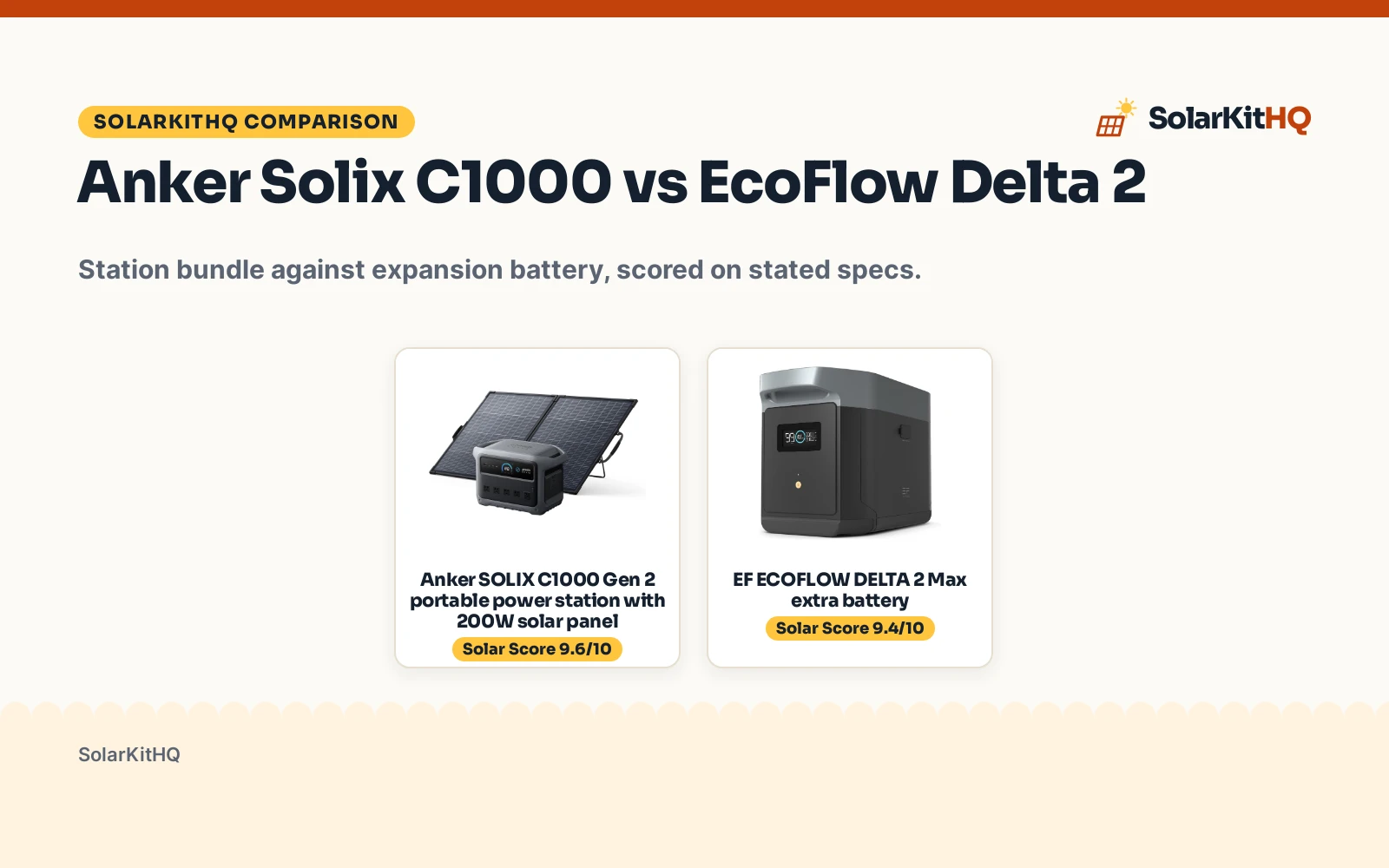
Picture an outage at dinner time: the kitchen goes dark, the fridge starts its countdown, and every phone in the house is nearly dead. That is the moment anker solix c1000 vs ecoflow delta 2 stops being a search term and becomes a decision. The verdict is short: the Anker SOLIX C1000 Gen 2 bundle is the pick if you need a complete station with a solar panel in the box, while the EcoFlow listing is a DELTA 2 Max extra battery, so it only makes sense if you already own a DELTA 2 or DELTA Max 2000 to expand. Below is what each listing states, what the listings leave unclear, and how the scores were built.
SolarKitHQ earns a commission when you buy through links on this page, at no extra cost to you. As an Amazon Associate I earn from qualifying purchases. Affiliate disclosure.
Anker Solix C1000 vs EcoFlow Delta 2: the verdict
The Anker example arrives as a two-package bundle: the C1000 Gen 2 station plus a PS200 bifacial portable solar panel with its cables. It states 2,000W output through 9 ports with 3,000W peak, a 1,024Wh LiFePO4 battery, and a full charge in 49 min at 1,600W with HyperFlash enabled in the Anker app. Solar recharging takes 1.8 hours from 600W of solar at 60V max, and a 10 ms UPS switchover keeps CPAP machines and laptops running through short outages.
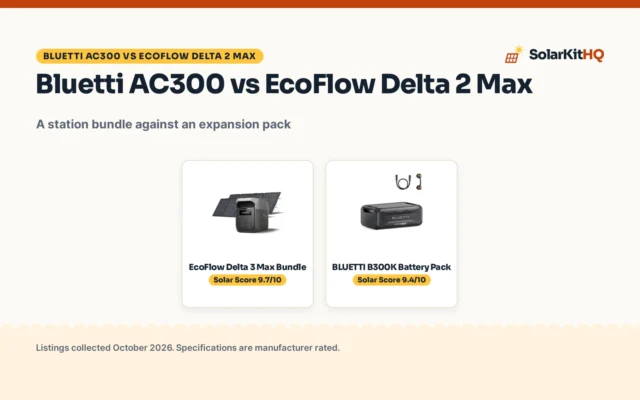
The EcoFlow example is a different kind of product: a DELTA 2 Max extra battery with 2048Wh that expands a DELTA 2 or DELTA Max 2000 to 2-6kWh of capacity, up to 6144Wh with two batteries. It states 3000+ cycles to 80% of original capacity and 10 years of daily use from its LFP chemistry, with 3400 watts starting wattage on the spec table. Pick the Anker side for a standalone station you can buy once and use; pick the EcoFlow side to add runtime to a station you already own.
What the Anker side states
Anker states 2,000W output via 9 ports with 3,000W peak and a 1,024Wh LiFePO4 battery. The 49 min full recharge runs at 1,600W with HyperFlash enabled in the Anker app, while solar recharging needs 1.8 hours from 600W of solar at 60V max. A 10 ms UPS switchover keeps CPAP machines and laptops running, and TOU mode in the Anker app monitors, controls and schedules power around peak surcharges.
Longevity is stated as 10 years of InfiniPower with at least 80% capacity after 4,000 cycles. The station measures 15.1″L x 8.2″W x 9.6″H, is described as 14% smaller and 11% lighter than similar models, and carries a 5 years warranty. The box ships as two packages: the station with an AC charging cable, quick start guide and safety and warranty card, and the PS200 bifacial portable solar panel with 8.2 ft (2.5 m) and 1.6 ft (0.5 m) XT60i solar charging cables.
What the EcoFlow side states
The EcoFlow listing is the DELTA 2 Max extra battery, model EFD350, not the DELTA 2 station itself. It adds 2048Wh to a DELTA 2 or DELTA Max 2000, with 2-6kWh of expandable capacity and up to 6144Wh when two extra batteries are added. The LFP chemistry is stated for 3000+ cycles to 80% of its original capacity and 10 years of daily use.
The spec table states 3400 watts starting wattage, 6 total power outlets, 120 volts, a 42-pound weight and 11″L x 9″W x 18″H dimensions. The warranty description is 1 year manufacturer. Our portable power station for road trip picks cover complete stations built for travel, which is the matchup to read if you want two full stations side by side.
What the listings leave unclear
The EcoFlow listing states no output wattage of its own beyond the 3400 watts starting figure, no solar input figure, and no recharge time: as an expansion battery it inherits those from the host station. The Anker listing states no expansion-battery option of its own. Neither listing states certifications, so the safety column scores 0 for both and no winner is declared there.
The Anker example states 9 ports against 6 on the EcoFlow example, but those count different things on a station versus an expansion battery, so the port count is not scored as a win for either side. Likewise the Anker example’s 1,024Wh cannot be set directly against the EcoFlow example’s 2048Wh, because one is a standalone station and the other is add-on capacity.
How we scored them
Each listing was scored across performance, build, value, safety and warranty, using only stated figures. The Anker example: 2,000W output with 3,000W peak and 49-min recharging led performance, 4,000 cycles to 80% led build, the included 200W panel led value, and the 5 years warranty led the warranty column.
The EcoFlow example: 2048Wh of expandable capacity and 3400 watts starting led performance, 3000+ cycles to 80% led build, 2-6kWh expandability led value, and the 1 year manufacturer warranty set the warranty column. Neither listing states certifications, so safety scored 0 for both.
Anker solix c1000 vs ecoflow delta 2: which should you choose?
Choose the Anker SOLIX C1000 Gen 2 bundle if you are buying your first station: 2,000W output, 1,024Wh, 9 ports, a 200W panel in the box and a 5 years warranty make it a complete off-grid kit with nothing else to buy. The 49 min HyperFlash recharge and 10 ms UPS switchover are the two standout stated features for home backup use.
Choose the EcoFlow DELTA 2 Max extra battery if you already own a DELTA 2 or DELTA Max 2000 and need more runtime: 2048Wh per battery, 2-6kWh expandable, up to 6144Wh with two, and 3000+ cycles to 80%. Do not buy the EcoFlow example expecting a standalone station; the listing describes an expansion battery only. For a different pairing, see Anker Solix C1000 vs EcoFlow Delta 3.
| If you need | Look at |
|---|---|
| A complete station with solar panel | Anker SOLIX C1000 Gen 2 bundle, 2,000W with 200W panel |
| More runtime for an existing DELTA 2 | EF ECOFLOW DELTA 2 Max extra battery, 2048Wh |
| Fastest stated recharge | Anker example, 49 min at 1,600W |
| Longest stated warranty | Anker example, 5 years |
Sizing Notes
- Match watt-hours to the loads: 1,024Wh in the Anker example, 2048Wh per EcoFlow example battery.
- Match output to the appliance: 2,000W with 3,000W peak on the Anker example; the EcoFlow example states 3400 watts starting as an expansion battery.
- Match solar input: 600W at 60V max on the Anker example; the EcoFlow example states none.
- Match cycle life claims: 4,000 cycles to 80% on the Anker example, 3000+ cycles to 80% on the EcoFlow example.
Frequently Asked Questions
Which side includes a solar panel?
The Anker side: the bundle ships with a PS200 200W bifacial portable solar panel and its 8.2 ft (2.5 m) and 1.6 ft (0.5 m) XT60i cables. The EcoFlow example is a battery only.
Can the EcoFlow example run devices by itself?
The listing describes it as an extra battery compatible with DELTA 2 and DELTA Max 2000, adding 2048Wh per battery. It is not a standalone station.
Which listing states more cycles?
The Anker example states 4,000 cycles to at least 80% capacity; the EcoFlow example states 3000+ cycles to 80% of original capacity.
Which listing states the longer warranty?
The Anker example states 5 years; the EcoFlow example states 1 year manufacturer.
Do both use lithium iron phosphate?
The Anker example states a LiFePO4 battery; the EcoFlow example states LFP battery chemistry.