On this page
The lights went out just as dinner hit the table, and the only question in the anker solix c1000 vs ecoflow delta 3 debate was whether a carryable station or a much larger home unit fit the outage plan. The short verdict: the Anker SOLIX C1000 side suits camping, RV trips and moving the station around, while the EcoFlow side suits bigger loads and longer backup, because the EcoFlow listing here describes the DELTA Pro 3. This comparison covers the two listings on capacity, output, solar input, weight, water resistance and warranty terms.
SolarKitHQ earns a commission when you buy through links on this page, at no extra cost to you. As an Amazon Associate I earn from qualifying purchases. Affiliate disclosure.
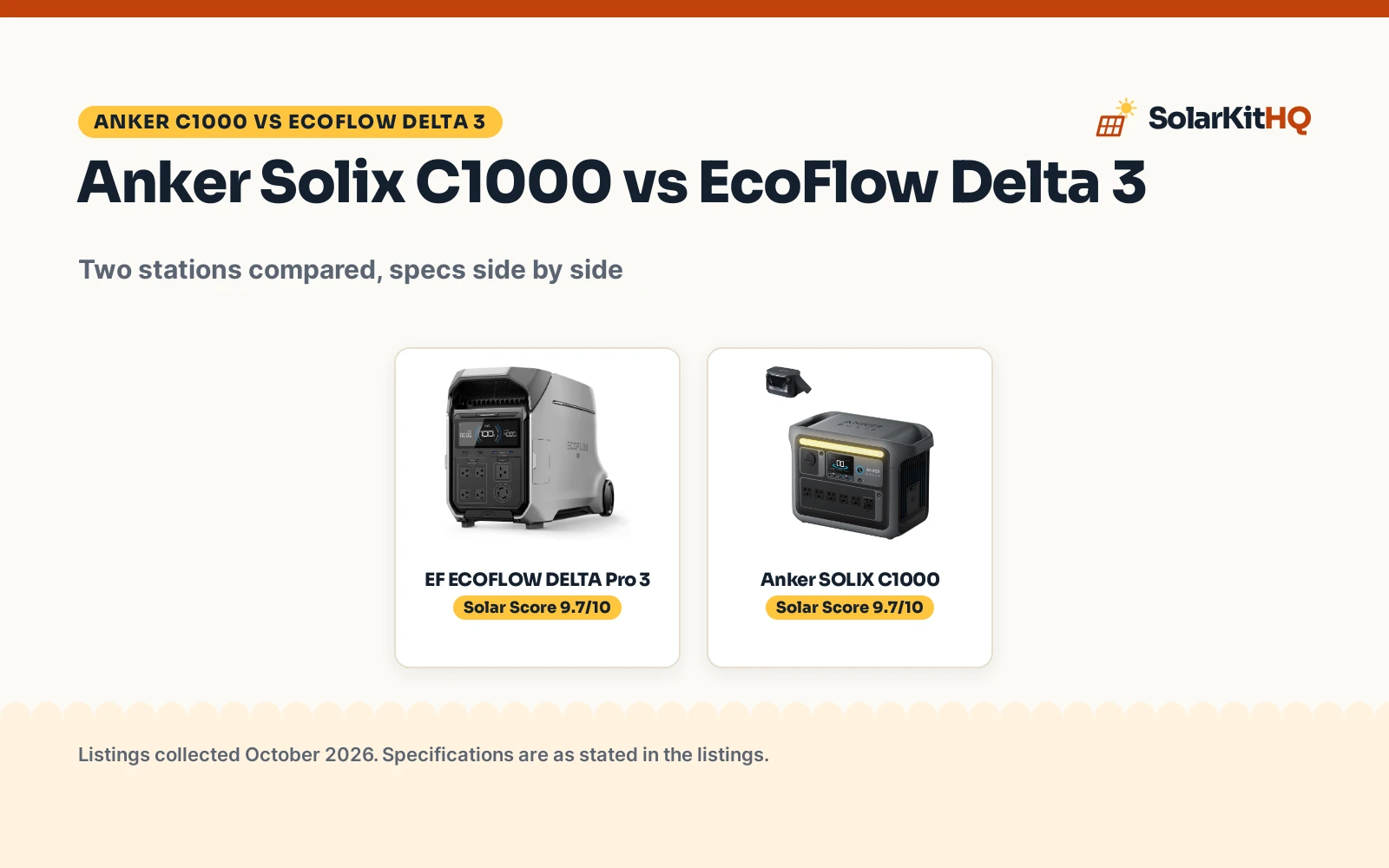
Anker Solix C1000 vs Ecoflow Delta 3: side by side
| Anker C1000 vs EcoFlow Delta 3 | EF ECOFLOW DELTA Pro 3 | Anker SOLIX C1000 |
|---|---|---|
| Capacity | 4096Wh LFP | 1,056Wh LiFePO4 |
| Continuous output | 4000W | 1,800W |
| Peak output | 6000W (X-Boost) | 2,400W |
| Max solar input | Not stated | 600W |
| Weight | 115 pounds | 28.4 pounds |
| Water resistance | IP65 | IP54 |
| Warranty | 5 years | 5 years |
Specifications are as stated in the listings, collected 21 October 2026.
Capacity and output
The Anker SOLIX C1000 listing states a 1,056Wh LiFePO4 battery with 1,800W continuous output and 2,400W peak, and says its SurgePad technology runs 99% of appliances through 11 ports. The EcoFlow listing states a 4096Wh LFP battery with 4000W AC output, 6000W with X-Boost and up to 12000W when scaled, plus 120/240V voltage support. These are not the same class of station: the EcoFlow listing describes the DELTA Pro 3, a 115-pound unit built for whole-home backup, while the Anker is a 28.4-pound station built to move. Do not read the gap as a win for either side; it is a difference in what each listing describes.
Solar input and recharging
On recharging, the Anker listing is specific: up to 600W solar input with a stated full solar recharge in 1.8 hours, and 80% in 43 minutes on AC input with UltraFast mode turned on in the Anker app. The EcoFlow listing states 7 unique and 18 combo charging methods, including AC wall outlets, solar panels, gas generators, EV charging piles and the EcoFlow smart home panel 2, but it states no solar input wattage. If solar charging speed matters to you, the Anker listing gives you figures to plan with; the EcoFlow listing does not.
Weight, size and water resistance
The Anker SOLIX C1000 is listed at 28.4 pounds and 14.8 by 8.7 by 10.5 inches, with IP54 water resistance, elevated rubber feet and a water-resistant bag included in the box that ships separately. The EcoFlow station is listed at 115 pounds and 16.16 by 13.43 by 27.38 inches, with an IP65 CTC battery pack built from automotive-grade LFP cells. One is built to ride along; the other is built to sit in place.
What the listings leave unclear
Outlet counts need a note. The Anker title states 6 AC outlets and the bullets state 11 ports, but the spec table lists Total Power Outlets as 4; use the title and bullets. The EcoFlow spec table lists Total Power Outlets as 1, which is unclear next to the 120/240V outlets the listing describes. And the headline names the EcoFlow Delta 3 while the listing title and bullets describe the DELTA Pro 3, so every EcoFlow figure here describes the DELTA Pro 3.
Two examples

EF ECOFLOW DELTA Pro 3
A 4096Wh LFP portable power station with 4000W AC output, 120/240V support, expansion to 48kWh, an IP65 CTC battery pack and a 5-year warranty.
Pros
- 4096Wh LFP capacity, expandable to 48kWh with extra batteries
- 4000W AC output with 120/240V support, 6000W with X-Boost
- IP65 CTC battery pack with automotive-grade LFP cells
- 10 ms switch-over and 30 dB X-Quiet operation stated
Cons
- 115 pounds stated, so plan a fixed spot for it
- No solar input wattage is stated
- The spec table lists Total Power Outlets as 1, which is unclear
- The listing describes the DELTA Pro 3, a larger station than the Delta 3 in the headline
Detailed Review
The listing states a 4096Wh LFP portable power station with 4000W AC output, 6000W with X-Boost and up to 12000W when scaled, 120/240V voltage support, expansion to 48kWh with extra batteries or smart generators, 10 ms switch-over for backup, 30 dB X-Quiet operation, an IP65 CTC battery pack with automotive-grade LFP cells, 7 unique and 18 combo charging methods including solar panels and EV charging piles, 115 pounds, 16.16 by 13.43 by 27.38 inches and a 5 Year Manufacturer warranty. Note that the title and bullets describe the DELTA Pro 3, a larger station than the Delta 3 named in the headline, so every figure here describes the DELTA Pro 3. The spec table lists Total Power Outlets as 1, which is unclear next to the outlets the listing describes.
Who it's for: owners planning whole-home backup or large loads who can give the station a fixed spot. Who should skip it: anyone who needs to carry the station to a campsite or move it often.
Its Solar Score of 9.7/10 comes from performance 32/35, build 22/25, value 19/25, safety 8/10 and warranty 3/5: 84 of 100 points, placed on our 9.2 to 9.8 scale.
Key Specifications
| Capacity | 4096Wh LFP, expandable to 48kWh |
|---|---|
| Output | 4000W AC, 120/240V, 6000W X-Boost |
| Backup and noise | 10 ms switch-over, 30 dB X-Quiet |
| Size and weight | 16.16 x 13.43 x 27.38 in, 115 lb |
Figures as published on the retailer listing, collected 21 October 2026. Performance figures are manufacturer rated.
Safety and Warranty
What this listing states. Automotive-grade LFP cells, IP65 CTC battery pack and 10 ms switch-over stated, so safety scores 8 of 10. 5 Year Manufacturer stated. It does not say everything a buyer needs, such as who pays return shipping, so warranty scores 3 of 5. See How We Pick.
Power station limits. Stay within the stated continuous output and solar input limits, keep the unit ventilated and dry, charge within the stated temperature range, and never connect it to home wiring except through equipment a licensed electrician installs.
This is general buying information, not professional advice. Follow each product manual and local rules, and see our Safety Disclaimer.

Anker SOLIX C1000
A 1,056Wh LiFePO4 portable power station with 1,800W continuous output, 6 AC outlets, 600W max solar input, an IP54 water-resistant bag and a 5-year warranty.
Pros
- 1,056Wh LiFePO4 battery with 3,000 cycles stated
- 1,800W continuous output with 2,400W peak
- 600W max solar input with a full solar recharge in 1.8 hours stated
- 80% recharge in 43 minutes on AC with UltraFast mode stated
Cons
- The spec table lists Total Power Outlets as 4 against 6 AC outlets in the title
- The water-resistant bag ships separately, per the listing
- UltraFast recharging needs AC input and UltraFast mode in the Anker app
- No expansion capacity is stated
Detailed Review
The listing states a 1,056Wh LiFePO4 portable power station with 1,800W continuous output and 2,400W peak, 6 AC outlets in the title and 11 ports in the bullets, up to 600W solar input with a stated full solar recharge in 1.8 hours, 80% recharge in 43 minutes on AC input with UltraFast mode in the Anker app, 3,000 cycles, IP54 water resistance with elevated rubber feet and a water-resistant bag that ships separately, 28.4 pounds, 14.8 by 8.7 by 10.5 inches and a 5 years warranty description. The spec table lists Total Power Outlets as 4, which does not match the 6 AC outlets in the title; use the title and bullets.
Who it's for: campers, RV owners and anyone who wants a carryable station with stated fast solar and AC recharging. Who should skip it: anyone sizing backup for large 240V loads or whole-home use.
Its Solar Score of 9.7/10 comes from performance 30/35, build 21/25, value 20/25, safety 8/10 and warranty 3/5: 82 of 100 points, placed on our 9.2 to 9.8 scale.
Key Specifications
| Capacity | 1,056Wh LiFePO4, 3,000 cycles |
|---|---|
| Output | 1,800W continuous, 2,400W peak |
| Recharging | 80% in 43 minutes on AC; 600W solar, 1.8 hour full recharge |
| Size and weight | 14.8 x 8.7 x 10.5 in, 28.4 lb |
Figures as published on the retailer listing, collected 21 October 2026. Performance figures are manufacturer rated.
Safety and Warranty
What this listing states. IP54 water resistance, elevated rubber feet and water-resistant bag stated, so safety scores 8 of 10. 5 years stated. It does not say everything a buyer needs, such as who pays return shipping, so warranty scores 3 of 5. See How We Pick.
Power station limits. Stay within the stated continuous output and solar input limits, keep the unit ventilated and dry, charge within the stated temperature range, and never connect it to home wiring except through equipment a licensed electrician installs.
This is general buying information, not professional advice. Follow each product manual and local rules, and see our Safety Disclaimer.
As an Amazon Associate I earn from qualifying purchases.
How we scored them
The Solar Score weighs performance, build, value, safety and warranty. For portable power stations, safety means stated protections such as water resistance codes, battery pack safeguards and backup switch-over; the Anker listing states IP54 water resistance and the EcoFlow listing states an IP65 CTC battery pack with automotive-grade LFP cells and 10 ms switch-over. Both listings state a warranty term: 5 years on the Anker and a 5 Year Manufacturer warranty on the EcoFlow. How we pick explains the weights.
| Product | Solar Score | Perf. /35 | Build /25 | Value /25 | Safety /10 | Warranty /5 |
|---|---|---|---|---|---|---|
| EF ECOFLOW DELTA Pro 3 | 9.7 | 32 | 22 | 19 | 8 | 3 |
| Anker SOLIX C1000 | 9.7 | 30 | 21 | 20 | 8 | 3 |
Scores run from 9.2 to 9.8: each product’s point total is placed on that range, so more points always means a higher score.
Anker Solix C1000 vs Ecoflow Delta 3: which should you choose?
Choose the Anker SOLIX C1000 if the station needs to move: it is listed at 28.4 pounds with a water-resistant bag, 6 AC outlets and 1,800W continuous output, which suits camping, tailgating and RV use. Choose the EcoFlow side if the loads are bigger or the outage is longer: the listing describes the DELTA Pro 3 with 4096Wh, 4000W output and 120/240V support. If you are sizing a full outage plan, see the best portable power station for home backup; for life on the road, the best solar generator for full time RV living rounds up options built for that use.
| If you need | Look at |
|---|---|
| The lighter station | Anker SOLIX C1000, 28.4 lb |
| More stated capacity | EF ECOFLOW DELTA Pro 3, 4096Wh |
| Stated fast solar recharging | Anker SOLIX C1000, 600W solar, 1.8 hour full recharge |
| 120/240V output | EF ECOFLOW DELTA Pro 3 |
Sizing Notes
- Match the station’s continuous output to the loads you plan: the Anker listing states 1,800W continuous and 2,400W peak, and the EcoFlow listing states 4000W with 6000W X-Boost.
- Match battery capacity to the loads you plan to run: 1,056Wh on the Anker listing, 4096Wh on the EcoFlow listing, with stated expansion to 48kWh on the EcoFlow side.
- Check solar input against the panels you own: the Anker listing states up to 600W solar input, while the EcoFlow listing states no solar input wattage.
- Check weight and footprint against where the station will live: 28.4 pounds and 14.8 by 8.7 by 10.5 inches for the Anker, 115 pounds and 16.16 by 13.43 by 27.38 inches for the EcoFlow.
Frequently Asked Questions
Which station states more battery capacity?
The EcoFlow listing states 4096Wh, expandable to 48kWh with extra batteries, while the Anker listing states 1,056Wh.
Which station is lighter?
The Anker SOLIX C1000 is listed at 28.4 pounds; the EcoFlow station is listed at 115 pounds.
What solar input does each listing state?
The Anker listing states up to 600W solar input with a full solar recharge in 1.8 hours. The EcoFlow listing names solar panels among its charging methods but states no solar input wattage.
Is the EcoFlow station here the Delta 3?
The listing title and bullets describe the DELTA Pro 3, so the figures on the EcoFlow side describe that larger station rather than the Delta 3.
Do both listings state a warranty?
Yes. The Anker listing states 5 years, and the EcoFlow listing states a 5 Year Manufacturer warranty.
Related guides
See every Portable Power Stations guide and all Power Stations and Generators guides. Also see our best portable power station for hiking. Also see our best portable power station for coffee maker.
More picks: best solar panel for EcoFlow, power inverter vs converter charger and best solar generator for a shed.