On this page
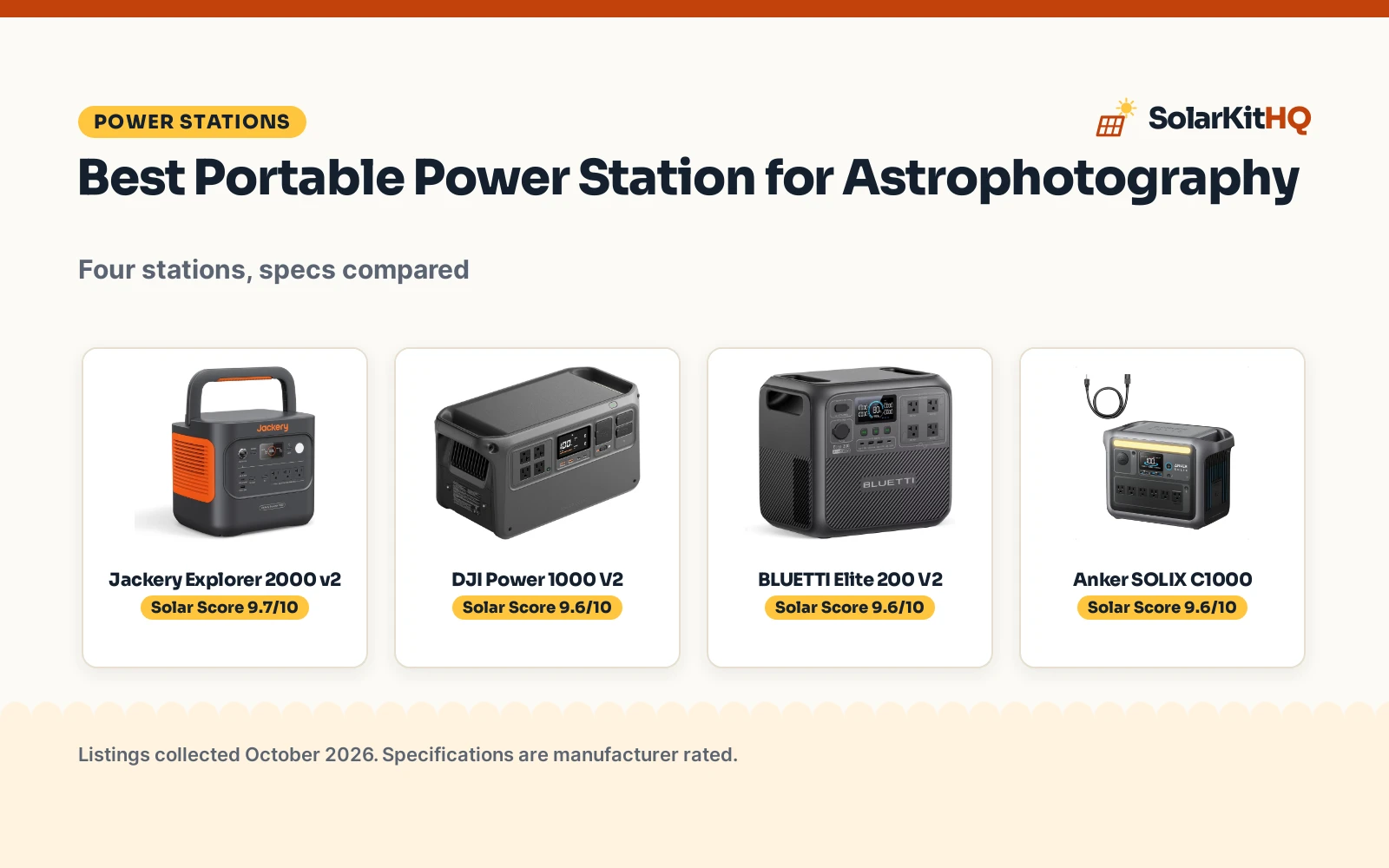
A mount tracking the Milky Way at 2 a.m., a cooled camera and a laptop running all night: the best portable power station for astrophotography keeps the rig alive without a generator humming in the dark. We compared four stations, from 1024Wh to 2073.6Wh, on capacity, USB-C output, noise, certifications and warranty terms their listings publish. Certified UPS backup and stated warranty terms separated the top two.
SolarKitHQ earns a commission when you buy through links on this page, at no extra cost to you. As an Amazon Associate I earn from qualifying purchases. Affiliate disclosure.
Quick picks
 Best Overall Jackery Explorer 2000 v2: 2042Wh with 2200W output, UL1778 UPS and 5-year warranty Check price on Amazon
 Quietest DJI Power 1000 V2: 1024Wh at 26 dB, dual 140W USB-C and 10ms UPS Check price on Amazon
 Biggest Capacity BLUETTI Elite 200 V2: 2073.6Wh with 2600W output, 3900W lifting and 4 AC outlets Check price on Amazon
 Fastest Recharge Anker SOLIX C1000: 1056Wh with 80% in 43 min, 600W solar and 11 ports Check price on Amazon
The picks
| # | Product | Solar Score | Buy |
|---|---|---|---|
| 1 | Jackery Explorer 2000 v2 | 9.7/10 | Buy on Amazon |
| 2 | DJI Power 1000 V2 | 9.6/10 | Buy on Amazon |
| 3 | BLUETTI Elite 200 V2 | 9.6/10 | Buy on Amazon |
| 4 | Anker SOLIX C1000 | 9.6/10 | Buy on Amazon |

Jackery Explorer 2000 v2
A 2042Wh LiFePO4 station with 2200W AC output, USB-C PD 100W, UL1778-certified UPS and a 5-year manufacturer warranty.
Pros
- 2042Wh with 2200W AC output
- UL1778 certified for UPS, 20ms switching
- 41% lighter and 34% smaller than typical 2kWh
- 0 to 80% in 66 min, full in 102 min
Cons
- 39.5 lb, the heaviest here
- Only 3 AC ports
- Solar panel optional, not included
- Solar full charge takes 6 hours with 400W panels
Detailed Review
The listing states a 2042Wh LiFePO4 station with 3 AC ports delivering 2200W total, a USB-C PD 100W port, and CTB (Cell-to-Body) construction at 39.5 lb, stated to be 41% lighter and 34% smaller than typical 2kWh LiFePO4 stations. It lists AC fast charging from 0 to 80% in 66 minutes and a full charge in 102 minutes via Emergency Super Charging through the app, solar charging in 6 hours with 400W panels, and a Silent Charging mode with a full charge in 5 hours at under 30dB. It states 20ms UPS switching and UL1778 certification for Uninterruptible Power Systems, a 10-year battery lifespan, and a 5 year manufacturer warranty, with smart temperature control adjusting fan speed.
Who it's for: imagers who want the biggest usable capacity here with certified UPS backup. Who should skip it: anyone who needs more than 3 AC outlets.
Its Solar Score of 9.7/10 comes from performance 32/35, build 21/25, value 20/25, safety 8/10 and warranty 3/5: 84 of 100 points, placed on our 9.2 to 9.8 scale.
Key Specifications
| Capacity | 2042Wh LiFePO4 |
|---|---|
| Output | 2200W AC, 3 ports |
| USB-C | 100W PD |
| UPS | 20ms, UL1778 |
Figures as published on the retailer listing, collected 20 October 2026. Performance figures are manufacturer rated.
Safety and Warranty
What this listing states. UL1778 certification for Uninterruptible Power Systems stated, so safety scores 8 of 10. 5 year manufacturer warranty stated. It does not say everything a buyer needs, such as who pays return shipping, so warranty scores 3 of 5. See How We Pick.
Power station limits. Stay within the stated continuous output and solar input limits, keep the unit ventilated and dry, charge within the stated temperature range, and never connect it to home wiring except through equipment a licensed electrician installs.
This is general buying information, not professional advice. Follow each product manual and local rules, and see our Safety Disclaimer.

DJI Power 1000 V2
A 1024Wh LFP station with 2600W stable output, dual 140W USB-C, 26dB operation, 10ms UPS and a 5-year warranty per the bullets.
Pros
- 2600W stable output from 1024Wh
- Dual 140W USB-C ports (280W total)
- 26dB ultra-silent operation
- 10ms UPS switching
Cons
- MPPT and car charging modules not built-in
- Spec table lists 1 Year Manufacturer against the 5-year bullets
- 1024Wh, the smallest capacity here
- No certification body is stated
Detailed Review
The listing states a 1024Wh LFP station with 2600W stable output at 17.64 by 8.85 by 9.05 inches, dual 140W USB-C ports (280W total), and recharging to 80% in 37 minutes. It lists operation as low as 26dB, seamless UPS with a 10ms switch time, an intelligent BMS, sub-nano coating and flame-retardant housing with a 10-year lifespan, and includes the station plus an AC power cable. The bullets state a 5-year warranty while the spec table lists 1 Year Manufacturer, so trust the bullets; note that MPPT and car charging modules are not built-in, so solar or car charging needs a separate adapter.
Who it's for: imagers who want the quietest station here with strong USB-C laptop charging. Who should skip it: anyone who needs big capacity or built-in solar charging.
Its Solar Score of 9.6/10 comes from performance 30/35, build 21/25, value 19/25, safety 7/10 and warranty 3/5: 80 of 100 points, placed on our 9.2 to 9.8 scale.
Key Specifications
| Capacity | 1024Wh LFP |
|---|---|
| Output | 2600W stable |
| USB-C | Dual 140W, 280W total |
| Noise | 26dB stated |
Figures as published on the retailer listing, collected 20 October 2026. Performance figures are manufacturer rated.
Safety and Warranty
What this listing states. Intelligent BMS, sub-nano coating and flame-retardant housing stated, so safety scores 7 of 10. 5-year warranty stated in the bullets. It does not say everything a buyer needs, such as who pays return shipping, so warranty scores 3 of 5. See How We Pick.
Power station limits. Stay within the stated continuous output and solar input limits, keep the unit ventilated and dry, charge within the stated temperature range, and never connect it to home wiring except through equipment a licensed electrician installs.
This is general buying information, not professional advice. Follow each product manual and local rules, and see our Safety Disclaimer.

BLUETTI Elite 200 V2
A 2073.6Wh LFP station with 2600W output, 3900W power lifting, 4 AC outlets, 6000+ cycles and UPS backup.
Pros
- 2073.6Wh, the biggest capacity here
- 2600W continuous with 3900W power lifting
- 6000+ cycles and 17-year lifespan stated
- 4x 2600W AC outlets
Cons
- No warranty term is stated
- 53.4 lb, far the heaviest here
- No certification body is stated
- 10W standby draw
Detailed Review
The listing states a 2073.6Wh LFP station with 2600W continuous AC output, 3900W in power lifting mode, and 4x 2600W AC outlets powering up to 9 devices, at 53.4 lb and 13.78 by 9.84 by 12.74 inches. It lists an automotive-grade LiFePO4 battery with over 6,000 cycles and a 17-year lifespan, CNAS certification of the battery, 33 evaluation standards, and multi-layer protection for extreme temperatures. It states Turbo charging to 0 to 80% in 50 minutes with dual AC and DC, a full charge in 2 hours with a 1200W alternator charger, solar full charge in 2.4 hours with 1000W panels, standby draw of 10W, and UPS backup at 15ms or less; no warranty term is stated.
Who it's for: imagers who need maximum capacity and 2600W output for a long night. Who should skip it: anyone who needs a stated warranty or a lighter unit.
Its Solar Score of 9.6/10 comes from performance 33/35, build 22/25, value 21/25, safety 7/10 and warranty 0/5: 83 of 100 points, placed on our 9.2 to 9.8 scale.
Key Specifications
| Capacity | 2073.6Wh LFP |
|---|---|
| Output | 2600W, 3900W lifting |
| Cycles | 6000+, 17-year stated |
| Weight | 53.4 lb |
Figures as published on the retailer listing, collected 20 October 2026. Performance figures are manufacturer rated.
Safety and Warranty
What this listing states. Multi-layer protection, BMS and CNAS-certified automotive-grade battery stated, so safety scores 7 of 10. No warranty term, so warranty scores zero. See How We Pick.
Power station limits. Stay within the stated continuous output and solar input limits, keep the unit ventilated and dry, charge within the stated temperature range, and never connect it to home wiring except through equipment a licensed electrician installs.
This is general buying information, not professional advice. Follow each product manual and local rules, and see our Safety Disclaimer.

Anker SOLIX C1000
A 1056Wh LiFePO4 station with 1800W output, 2400W SurgePad, 600W solar input, 11 ports and a 5-year warranty.
Pros
- Full charge in 58 min, 80% in 43 min
- 600W solar input, full in 1.8 hours
- 2400W SurgePad powers 99% of appliances stated
- 15% smaller than comparable 1kWh units
Cons
- No certification body is stated
- UltraFast recharge needs the app and a smartphone
- 27.6 lb for 1056Wh
- 1056Wh, the second-smallest capacity here
Detailed Review
The listing states a 1056Wh LiFePO4 station with 1800W continuous output, 2400W SurgePad and 11 ports, at 27.6 lb and 14.8 by 8.07 by 11.02 inches, stated to be 15% smaller than comparable 1kWh units. It lists UltraFast recharging to 80% in 43 minutes and a full charge in 58 minutes via AC input with the mode enabled in the Anker app (a smartphone is required), plus up to 600W solar input for a full charge in 1.8 hours. It states 3,000 battery cycles over a 10-year lifespan, includes an AC charging cable and a car charging cable, and gives a 5 Years warranty.
Who it's for: imagers who recharge fast between sessions and run on solar. Who should skip it: buyers who want a stated certification.
Its Solar Score of 9.6/10 comes from performance 32/35, build 21/25, value 21/25, safety 0/10 and warranty 3/5: 77 of 100 points, placed on our 9.2 to 9.8 scale.
Key Specifications
| Capacity | 1056Wh LiFePO4 |
|---|---|
| Output | 1800W, 2400W peak |
| Solar input | 600W, full in 1.8h |
| Weight | 27.6 lb |
Figures as published on the retailer listing, collected 20 October 2026. Performance figures are manufacturer rated.
Safety and Warranty
What this listing states. No UL, FCC or battery management statement is stated, so safety scores zero. 5 Years warranty stated. It does not say everything a buyer needs, such as who pays return shipping, so warranty scores 3 of 5. See How We Pick.
Power station limits. Stay within the stated continuous output and solar input limits, keep the unit ventilated and dry, charge within the stated temperature range, and never connect it to home wiring except through equipment a licensed electrician installs.
This is general buying information, not professional advice. Follow each product manual and local rules, and see our Safety Disclaimer.
As an Amazon Associate I earn from qualifying purchases.
Compare the picks
| Station | Solar Score | Capacity | AC output | USB-C | UPS | Warranty | Amazon |
|---|---|---|---|---|---|---|---|
| Jackery Explorer 2000 v2 | 9.7/10 | 2042Wh | 2200W | 100W PD | 20ms, UL1778 | 5 years | View on Amazon |
| DJI Power 1000 V2 | 9.6/10 | 1024Wh | 2600W | Dual 140W | 10ms | 5 years | View on Amazon |
| BLUETTI Elite 200 V2 | 9.6/10 | 2073.6Wh | 2600W (3900W lifting) | Not stated | 15ms or less | Not stated | View on Amazon |
| Anker SOLIX C1000 | 9.6/10 | 1056Wh | 1800W (2400W peak) | Not stated | UPS stated | 5 years | View on Amazon |
Specifications are manufacturer rated as listed, collected 20 October 2026.
How we scored them
The Solar Score weighs performance, build, value, safety and warranty. For power stations, safety means the certifications and protection features the listing actually states: UL1778 for UPS, an intelligent BMS, flame-retardant housing and multi-layer protection score here, while a station that states no certification scores lower. Three of the four listings state a 5-year warranty. How we pick explains the weights.
| Product | Solar Score | Perf. /35 | Build /25 | Value /25 | Safety /10 | Warranty /5 |
|---|---|---|---|---|---|---|
| Jackery Explorer 2000 v2 | 9.7 | 32 | 21 | 20 | 8 | 3 |
| DJI Power 1000 V2 | 9.6 | 30 | 21 | 19 | 7 | 3 |
| BLUETTI Elite 200 V2 | 9.6 | 33 | 22 | 21 | 7 | 0 |
| Anker SOLIX C1000 | 9.6 | 32 | 21 | 21 | 0 | 3 |
Scores run from 9.2 to 9.8: each product’s point total is placed on that range, so more points always means a higher score.
How to choose the best portable power station for astrophotography
Capacity for a full night
The BLUETTI states 2073.6Wh and the Jackery 2042Wh, roughly double the Anker at 1056Wh and the DJI at 1024Wh. BLUETTI’s own example: a 120V 60W heater run 10 hours a day lasts 3.3 days. Standby draw matters overnight, and the BLUETTI states just 10W.
USB-C and outlets for cameras and laptops
The DJI gives dual 140W USB-C ports (280W total) and the Jackery a 100W PD USB-C port, both stated for fast device charging. The Anker lists 11 ports with 2400W SurgePad, and the BLUETTI gives 4x 2600W AC outlets for up to 9 devices at once.
| Station | Capacity | AC output | USB-C | Noise | UPS |
|---|---|---|---|---|---|
| Jackery Explorer 2000 v2 | 2042Wh | 2200W | 100W PD | Under 30dB silent | 20ms, UL1778 |
| DJI Power 1000 V2 | 1024Wh | 2600W | Dual 140W | 26dB | 10ms |
| BLUETTI Elite 200 V2 | 2073.6Wh | 2600W (3900W lifting) | Not stated | 16-30dB | 15ms or less |
| Anker SOLIX C1000 | 1056Wh | 1800W (2400W peak) | Not stated | Not stated | UPS stated |
Recharge between sessions
The DJI reaches 0 to 80% in 37 minutes and the Anker 80% in 43 minutes with a full charge in 58 minutes, though the Anker’s UltraFast mode needs the app and a smartphone. The Jackery does 0 to 80% in 66 minutes and a full charge in 102 minutes; the BLUETTI does 0 to 80% in 50 minutes with dual AC and DC and a full charge in 2 hours with a 1200W alternator charger. By solar: Anker 600W for 1.8 hours, Jackery 400W for 6 hours, BLUETTI 1000W for 2.4 hours. Note the DJI’s MPPT and car charging modules are not built-in, so solar or car charging needs a separate adapter. For daytime top-ups, see our best portable power station for camping and best portable power station with solar panels for camping.
Sizing Notes
- Match capacity to the night: 2042 to 2073.6Wh for long sessions, 1024 to 1056Wh for shorter ones.
- Check USB-C wattage for laptop charging: dual 140W (DJI), 100W PD (Jackery).
- Note the noise floor: 26dB (DJI), under 30dB in silent mode (Jackery), 16 to 30dB (BLUETTI).
- Confirm UPS switching if outages matter: 10ms (DJI), 15ms or less (BLUETTI), 20ms with UL1778 (Jackery).
- Check the warranty: 5 years stated on three; none stated on the BLUETTI.
Frequently Asked Questions
Which station has the biggest capacity?
The BLUETTI at 2073.6Wh, followed by the Jackery at 2042Wh. The Anker and DJI are 1056Wh and 1024Wh.
Which is the quietest?
The DJI states 26dB. The Jackery states under 30dB in silent charging mode, and the BLUETTI 16 to 30dB in silent mode.
Which charges the fastest?
The DJI states 0 to 80% in 37 minutes and the Anker 80% in 43 minutes with a full charge in 58 minutes. The BLUETTI states 0 to 80% in 50 minutes with dual AC and DC, and the Jackery 0 to 80% in 66 minutes.
Which have USB-C laptop charging?
The DJI states dual 140W USB-C ports (280W total) and the Jackery a 100W PD USB-C port. The Anker and BLUETTI state no USB-C wattage.
Which state a certification?
The Jackery states UL1778 certification for Uninterruptible Power Systems. The other three state no certification body.
Can these recharge by solar?
The Anker states 600W solar for a 1.8-hour full charge, the Jackery 400W for 6 hours, and the BLUETTI 1000W for 2.4 hours. The DJI needs a separate adapter for solar charging.
Related guides
See every Portable Power Stations guide and all Power Stations and Generators guides. Also see our best portable power station for camping. Also see our best portable power station with solar panels for camping.
More picks: power station for air fryer, power station for a campervan, power station for home backup, power station for a projector.