On this page
The best portable power station with solar panels for camping is the one you will actually haul from the car to the tent and whose watt-hours cover the gap between sunset and the next charge. A campsite at dusk with a dead phone is a good moment to decide the numbers matter. We compared five power station kits that each include a panel or pair with one, using only what each Amazon listing publishes: watt-hours, continuous and surge watts, the panel in the box, outlets, weight and the warranty term. Four of the five ship with a panel in the box; the fifth works with the maker’s dedicated panels.
SolarKitHQ earns a commission when you buy through links on this page, at no extra cost to you. As an Amazon Associate I earn from qualifying purchases. Affiliate disclosure.
Quick picks
 Best Overall BROWEY S1600: 1024Wh LiFePO4, 1600W continuous and a 3-year warranty stated Check price on Amazon
 Best 300W Kit ZEROKOR R200: 280Wh, 60W panel included, built-in MPPT, 12-month warranty Check price on Amazon
 Best Pocketable Unit MARBERO M82: 88Wh at 3.2 lb, 8 ports, BMS and a 2-year warranty stated Check price on Amazon
 Best Pass-Through Charging ZEROKOR R100: 146Wh, 40W panel included, AC pass-through charging Check price on Amazon
 Lightest Here TAKKI SP81: 88.8Wh at 2.29 lb with a 21W foldable panel in the box Check price on Amazon
The picks
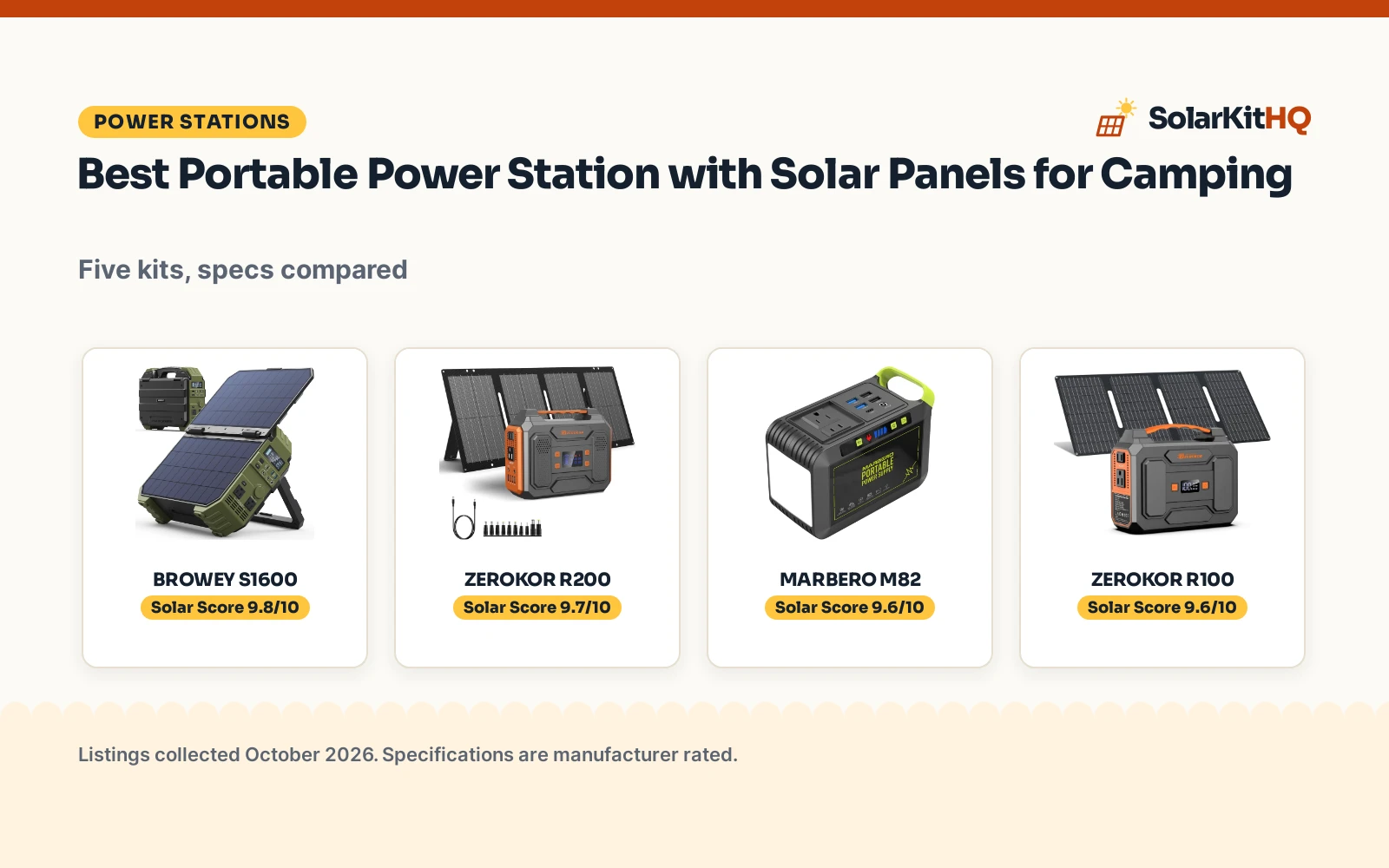
| # | Product | Solar Score | Buy |
|---|---|---|---|
| 1 | BROWEY S1600 | 9.8/10 | Buy on Amazon |
| 2 | ZEROKOR R200 | 9.7/10 | Buy on Amazon |
| 3 | MARBERO M82 | 9.6/10 | Buy on Amazon |
| 4 | ZEROKOR R100 | 9.6/10 | Buy on Amazon |
| 5 | TAKKI SP81 | 9.4/10 | Buy on Amazon |

BROWEY S1600
A 1024Wh LiFePO4 unit with 1600W continuous and 3200W peak output, a built-in 40W solar panel, 8 ports and a 3-year warranty.
Pros
- 1024Wh capacity with 1600W continuous and 3200W peak output stated
- 3000 plus cycles to 80 percent capacity stated on LiFePO4 cells
- Built-in 40W solar panel with MPPT, plus support for other panels
- 3-year warranty stated with lifetime customer support
Cons
- Spec table lists the battery cell type as lithium polymer while the bullets say LiFePO4
- 26 pounds is the heaviest unit here by a wide margin
- No UL, ETL, CSA, FCC or IP rating is stated
- 100W USB-C PD is the fastest USB output stated
Detailed Review
BROWEY lists a 1024Wh unit with 1600W continuous pure sine wave output and a 3200W peak, 8 ports including a 100W USB-C PD, a built-in 40W solar panel with an MPPT controller, and the option to connect other solar panels. The bullets state LiFePO4 cells with 3000 plus cycles to 80 percent capacity and a 10 plus year life, and an advanced BMS that protects against overvoltage, overheating and short circuits. It charges to 80 percent in 3 hours through the AC adapter and 100W PD port together, weighs 26 pounds and measures 13.3 by 17.1 by 5.5 inches. One contradiction: the spec table lists the battery cell type as lithium polymer while the bullets say LiFePO4; trust the bullets. No UL, ETL, CSA, FCC or IP rating is stated.
Who it's for: car campers, RV owners and outage planners who want the most watt-hours and watts in this group. Who should skip it: anyone who has to carry the unit far from the vehicle.
Its Solar Score of 9.8/10 comes from performance 34/35, build 22/25, value 21/25, safety 8/10 and warranty 4/5: 89 of 100 points, placed on our 9.2 to 9.8 scale.
Key Specifications
| Capacity | 1024Wh LiFePO4 |
|---|---|
| AC output | 1600W, 3200W peak |
| Built-in panel | 40W with MPPT |
| Weight | 26 lb |
Figures as published on the retailer listing, collected 19 October 2026. Performance figures are manufacturer rated.
Safety and Warranty
What this listing states. Advanced BMS stated against overvoltage, overheating and short circuits, so safety scores 8 of 10. 3 Years Warranty. It does not say everything a buyer needs, such as who pays return shipping, so warranty scores 4 of 5. See How We Pick.
Power station limits. Stay within the stated continuous output and solar input limits, keep the unit ventilated and dry, charge within the stated temperature range, and never connect it to home wiring except through equipment a licensed electrician installs.
This is general buying information, not professional advice. Follow each product manual and local rules, and see our Safety Disclaimer.

ZEROKOR R200
A 280Wh unit with 300W max AC output, 7 outlets, a 60W monocrystalline panel included and a 12-month warranty.
Pros
- 280Wh capacity with 300W max pure sine wave AC stated
- 60W monocrystalline panel included at 20.5 percent efficiency
- Built-in MPPT with DC5521 13V to 23V solar input
- BMS lists short circuit, over-current, over-voltage, overload and overheating protection
Cons
- Spec table lists a 3-watt starting wattage that conflicts with the 300W title and bullets
- No UL, ETL, CSA, FCC or IP rating is stated
- No surge watt figure is stated
- Panel junction box must be kept dry, per the listing
Detailed Review
ZeroKor lists a 280Wh unit with 300W max pure sine wave output, two 300W max AC outlets, one DC port at 9V to 12.6V and 10A max, three USB ports and one quick-charge USB port. A 60W monocrystalline panel is included at 20.5 percent efficiency, and the station takes DC5521 13V to 23V solar through a built-in MPPT or a 12V carport. The BMS lists short circuit, over-current, over-voltage, overload and overheating protection, and a cooling fan starts and stops with internal temperature. It weighs 5.1 pounds and measures 8.5 by 6.7 by 4.1 inches. The spec table's 3-watt starting wattage conflicts with the 300W title and bullets; trust the title and bullets. Warranty is stated as 12 months from the purchase date.
Who it's for: campers who want a real 300W AC output and a panel in the box without a heavy unit. Who should skip it: anyone who needs a stated surge figure or a panel junction box that tolerates wet weather.
Its Solar Score of 9.7/10 comes from performance 30/35, build 21/25, value 21/25, safety 9/10 and warranty 3/5: 84 of 100 points, placed on our 9.2 to 9.8 scale.
Key Specifications
| Capacity | 280Wh |
|---|---|
| AC output | 300W max |
| Included panel | 60W monocrystalline |
| Weight | 5.1 lb |
Figures as published on the retailer listing, collected 19 October 2026. Performance figures are manufacturer rated.
Safety and Warranty
What this listing states. BMS with short circuit, over-current, over-voltage, overload and overheating protection, so safety scores 9 of 10. 12 months from purchase date. It does not say everything a buyer needs, such as who pays return shipping, so warranty scores 3 of 5. See How We Pick.
Power station limits. Stay within the stated continuous output and solar input limits, keep the unit ventilated and dry, charge within the stated temperature range, and never connect it to home wiring except through equipment a licensed electrician installs.
This is general buying information, not professional advice. Follow each product manual and local rules, and see our Safety Disclaimer.

MARBERO M82
An 88Wh unit with 80W AC and a 120W surge, 8 output ports, a 3-level LED light and a 2-year warranty.
Pros
- 8 output ports including 2 AC outlets, USB and USB-C PD
- BMS stated, with UL safety standards for the cells and a UL drop rating of 3 drops from 0.9 m
- LED light with 3 brightness levels rated at 68, 48 and 37 hours plus an SOS mode
- 2-year warranty stated
Cons
- Spec table lists 1.04 kg while the bullets state 3.2 lb
- Solar panel not included; works with MARBERO's dedicated 30W or 60W panels
- 80W continuous output limits it to small devices
- No UL, ETL, CSA, FCC or IP rating is stated for the unit itself
Detailed Review
MARBERO lists an 88Wh unit with 80W AC output and a 120W surge, two 110V AC outlets and 8 output ports total, including USB and USB-C PD. It charges from 0 to 80 percent in 2 hours with the included adapter, and the listing says it works with MARBERO's dedicated 30W or 60W solar panels, which are optional. The LED light has 3 brightness levels rated at 68, 48 and 37 hours plus an SOS flashing mode. The BMS covers voltage and temperature control with automatic shutoff on short circuit or overload, and the listing states the cylindrical batteries meet UL safety standards with a UL drop rating of 3 drops from 0.9 m. The spec table lists 1.04 kg while the bullets state 3.2 lb; trust the bullets. Warranty is stated as 2 years.
Who it's for: light packers who want the most ports per pound and a long-running LED. Who should skip it: anyone who needs a panel in the box or more than 80W continuous.
Its Solar Score of 9.6/10 comes from performance 28/35, build 20/25, value 20/25, safety 9/10 and warranty 4/5: 81 of 100 points, placed on our 9.2 to 9.8 scale.
Key Specifications
| Capacity | 88Wh |
|---|---|
| AC output | 80W, 120W surge |
| Ports | 8 output ports |
| Weight | 3.2 lb |
Figures as published on the retailer listing, collected 19 October 2026. Performance figures are manufacturer rated.
Safety and Warranty
What this listing states. BMS stated; batteries meet UL safety standards; UL drop rating of 3 drops from 0.9 m stated, so safety scores 9 of 10. 2 Years. It does not say everything a buyer needs, such as who pays return shipping, so warranty scores 4 of 5. See How We Pick.
Power station limits. Stay within the stated continuous output and solar input limits, keep the unit ventilated and dry, charge within the stated temperature range, and never connect it to home wiring except through equipment a licensed electrician installs.
This is general buying information, not professional advice. Follow each product manual and local rules, and see our Safety Disclaimer.

ZEROKOR R100
A 146Wh unit with 100W max AC output, AC pass-through charging, a 40W foldable panel included and a 12-month warranty.
Pros
- 146Wh capacity with 100W max AC stated
- 40W foldable panel included at 22.8 percent efficiency
- AC pass-through charging stated
- BMS lists short circuit, over-current, over-voltage, overload and overheating protection
Cons
- Spec table lists a 1-hour runtime and a 2-watt starting wattage that the bullets do not explain
- No UL, ETL, CSA, FCC or IP rating is stated
- No surge watt figure is stated
- Listing asks for a recharge at least once every half a month when stored
Detailed Review
ZeroKor lists a 146Wh unit with 100W max AC output, two 100W max AC outlets, one DC port at 9V to 12.6V and 10A max, two USB ports, one quick-charge USB and one USB-C. A 40W foldable monocrystalline panel is included at 22.8 percent efficiency, and the station takes DC5521 solar through a built-in MPPT, a wall outlet or a 12V carport, with AC pass-through charging stated. The BMS lists short circuit, over-current, over-voltage, overload and overheating protection. It weighs 3.3 pounds and measures 7.6 by 3.7 by 6.1 inches in the bullets, against 7.59 by 3.74 by 6.16 inches in the spec table; trust the bullets on the rounding. The spec table's 1-hour runtime and 2-watt starting wattage are not explained by the bullets. Warranty is stated as 12 months.
Who it's for: campers who want pass-through charging and a panel in the box at 3.3 pounds. Who should skip it: anyone who needs a stated surge figure or a unit that tolerates long storage without attention.
Its Solar Score of 9.6/10 comes from performance 28/35, build 20/25, value 21/25, safety 8/10 and warranty 3/5: 80 of 100 points, placed on our 9.2 to 9.8 scale.
Key Specifications
| Capacity | 146Wh |
|---|---|
| AC output | 100W max |
| Included panel | 40W foldable |
| Weight | 3.3 lb |
Figures as published on the retailer listing, collected 19 October 2026. Performance figures are manufacturer rated.
Safety and Warranty
What this listing states. BMS with short circuit, over-current, over-voltage, overload and overheating protection, so safety scores 8 of 10. 12 months. It does not say everything a buyer needs, such as who pays return shipping, so warranty scores 3 of 5. See How We Pick.
Power station limits. Stay within the stated continuous output and solar input limits, keep the unit ventilated and dry, charge within the stated temperature range, and never connect it to home wiring except through equipment a licensed electrician installs.
This is general buying information, not professional advice. Follow each product manual and local rules, and see our Safety Disclaimer.

TAKKI SP81
An 88.8Wh unit with 80W continuous and 120W peak output, 8 ports, a 21W foldable panel included, at 2.29 pounds.
Pros
- 2.29 pounds is the lightest unit here
- 21W foldable panel included at up to 23 percent conversion efficiency
- 8 ports including 2 AC outlets, 2 QC3.0 USB, 2 USB and a USB-C PD
- Panel rated to recharge to 80 percent in 5 to 7 hours
Cons
- Spec table lists 5.7 by 3 by 4.13 in while the bullets state 5.7 by 4.13 by 3 in
- No warranty term is stated
- No BMS or safety certification is stated
- Listing warns against powering devices while the unit charges itself
Detailed Review
Takki lists an 88.8Wh unit with 80W continuous and 120W peak output, two 110V AC outlets, two 18W QC3.0 USB ports, two 5V and 2.4A USB ports, one 18W PD USB-C and one 12V DC port. A 21W foldable panel is included at up to 23 percent conversion efficiency, and the listing says it recharges to 80 percent in 5 to 7 hours, or 0 to 80 percent in 2 hours from the AC charger. It weighs 2.29 pounds, and the panel folds to 10.78 by 8.18 inches from 16.45 by 10.78 inches unfolded. The spec table lists the unit as 5.7 by 3 by 4.13 inches while the bullets state 5.7 by 4.13 by 3 inches; trust the bullets. The listing warns against powering devices while the unit charges itself, and no warranty term or BMS is stated.
Who it's for: backpackers and day-trippers who want the lightest kit with a panel in the box. Who should skip it: anyone who needs a warranty term or a stated battery protection system.
Its Solar Score of 9.4/10 comes from performance 28/35, build 19/25, value 21/25, safety 0/10 and warranty 0/5: 68 of 100 points, placed on our 9.2 to 9.8 scale.
Key Specifications
| Capacity | 88.8Wh |
|---|---|
| AC output | 80W, 120W peak |
| Included panel | 21W foldable |
| Weight | 2.29 lb |
Figures as published on the retailer listing, collected 19 October 2026. Performance figures are manufacturer rated.
Safety and Warranty
What this listing states. No UL, FCC or battery management statement is stated, so safety scores zero. No warranty term, so warranty scores zero. See How We Pick.
Power station limits. Stay within the stated continuous output and solar input limits, keep the unit ventilated and dry, charge within the stated temperature range, and never connect it to home wiring except through equipment a licensed electrician installs.
This is general buying information, not professional advice. Follow each product manual and local rules, and see our Safety Disclaimer.
As an Amazon Associate I earn from qualifying purchases.
Compare the picks
| Power station | Solar Score | Capacity | AC output | Panel included | Weight | Warranty | Amazon |
|---|---|---|---|---|---|---|---|
| BROWEY S1600 | 9.8/10 | 1024Wh LiFePO4 | 1600W, 3200W peak | 40W built-in | 26 lb | 3 years | View on Amazon |
| ZEROKOR R200 | 9.7/10 | 280Wh | 300W | 60W included | 5.1 lb | 12 months | View on Amazon |
| MARBERO M82 | 9.6/10 | 88Wh | 80W, 120W surge | Optional, 30W or 60W | 3.2 lb | 2 years | View on Amazon |
| ZEROKOR R100 | 9.6/10 | 146Wh | 100W | 40W included | 3.3 lb | 12 months | View on Amazon |
| TAKKI SP81 | 9.4/10 | 88.8Wh | 80W, 120W peak | 21W included | 2.29 lb | Not stated | View on Amazon |
Specifications are manufacturer rated as listed, collected 19 October 2026.
How we scored them
The Solar Score weighs performance, build, value, safety and warranty. For a power station, safety means a battery management system, stated electrical protections or a safety certification the listing names; four of the five state a BMS, and the MARBERO adds UL-related statements. Four of the five state a warranty term. How we pick explains the weights.
| Product | Solar Score | Perf. /35 | Build /25 | Value /25 | Safety /10 | Warranty /5 |
|---|---|---|---|---|---|---|
| BROWEY S1600 | 9.8 | 34 | 22 | 21 | 8 | 4 |
| ZEROKOR R200 | 9.7 | 30 | 21 | 21 | 9 | 3 |
| MARBERO M82 | 9.6 | 28 | 20 | 20 | 9 | 4 |
| ZEROKOR R100 | 9.6 | 28 | 20 | 21 | 8 | 3 |
| TAKKI SP81 | 9.4 | 28 | 19 | 21 | 0 | 0 |
Scores run from 9.2 to 9.8: each product’s point total is placed on that range, so more points always means a higher score.
How to choose the best portable power station with solar panels for camping
Start with the size class
These kits fall into three groups. The MARBERO M82 at 88Wh and the Takki SP81 at 88.8Wh are the lightest, at 3.2 and 2.29 pounds respectively, and suit phones, tablets, laptops and lights. The ZeroKor R100 at 146Wh and the R200 at 280Wh weigh 3.3 and 5.1 pounds and add headroom for bigger loads. The BROWEY S1600 at 1024Wh and 26 pounds is a different animal: the listing says it can run refrigerators, CPAP machines and tools. Pick the class that fits how you camp, not the biggest box you can afford to drag.
Continuous watts decide what runs
Surge and peak figures last a moment; the continuous rating is what a cooler, a fan or a projector actually draws. The BROWEY states 1600W continuous with a 3200W peak, the ZeroKor R200 states 300W, the ZeroKor R100 states 100W, and the MARBERO and Takki each state 80W with a 120W surge or peak. Check your device’s label watts against those numbers before you buy.
| Power station | Continuous AC | Surge or peak | Capacity |
|---|---|---|---|
| BROWEY S1600 | 1600W | 3200W peak | 1024Wh |
| ZEROKOR R200 | 300W | Not stated | 280Wh |
| ZEROKOR R100 | 100W | Not stated | 146Wh |
| MARBERO M82 | 80W | 120W surge | 88Wh |
| TAKKI SP81 | 80W | 120W peak | 88.8Wh |
Plan the solar side before you buy
The Takki ships with a 21W foldable panel that the listing says recharges to 80 percent in 5 to 7 hours. The ZeroKor R200 includes a 60W monocrystalline panel at 20.5 percent efficiency with a built-in MPPT controller, and the R100 includes a 40W foldable panel at 22.8 percent. The BROWEY builds a 40W panel into the unit itself and says it can also connect with other panels. The MARBERO is the outlier: it works with MARBERO’s dedicated 30W or 60W panels, sold separately. Our portable solar panel guides cover the panel side if you are pairing one yourself.
Outlets, lights and the small print
The MARBERO and Takki each list 8 output ports, the BROWEY lists 8 ports including a 100W USB-C PD, the R200 lists 7 outlets and the R100 lists its AC, DC and USB mix. Three of the five include an LED light with an SOS mode, which is genuinely useful at a dark campsite. Read the tips the listings print in small type: the Takki warns against powering devices while the unit charges itself, and both ZeroKor listings say to keep the battery between 60 and 80 percent and recharge it regularly when stored. For more on the category, see our solar generator guides and the LiFePO4 battery explainers.
Sizing Notes
- Match each device’s label watts to the continuous AC rating, not the surge or peak figure: 80W on the MARBERO and Takki, 100W on the R100, 300W on the R200, 1600W on the BROWEY.
- Compare the watt-hours you need against the stated capacity: 88Wh on the MARBERO, 88.8Wh on the Takki, 146Wh on the R100, 280Wh on the R200, 1024Wh on the BROWEY.
- Check the solar input the listing states before choosing a panel: the R200 takes DC5521 13V to 23V solar, the Takki ships with a 21W panel rated to 80 percent in 5 to 7 hours, and the MARBERO works with MARBERO’s dedicated 30W or 60W panels.
- Keep the ZeroKor units between 60 and 80 percent charge when stored, per both listings, and note the Takki listing warns against powering devices while the unit charges itself.
Frequently Asked Questions
Which kit has the most capacity?
The BROWEY S1600 at 1024Wh, followed by the ZeroKor R200 at 280Wh. The R100 states 146Wh, the Takki 88.8Wh and the MARBERO 88Wh.
Which is the lightest?
The Takki SP81 at 2.29 pounds stated, then the MARBERO M82 at 3.2 pounds. The heaviest is the BROWEY S1600 at 26 pounds.
Do the panels come in the box?
The Takki, ZeroKor R200 and ZeroKor R100 each include a foldable panel, and the BROWEY builds a 40W panel into the unit. The MARBERO works with MARBERO’s dedicated 30W or 60W panels, which the listing treats as optional.
Which listings state a warranty?
The BROWEY states 3 years with lifetime customer support, the MARBERO states 2 years, and the ZeroKor R200 and R100 each state 12 months. The Takki listing states no warranty term.
What does the BMS protect against?
The ZeroKor listings name short circuit, over-current, over-voltage, overload and overheating protection. The BROWEY names overvoltage, overheating and short circuit protection, and the MARBERO names voltage and temperature control with automatic shutoff on short circuit or overload.
Related guides
See every Portable Power Stations guide and all Power Stations and Generators guides. Also see our best portable power station for camping. Also see our best solar panel kit for RV. Also see our LiFePO4 vs AGM battery for RV. Also see our best portable power station for a campervan. Also see our best portable power station for a projector. Also see our best portable power station for a shed. Also see our best portable power station for astrophotography. Also see our best portable power station for coffee maker. Also see our best portable power station for dj. Also see our best portable power station for hiking. Also see our best portable power station for off grid living. Also see our best portable power station for pitching machine. Also see our anker solix c300 vs c1000. Also see our jackery explorer 500 vs explorer 1000. Also see our jackery explorer 300 vs explorer 500. Also see our bluetti ac180 vs ac200max. Also see our ecoflow delta 3 vs ecoflow river 3 plus. Also see our best portable power station for wifi router. Also see our bluetti eb3a vs ecoflow river 2. Also see our best portable power station for cold weather. Also see our bluetti eb70 vs ecoflow delta 2. Also see our best portable power station for off grid camping. Also see our anker solix c300 vs c2000. Also see our best portable power station for power tools. Also see our anker solix c1000 vs ecoflow delta 2. Also see our anker solix c300 vs c1000 gen 2. Also see our bluetti elite 30 v2 vs elite 100 v2. Also see our ecoflow delta 2 max vs explorer 2000 v2. Also see our bluetti elite 100 v2 vs anker solix c1000. Also see our best portable power station for landscaping. Also see our best 1500wh power station for camping. Also see our ecoflow delta 3 plus vs jackery 1000 v2. Also see our goal zero yeti 1500x vs ecoflow delta 2. Also see our power station 2400w. Also see our jackery explorer 2000 v2 vs 2000 pro. Also see our bluetti eb70 vs ecoflow delta 3. Also see our bluetti eb3a vs ecoflow river 2 pro. Also see our dji power 1000 vs ecoflow delta 3. Also see our power station suitcase. Also see our dji power 1000 vs bluetti ac180. Also see our power station usb type c. Also see our best portable power station for electric fence. Also see our best portable power station for desktop computer. Also see our ecoflow river 3 plus vs jackery 1000 v2. Also see our best 1500wh power station for rv. Also see our best 1000wh power station for rv. Also see our jackery explorer 2000 v2 vs 3000 pro. Also see our bluetti elite 100 v2 vs jackery explorer 2000 v2. Also see our best portable power station for alarm system. Also see our ecoflow delta 2 vs jackery explorer 300. Also see our bluetti ac300 vs ecoflow delta 2 max. Also see our bluetti elite 100 v2 vs jackery explorer 1000. Also see our bluetti elite 30 v2 vs jackery explorer 300. Also see our jackery 1000 v2 vs ecoflow delta 3 classic.