On this page
When the lights go out at dinner time and a campsite at dusk leaves phones fading, ecoflow delta 2 vs jackery explorer 300 gives a clear split: the EcoFlow example suits a larger backup role, while the Jackery example suits a light portable role. This comparison uses the listings as examples, with the EcoFlow side represented by a Delta 3 Ultra listing and the Jackery side represented by an Explorer 300 listing. Pick the EcoFlow example for a larger stated capacity and a higher stated output, and pick the Jackery example for a lighter stated weight and a smaller portable footprint.
SolarKitHQ earns a commission when you buy through links on this page, at no extra cost to you. As an Amazon Associate I earn from qualifying purchases. Affiliate disclosure.
Ecoflow Delta 2 vs Jackery Explorer 300: side by side
| Portable power station | Solar Score | Capacity | AC output | Weight | Warranty |
|---|---|---|---|---|---|
| EF ECOFLOW Delta 3 Ultra | 9.7/10 | 3072Wh | 3600W | 72.1 pounds | 5 year manufacturer |
| Jackery Explorer 300 | 9.5/10 | 293Wh | 300W | 7.1 pounds | 90 days limited warranty |
Specifications are manufacturer rated as listed, collected 30 October 2026.
Capacity and output
Capacity is the widest gap between the listings. The EcoFlow example lists 3072Wh, while the Jackery example lists 293Wh. Output follows the same pattern: the EcoFlow example lists 3600W continuous AC output with 7200W surge output, while the Jackery example lists 300W power from 2 Pure Sine Wave AC outlets. Since each listing states capacity and output, the gap can be stated plainly: the EcoFlow example states a much larger capacity and a much higher output, and the Jackery example states a smaller capacity suited to smaller loads.
Weight and size
Weight reverses the picture. The EcoFlow example lists 72.1 pounds with dimensions of 24.6 inches x 12.9 inches x 15.6 inches, while the Jackery example lists 7.1 pounds. A station at 72.1 pounds asks for a fixed spot at home, in an RV or at a cabin, while a station at 7.1 pounds can move with a campsite kit. The Jackery example does not gain its light weight by hiding its limits: its stated capacity and output stay far below the EcoFlow example, so weight and capacity pull in opposite directions here.
Charging and outlets
Charging options also differ in kind. The EcoFlow example lists 4 charging options: wall outlet, solar panels, car input and EcoFlow Smart Generator. The Jackery example lists recharging to 80% in 2 hours through the wall outlet and 60W PD USB-C port at the same time, plus charging through the car outlet and compatibility with the Jackery SolarSaga 100 solar panel, with the solar panel not included in the title. For outlets, the Jackery example lists 2 Pure Sine Wave AC outlets, 1 PD 60W USB-C port, 1 fast charge 3.0 port, 1 USB-A port and 1 DC car port, and charging for up to 6 devices at the same time. The EcoFlow listing does not state an outlet count, so that figure stays unclear for that example.
What the listings leave unclear
The EcoFlow listing names Delta 3 Ultra in its title and bullets, not Delta 2, so its figures describe that example only and must not be read as Delta 2 figures. The Jackery spec table names Model SolarSaga 100, which conflicts with the Explorer 300 title and bullets, so the title and bullets are trusted over the spec table and SolarSaga 100 is read as the compatible solar panel named in the bullets. The Jackery title also marks the listing as Renewed, and its title states that a solar panel is not included. Neither listing states an EcoFlow outlet count, and the Jackery listing states no panel wattage for solar charging, so those figures stay unclear.
Two examples

EF ECOFLOW Delta 3 Ultra
The EcoFlow example lists 3072Wh, 3600W AC output with 7200W surge, LiFePO4 battery chemistry and 4 charging options.
Pros
- Lists 3072Wh capacity with 3600W continuous AC output and 7200W surge output.
- Lists LiFePO4 battery chemistry with a stated claim of 10 years of daily use.
- Lists 4 charging options: wall outlet, solar panels, car input and EcoFlow Smart Generator.
- Lists operation at 25dB under load and switching in under 10 milliseconds.
Cons
- The listing names Delta 3 Ultra, not Delta 2, so its figures describe that example only, not a Delta 2 listing.
- Lists 72.1 pounds, a heavier stated weight than the Jackery example at 7.1 pounds.
- Stated dimensions are 24.6 inches x 12.9 inches x 15.6 inches.
- No outlet count is stated in the listing, so the number of AC outlets stays unclear.
Detailed Review
The listing states a Delta 3 Ultra portable power station with 3072Wh, 3600W continuous output and 7200W surge output, a LiFePO4 battery, X-Quiet 3.0 technology, operation at 25dB under load, and switching in under 10 milliseconds. The title and bullets name Delta 3 Ultra throughout, so this example does not describe a Delta 2 listing, and its figures must not be read as Delta 2 figures. The listing also states 4 charging options and a 5 year manufacturer warranty term.
Who it's for: readers who need a large stated capacity and a high stated AC output for home, RV or off-grid use as the listing describes. Who should skip it: readers who need a light portable unit or a listing that actually names Delta 2.
Its Solar Score of 9.7/10 comes from performance 32/35, build 21/25, value 20/25, safety 8/10 and warranty 4/5: 85 of 100 points, placed on our 9.2 to 9.8 scale.
Key Specifications
| Capacity | 3072Wh |
|---|---|
| AC output | 3600W continuous, 7200W surge |
| Weight | 72.1 pounds |
| Dimensions | 24.6 inches x 12.9 inches x 15.6 inches |
Figures as published on the retailer listing, collected 30 October 2026. Performance figures are manufacturer rated.
Safety and Warranty
What this listing states. LiFePO4 battery, EV-grade CTC structure and 24/7 battery protection system stated, so safety scores 8 of 10. 5 year manufacturer. It does not say everything a buyer needs, such as who pays return shipping, so warranty scores 4 of 5. See How We Pick.
Power station limits. Stay within the stated continuous output and solar input limits, keep the unit ventilated and dry, charge within the stated temperature range, and never connect it to home wiring except through equipment a licensed electrician installs.
This is general buying information, not professional advice. Follow each product manual and local rules, and see our Safety Disclaimer.
Jackery Explorer 300
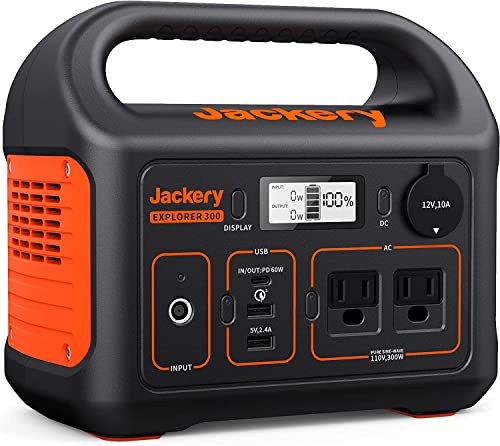
The Jackery example lists 293Wh, 300W power from 2 Pure Sine Wave AC outlets, a weight of 7.1 pounds and charging for up to 6 devices at the same time.
Pros
- Lists a weight of 7.1 pounds, lighter than the EcoFlow example at 72.1 pounds.
- Lists 2 Pure Sine Wave AC outlets, 1 PD 60W USB-C port, 1 fast charge 3.0 port, 1 USB-A port and 1 DC car port.
- Lists recharging to 80% in 2 hours through the wall outlet and 60W PD USB-C port at the same time.
- Lists compatibility with the Jackery SolarSaga 100 solar panel and an integrated MPPT controller.
Cons
- The listing is marked Renewed, so its condition differs from a new listing as titled.
- The spec table names Model SolarSaga 100, which conflicts with the Explorer 300 title and bullets; the title and bullets are trusted here.
- Lists 293Wh and 300W power, lower stated figures than the EcoFlow example at 3072Wh and 3600W.
- Lists a 90 days limited warranty, a shorter stated term than the EcoFlow example at 5 years.
Detailed Review
The listing states an Explorer 300 portable power station with 293Wh, 300W power, 2 Pure Sine Wave AC outlets and a weight of 7.1 pounds, plus charging for up to 6 devices at the same time. The spec table names Model SolarSaga 100, which conflicts with the Explorer 300 title and bullets, so the title and bullets are trusted over the spec table and SolarSaga 100 is read as the compatible solar panel named in the bullets, not as the station model. The listing is marked Renewed in the title.
Who it's for: readers who need a light portable station for drones, Macbook and cameras and similar small loads as the listing describes, plus tent camping and road trips. Who should skip it: readers who need a large stated capacity, a high stated AC output, or a new, non-renewed listing.
Its Solar Score of 9.5/10 comes from performance 26/35, build 19/25, value 19/25, safety 5/10 and warranty 1/5: 70 of 100 points, placed on our 9.2 to 9.8 scale.
Key Specifications
| Capacity | 293Wh |
|---|---|
| AC output | 300W, 2 Pure Sine Wave AC outlets |
| Weight | 7.1 pounds |
| Recharge | 80% in 2 hours |
Figures as published on the retailer listing, collected 30 October 2026. Performance figures are manufacturer rated.
Safety and Warranty
What this listing states. Pure Sine Wave AC outlets stated to deliver stable and safe power, so safety scores 5 of 10. 90 days limited warranty. It does not say everything a buyer needs, such as who pays return shipping, so warranty scores 1 of 5. See How We Pick.
Power station limits. Stay within the stated continuous output and solar input limits, keep the unit ventilated and dry, charge within the stated temperature range, and never connect it to home wiring except through equipment a licensed electrician installs.
This is general buying information, not professional advice. Follow each product manual and local rules, and see our Safety Disclaimer.
As an Amazon Associate I earn from qualifying purchases.
How we scored them
The Solar Score weighs performance, build, value, safety and warranty. For portable power stations, safety means protection features, battery chemistry protections or power delivery features the listing names; the EcoFlow example states a LiFePO4 battery, an EV-grade CTC structure and a 24/7 battery protection system, and the Jackery example states Pure Sine Wave AC outlets described as stable and safe. Both examples state a warranty term, with the EcoFlow example at 5 years and the Jackery example at 90 days. How we pick explains the weights.
| Product | Solar Score | Perf. /35 | Build /25 | Value /25 | Safety /10 | Warranty /5 |
|---|---|---|---|---|---|---|
| EF ECOFLOW Delta 3 Ultra | 9.7 | 32 | 21 | 20 | 8 | 4 |
| Jackery Explorer 300 | 9.5 | 26 | 19 | 19 | 5 | 1 |
Scores run from 9.2 to 9.8: each product’s point total is placed on that range, so more points always means a higher score.
How to choose the best ecoflow delta 2 vs jackery explorer 300
Match capacity and output to the load
Start from the loads planned. The EcoFlow example lists 3072Wh and 3600W continuous output with 7200W surge output, which fits the listing description of refrigerators, microwaves, heaters and power tools. The Jackery example lists 293Wh and 300W power, which fits the listing description of drones, Macbook and cameras. If a load needs more than the stated output, the smaller example is not a fit, whatever its weight advantage.
Match weight to how the station moves
Weight decides where a station lives. At 72.1 pounds, the EcoFlow example belongs in a fixed spot, while at 7.1 pounds, the Jackery example suits a campsite kit, a road trip and tent camping, as the listing describes. For portable power, see the best portable power station for camping guide and the best portable power station for travel guide.
Check charging options and solar compatibility
Check how each station recharges before choosing. The EcoFlow example lists wall outlet, solar panels, car input and EcoFlow Smart Generator charging. The Jackery example lists wall outlet and car outlet charging, recharging to 80% in 2 hours through the wall outlet and 60W PD USB-C port at the same time, and compatibility with the Jackery SolarSaga 100 solar panel. For the panel side, see the best solar panel for Jackery 300 guide.
Check warranty terms and listing condition
Read the warranty term and the listing condition together. The EcoFlow example lists a 5 year manufacturer term, while the Jackery example lists a 90 days limited warranty and is marked Renewed in its title. A renewed listing and a short stated warranty term deserve a closer look at what the listing actually promises, before the capacity and output figures decide the choice.
| If you need | Look at |
|---|---|
| Larger stated capacity | EF ECOFLOW Delta 3 Ultra, 3072Wh |
| Higher stated AC output | EF ECOFLOW Delta 3 Ultra, 3600W |
| Lowest stated weight | Jackery Explorer 300, 7.1 pounds |
| Longest stated warranty | EF ECOFLOW Delta 3 Ultra, 5 year manufacturer |
Sizing Notes
- Match stated watt-hours to the loads planned: the EcoFlow example lists 3072Wh and the Jackery example lists 293Wh.
- Match stated AC output to the load: the EcoFlow example lists 3600W continuous and 7200W surge, and the Jackery example lists 300W.
- Match stated solar compatibility: the Jackery example lists compatibility with the Jackery SolarSaga 100 solar panel, and the EcoFlow example lists solar panels among 4 charging options.
- Check stated weight before moving a station: the EcoFlow example lists 72.1 pounds and the Jackery example lists 7.1 pounds.
- Check stated warranty terms: the EcoFlow example lists 5 year manufacturer terms and the Jackery example lists 90 days limited warranty.
Frequently Asked Questions
Which example lists a larger capacity?
The EcoFlow example lists 3072Wh, and the Jackery example lists 293Wh.
Does the EcoFlow listing name Delta 2?
No. The EcoFlow listing names Delta 3 Ultra, so its figures describe that example, not a Delta 2 listing.
How does the Jackery example recharge?
The listing states recharging to 80% in 2 hours through the wall outlet and 60W PD USB-C port at the same time, plus car outlet charging and compatibility with the Jackery SolarSaga 100 solar panel.
What warranty terms do the listings state?
The EcoFlow example lists a 5 year manufacturer term, and the Jackery example lists a 90 days limited warranty.
Related guides
See every Portable Power Stations guide and all Power Stations and Generators guides. For portable power, see the best portable power station for camping guide and the best portable power station for travel guide.
More picks: best power station with USB-C, best portable power station for road trip and best solar panel for Jackery 300.