On this page
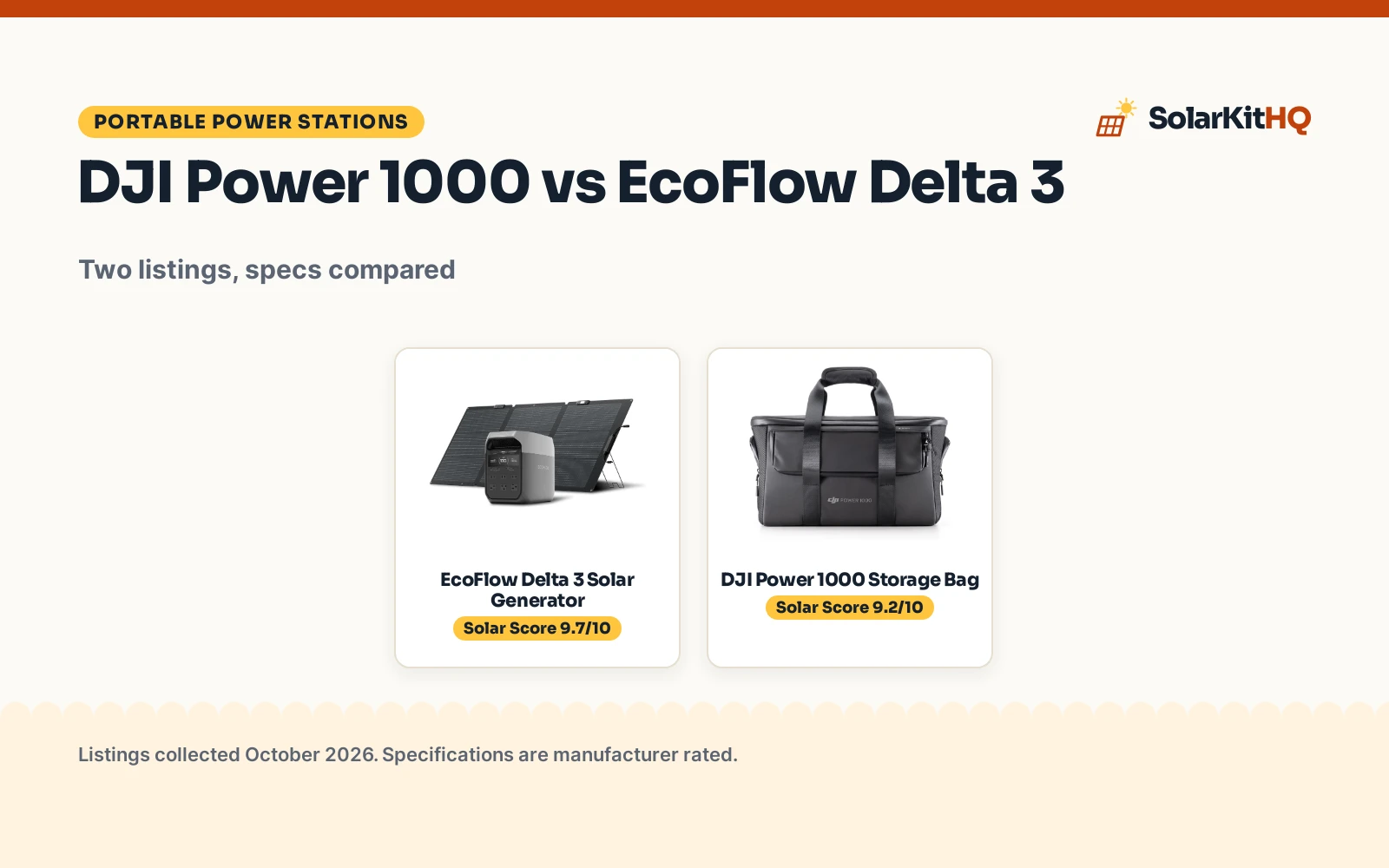
The short answer on dji power 1000 vs ecoflow delta 3: the EcoFlow side is the only side here with a station to compare, while the DJI side offers a carry bag for the Power 1000 and no station specs at all. We compared the two listings on what each states: capacity, output, charging, protection and warranty terms. The EcoFlow listing states the lot, and the DJI listing states bag dimensions and little else, so the verdict below follows the listings, not the brands.
SolarKitHQ earns a commission when you buy through links on this page, at no extra cost to you. As an Amazon Associate I earn from qualifying purchases. Affiliate disclosure.
DJI Power 1000 vs EcoFlow Delta 3: side by side
| DJI Power 1000 vs EcoFlow Delta 3 | DJI Power 1000 Storage Bag | EcoFlow Delta 3 Solar Generator | Reading |
|---|---|---|---|
| Type | Storage bag | Solar generator with 160W panel | Bag vs station |
| Capacity | Not stated | 1024Wh | EcoFlow only |
| AC output | Not stated | 1800W | EcoFlow only |
| Solar input | Not stated | 500W | EcoFlow only |
| Full charge | Not stated | 56 minutes | EcoFlow only |
| Outlets | Not stated | 13 | EcoFlow only |
| Battery | Not stated | LFP, 4000 cycles to 80% | EcoFlow only |
| Warranty | Not stated | 5 years | EcoFlow only |
| Size | 17.8 x 9.45 x 9.13 in | 15.7 x 8 x 11.2 in | Both stated |
Specifications are manufacturer rated as listed, collected 25 October 2026.
Capacity and output
On capacity and output, only the EcoFlow listing states figures, so there is no head-to-head to call here. The Delta 3 listing states a 1024Wh LFP battery, 1800W AC output, 100W USB-C output and 13 total power outlets, with X-Boost for resistive appliances with power demands over 2600W continuously. The DJI listing states no capacity, no output and no outlet count, so its side of the table stays blank and the listing leaves it unclear rather than losing a round.
Charging
Charging is the EcoFlow listing’s strongest stated story. It claims a full charge in 56 minutes from 500W solar input combined with 1500W max AC input, and an 80% charge in 30 minutes, with a 160W portable solar panel in the box. The DJI listing is a bag, so it states no charging figure at all, and a buyer comparing charge times has only the EcoFlow side to read.
Protection and battery life
The EcoFlow listing states LFP cells retaining 80% capacity after 4000 cycles, a 10-year lifespan for daily use and an IP65 battery pack with splash-proof, dust-proof and oil-proof protection. The DJI listing states ventilation as a special feature and nothing about cells, cycles or protection, which fits a bag but says nothing about a station. On protection and battery life, then, the comparison is again one-sided, and the DJI side should not be read as weaker on cells it never claims to have.
What the listings leave unclear
Two things in the EcoFlow listing need care. The spec table lists wattage as 1024 KW, which conflicts with the 1024Wh capacity in the title, so trust the title on capacity. The station and the 160W panel also arrive in separate packages, and the 25% more durability and 28% more energy figures are maker claims against baselines the listing does not name. On the DJI side, the listing leaves everything about the station unclear: it is a storage bag, not a Power 1000 station, so capacity, output, charging and warranty for the DJI station cannot be judged from it. Neither listing states a weight figure for its station, and only the EcoFlow listing states a warranty term.
Two examples

EcoFlow Delta 3 Solar Generator
A 1024Wh LFP solar generator with 1800W AC output, a 160W panel, a 56 minute full charge and expansion to 5kWh.
Pros
- 1024Wh LFP battery with 1800W AC output and 100W USB-C output
- Full charge in 56 minutes from 500W solar input and 1500W max AC input
- Powers 13 appliances at once, with X-Boost for resistive loads over 2600W
- Expandable to 5kWh with Delta 3 series battery packs
Cons
- Spec table lists wattage as 1024 KW, which does not match the 1024Wh title
- Station and 160W panel arrive in separate packages
- Durability and energy gain figures are maker claims against unnamed baselines
- No weight figure is stated
Detailed Review
The listing states a 1024Wh LFP portable power station with 1800W AC output, 100W USB-C output, a 160W portable solar panel, 500W solar input, 1500W max AC input, a full charge in 56 minutes, an 80% charge in 30 minutes, 13 total power outlets, expansion to 5kWh, 4000 cycles retaining 80% capacity, a 10-year lifespan for daily use and an IP65 battery pack with splash-proof, dust-proof and oil-proof protection. The spec table lists wattage as 1024 KW, which conflicts with the 1024Wh capacity in the title, so trust the title on capacity. The station and panel arrive in separate packages.
Who it's for: campers, RV owners and homeowners who want a solar generator with a stated fast charge and an expansion path. Who should skip it: buyers who want a stated weight figure or a single-box delivery.
Its Solar Score of 9.7/10 comes from performance 32/35, build 21/25, value 21/25, safety 8/10 and warranty 3/5: 85 of 100 points, placed on our 9.2 to 9.8 scale.
Key Specifications
| Capacity | 1024Wh LFP |
|---|---|
| Output | 1800W AC, 100W USB-C |
| Charge | 56 minutes full, 80% in 30 minutes |
| Expansion | Up to 5kWh |
Figures as published on the retailer listing, collected 25 October 2026. Performance figures are manufacturer rated.
Safety and Warranty
What this listing states. IP65 battery pack with splash-proof, dust-proof and oil-proof protection stated, so safety scores 8 of 10. 5 year manufacturer warranty stated. It does not say everything a buyer needs, such as who pays return shipping, so warranty scores 3 of 5. See How We Pick.
Power station limits. Stay within the stated continuous output and solar input limits, keep the unit ventilated and dry, charge within the stated temperature range, and never connect it to home wiring except through equipment a licensed electrician installs.
This is general buying information, not professional advice. Follow each product manual and local rules, and see our Safety Disclaimer.

DJI Power 1000 Storage Bag
A nylon protective storage bag for the DJI Power 1000 with a cable space and ventilation, sized at 452 by 240 by 232 mm.
Pros
- Dedicated cable space on the back
- Single-handed carrying design
- Ventilation feature stated
- Fits DJI Power 1000 and DJI Power 1000 V2
Cons
- No station capacity, output or charging spec is stated
- No warranty term is stated
- A bag, not a power station, so it cannot answer the station comparison
- No padding or protection detail is stated
Detailed Review
The listing states a protective storage bag for the DJI Power 1000, with a dedicated space for cables on the back, single-handed carrying, ventilation and a size of 452 by 240 by 232 mm, or 17.8 by 9.45 by 9.13 inches in the spec table. It fits the DJI Power 1000 and the DJI Power 1000 V2. It states no station spec at all: no capacity, no output, no charging time and no battery detail, so it cannot speak to the station comparison.
Who it's for: DJI Power 1000 owners who want a fitted bag with cable space. Who should skip it: buyers comparing station capacity and output, who will find nothing to compare here.
Its Solar Score of 9.2/10 comes from performance 14/35, build 15/25, value 12/25, safety 0/10 and warranty 0/5: 41 of 100 points, placed on our 9.2 to 9.8 scale.
Key Specifications
| Material | Nylon |
|---|---|
| Size | 452 x 240 x 232 mm |
| Closure | Zipper |
| Fits | DJI Power 1000 and V2 |
Figures as published on the retailer listing, collected 25 October 2026. Performance figures are manufacturer rated.
Safety and Warranty
What this listing states. This product does not plug in or run on a battery, so safety is not part of its score. No warranty term, so warranty scores zero. See How We Pick.
Power station limits. Stay within the stated continuous output and solar input limits, keep the unit ventilated and dry, charge within the stated temperature range, and never connect it to home wiring except through equipment a licensed electrician installs.
This is general buying information, not professional advice. Follow each product manual and local rules, and see our Safety Disclaimer.
As an Amazon Associate I earn from qualifying purchases.
How we scored them
The Solar Score weighs performance, build, value, safety and warranty. For a portable power station, safety means stated protection such as an IP65 pack, cell chemistry and cycle life the listing actually names; the EcoFlow listing states each of these, and the DJI bag listing states none. Only the EcoFlow listing states a warranty term. How we pick explains the weights.
| Product | Solar Score | Perf. /35 | Build /25 | Value /25 | Safety /10 | Warranty /5 |
|---|---|---|---|---|---|---|
| EcoFlow Delta 3 Solar Generator | 9.7 | 32 | 21 | 21 | 8 | 3 |
| DJI Power 1000 Storage Bag | 9.2 | 14 | 15 | 12 | 0 | 0 |
Scores run from 9.2 to 9.8: each product’s point total is placed on that range, so more points always means a higher score.
DJI Power 1000 vs EcoFlow Delta 3: which should you choose?
Choose the EcoFlow Delta 3 side if you want a station with stated specs: a 1024Wh LFP battery, 1800W AC output, a 56 minute full charge and expansion to 5kWh. Choose the DJI side only for what its listing actually sells: a fitted storage bag with cable space for a DJI Power 1000 you already own. If you want DJI station specs, this listing cannot give them, and a fuller DJI station listing is what to look for next.
| If you need | Look at |
|---|---|
| A station with stated specs | EcoFlow Delta 3 Solar Generator |
| A carry bag for a DJI Power 1000 | DJI Power 1000 Storage Bag |
| A fast stated full charge | EcoFlow Delta 3, 56 minutes |
| Expansion past the base capacity | EcoFlow Delta 3, up to 5kWh |
Sizing Notes
- Match capacity to the loads you plan: the EcoFlow listing states 1024Wh in the base unit and expansion to 5kWh with Delta 3 series battery packs.
- Match solar input to the panel in the box: the EcoFlow listing pairs 500W solar input with a 160W portable panel.
- Match outlets to the appliances you plan: the EcoFlow listing states 13 total power outlets.
- Match the bag to the unit: the DJI listing fits the DJI Power 1000 and the DJI Power 1000 V2 at 452 by 240 by 232 mm.
Frequently Asked Questions
Which side here states a full station spec?
The EcoFlow side. Its listing states a 1024Wh battery, 1800W AC output, 100W USB-C output and 13 outlets, while the DJI listing states only a storage bag.
How fast does the EcoFlow Delta 3 charge?
The listing claims a full charge in 56 minutes from 500W solar input combined with 1500W max AC input, and an 80% charge in 30 minutes.
Does the Delta 3 expand?
Yes. The listing states expansion up to 5kWh with Delta 3 series battery packs, including Delta 3, Delta Pro 3 and Delta 2 Max packs.
What does the DJI listing actually cover?
A protective storage bag for the DJI Power 1000 and the DJI Power 1000 V2, with a dedicated cable space on the back, single-handed carrying and ventilation, at 452 by 240 by 232 mm.
Related guides
See every Portable Power Stations guide and all Power Stations and Generators guides. For the panel side, see the best portable power station for camping, and for carrying gear, the best power station carrying bag.
More picks: best portable power station for camping, best 1500wh power station for camping, best power station carrying bag, solar generator vs home battery backup.