On this page
When the lights go out at dinner, the choice in solar generator vs home battery backup decides what keeps running until the power returns. This comparison puts a portable solar generator kit against a plug-in home battery backup, using listings as concrete examples: a Takki solar generator with panels included, and a CyberPower UPS built for workstations and home entertainment gear. The sides solve the same problem in different ways, and the listing details show where each one fits.
SolarKitHQ earns a commission when you buy through links on this page, at no extra cost to you. As an Amazon Associate I earn from qualifying purchases. Affiliate disclosure.
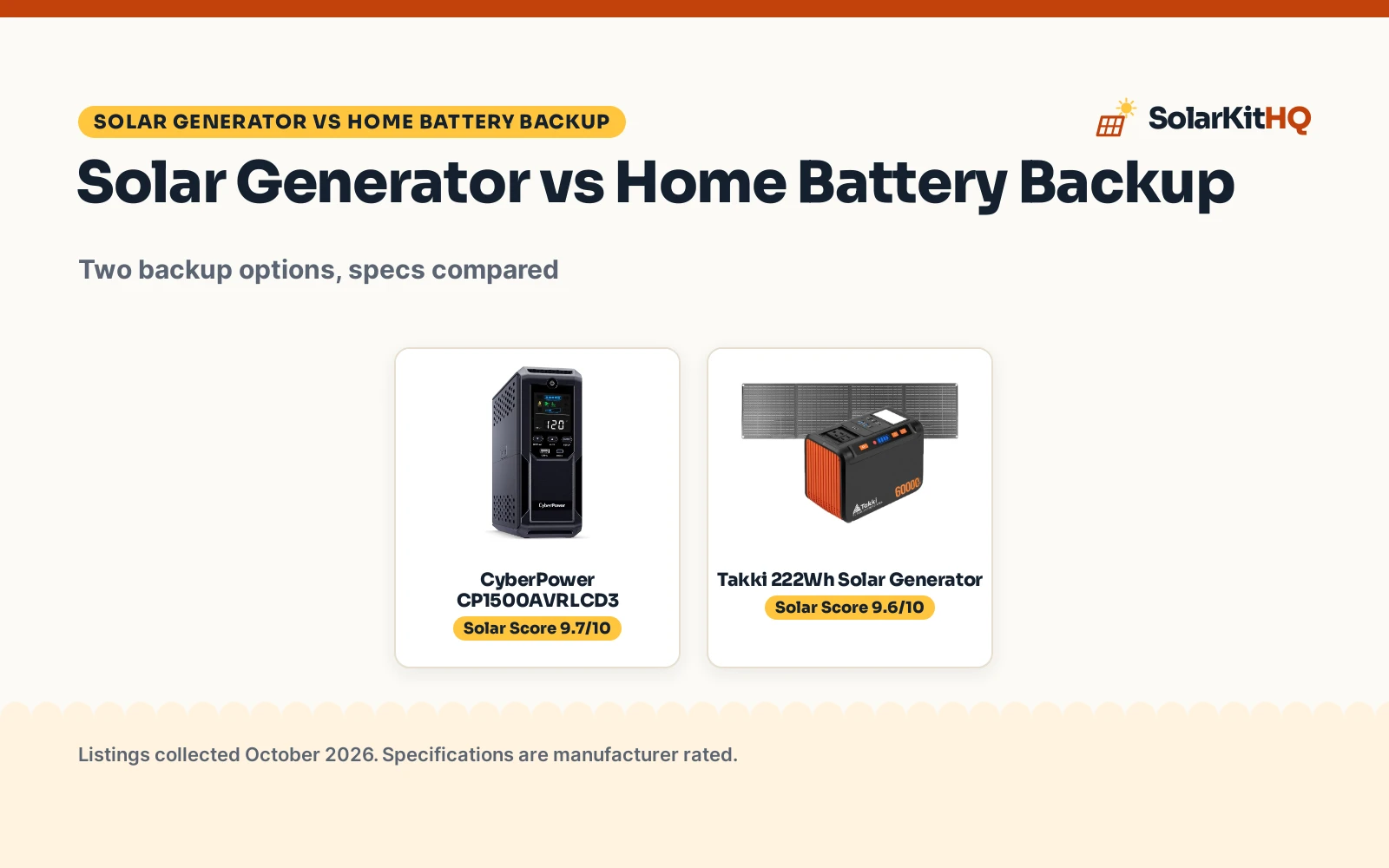
Solar generator vs home battery backup: side by side
| Solar generator vs home battery backup | Solar Score | Output | Outlets | Weight | Warranty |
|---|---|---|---|---|---|
| CyberPower CP1500AVRLCD3 | 9.7/10 | 900W | 12 | 23.8 pounds | 3 years |
| Takki 222Wh Solar Generator | 9.6/10 | 250W | 8 | 5.95 pounds | Not stated |
Specifications are manufacturer rated as listed, collected 24 October 2026.
Portability and weight
The weight gap is wide. The Takki example lists the station at 5.95 pounds, with a foldable panel at 1.87 pounds and a compact handle design, which suits carrying the kit to a campsite or around a property. The CyberPower example lists 23.8 pounds in a mini-tower case with dimensions of 13.78 by 3.94 by 10.2 inches, which suits a fixed spot near the gear it backs up. Portability favors the solar generator side here, while the UPS side trades movement for a larger outlet count and a higher rated output.
Outlets and loads
The CyberPower example lists 12 outlets: six battery backup and surge protected, six surge protected only, plus 1 Type-A and 1 Type-C USB charge port. The Takki example lists 8 output ports, including 110V AC sockets, USB ports and 12V DC. On rated output, the CyberPower example lists 900W and the Takki example lists 250W rated with 450W peak, so the UPS side covers larger plug-in loads while the solar generator side covers smaller portable loads within 250W. Neither listing states a figure for every load type, so match each load you plan against the rated figure, not the peak figure.
Charging and backup behavior
Charging is where the sides split most clearly. The Takki example charges from a wall AC outlet, a solar panel or a 12V car charger, charges from 0% to 80% in 4 hours with the included AC charger, and reaches a full charge in 6~7 hours by AC charger. The CyberPower example charges its battery from the wall through a NEMA 5-15P plug with a 6-foot power cord, with a stated battery charge time of 8 hours, and its spec table lists a runtime of 3 minutes. A solar generator kit keeps charging while the sun is available; a UPS holds its charge from the wall and covers short interruptions. The Takki example also lists a camping light with reading and SOS modes, which suits use away from the house.
What the listings leave unclear
The Takki listing conflicts with itself in several places: the title says a 60W panel set while the bullets describe a 40W foldable panel for outdoor charging, the spec table lists running wattage as 450 watts against 250W rated in the bullets, and the spec table lists 2.7 kg while the bullets list 5.95 pounds. The CyberPower listing is steadier, but its spec table lists output voltage as 12 volts against an input voltage of 120 volts, which the listing leaves unclear. Neither listing states a solar charge time for the UPS side, since the UPS example has no panel input, and the Takki example states no warranty term at all.
Two examples

CyberPower CP1500AVRLCD3
A mini-tower UPS with 1500VA/900W output, 12 outlets, automatic voltage regulation and a color LCD panel.
Pros
- Six battery backup outlets plus six surge-only outlets, 12 in total
- Automatic voltage regulation corrects minor fluctuations without switching to battery power
- Color LCD panel shows battery and power conditions at a glance
- 3-year warranty including the battery stated
Cons
- Simulated sine wave output rather than pure sine wave
- Spec table runtime of 3 minutes covers short interruptions
- Battery charge time of 8 hours stated
- 6-foot power cord limits how far the unit sits from an outlet
Detailed Review
The listing states a 1500VA/900W mini-tower UPS with 12 outlets: six battery backup and surge protected, six surge protected only, plus 1 Type-A and 1 Type-C USB charge port, a NEMA 5-15P plug with a 6-foot power cord, automatic voltage regulation, a color LCD panel and UL certification. The spec table gives a battery charge time of 8 hours, a runtime of 3 minutes, a lead acid battery type, a weight of 23.8 pounds and dimensions of 13.78 by 3.94 by 10.2 inches. The warranty description is a 3 Year Limited Warranty, including the battery. The spec table lists output voltage as 12 volts against an input voltage of 120 volts, which the listing leaves unclear.
Who it's for: households that want a plug-in backup for workstations, networking gear and home entertainment equipment during short interruptions. Who should skip it: anyone who needs hours of backup from one unit, or solar charging away from an outlet.
Its Solar Score of 9.7/10 comes from performance 30/35, build 21/25, value 20/25, safety 8/10 and warranty 3/5: 82 of 100 points, placed on our 9.2 to 9.8 scale.
Key Specifications
| Output | 1500VA/900W |
|---|---|
| Outlets | 12, six battery backup |
| Size | Mini-Tower, 13.78 x 3.94 x 10.2 in |
| Weight | 23.8 pounds |
Figures as published on the retailer listing, collected 24 October 2026. Performance figures are manufacturer rated.
Safety and Warranty
What this listing states. UL certified, Energy Star and RoHS stated, so safety scores 8 of 10. 3 Year Limited Warranty stated. It does not say everything a buyer needs, such as who pays return shipping, so warranty scores 3 of 5. See How We Pick.
Power station limits. Stay within the stated continuous output and solar input limits, keep the unit ventilated and dry, charge within the stated temperature range, and never connect it to home wiring except through equipment a licensed electrician installs.
This is general buying information, not professional advice. Follow each product manual and local rules, and see our Safety Disclaimer.

Takki 222Wh Solar Generator
A 222Wh portable power station with a solar panel set included, 250W rated output and 8 output ports.
Pros
- Solar panel set included for charging away from a wall outlet
- 8 output ports including 110V AC, USB and 12V DC
- Battery Management System stated for voltage and temperature control
- Station weight of 5.95 pounds with a compact handle design
Cons
- Panel wattage conflicts: the title says 60W while the bullets describe a 40W panel for outdoor charging
- No warranty term is stated
- Spec table running wattage of 450 watts conflicts with 250W rated in the bullets
- Stated run times of 3+ hours for a mini car fridge and for CPAP limit longer use
Detailed Review
The listing states a 222Wh portable power station with a 60W panel set in the title, 250W rated output with 450W peak, 8 output ports including 110V AC sockets, USB ports and 12V DC, a Battery Management System for voltage and temperature control, and a camping light with reading and SOS modes. It charges laptops 3.5 times and smartphones 17+ times per the bullets, runs a mini car fridge for 3+ hours and CPAP for 3+ hours, charges from 0% to 80% in 4 hours with the included AC charger, and reaches a full charge in 6~7 hours by AC charger. The title says a 60W panel set while the bullets describe a 40W foldable panel for outdoor charging; the spec table lists running wattage as 450 watts against 250W rated in the bullets; and the spec table lists 2.7 kg while the bullets list 5.95 pounds. Trust the title and bullets over the spec table on these points.
Who it's for: campers and households that want a portable kit with panels included for phones, laptops and small loads away from an outlet. Who should skip it: anyone who needs a stated warranty term, or backup for loads above 250W rated.
Its Solar Score of 9.6/10 comes from performance 28/35, build 21/25, value 21/25, safety 7/10 and warranty 0/5: 77 of 100 points, placed on our 9.2 to 9.8 scale.
Key Specifications
| Capacity | 222Wh, 60000mAh, 3.7V |
|---|---|
| Output | 250W rated, 450W peak |
| Ports | 8, including 110V AC |
| Station weight | 5.95 pounds |
Figures as published on the retailer listing, collected 24 October 2026. Performance figures are manufacturer rated.
Safety and Warranty
What this listing states. Battery Management System (BMS) with voltage and temperature control stated, so safety scores 7 of 10. No warranty term, so warranty scores zero. See How We Pick.
Power station limits. Stay within the stated continuous output and solar input limits, keep the unit ventilated and dry, charge within the stated temperature range, and never connect it to home wiring except through equipment a licensed electrician installs.
This is general buying information, not professional advice. Follow each product manual and local rules, and see our Safety Disclaimer.
As an Amazon Associate I earn from qualifying purchases.
How we scored them
The Solar Score weighs performance, build, value, safety and warranty. For backup power, safety means a battery management system, a stated certification or another protection the listing names: the Takki example states a Battery Management System for voltage and temperature control, and the CyberPower example states UL certification. The CyberPower example states a 3-year warranty including the battery, while the Takki example states no warranty term. How we pick explains the weights.
| Product | Solar Score | Perf. /35 | Build /25 | Value /25 | Safety /10 | Warranty /5 |
|---|---|---|---|---|---|---|
| CyberPower CP1500AVRLCD3 | 9.7 | 30 | 21 | 20 | 8 | 3 |
| Takki 222Wh Solar Generator | 9.6 | 28 | 21 | 21 | 7 | 0 |
Scores run from 9.2 to 9.8: each product’s point total is placed on that range, so more points always means a higher score.
How to choose the best solar generator vs home battery backup
Start from where the backup will sit and what it must run. A portable kit suits use away from a wall outlet; a plug-in UPS suits gear that already sits near an outlet. The sections below walk through the choice with the listings as examples.
Portable power or fixed backup?
Pick the solar generator side for camping, road trips and use around a property away from an outlet: the Takki example includes a panel set, a handle and a camping light. Pick the home battery backup side for a desk or entertainment setup that stays put: the CyberPower example is a mini-tower with a color LCD panel. For portable power on the road, see the best portable power station for a campervan.
Outlets and loads
Count the loads before choosing. The CyberPower example lists 12 outlets with six battery backup outlets for the gear that must stay on, while the Takki example lists 8 output ports for smaller portable loads within 250W rated. If the load list is longer than the outlet count, the UPS side fits better; if the loads are phones, laptops and a mini car fridge, the solar generator side covers them per its stated run figures. For a kit built around camping loads, see the best solar generator for backpacking.
Charging and runtime
Charging decides how long backup lasts across an extended outage. The Takki example recharges from a panel set, a wall outlet or a car charger, and lists a full charge in 6~7 hours by AC charger. The CyberPower example recharges from the wall with a stated charge time of 8 hours and lists a spec table runtime of 3 minutes, so it suits short interruptions rather than extended off-grid use. For a solar generator sized for a larger cold load, see the best solar generator for freezer.
| If you need | Look at |
|---|---|
| Lowest weight stated | Takki 222Wh Solar Generator, 5.95 pounds |
| Highest outlet count | CyberPower CP1500AVRLCD3, 12 outlets |
| Panels included | Takki 222Wh Solar Generator, 60W panel set in the title |
| Longest stated warranty | CyberPower CP1500AVRLCD3, 3 years |
Sizing Notes
- Match each load to the rated output figure: 250W rated for the Takki example, 900W for the CyberPower example.
- Count the outlets you need against the stated counts: 8 on the Takki example, 12 on the CyberPower example, with six battery backup outlets on the CyberPower example.
- Match the panel set to the station and unfold it fully in full sunlight: the Takki title lists a 60W panel set.
- Check the stated charge times before relying on a unit: 0% to 80% in 4 hours with the AC charger for the Takki example, and a battery charge time of 8 hours for the CyberPower example.
- Leave any change to fixed home wiring to a licensed electrician.
Frequently Asked Questions
Can a solar generator run a mini car fridge during an outage?
The Takki example lists a mini car fridge at 3+ hours within its 250W rated output, so a small fridge load fits that stated figure, while larger loads above 250W rated do not.
What does a UPS battery backup do when the power goes out?
The CyberPower example switches its six battery backup outlets to battery power, while its six surge-only outlets stay surge protected without battery backup, and its color LCD panel shows battery and power conditions.
Which option charges from the sun?
The solar generator side: the Takki example includes a panel set and lists charging by solar panel, wall AC outlet or 12V car charger. The CyberPower example lists charging from a wall outlet, with no panel input stated.
Which example states a warranty?
The CyberPower example states a 3-year warranty including the battery. The Takki example states no warranty term.
Related guides
See every Solar Generators guide and all Power Stations and Generators guides. For the home backup side, see the Home Backup Power Stations guides.
More picks: best portable power station for camping, best solar generator for freezer, best portable power station for a campervan.