On this page
When the power cuts out at dinner time and the fridge, the router and the lights all go dark at once, the question is not whether a portable station helps but which station fits the loads you actually run, and that is the question behind dji power 1000 vs bluetti ac180. Pick the DJI example for a shorter stated recharge time, drone battery charging and a stated warranty term. Pick the BLUETTI example for stated solar input, a stated outlet count and app control of the output boost. We compared each listing on what it states: capacity, output, outlets, charging, UPS switching, safety features and warranty.
SolarKitHQ earns a commission when you buy through links on this page, at no extra cost to you. As an Amazon Associate I earn from qualifying purchases. Affiliate disclosure.
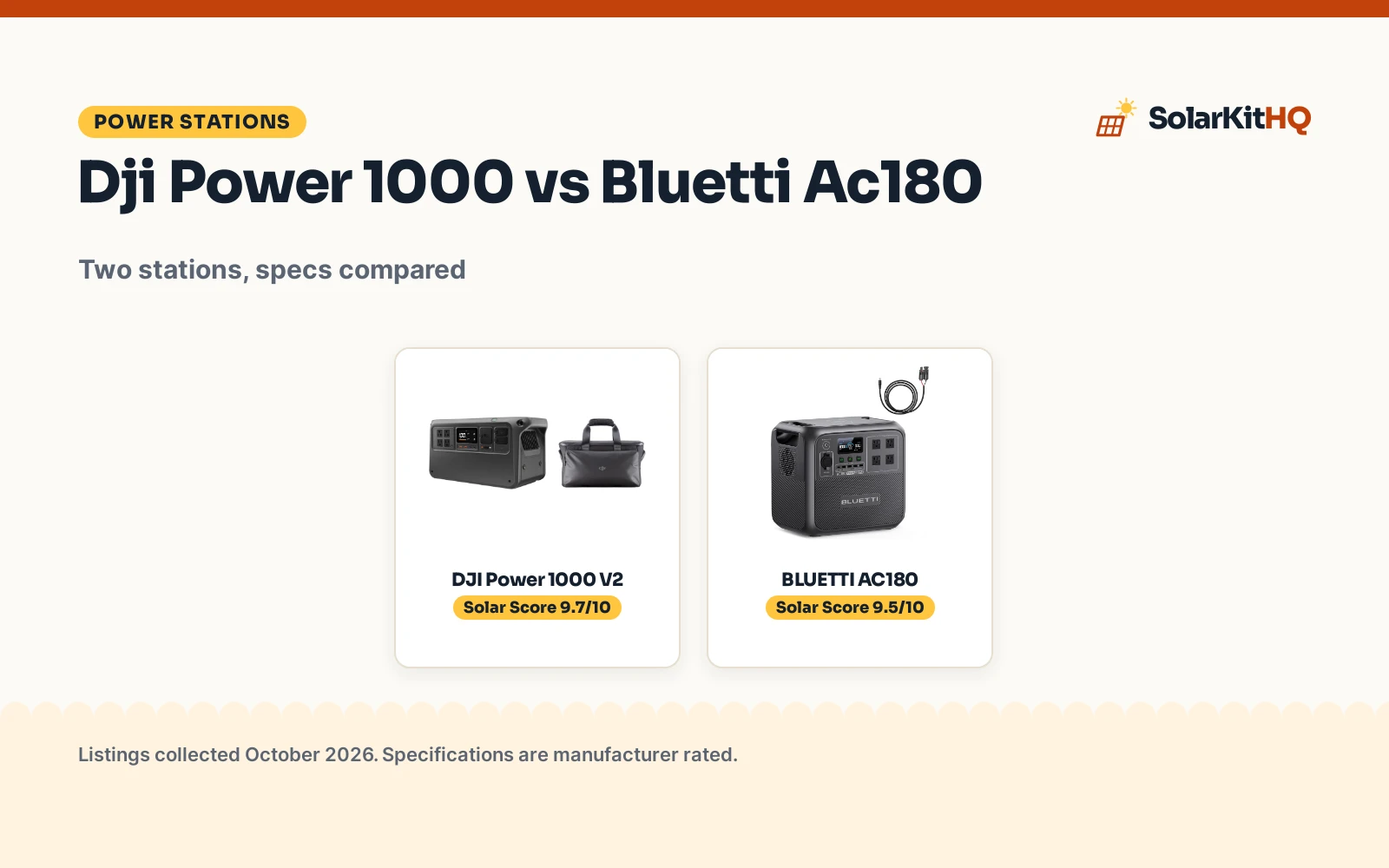
Dji Power 1000 vs Bluetti Ac180: side by side
| Power station | Solar Score | Capacity | Output | Outlets | Warranty |
|---|---|---|---|---|---|
| DJI Power 1000 V2 | 9.7/10 | 1024Wh | 2600W | Dual 140W USB-C | 3 years, extendable to 5 years |
| BLUETTI AC180 | 9.5/10 | 1152Wh | 1800W, 2700W peak | 11 outlets | Not stated |
Specifications are manufacturer rated as listed, collected 25 October 2026.
Capacity and output
The two stations sit close on stored energy and apart on output. The DJI Power 1000 V2 example lists a 1024Wh LFP battery with 2600W of output at 110 volts, while the BLUETTI AC180 example lists a 1152Wh LiFePO4 battery with 1800W of output and a 2700W peak at 120 volts. The capacity line is a straight read of the two stated figures: the BLUETTI example lists the larger capacity, and the DJI example lists the higher continuous output. The BLUETTI example also states 3000+ cycles for its battery, while the DJI example states a 10-year lifespan instead of a cycle count, so the two longevity claims do not share a unit.
Charging and solar input
Recharge speed is where the DJI example pulls ahead on paper. The DJI example lists a recharge to 80% in 37 minutes, while the BLUETTI example lists 0-80% in 45 minutes and a full charge in 1 hour at 1440W AC input. Solar is the reverse: the BLUETTI example states a built-in MPPT controller with up to 500W of solar input and a full solar charge in 2.8-3.3 hours, while the DJI example lists solar as a power source but states no solar input watt figure. The DJI example adds SDC charging for select DJI drone batteries, with takeoff in 30 minutes stated for those batteries, a feature the BLUETTI example does not list.
Outlets, UPS and noise
The outlet picture favors the BLUETTI example on count and the DJI example on USB-C power. The BLUETTI example states 11 outlets, including 4 AC outlets, and an app tap that boosts output to 2700W. The DJI example states dual 140W USB-C ports, 280W total, but states no total outlet count, so the two outlet lines cannot be ranked directly. For backup use, the DJI example states UPS switching in 10ms and the BLUETTI example states 20ms. On noise, the DJI example lists 26 dB, while the BLUETTI example states no noise figure, so that line is also left unclear rather than scored as a win.
What the listings leave unclear
Two listing quirks deserve a note before the verdict. The DJI example states a 3-year warranty, extendable to 5 years with quick registration, in its bullets, while its spec table says 5 Years of Warranty; the bullets are the safer read. The BLUETTI example states no warranty term and no safety certification, and its spec table lists a 4 Stroke engine type, which does not describe a battery station, so the title and bullets carry that listing. Weight is stated in different units, 14.14 kg on the DJI example and 37.4 pounds on the BLUETTI example, so no direct weight comparison is made here.
Two examples

DJI Power 1000 V2
A portable power station with a 1024Wh LFP battery, 2600W of output, dual 140W USB-C ports and a stated 3-year warranty.
Pros
- 2600W output with a 1024Wh LFP battery
- Recharges to 80% in 37 minutes, per the listing
- Dual 140W USB-C ports, 280W total
- UPS switching in 10ms, per the listing
Cons
- No solar input watt figure is stated
- No total outlet count is stated
- Warranty terms differ between the bullets and the spec table
- Weight is stated in kilograms only
Detailed Review
The listing states a 1024Wh LFP battery with 2600W of output at 110 volts, an intelligent BMS, sub-nano coating and flame-retardant housing, a recharge to 80% in 37 minutes, dual 140W USB-C ports, UPS switching in 10ms, noise as low as 26 dB, SDC charging for select DJI drone batteries with takeoff in 30 minutes, a 10-year lifespan, and a protective storage bag plus an AC power cable in the box. It measures 19.2 x 8.85 x 9.05 in and weighs 14.14 kg. The bullets state a 3-year warranty, extendable to 5 years with quick registration, while the spec table says 5 Years of Warranty; the bullets are the safer read.
Who it's for: a camper, creator or homeowner who wants fast AC recharging, drone battery charging and a stated warranty. Who should skip it: anyone who needs a stated solar input figure or a stated total outlet count.
Its Solar Score of 9.7/10 comes from performance 32/35, build 21/25, value 21/25, safety 8/10 and warranty 3/5: 85 of 100 points, placed on our 9.2 to 9.8 scale.
Key Specifications
| Capacity | 1024Wh LFP |
|---|---|
| Output | 2600W |
| Size | 19.2 x 8.85 x 9.05 in |
| Weight | 14.14 kg |
Figures as published on the retailer listing, collected 25 October 2026. Performance figures are manufacturer rated.
Safety and Warranty
What this listing states. Intelligent BMS, sub-nano coating and flame-retardant housing stated, so safety scores 8 of 10. 3-year warranty, extendable to 5 years with quick registration stated. It does not say everything a buyer needs, such as who pays return shipping, so warranty scores 3 of 5. See How We Pick.
Power station limits. Stay within the stated continuous output and solar input limits, keep the unit ventilated and dry, charge within the stated temperature range, and never connect it to home wiring except through equipment a licensed electrician installs.
This is general buying information, not professional advice. Follow each product manual and local rules, and see our Safety Disclaimer.

BLUETTI AC180
A portable power station with a 1152Wh LiFePO4 battery, 1800W of output with a 2700W peak, 11 outlets and stated solar charging.
Pros
- 1152Wh LiFePO4 battery with 3000+ cycles stated
- 1800W output with a 2700W peak and 11 outlets
- Built-in MPPT with up to 500W of solar input
- Charges to 80% in 45 minutes and fully in 1 hour at 1440W AC input
Cons
- No warranty term is stated
- No safety certification or battery management system is stated
- No noise figure is stated
- Spec table lists a 4 Stroke engine type, which does not fit a battery station
Detailed Review
The listing states a 1152Wh LiFePO4 battery with 1800W of output, a 2700W peak, 11 outlets including 4 AC outlets, a built-in MPPT controller with up to 500W of solar input, a full solar charge in 2.8-3.3 hours, a full AC charge in 1 hour at 1440W AC input, UPS switching in 20ms, 3000+ cycles, and AC, car and solar charging cables in the box. It measures 13.4 x 9.7 x 12.5 in, weighs 37.4 pounds and uses engineering plastic or metal. The spec table lists a 4 Stroke engine type, which does not describe a battery station; the title and bullets carry that listing.
Who it's for: a camper or homeowner who wants many outlets, stated solar charging and a larger stated capacity. Who should skip it: anyone who wants a stated warranty term or stated safety certification.
Its Solar Score of 9.5/10 comes from performance 30/35, build 21/25, value 21/25, safety 0/10 and warranty 0/5: 72 of 100 points, placed on our 9.2 to 9.8 scale.
Key Specifications
| Capacity | 1152Wh LiFePO4 |
|---|---|
| Output | 1800W, 2700W peak |
| Size | 13.4 x 9.7 x 12.5 in |
| Weight | 37.4 pounds |
Figures as published on the retailer listing, collected 25 October 2026. Performance figures are manufacturer rated.
Safety and Warranty
What this listing states. No UL, FCC or battery management statement is stated, so safety scores zero. No warranty term, so warranty scores zero. See How We Pick.
Power station limits. Stay within the stated continuous output and solar input limits, keep the unit ventilated and dry, charge within the stated temperature range, and never connect it to home wiring except through equipment a licensed electrician installs.
This is general buying information, not professional advice. Follow each product manual and local rules, and see our Safety Disclaimer.
As an Amazon Associate I earn from qualifying purchases.
How we scored them
The Solar Score weighs performance, build, value, safety and warranty. For portable power stations, safety means stated protections such as a battery management system or flame-retardant housing; the DJI example states these and the BLUETTI example states none. One of the two examples states a warranty term. How we pick explains the weights.
| Product | Solar Score | Perf. /35 | Build /25 | Value /25 | Safety /10 | Warranty /5 |
|---|---|---|---|---|---|---|
| DJI Power 1000 V2 | 9.7 | 32 | 21 | 21 | 8 | 3 |
| BLUETTI AC180 | 9.5 | 30 | 21 | 21 | 0 | 0 |
Scores run from 9.2 to 9.8: each product’s point total is placed on that range, so more points always means a higher score.
How to choose between the dji power 1000 vs bluetti ac180
Match capacity and output to your loads
Start from the loads you plan to run, not the headline watts. The DJI Power 1000 V2 example lists 2600W of output, which suits heavier single loads, while the BLUETTI AC180 example lists 1800W with a 2700W peak for short boosts through its app. On stored energy, the BLUETTI example lists 1152Wh against the DJI example’s 1024Wh, so a long, light load favors the BLUETTI example and a short, heavy load favors the DJI example. For more capacity ideas, see the best 1500Wh power station for camping guide.
Check charging options before you buy
How a station recharges matters as much as how much it holds. The DJI example recharges to 80% in 37 minutes from AC, while the BLUETTI example takes 45 minutes to 80% but adds stated solar charging through its MPPT controller. If your site has sun and time, the solar line matters; if you recharge between stops, the AC time matters more.
| If you need | Look at |
|---|---|
| 80% recharge time | DJI Power 1000 V2, 37 minutes |
| Solar input stated | BLUETTI AC180, up to 500W |
| Drone battery charging | DJI Power 1000 V2, SDC charging |
| Outlet count stated | BLUETTI AC180, 11 outlets |
Read the warranty and safety lines
Warranty and safety separate these two listings more than capacity does. The DJI example states a 3-year warranty, extendable to 5 years with quick registration, plus an intelligent BMS, sub-nano coating and flame-retardant housing. The BLUETTI example states no warranty term and no safety certification, so its lower score on those two lines is a gap in the listing, not a claim about the hardware. For the home backup angle, see the solar generator vs home battery backup guide.
Sizing Notes
- Match the station’s stated output to the loads you plan: 2600W on the DJI example, 1800W with a 2700W peak on the BLUETTI example.
- Match stated capacity to your loads: 1024Wh on the DJI example, 1152Wh on the BLUETTI example.
- Match solar input to the station input: the BLUETTI example states up to 500W through a built-in MPPT controller, while the DJI example states no solar input figure.
- Check the outlet count against the loads you run at once: the BLUETTI example states 11 outlets, while the DJI example states dual 140W USB-C ports without a total count.
- Note the UPS switching each listing states: 10ms on the DJI example, 20ms on the BLUETTI example. If a station connects to home wiring, a licensed electrician should install it.
Frequently Asked Questions
Which station has the larger stated capacity?
The BLUETTI AC180 example lists 1152Wh, and the DJI Power 1000 V2 example lists 1024Wh.
Which station recharges to 80% sooner?
The DJI example lists 80% in 37 minutes, while the BLUETTI example lists 80% in 45 minutes.
Can either station charge from solar?
The BLUETTI example states a built-in MPPT controller with up to 500W of solar input and a full solar charge in 2.8-3.3 hours. The DJI example lists solar as a power source but states no solar input watt figure.
Which station states a warranty?
The DJI example states a 3-year warranty, extendable to 5 years with quick registration. The BLUETTI example states no warranty term.
Related guides
See every Portable Power Stations guide and all Power Stations and Generators guides.
More picks: DJI Power 1000 vs EcoFlow Delta 3, best power station with USB ports and deep cycle battery vs power station.