On this page
The short answer on anker solix c300 vs c1000 gen 2: pick the C300 side if you already own the Anker SOLIX C300 DC and want a fitted bag to carry and protect it; pick the C1000 Gen 2 if you need power itself, with 2,000W of output, a 1,024Wh LiFePO4 battery and a 400W panel in the box. The two listings barely overlap: one sells storage, the other sells electricity.
SolarKitHQ earns a commission when you buy through links on this page, at no extra cost to you. As an Amazon Associate I earn from qualifying purchases. Affiliate disclosure.
Anker Solix C300 vs C1000 Gen 2: side by side
| Spec | C300 side (bag) | C1000 Gen 2 side | Note |
|---|---|---|---|
| What it is | Fitted travel bag for the C300 DC | Power station plus 400W panel bundle | One sells storage, the other sells electricity |
| Station capacity | 288Wh on the C300 the bag fits | 1,024Wh LiFePO4 | The 288Wh figure describes the station, not the bag |
| Output stated | Not stated | 2,000W, 3,000W peak | Only the C1000 Gen 2 lists output figures |
| Recharge stated | Not stated | 1,600W HyperFlash, 49 min; 600W solar, 1.8 hr | Only the C1000 Gen 2 lists charge figures |
| Ports | Not stated | 10 | Only the C1000 Gen 2 lists ports |
| Panel | None | PS400 bifacial 400W, IP68 | Panel ships with the C1000 Gen 2 bundle |
| Weather code | Not stated | IP68 on the panel | No IP figure for the station or the bag |
| Warranty | Not stated | 5 years | Only the C1000 Gen 2 states a term |
Specifications are manufacturer rated as listed, collected 22 October 2026.
What each listing actually sells
The C300 side is not a power station: it is an amiumuca travel bag designed for the Anker SOLIX C300 DC, which the bag’s title describes as a 288Wh, 90,000mAh power bank station. The bag adds no capacity of its own. What it adds is 1680D Oxford cloth outside, an 8mm pearl cotton shock layer in the middle, an aluminum foil interior that is easy to clean, a moisture-protecting zipper, four compartments, side pockets for cables, and a shoulder strap with an opening at the top so the station’s own handle stays reachable. The C1000 Gen 2 side is the opposite: a full Anker SOLIX C1000 Gen 2 portable power station bundled with a PS400 bifacial 400W solar panel, an AC charging cable, two 8.2 ft solar charging cables and a 1.6 ft XT60i cable.
Power and charging
There is no contest on output because only one side states any. The C1000 Gen 2 lists 2,000W of output with 3,000W peak across 10 ports, and a 1,024Wh LiFePO4 battery. Recharging is stated three ways: 49 minutes at 1,600W with HyperFlash enabled in the Anker app, 1.8 hours from 600W of solar at up to 60V, and the folded PS400 panel at 21.9 lb and 22.3 by 38.7 by 3.2 in, IP68-rated with a reinforced aluminium frame. The bag listing states no watts, no ports and no charge times; it is sized 11.8 by 10.2 by 5.5 in and weighs 0.31 kg. Do not read the C300’s 288Wh as a comparison figure: it describes the station the bag fits, not the bag.
What the listings leave unclear
The bag listing names no warranty term and no IP code, though it claims moisture protection and shock absorption. The C1000 Gen 2 listing states a 5 year warranty in its spec table and IP68 for the panel, but no IP figure for the station itself. The bag’s 288Wh and 90,000mAh figures come from its title’s description of the C300 DC, so treat them as the station’s figures, not the bag’s. Anker says the C1000 Gen 2 is 14 percent smaller and 11 percent lighter than similar models, and the PS400 panel 50 percent lighter than comparable 400W panels, without naming the models it compares against.
Two examples

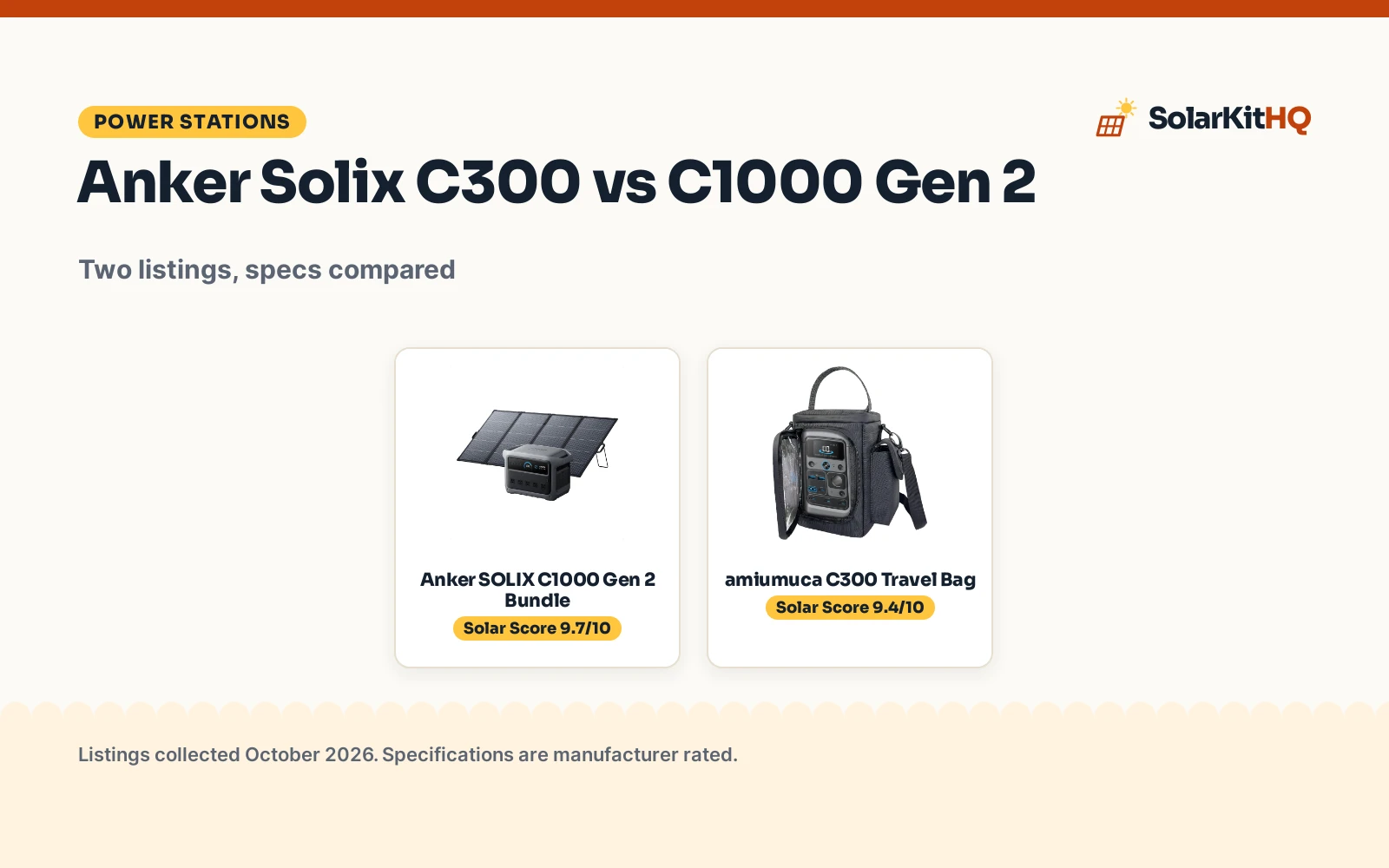
Anker SOLIX C1000 Gen 2 Bundle
A 1,024Wh LiFePO4 power station with 2,000W output, 10 ports and a PS400 bifacial 400W panel, with a 5 year warranty stated.
Pros
- 2,000W output with 3,000W peak across 10 ports stated
- 1,024Wh LiFePO4 battery stated
- 49 minutes at 1,600W with HyperFlash, or 1.8 hours from 600W solar
- 5 year warranty stated in the spec table
Cons
- No IP figure stated for the station itself, only IP68 for the panel
- 14 percent smaller and 11 percent lighter claims name no comparison models
- Panel and station ship separately, per the bullets
- 50 percent lighter panel claim names no comparison models
Detailed Review
The listing states the Anker SOLIX C1000 Gen 2 with a 1,024Wh LiFePO4 battery, 2,000W output, 3,000W peak and 10 ports, bundled with a PS400 bifacial 400W panel. Recharging is stated at 49 minutes with 1,600W HyperFlash in the app, or 1.8 hours from 600W of solar at up to 60V. The panel is listed at 21.9 lb, 22.3 by 38.7 by 3.2 in folded, IP68-rated with a reinforced aluminium frame and an impact-resistant design. The spec table gives the station as 10.3 by 11.2 by 17.6 in and states a 5 year warranty.
Who it's for: home backup and off-grid campers who want a mid-size station with a panel in the box. Who should skip it: anyone who only needs a way to carry a smaller station they already own.
Its Solar Score of 9.7/10 comes from performance 33/35, build 21/25, value 20/25, safety 8/10 and warranty 4/5: 86 of 100 points, placed on our 9.2 to 9.8 scale.
Key Specifications
| Capacity | 1,024Wh LiFePO4 |
|---|---|
| Output | 2,000W, 3,000W peak, 10 ports |
| Recharge | 1,600W HyperFlash, 49 min; 600W solar, 1.8 hr |
| Panel | PS400 bifacial 400W, IP68 |
Figures as published on the retailer listing, collected 22 October 2026. Performance figures are manufacturer rated.
Safety and Warranty
What this listing states. IP68 panel, reinforced aluminium frame and impact-resistant design stated, so safety scores 8 of 10. 5 years stated. It does not say everything a buyer needs, such as who pays return shipping, so warranty scores 4 of 5. See How We Pick.
Power station limits. Stay within the stated continuous output and solar input limits, keep the unit ventilated and dry, charge within the stated temperature range, and never connect it to home wiring except through equipment a licensed electrician installs.
This is general buying information, not professional advice. Follow each product manual and local rules, and see our Safety Disclaimer.

amiumuca C300 Travel Bag
A fitted travel bag for the Anker SOLIX C300 DC with 1680D Oxford cloth, an 8mm shock layer, four compartments and a shoulder strap.
Pros
- Designed for the Anker SOLIX C300 DC, usable with the station inside
- 8mm pearl cotton shock layer stated
- Four compartments plus side pockets for cables
- Shoulder strap with top opening for the station's own handle
Cons
- Adds no capacity: it is a bag, not a power station
- No warranty term stated
- No IP code stated
- 11.8 by 10.2 by 5.5 in fits only the C300 DC
Detailed Review
The listing states a travel bag fitted to the Anker SOLIX C300 DC, which its title describes as a 288Wh, 90,000mAh power bank station. The bag itself is 1680D Oxford cloth with a moisture-protecting zipper, an aluminum foil interior, an 8mm pearl cotton shock layer, four compartments, side pockets for cables, a shoulder strap and a top opening for the station's handle, at 11.8 by 10.2 by 5.5 in and 0.31 kg. No warranty term is stated.
Who it's for: C300 DC owners who carry the station to campsites and want scuff and shock protection. Who should skip it: anyone shopping for actual power output or capacity.
Its Solar Score of 9.4/10 comes from performance 21/35, build 20/25, value 19/25, safety 4/10 and warranty 0/5: 64 of 100 points, placed on our 9.2 to 9.8 scale.
Key Specifications
| Fits | Anker SOLIX C300 DC |
|---|---|
| Material | 1680D Oxford cloth |
| Padding | 8mm pearl cotton |
| Size | 11.8 x 10.2 x 5.5 in |
Figures as published on the retailer listing, collected 22 October 2026. Performance figures are manufacturer rated.
Safety and Warranty
What this listing states. moisture protection and 8mm shock-absorbing layer stated, so safety scores 4 of 10. No warranty term, so warranty scores zero. See How We Pick.
Power station limits. Stay within the stated continuous output and solar input limits, keep the unit ventilated and dry, charge within the stated temperature range, and never connect it to home wiring except through equipment a licensed electrician installs.
This is general buying information, not professional advice. Follow each product manual and local rules, and see our Safety Disclaimer.
As an Amazon Associate I earn from qualifying purchases.
How we scored them
The Solar Score weighs performance, build, value, safety and warranty. For a power station, safety means stated protections, weather codes and build details; the C1000 Gen 2 states an IP68 panel, a reinforced aluminium frame and an impact-resistant design, while the bag states moisture protection and a shock-absorbing layer. Only the C1000 Gen 2 states a warranty term, at 5 years. How we pick explains the weights.
| Product | Solar Score | Perf. /35 | Build /25 | Value /25 | Safety /10 | Warranty /5 |
|---|---|---|---|---|---|---|
| Anker SOLIX C1000 Gen 2 Bundle | 9.7 | 33 | 21 | 20 | 8 | 4 |
| amiumuca C300 Travel Bag | 9.4 | 21 | 20 | 19 | 4 | 0 |
Scores run from 9.2 to 9.8: each product’s point total is placed on that range, so more points always means a higher score.
Anker Solix C300 vs C1000 Gen 2: which should you choose?
Choose the C300 side if the Anker SOLIX C300 DC is already on your shelf and you want to carry it to campsites without scuffing it: the bag’s shoulder strap, cable pockets and handle opening are built for exactly that. Choose the C1000 Gen 2 if you are buying power, not storage: 1,024Wh of LiFePO4, 2,000W of output and a 400W panel cover home backup and off-grid camping in one box. If the older C1000 is also on your shortlist, see our Anker Solix C300 vs C1000 comparison.
| If you need | Look at |
|---|---|
| A way to carry a C300 DC | amiumuca bag, 1680D Oxford cloth, 8mm shock layer |
| 2,000W of output | C1000 Gen 2, 3,000W peak, 10 ports |
| A panel in the box | C1000 Gen 2, PS400 bifacial 400W, IP68 |
| A 5 year warranty stated | C1000 Gen 2 |
Sizing Notes
- Confirm the C300 DC is the station you own before buying the bag: it is fitted to that model at 11.8 by 10.2 by 5.5 in.
- Match the C1000 Gen 2’s 2,000W output and 1,024Wh capacity against the loads you plan to run.
- Count solar input against the 600W, 60V max figure if you plan to recharge the C1000 Gen 2 from panels.
- The bag states no electrical figures, so compare it on fit, compartments and carry, not on power.
Frequently Asked Questions
Is the C300 listing a power station?
No. It is a travel bag designed for the Anker SOLIX C300 DC, which its title describes as a 288Wh, 90,000mAh station. The bag itself adds no capacity.
What comes in the C1000 Gen 2 box?
The Anker SOLIX C1000 Gen 2 station, an AC charging cable, the PS400 bifacial 400W panel, two 8.2 ft solar charging cables, a 1.6 ft XT60i cable, and quick start and safety guides.
How fast does the C1000 Gen 2 recharge?
The listing states 49 minutes at 1,600W with HyperFlash enabled in the Anker app, or 1.8 hours from 600W of solar at up to 60V.
Which listing states a warranty?
The C1000 Gen 2 states 5 years in its spec table. The bag listing states no warranty term.
Related guides
See every Portable Power Stations guide and all Power Stations and Generators guides. For camp use, see our best portable power station for camping, and for panels to pair with a station, the best solar panel for Anker Solix C1000.