On this page
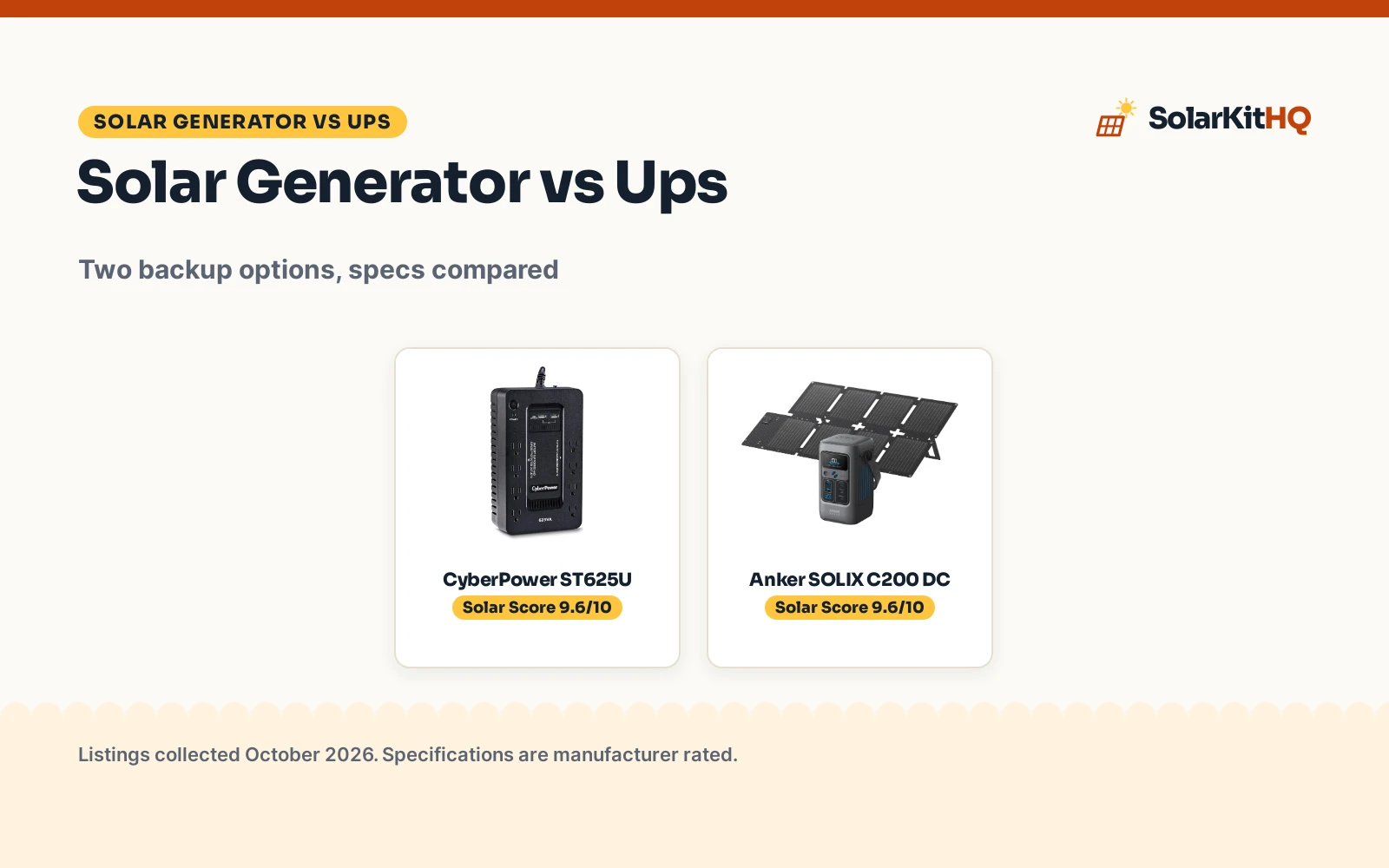
The short answer on solar generator vs ups: pick the solar generator side for portable power with solar recharging, and pick the UPS side for a desk setup that needs battery backup and surge protection for a computer and router. We compared one example from each side on output, capacity, outlets, recharging and warranty, using only what each listing publishes.
SolarKitHQ earns a commission when you buy through links on this page, at no extra cost to you. As an Amazon Associate I earn from qualifying purchases. Affiliate disclosure.
Solar generator vs UPS: side by side
| Solar generator vs UPS | CyberPower ST625U | Anker SOLIX C200 DC | Takeaway |
|---|---|---|---|
| Output | 360W, 625VA | 200W | UPS states more watts |
| Energy | Not stated | 192Wh | Unclear: UPS leaves it unstated |
| Outlets and ports | 8 outlets, 2 USB ports | 5 charging ports | Different plugs, no winner |
| Recharging | Wall outlet, 5 foot cord | Wall, car or 60W solar panel | Solar generator recharges more ways |
| Battery type | Lead acid | LiFePO4 | Different chemistries |
| Weight | 5 pounds | 1.9 kg | Units differ, no direct comparison |
| Warranty | 3-year, including battery | 3-year | Tie at 3 years |
| Certification | UL certified | Not stated | Only the UPS states UL |
Specifications are manufacturer rated as listed, collected 25 October 2026. Where a listing contradicts itself, both figures are shown.
Power and capacity
Output watts are stated on both sides, so they can be compared directly. The CyberPower example states 625VA and 360W, while the Anker example states 200W and 192Wh. The UPS example states the higher output figure, while only the solar generator example states an energy figure in watt-hours. The UPS listing leaves energy unstated, so no watt-hour comparison is possible here. For a desk setup with a computer and router, the higher output figure matters; for portable use, the stated energy figure matters more, since it decides how long the battery can run small devices.
Ports and outlets
Outlets decide what each side can run. The CyberPower example offers 8 outlets: 4 battery backup and surge protected outlets, and 4 surge protected outlets, plus 2 USB charging ports that share 2.1 amps. The Anker example offers 5 charging ports: 1 USB-C at 100W, 1 USB-C at 140W, 1 USB-C at 15W and 2 USB-A at 12W. The UPS side fits wall plugs for a computer, gaming console or broadband router, while the solar generator side fits USB devices such as a laptop, phone, camera, drone or mini fan. Neither side covers the other side’s plugs, so the devices you run decide the side.
Recharging
Recharging separates the two sides more than any other spec. The Anker example recharges to 80% in 50 minutes with a wall outlet, in about 4 hours with the included 60W solar panel, and it can also charge via a car or the USB-C port. The CyberPower example plugs into a wall outlet with a 5 foot power cord and provides battery backup from that connection, with no solar input stated. A solar generator keeps working away from an outlet as long as the panel has sun, while a UPS stays ready at a desk where the wall outlet is always near.
What the listings leave unclear
Both listings have figures that conflict or go unstated, and those gaps matter for a fair comparison. The Anker bullets list 5 charging ports while the spec table lists 7, and the bullets state 80% in 50 minutes while the spec table states 80% in 1.3 hours, so the bullets win on both points. The CyberPower spec table lists a maximum power of 330 watts against the 360W title and output wattage, so the title wins there. The CyberPower spec table also lists a runtime of 2 minutes without stating the load, so that figure cannot be compared with anything. The UPS listing states no energy figure, and the Anker listing states no certification, so neither side can claim a win on those points.
Two examples

CyberPower ST625U
A 625VA/360W standby UPS with 8 outlets, 2 USB charging ports and a 5 foot power cord, UL certified.
Pros
- 8 outlets: 4 battery backup and surge protected, 4 surge protected
- 2 USB charging ports sharing 2.1 amps
- UL certified with Energy Star and RoHS stated
- 3-year warranty including the battery, with PowerPanel software
Cons
- Simulated sine wave output, not pure sine wave
- Spec table maximum power of 330 watts against the 360W title
- Spec table lists a runtime of 2 minutes without a stated load
- Lead acid battery cell type, not lithium
Detailed Review
The CyberPower ST625U is a 625VA/360W standby UPS with 8 NEMA 5-15R outlets: 4 battery backup and surge protected, and 4 surge protected. The input is a NEMA 5-15P plug with a 5 foot power cord, and 2 USB charging ports share 2.1 amps. The output is a simulated sine wave, the unit weighs 5 pounds, and the dimensions are 3.2 x 9.8 x 5.8 in. Note the conflict: the spec table lists a maximum power of 330 watts against the 360W title and output wattage, so trust the title and bullets.
Who it's for: a home office or home entertainment setup that wants battery backup and surge protection for a computer, gaming console or broadband router. Who should skip it: anyone who wants solar recharging, or a portable battery for outdoor use.
Its Solar Score of 9.6/10 comes from performance 29/35, build 21/25, value 20/25, safety 8/10 and warranty 3/5: 81 of 100 points, placed on our 9.2 to 9.8 scale.
Key Specifications
| Output | 360W, 625VA |
|---|---|
| Outlets | 8, 4 battery backup |
| USB | 2 ports, 2.1 amps shared |
| Weight | 5 pounds |
Figures as published on the retailer listing, collected 25 October 2026. Performance figures are manufacturer rated.
Safety and Warranty
What this listing states. UL certified, Energy Star and RoHS stated, so safety scores 8 of 10. 3-year warranty including the battery. It does not say everything a buyer needs, such as who pays return shipping, so warranty scores 3 of 5. See How We Pick.
Power station limits. Stay within the stated continuous output and solar input limits, keep the unit ventilated and dry, charge within the stated temperature range, and never connect it to home wiring except through equipment a licensed electrician installs.
This is general buying information, not professional advice. Follow each product manual and local rules, and see our Safety Disclaimer.

Anker SOLIX C200 DC
A 192Wh LiFePO4 portable power station with 200W output, 5 charging ports and a 60W solar panel in the box.
Pros
- 192Wh LiFePO4 battery with 200W output
- 60W solar panel included for solar recharging
- 5 charging ports including 140W and 100W USB-C ports
- Recharge to 80% in 50 minutes with a wall outlet, per the bullets
Cons
- No wall charger included, per the title
- Shoulder strap sold separately, not included
- Not compatible with Anker SOLIX PS30, PS200 or PS400 panels
- Spec table port count of 7 against the 5 ports in the bullets
Detailed Review
The Anker SOLIX C200 DC is a 192Wh LiFePO4 portable power station with 200W output and a 60W solar panel in the box. The bullets list 5 charging ports: 1 USB-C at 100W, 1 USB-C at 140W, 1 USB-C at 15W and 2 USB-A at 12W. Recharging to 80% takes 50 minutes with a wall outlet, or about 4 hours with the 60W solar panel, and car charging is also stated. Note the conflicts: the spec table lists 7 ports against the 5 in the bullets, and a rapid charging figure of 80% in 1.3 hours against the 50 minutes in the bullets, so trust the bullets.
Who it's for: outdoor, travel and emergency use where a portable battery with solar recharging fits. Who should skip it: anyone who wants a standby UPS with surge protected outlets for a desk setup.
Its Solar Score of 9.6/10 comes from performance 30/35, build 21/25, value 21/25, safety 0/10 and warranty 3/5: 75 of 100 points, placed on our 9.2 to 9.8 scale.
Key Specifications
| Energy | 192Wh |
|---|---|
| Output | 200W |
| Ports | 5 charging ports |
| Solar | 60W panel included |
Figures as published on the retailer listing, collected 25 October 2026. Performance figures are manufacturer rated.
Safety and Warranty
What this listing states. No UL, FCC or battery management statement is stated, so safety scores zero. 3-year warranty. It does not say everything a buyer needs, such as who pays return shipping, so warranty scores 3 of 5. See How We Pick.
Power station limits. Stay within the stated continuous output and solar input limits, keep the unit ventilated and dry, charge within the stated temperature range, and never connect it to home wiring except through equipment a licensed electrician installs.
This is general buying information, not professional advice. Follow each product manual and local rules, and see our Safety Disclaimer.
As an Amazon Associate I earn from qualifying purchases.
How we scored them
The Solar Score weighs performance, build, value, safety and warranty. For backup power, safety means stated certifications: the CyberPower states UL certification, while the Anker states no certification. Both state a 3-year warranty, so both earn the same warranty points. How we pick explains the weights.
| Product | Solar Score | Perf. /35 | Build /25 | Value /25 | Safety /10 | Warranty /5 |
|---|---|---|---|---|---|---|
| CyberPower ST625U | 9.6 | 29 | 21 | 20 | 8 | 3 |
| Anker SOLIX C200 DC | 9.6 | 30 | 21 | 21 | 0 | 3 |
Scores run from 9.2 to 9.8: each product’s point total is placed on that range, so more points always means a higher score.
Solar generator vs ups: which should you choose?
| Side | Pick it for | Note |
|---|---|---|
| Solar generator side | Portable outdoor, travel and emergency power with solar recharging | No wall charger included |
| UPS side | Desk setup with battery backup and surge protection | Simulated sine wave output |
Sizing Notes
- Match output watts to the loads: the UPS example states 360W, the solar generator example states 200W.
- Match outlets to devices: wall outlets for a computer and router, USB ports for a laptop, phone and camera.
- Check recharge options: the solar generator example recharges from a wall outlet, a car or a 60W solar panel.
- Check size and weight against the space: the UPS example weighs 5 pounds, the solar generator example weighs 1.9 kg.
Frequently Asked Questions
Can a solar generator replace a UPS?
Not directly. The CyberPower is a standby UPS with 4 battery backup outlets for a desk setup, while the Anker is a portable power station with solar recharging and no UPS function described. Pick the UPS side for always-ready desk backup, and the solar generator side for portable power.
Can I recharge a solar generator from a wall outlet?
Yes. The Anker example recharges to 80% in 50 minutes with a wall outlet, and it can also charge via a car or the included 60W solar panel in about 4 hours.
How many outlets does each side offer?
The CyberPower offers 8 outlets plus 2 USB charging ports, while the Anker offers 5 charging ports. The UPS side fits wall plugs, while the solar generator side fits USB devices.
Which side has the longer warranty?
Neither side leads. Both state a 3-year warranty, and the CyberPower warranty includes the battery and adds a connected equipment guarantee.
Related guides
See every solar generator guide and all power station guides.
More picks: solar generator vs gas generator, inverter vs UPS, portable power station for camping.