On this page
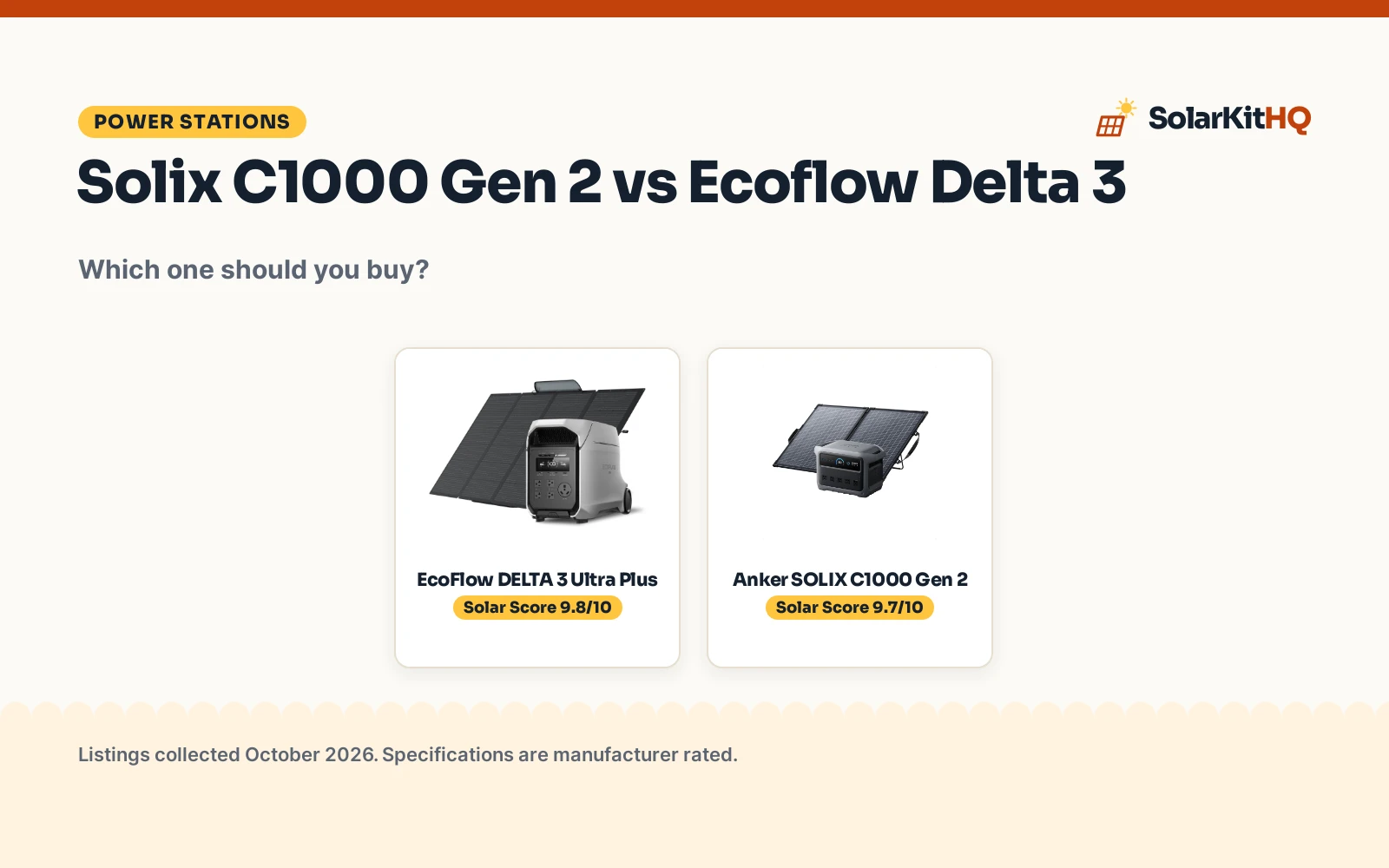
Choose the EcoFlow DELTA 3 Ultra Plus if you want the most capacity and power: 3072Wh expandable to 11kWh and 3600W of output for home backup. Choose the Anker SOLIX C1000 Gen 2 if you want portability: 1,024Wh at 24.9 lb with 10 ports and a 49-minute recharge. We compared the two on what each listing states: capacity, output, solar input, weight, ports and warranty.
SolarKitHQ earns a commission when you buy through links on this page, at no extra cost to you. As an Amazon Associate I earn from qualifying purchases.
Solix C1000 Gen 2 vs Ecoflow Delta 3: side by side
| Feature | Anker SOLIX C1000 Gen 2 | EcoFlow DELTA 3 Ultra Plus |
|---|---|---|
| Solar Score | 87 | 88 |
| Capacity | 1,024Wh | 3072Wh (11kWh max) |
| Output | 2,000W (3,000W peak) | 3600W (7200W surge) |
| Solar panel | 100W | 400W |
| Ports | 10 | 4 |
| Weight | 24.9 lb | 125 lb |
| Fast recharge | 49 min | 80% in under an hour |
| Warranty | 5 years | 5 Year Manufacturer |
22 October 2026
Specifications are manufacturer rated as listed.
Capacity and expandability
The EcoFlow lists 3072Wh expandable to 11kWh with extra batteries, while the Anker lists 1,024Wh with no expansion stated. For multi-day blackouts, RV living or extended off-grid trips, the EcoFlow’s expandability is the deciding factor: add batteries as your needs grow. For a weekend trip, a single day of backup, or keeping essentials running during a short outage, the Anker’s 1,024Wh covers phones, laptops, lights and small appliances without the extra batteries.
Output power
The EcoFlow lists 3600W continuous with 7200W surge, enough for heavy-duty appliances and power tools. The Anker lists 2,000W with 3,000W peak across 10 ports. If you run a refrigerator, power tools or an RV air conditioner, the EcoFlow’s headroom matters. For laptops, phones, lights and a small fridge, the Anker’s 2,000W is enough.
Solar input
The EcoFlow includes a 400W solar panel, while the Anker includes a 100W bifacial panel. The Anker lists 1.8-hour solar recharging with 600W of solar input at 60V max. More panel watts means faster solar recharging, so the EcoFlow refills its larger battery faster in good sun. The Anker’s 100W panel suits topping up rather than full recharges.
Weight and portability
The Anker weighs 24.9 lb, while the EcoFlow weighs 125 lb. The Anker is built to carry, store and move around; the EcoFlow is built to sit in a garage or utility room. If you load the station into a truck or carry it to a campsite, the Anker’s weight is the clear advantage. If it never moves, weight does not matter.
Ports and outlets
The Anker lists 10 ports against the EcoFlow’s 4, which matters when several devices charge at once. Ten ports across 2,000W means phones, laptops, lights and a small appliance can all plug in without unplugging something else. Four ports on the EcoFlow is fewer, but each can draw from a larger 3600W pool. If you run many small devices, the Anker’s port count wins; if you run a few big ones, the EcoFlow’s per-port headroom wins. Neither listing fully breaks down the port types, so check the specific outlets against your plugs.
Recharge speed
The Anker lists a full recharge in 49 minutes using HyperFlash at 1,600W, enabled in the Anker app. The EcoFlow lists 80% in under an hour with X-Stream fast charging. Both are fast by power station standards, but they measure differently: the Anker gives a full-charge time while the EcoFlow gives an 80% time. For solar recharging, the Anker lists 1.8 hours with 600W of solar at 60V max. Faster recharge matters most when the station cycles daily; for occasional backup use, either is fast enough.
What the listings leave unclear
Neither listing states a cycle life figure. The Anker lists LiFePO4 chemistry while the EcoFlow lists LFP, which are the same chemistry under different names. The EcoFlow lists 4 ports while the Anker lists 10, but neither breaks down the port types fully. Both list a 5-year warranty term.
Two examples

EcoFlow DELTA 3 Ultra Plus
A 3072Wh expandable power station with 3600W output and a 400W solar panel.
Pros
- 3072Wh capacity, expandable to 11kWh
- 3600W output with 7200W surge
- 400W solar panel included
- 5 Year Manufacturer warranty stated
Cons
- 125 lb, the heaviest of the two by far
- 4 ports, fewer than the Anker's 10
- Large size needs dedicated space
- Higher capacity means longer recharge times
Detailed Review
The listing describes a 3072Wh LFP power station expandable to 11kWh, with 3600W continuous output and 7200W surge, 4 ports, a 400W solar panel, <10ms UPS switchover and a 5 Year Manufacturer warranty. It weighs 125 lb.
Who it is for: a homeowner who wants maximum backup capacity. Who should skip it: someone who needs to carry it often.
Its Solar Score of 9.8/10 comes from performance 33/35, build 22/25, value 21/25, safety 9/10 and warranty 4/5: 89 of 100 points, placed on our 9.2 to 9.8 scale.
Key Specifications
| Brand | EF ECOFLOW |
|---|---|
| Capacity | 3072Wh |
| Output | 3600W |
| Weight | 125 lb |
Figures as published on the retailer listing, collected 22 October 2026. Performance figures are manufacturer rated.
Safety and Warranty
What this listing states. <10ms UPS switchover stated, so safety scores 9 of 10. 5 Year Manufacturer warranty stated. It does not say everything a buyer needs, such as who pays return shipping, so warranty scores 4 of 5. See How We Pick.
Power station limits. Stay within the stated continuous output and solar input limits, keep the unit ventilated and dry, charge within the stated temperature range, and never connect it to home wiring except through equipment a licensed electrician installs.
This is general buying information, not professional advice. Follow each product manual and local rules, and see our Safety Disclaimer.

Anker SOLIX C1000 Gen 2
A 1,024Wh portable power station with 2,000W output, 10 ports and a 100W solar panel.
Pros
- 1,024Wh in a 24.9 lb portable package
- 2,000W output with 3,000W peak across 10 ports
- Full recharge in 49 min with HyperFlash
- IP68-rated 100W bifacial solar panel included
Cons
- 1,024Wh is a third of the EcoFlow's capacity
- 100W panel is a quarter of the EcoFlow's 400W
- Not expandable per the listing
- 10 ports share 2,000W of output
Detailed Review
The listing describes a 1,024Wh LiFePO4 power station with 2,000W output and 3,000W peak, 10 ports, a 100W bifacial solar panel with IP68 rating, 49-minute recharge and a 5-year warranty. It weighs 24.9 lb.
Who it is for: a camper or road traveler who values portability. Who should skip it: someone who needs multi-day home backup.
Its Solar Score of 9.7/10 comes from performance 32/35, build 21/25, value 21/25, safety 9/10 and warranty 4/5: 87 of 100 points, placed on our 9.2 to 9.8 scale.
Key Specifications
| Brand | Anker |
|---|---|
| Capacity | 1,024Wh |
| Output | 2,000W |
| Weight | 24.9 lb |
Figures as published on the retailer listing, collected 22 October 2026. Performance figures are manufacturer rated.
Safety and Warranty
What this listing states. IP68-rated solar panel for rain, mud and dust, so safety scores 9 of 10. 5 years warranty stated. It does not say everything a buyer needs, such as who pays return shipping, so warranty scores 4 of 5. See How We Pick.
Power station limits. Stay within the stated continuous output and solar input limits, keep the unit ventilated and dry, charge within the stated temperature range, and never connect it to home wiring except through equipment a licensed electrician installs.
This is general buying information, not professional advice. Follow each product manual and local rules, and see our Safety Disclaimer.
As an Amazon Associate I earn from qualifying purchases.
How we scored them
The Solar Score weighs performance, build, value, safety and warranty. The EcoFlow leads on capacity and output, while the Anker leads on portability and recharge speed. Both state a 5-year warranty. The Anker’s IP68 panel rating gives it the safety edge for outdoor use.
| Product | Solar Score | Perf. /35 | Build /25 | Value /25 | Safety /10 | Warranty /5 |
|---|---|---|---|---|---|---|
| EcoFlow DELTA 3 Ultra Plus | 9.8 | 33 | 22 | 21 | 9 | 4 |
| Anker SOLIX C1000 Gen 2 | 9.7 | 32 | 21 | 21 | 9 | 4 |
Scores run from 9.2 to 9.8: each product’s point total is placed on that range, so more points always means a higher score.
Solix C1000 Gen 2 vs Ecoflow Delta 3: which should you choose?
For home backup and maximum power, the EcoFlow DELTA 3 Ultra Plus is the pick: more capacity, more output and expandability for multi-day outages. For portability and fast recharging on the move, the Anker SOLIX C1000 Gen 2 is the pick: lighter, more ports and a 49-minute recharge for campsites and road trips. The right choice depends on whether the station stays home or travels, and on whether you value watts or weight more.
Sizing Notes
- Add up the watts of everything you will run at once, then compare to 2,000W or 3600W.
- Match the solar panel to your sun hours: 400W refills faster than 100W.
- Measure the storage spot: 125 lb needs a permanent place.
- Confirm the ports fit your plugs before you buy.
Frequently Asked Questions
Which has more capacity?
The EcoFlow DELTA 3 Ultra Plus at 3072Wh, expandable to 11kWh. The Anker SOLIX C1000 Gen 2 lists 1,024Wh.
Which is more portable?
The Anker at 24.9 lb. The EcoFlow weighs 125 lb.
Which charges faster?
The Anker lists a full recharge in 49 min. The EcoFlow lists 80% in under an hour.
Do both include solar panels?
The Anker includes a 100W bifacial panel. The EcoFlow includes a 400W solar panel.
Which has a longer warranty?
Both list 5 years: the Anker lists 5 years and the EcoFlow lists a 5 Year Manufacturer warranty.
Can either power an RV?
The EcoFlow lists RV living among its uses and offers 3600W for RV essentials. The Anker lists outdoor and camping uses with 2,000W. For a full RV with air conditioning, the EcoFlow’s higher output fits better; for tent camping or a van, the Anker’s portability fits better.
Related guides
See every power stations guide. Also see our portable power station vs inverter generator comparison.