On this page
The short answer on dual fuel vs gas generator use: pick dual fuel if you want another fuel to fall back on, and pick a gas unit if you want a lighter, simpler unit for small loads. Fuel generators run outdoors only, far from doors and windows, because of carbon monoxide. We compared dual fuel examples and gas examples on what each listing states: fuel choice, watts on each fuel, run time, noise, weight and warranty terms. The dual fuel pair offers fuel choice, while the gas pair offers lighter units, and a gas-tagged example states propane power too.
SolarKitHQ earns a commission when you buy through links on this page, at no extra cost to you. As an Amazon Associate I earn from qualifying purchases. Affiliate disclosure.
Dual fuel vs gas generator: side by side
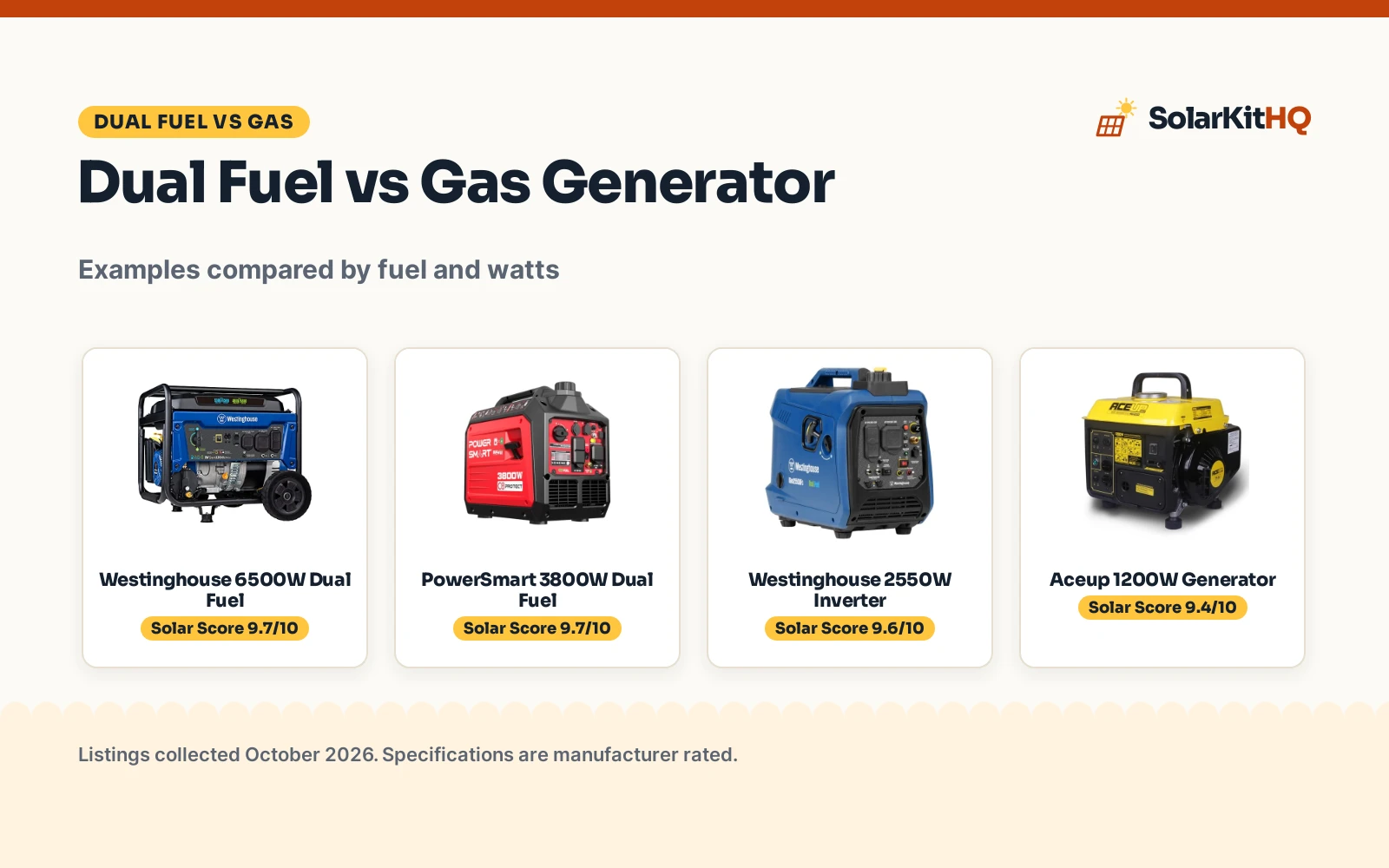
| Dual fuel vs gas generator | Westinghouse 6500W Dual Fuel | PowerSmart 3800W Dual Fuel | Westinghouse 2550W Inverter | Aceup 1200W Generator | Amazon |
|---|---|---|---|---|---|
| Side | Dual fuel | Dual fuel | Gas, listing states gas or propane | Gas | |
| Starting or peak watts | 6500 gasoline, 5800 propane | 3800 gasoline, 3500 propane | 2550 | 1200 | |
| Running or rated watts | 5300 gasoline, 4800 propane | 3300 gasoline, 3100 propane | 1900 | 900 | |
| Run time | Up to 14.5 hours | 8 hours gasoline, up to 24 hours propane | Up to 11 hours | 6 hours at half load | |
| Noise | Not stated | 59 dBA | 52 dBA | Not stated | |
| Weight | 135.6 pounds | 50.7 pounds | 42 pounds | 35.3 pounds | |
| Warranty | 3 years | 2 years | 1 year | 3 years |
Specifications are manufacturer rated as listed, collected 3 November 2026.
Fuel choice and watts
Fuel choice is the whole difference, and watts show what each choice gives up. The Westinghouse 6500 lists 5300 running watts and 6500 peak watts on gasoline. The Westinghouse 6500 lists 4800 running watts and 5800 peak watts on propane. The PowerSmart lists 3800 starting watts and 3300 running watts on gasoline. The PowerSmart lists 3500 starting watts and 3100 running watts on propane. The Westinghouse 2550 lists 2550 peak watts and 1900 rated watts. The Aceup lists 1200 peak watts and 900 running watts. The dual fuel examples list higher peak watts than the gas examples in this group, and the gas examples list lower weights than the dual fuel examples in this group. For the difference between starting and running watts, see continuous vs surge watts.
Run time and tanks
Run time only means something beside the tank behind it, and the fuel behind it. The Westinghouse 6500 lists a 4.7-gallon fuel tank with a fuel gauge. The Westinghouse 6500 lists up to 14.5 hours of run time without naming the fuel behind that figure. The PowerSmart lists 8 hours at 25% load on a 1.3-gallon gas tank. The PowerSmart lists up to 24 hours on a standard 20-lb propane tank. The Westinghouse 2550 lists up to 11 hours of run time on a 1.16-gallon gas tank at 25% load. The Aceup lists 6 hours of operation at half load on a 1.1-gallon fuel tank.
Noise and weight
Noise and weight decide where a unit can run and who can move it. The Westinghouse 2550 lists as low as 52 dBA noise. The PowerSmart lists 59 dBA at 25% load in Eco Mode. The Westinghouse 6500 lists no noise figure in dBA. The Aceup lists no noise figure in dBA. The Westinghouse 6500 lists 135.6 pounds. The PowerSmart lists 50.7 pounds. The Westinghouse 2550 lists 42 pounds in its bullets. The Aceup lists 35.3 pounds in its bullets.
What the listings leave unclear
Some figures need a careful read before they can be compared. The Aceup bullets state 35.3 pounds while the Aceup spec table states 35.5 pounds, so this article uses the bullets figure. The Westinghouse 2550 bullets state 42 pounds while the Westinghouse 2550 spec table states 43.2 pounds, so this article uses the bullets figure. The Westinghouse 2550 title and bullets state gas or propane power, so its fuel line stays unclear beside the gas examples. The Westinghouse 6500 lists up to 14.5 hours of run time without naming the fuel behind that figure. The Aceup spec table prints dimensions to many decimal places, so this article states no dimensions for that example. The Westinghouse 6500 bullets print a household duplex figure that reads as a typo, so this article does not state its amperage.
The examples
| # | Product | Solar Score | Buy |
|---|---|---|---|
| 1 |  Westinghouse 6500W Dual Fuel | 9.7/10 | Buy on Amazon |
| 2 |  PowerSmart 3800W Dual Fuel | 9.7/10 | Buy on Amazon |
| 3 |  Westinghouse 2550W Inverter | 9.6/10 | Buy on Amazon |
| 4 |  Aceup 1200W Generator | 9.4/10 | Buy on Amazon |

Westinghouse 6500W Dual Fuel
6500 peak watts on gasoline and 5800 peak watts on propane with a 4.7-gallon fuel tank and a 3-year limited warranty.
Pros
- 6500 peak watts on gasoline and 5800 peak watts on propane
- 5300 running watts on gasoline and 4800 running watts on propane
- 4.7-gallon fuel tank with a fuel gauge
- Automatic low-oil and carbon monoxide shutdown stated
Cons
- 135.6 pounds stated
- Run time fuel is not named for the 14.5-hour figure
- No noise figure in dBA is stated
- No propane tank size is stated
Detailed Review
The title states 6500 watts, dual fuel home backup, a transfer-switch-ready 30A outlet, an RV-ready 30A outlet and a CO sensor. The bullets add 5300 running watts and 6500 peak watts on gasoline, 4800 running watts and 5800 peak watts on propane, a 4.7-gallon fuel tank with a fuel gauge, up to 14.5 hours of run time, a 274cc engine with a cast iron sleeve, automatic low-oil and carbon monoxide shutdown, a wheel kit and a propane hose. The spec table gives 135.6 pounds and 21.0 by 18.0 by 19.09 inches, and lists a 3-year limited warranty that matches the bullets. The bullets do not name the fuel behind the 14.5-hour run time figure.
Who it's for: homeowners who want dual fuel backup with high running watts on gasoline and propane. Who should skip it: buyers who want a stated noise figure or a lighter unit.
Its Solar Score of 9.7/10 comes from performance 32/35, build 21/25, value 21/25, safety 8/10 and warranty 4/5: 86 of 100 points, placed on our 9.2 to 9.8 scale.
Key Specifications
| Gasoline watts | 5300 running, 6500 peak |
|---|---|
| Propane watts | 4800 running, 5800 peak |
| Tank | 4.7 gallons |
| Weight | 135.6 pounds |
Figures as published on the retailer listing, collected 3 November 2026. Performance figures are manufacturer rated.
Safety and Warranty
What this listing states. Automatic low-oil and carbon monoxide shutdown stated, so safety scores 8 of 10. 3-year limited warranty stated. It does not say everything a buyer needs, such as who pays return shipping, so warranty scores 4 of 5. See How We Pick.
Inverter limits. Stay within the stated continuous watts (surge watts last only a moment), use the cable size and fuse the manual gives, ventilate it, and never connect an inverter to home wiring yourself; that is work for a licensed electrician.
This is general buying information, not professional advice. Follow each product manual and local rules, and see our Safety Disclaimer.
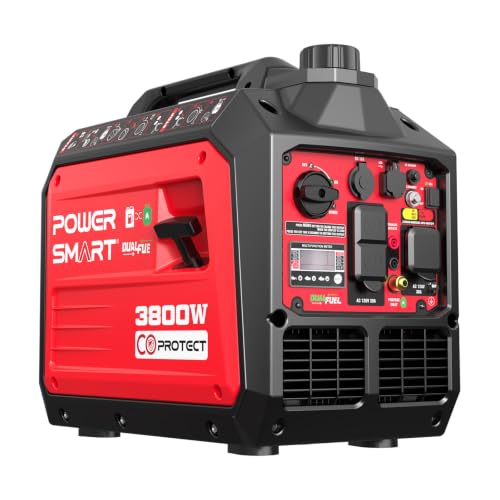
PowerSmart 3800W Dual Fuel
3800 starting watts on gasoline and 3500 starting watts on propane with clean power under 3% THD and a 2-year limited warranty.
Pros
- 3800 starting watts on gasoline and 3500 starting watts on propane
- Up to 24 hours on a standard 20-lb propane tank
- 59 dBA at 25% load in Eco Mode
- Overload, short circuit, CO sensor and low-oil shutdown stated
Cons
- 50.7 pounds stated
- 8 hours at 25% load on gasoline, shorter than the propane figure
- 1.3-gallon gas tank stated
- No TT-30R RV outlet is stated
Detailed Review
The title states 3800 watts, dual fuel use, 8 hours run time, 59 dBA, CO Protect, clean power under 3% THD and parallel readiness. The bullets add 3800 starting watts and 3300 running watts on gasoline, 3500 starting watts and 3100 running watts on propane, 59 dBA at 25% load in Eco Mode, 8 hours at 25% load on a 1.3-gallon gas tank, up to 24 hours on a standard 20-lb propane tank, overload, short circuit, carbon monoxide sensor and low-oil shutdown protection, and certification to ANSI/PGMA G300, ANSI/UL2201 and EPA standards. The bullets also list a 120V 30A twist-lock outlet, a 120V 20A duplex outlet, a 12V 8A DC port and dual 5V 2.1A USB ports. The spec table gives 50.7 pounds and 21.9 by 13.4 by 19.5 inches, and lists a 2-year warranty that matches the bullets.
Who it's for: campers and homeowners who want propane run time beside gasoline power. Who should skip it: buyers who want a TT-30R RV outlet or higher running watts.
Its Solar Score of 9.7/10 comes from performance 29/35, build 21/25, value 21/25, safety 9/10 and warranty 3/5: 83 of 100 points, placed on our 9.2 to 9.8 scale.
Key Specifications
| Gasoline watts | 3300 running, 3800 starting |
|---|---|
| Propane watts | 3100 running, 3500 starting |
| Run time | 8 hours gasoline, up to 24 hours propane |
| Weight | 50.7 pounds |
Figures as published on the retailer listing, collected 3 November 2026. Performance figures are manufacturer rated.
Safety and Warranty
What this listing states. Overload, short circuit, CO sensor and low-oil shutdown stated, certified to ANSI/PGMA G300 and ANSI/UL2201, so safety scores 9 of 10. 2-year limited warranty stated. It does not say everything a buyer needs, such as who pays return shipping, so warranty scores 3 of 5. See How We Pick.
Inverter limits. Stay within the stated continuous watts (surge watts last only a moment), use the cable size and fuse the manual gives, ventilate it, and never connect an inverter to home wiring yourself; that is work for a licensed electrician.
This is general buying information, not professional advice. Follow each product manual and local rules, and see our Safety Disclaimer.

Westinghouse 2550W Inverter
2550 peak watts and 1900 rated watts with an RV-ready outlet, a CO sensor and a 3-year limited warranty.
Pros
- 2550 peak watts and 1900 rated watts at less than 3% THD
- As low as 52 dBA noise
- Up to 11 hours of run time on a 1.16-gallon gas tank
- TT-30R RV-ready outlet plus two 120V 20A outlets
Cons
- Title and bullets state gas or propane power
- Weight differs between bullets and spec table
- 1.16-gallon gas tank stated
- No propane tank size is stated
Detailed Review
The title states 2550 peak watts, an RV-ready 30A outlet, gas and propane power, a CO sensor, parallel capability and long run time. The bullets add 2550 peak watts and 1900 rated watts at less than 3% THD, 42 pounds, one RV-ready TT-30R outlet, two 120V 20A outlets, two USB outlets, as low as 52 dBA noise, up to 11 hours of run time on a 1.16-gallon gas tank at 25% load and Economy Mode. The spec table gives 43.2 pounds and 18.5 by 11.0 by 18.0 inches, and lists a 3-year limited warranty that matches the bullets. The bullets state 42 pounds while the spec table states 43.2 pounds, so this article uses the bullets figure. The gas-or-propane wording also leaves the fuel line unclear.
Who it's for: campers and homeowners who want a light unit with an RV-ready outlet and low stated noise. Who should skip it: buyers who want higher rated watts or a listing without propane wording.
Its Solar Score of 9.6/10 comes from performance 26/35, build 21/25, value 21/25, safety 7/10 and warranty 4/5: 79 of 100 points, placed on our 9.2 to 9.8 scale.
Key Specifications
| Peak watts | 2550 |
|---|---|
| Rated watts | 1900 |
| Run time | Up to 11 hours |
| Weight | 42 pounds |
Figures as published on the retailer listing, collected 3 November 2026. Performance figures are manufacturer rated.
Safety and Warranty
What this listing states. CO sensor stated, so safety scores 7 of 10. 3-year limited warranty stated. It does not say everything a buyer needs, such as who pays return shipping, so warranty scores 4 of 5. See How We Pick.
Inverter limits. Stay within the stated continuous watts (surge watts last only a moment), use the cable size and fuse the manual gives, ventilate it, and never connect an inverter to home wiring yourself; that is work for a licensed electrician.
This is general buying information, not professional advice. Follow each product manual and local rules, and see our Safety Disclaimer.
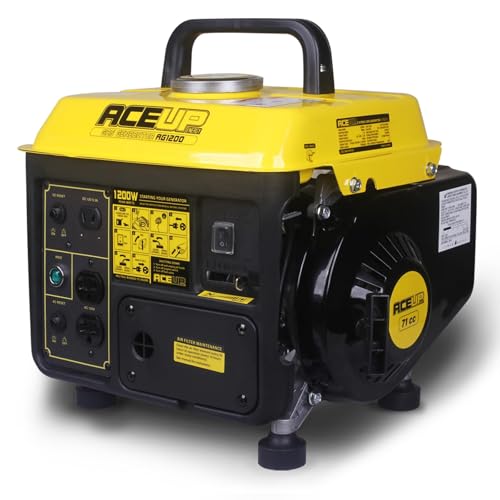
Aceup 1200W Generator
1200 peak watts and 900 running watts with a 1.1-gallon fuel tank and a 1-year limited warranty.
Pros
- 1200 peak watts and 900 running watts
- 35.3 pounds for transport
- 1.1-gallon fuel tank with 6 hours at half load
- AC and DC overload protection stated
Cons
- Weight differs between bullets and spec table
- 900 running watts, the lowest in this group
- 1-year limited warranty stated
- 50:1 gasoline-to-oil mix stated
Detailed Review
The title states 1200 watts, gas power, small portable use and EPA and CARB compliance. The bullets add 1200 peak watts and 900 running watts, 60Hz, a 120V household outlet, an American-style duplex socket, AC overload protection, a 12V DC power supply, DC overload protection, an indicator light, a 71cc single cylinder 2-cycle engine with air cooling and recoil start, a 50:1 gasoline-to-oil mix, a 1.1-gallon fuel tank and 6 hours of operation at half load. The bullets state 35.3 pounds while the spec table states 35.5 pounds, so this article uses the bullets figure. The spec table prints dimensions to many decimal places, so this article states no dimensions for this example.
Who it's for: buyers who want a small, light gas unit for small loads. Who should skip it: buyers who want higher watts, an RV-ready outlet or a longer warranty term.
Its Solar Score of 9.4/10 comes from performance 23/35, build 19/25, value 20/25, safety 4/10 and warranty 2/5: 68 of 100 points, placed on our 9.2 to 9.8 scale.
Key Specifications
| Peak watts | 1200 |
|---|---|
| Running watts | 900 |
| Tank | 1.1 gallons |
| Weight | 35.3 pounds |
Figures as published on the retailer listing, collected 3 November 2026. Performance figures are manufacturer rated.
Safety and Warranty
What this listing states. AC and DC overload protection stated, so safety scores 4 of 10. 1-year limited warranty stated. It does not say everything a buyer needs, such as who pays return shipping, so warranty scores 2 of 5. See How We Pick.
Inverter limits. Stay within the stated continuous watts (surge watts last only a moment), use the cable size and fuse the manual gives, ventilate it, and never connect an inverter to home wiring yourself; that is work for a licensed electrician.
This is general buying information, not professional advice. Follow each product manual and local rules, and see our Safety Disclaimer.
As an Amazon Associate I earn from qualifying purchases.
Where the points went
The Solar Score weighs performance, build, value, safety and warranty. For generators, safety means carbon monoxide shutdown, low-oil shutdown, overload and short circuit protection, or a certification the listing names; the PowerSmart states the fullest set here, and the Aceup states overload protection only. All examples here state a warranty term, from 1 year to 3 years. How we pick explains the weights.
| Product | Solar Score | Perf. /35 | Build /25 | Value /25 | Safety /10 | Warranty /5 |
|---|---|---|---|---|---|---|
| Westinghouse 6500W Dual Fuel | 9.7 | 32 | 21 | 21 | 8 | 4 |
| PowerSmart 3800W Dual Fuel | 9.7 | 29 | 21 | 21 | 9 | 3 |
| Westinghouse 2550W Inverter | 9.6 | 26 | 21 | 21 | 7 | 4 |
| Aceup 1200W Generator | 9.4 | 23 | 19 | 20 | 4 | 2 |
Scores run from 9.2 to 9.8: each product’s point total is placed on that range, so more points always means a higher score.
Dual fuel vs gas generator: which should you choose?
Choose dual fuel if you want propane beside gasoline. Choose a gas example if you want a lighter unit for small loads, and check the Westinghouse 2550 listing closely, since it states propane power too. For a cabin view of the same choice, see inverter vs generator for cabin.
| If you need | Look at |
|---|---|
| Fuel choice on one unit | Westinghouse 6500W Dual Fuel |
| Lowest stated noise | Westinghouse 2550W Inverter, 52 dBA |
| Longest propane run time stated | PowerSmart 3800W Dual Fuel, up to 24 hours on propane |
| Lowest stated weight | Aceup 1200W Generator, 35.3 pounds |
Sizing Notes
- Match running watts to the loads you plan: the examples here list 900 running watts to 5300 running watts.
- Match the fuel to the tank you have: the PowerSmart lists 8 hours at 25% load on a 1.3-gallon gas tank and up to 24 hours on a 20-lb propane tank.
- Check outlets before you buy: the Westinghouse 6500 lists an RV-ready TT-30R 30A receptacle.
- Check weight for transport: the Aceup example lists 35.3 pounds.
- A licensed electrician should handle any home connection for the transfer-switch-ready outlet.
FAQ: power away from the grid
Which example lists the highest running watts here?
The Westinghouse 6500 lists 5300 running watts on gasoline and 4800 running watts on propane.
Can the gas-tagged Westinghouse 2550 run on propane?
Yes, its title and bullets state gas or propane power.
Which example lists the longest run time?
The PowerSmart lists up to 24 hours on a standard 20-lb propane tank.
Which example lists the lowest stated noise?
The Westinghouse 2550 lists as low as 52 dBA noise.
Do all examples here state a warranty term?
Yes. The Westinghouse 6500 and the Westinghouse 2550 both list a 3-year limited warranty. The PowerSmart lists a 2-year limited warranty. The Aceup lists a 1-year limited warranty.
Related solar guides
See every Inverter and Dual Fuel Generators guide and all Power Stations and Generators guides.
More picks: inverter vs generator for food truck, portable power station vs gas generator for tailgating, solar generator vs gas generator home backup.