On this page
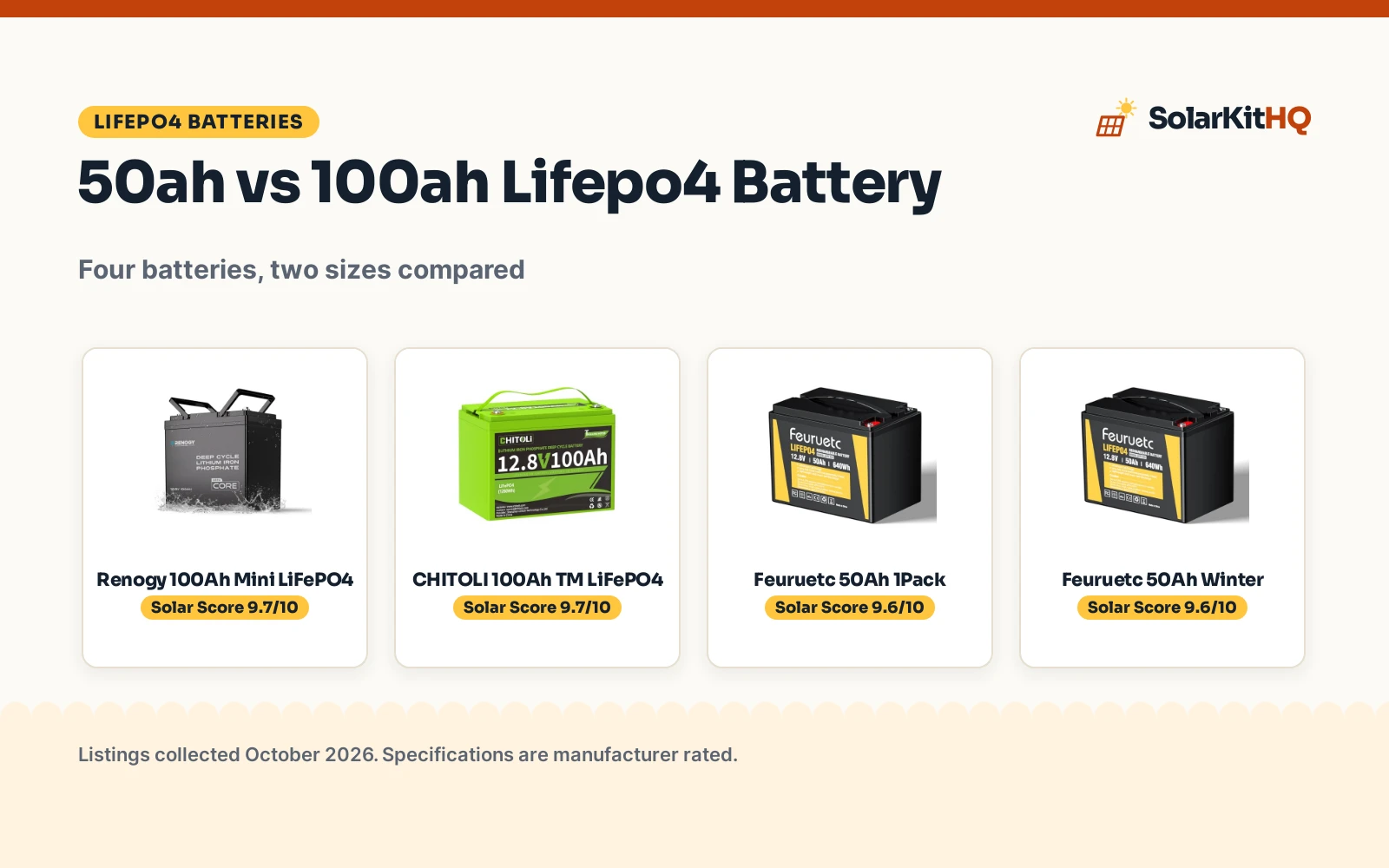
A battery bank that runs out before the night does is the problem here, and the choice usually comes down to a smaller bank that is easy to carry or a larger bank that holds more charge. The short verdict on 50ah vs 100ah lifepo4 battery use: pick the smaller size when weight and space matter most, and pick the larger size when the load runs longer between charges and the tray has room for it. The gap is not only about capacity: BMS amps, stated weight, cycle figures and warranty terms all differ.
SolarKitHQ earns a commission when you buy through links on this page, at no extra cost to you. As an Amazon Associate I earn from qualifying purchases. Affiliate disclosure.
50ah vs 100ah lifepo4 battery: side by side
| 50Ah vs 100Ah | Renogy 100Ah Mini LiFePO4 | CHITOLI 100Ah TM LiFePO4 | Feuruetc 50Ah 1Pack | Feuruetc 50Ah Winter | Amazon |
|---|---|---|---|---|---|
| Side | 100Ah | 100Ah | 50Ah | 50Ah | |
| BMS | 100A | 100A | 50A | 50A | |
| Weight | Not stated | 22.57 lb | 10.58 lb | 10.58 lb | |
| Cycles at 100% DOD | Not stated | 4000+ | 4000 | 4000 | |
| Warranty | 5 Years | 5-year | 5-year, spec table 1 year | 5-year, spec table 1 year | |
| Size | Group 22NF | Group 24 | Not stated | Not stated |
Specifications are manufacturer rated as listed, collected 30 October 2026.
Capacity and weight
Capacity is the headline difference, and weight is the clearest stated gap. The Feuruetc 50Ah examples each state 10.58 lb per module, while the CHITOLI 100Ah example states 22.57 lb. The Renogy 100Ah example states no weight, so the CHITOLI example carries that side alone. Size is stated for the larger examples only: the CHITOLI example is a Group 24 case at 10.23 by 6.61 by 8.3 inches, and the Renogy example is a Group 22NF mini case at 9.02 by 5.43 by 8.39 inches. Neither Feuruetc listing states case dimensions, so tray fit for the smaller examples is unstated.
Protection and monitoring
Every example states a built-in BMS: 50A on both Feuruetc examples and 100A on both larger examples. The Renogy example lists the fullest protection set, with a 100A BMS covering low temperature charging, high temperature, overvoltage, undervoltage, overcurrent and short circuits, plus UL-listed cells and an IP65 casing. The CHITOLI example states a smart BMS that guards against over-charging, over-discharging, over-current and short circuits, with safe use in low temperature stated. The Feuruetc examples state automatic overload detection, protection and recovery, plus protection against voltage spikes and surges. On monitoring, only the Renogy example names an option, sold separately: a Renogy 300A Battery Shunt for app or monitor readings.
Cycles and lifetime
Three listings share the same DOD breakdown. The CHITOLI example and both Feuruetc examples state 4000 cycles at 100% DOD, 6000 at 80% DOD and 15000 at 60% DOD, with a 10-year lifetime or lifespan stated. The Renogy example states no cycle or lifetime figure. The Feuruetc titles also claim 5000+ deep cycles, which sits apart from the DOD breakdown in their bullets, so the DOD figures are the ones to compare on.
What the listings leave unclear
Three gaps deserve a careful read. The Feuruetc bullets state a 5-year warranty, but both Feuruetc spec tables say 1 year, so trust the bullets. The Renogy example states no weight and no cycle figure, which leaves weight and cycles blank for the mini battery. The CHITOLI example carries a use limit the other listings do not state: it is suitable for energy storage rather than start-up, so it is not the pick for cranking duty. The Renogy example mounts in any orientation, but tipping it upside down is not recommended.
Four examples
| # | Product | Solar Score | Buy |
|---|---|---|---|
| 1 |  Renogy 100Ah Mini LiFePO4 | 9.7/10 | Buy on Amazon |
| 2 |  CHITOLI 100Ah TM LiFePO4 | 9.7/10 | Buy on Amazon |
| 3 |  Feuruetc 50Ah 1Pack | 9.6/10 | Buy on Amazon |
| 4 | Feuruetc 50Ah Winter | 9.6/10 | Buy on Amazon |
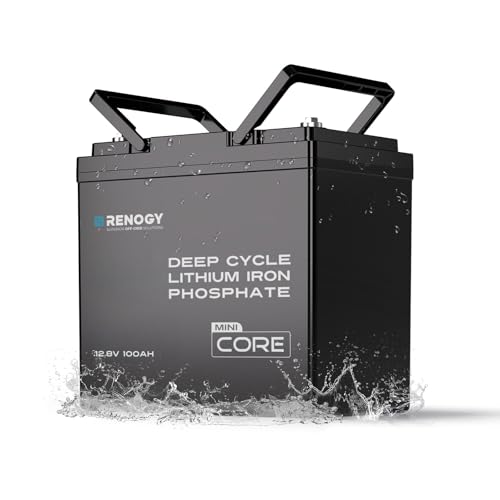
Renogy 100Ah Mini LiFePO4
A mini 100Ah LiFePO4 battery in a Group 22NF case with a 100A BMS, UL-listed cells and an IP65 casing stated.
Pros
- UL-listed, EV-grade prismatic cells stated
- 100A BMS with low temperature charging, high temperature, overvoltage, undervoltage, overcurrent and short circuit protection
- IP65 casing stated for splashes and dust
- Mini Group 22NF case at 9.02 by 5.43 by 8.39 inches, mountable in any orientation
Cons
- No weight figure is stated
- No cycle figure or lifetime figure is stated
- Remote monitoring needs a Renogy 300A Battery Shunt sold separately
- Upside-down mounting is not recommended despite the any-orientation claim
Detailed Review
The listing states a mini 100Ah LiFePO4 battery in a Group 22NF case at 9.02 by 5.43 by 8.39 inches, up to 50% smaller than a Group 31 battery and 13% smaller than other 12.8V 100Ah mini batteries. It states a 100A BMS with protection against low temperature charging, high temperature, overvoltage, undervoltage, overcurrent and short circuits, UL-listed EV-grade prismatic cells, and an IP65 casing for splashes and dust. Any-orientation mounting is stated, but not upside down, and remote monitoring needs a Renogy 300A Battery Shunt sold separately. No weight figure and no cycle figure are stated, and a 5 Years material and workmanship warranty is stated.
Who it's for: RV, boat, cabin and off-grid owners with a tight space who want a mini 100Ah battery with a full protection list. Who should skip it: buyers who want a stated weight or cycle figure before choosing.
Its Solar Score of 9.7/10 comes from performance 32/35, build 22/25, value 20/25, safety 9/10 and warranty 3/5: 86 of 100 points, placed on our 9.2 to 9.8 scale.
Key Specifications
| Capacity | 100Ah |
|---|---|
| Voltage | 12V |
| BMS | 100A |
| Size | 9.02 x 5.43 x 8.39 in, Group 22NF |
Figures as published on the retailer listing, collected 30 October 2026. Performance figures are manufacturer rated.
Safety and Warranty
What this listing states. UL-listed cells, 100A BMS protections and IP65 casing stated, so safety scores 9 of 10. Material and Workmanship Warranty: 5 Years. It does not say everything a buyer needs, such as who pays return shipping, so warranty scores 3 of 5. See How We Pick.
Battery safety. Charge with a charger and settings that match the stated chemistry, fuse the positive lead as the manual directs, cover terminals, keep within the stated temperature range, and never charge a damaged battery.
This is general buying information, not professional advice. Follow each product manual and local rules, and see our Safety Disclaimer.

CHITOLI 100Ah TM LiFePO4
A 100Ah LiFePO4 battery in a Group 24 case with a 100A smart BMS, DOD cycle figures and a 5-year warranty stated.
Pros
- 100A smart BMS guarding against over-charging, over-discharging, over-current and short circuits, with low temperature use stated
- Group 24 case compatible with a Group 24 battery box, at 10.23 by 6.61 by 8.3 inches
- 4000 cycles at 100% DOD, 6000 at 80% DOD and 15000 at 60% DOD, with a 10-year lifespan stated
- 5-year warranty stated, with a 14.6V charging voltage and 20A charging current taking about 5hrs for a full charge
Cons
- Suitable for energy storage rather than start-up, so it is not for cranking duty
- No IP code is stated
- No monitoring option is stated
- Energy density gain is given as a 3-5 times range rather than a precise figure
Detailed Review
The listing states a 12V 100Ah Group 24 LiFePO4 battery at 22.57 lb, built from automotive grade cells, with a built-in smart BMS, a 10-year lifespan and a 5-year warranty. Cycle figures are given by depth of discharge: 4000+ cycles at 100% DOD, 6000 cycles at 80% DOD and 15000 cycles at 60% DOD. Charging is stated at 14.6V and 20A, taking about 5hrs for a full charge. The listing states the battery is suitable for energy storage rather than start-up, and that it is 35% smaller and 60% lighter than ordinary lead-acid batteries. No IP code or monitoring option is stated.
Who it's for: RV, marine, camping and home energy storage owners with a Group 24 tray who want a 100Ah battery with a full cycle breakdown. Who should skip it: buyers who need start-up duty or a stated IP code.
Its Solar Score of 9.7/10 comes from performance 30/35, build 21/25, value 21/25, safety 8/10 and warranty 3/5: 83 of 100 points, placed on our 9.2 to 9.8 scale.
Key Specifications
| Capacity | 100Ah |
|---|---|
| Voltage | 12V |
| BMS | 100A |
| Size | 10.23 x 6.61 x 8.3 in, Group 24 |
Figures as published on the retailer listing, collected 30 October 2026. Performance figures are manufacturer rated.
Safety and Warranty
What this listing states. 100A smart BMS with over-charging, over-discharging, over-current and short circuit protection stated, so safety scores 8 of 10. 5-year warranty stated. It does not say everything a buyer needs, such as who pays return shipping, so warranty scores 3 of 5. See How We Pick.
Battery safety. Charge with a charger and settings that match the stated chemistry, fuse the positive lead as the manual directs, cover terminals, keep within the stated temperature range, and never charge a damaged battery.
This is general buying information, not professional advice. Follow each product manual and local rules, and see our Safety Disclaimer.

Feuruetc 50Ah 1Pack
A 50Ah LiFePO4 battery with a 50A BMS, Grade A+ cells and a 10.58 lb module weight stated.
Pros
- Grade A+ LiFePO4 cells with a UL certificate for the cell inside stated
- 50A BMS with automatic overload detection, protection and recovery, plus protection against voltage spikes and surges
- 10.58 lb for one module, stated as 50% lighter than a lead acid battery with the same capacity
- 4000 cycles at 100% DOD, 6000 at 80% DOD and 15000 at 60% DOD, with a 10-year lifetime stated
Cons
- Bullets state a 5-year warranty while the spec table says 1 YEAR, so the warranty term needs a careful read
- Title claims 5000+ deep cycles while the bullets give a DOD breakdown, so the headline figure is not the one to compare on
- No case dimensions are stated, so tray fit cannot be checked from the listing
- No monitoring option is stated
Detailed Review
The listing states a 12V 50Ah LiFePO4 battery built from Grade A+ cells, with a built-in 50A BMS, a UL certificate for the cell inside, and a module weight of 10.58 lb. Cycle figures are given by depth of discharge: 4000 cycles at 100% DOD, 6000 at 80% DOD and 15000 at 60% DOD, with a 10-year lifetime stated, while the title claims 5000+ deep cycles. The bullets state a 5-year warranty, but the spec table says 1 YEAR, so trust the bullets for the warranty term. Uses stated include RV, camping, home storage and trolling motor use.
Who it's for: owners who want a lighter 50Ah module for an RV, camper, boat or solar setup with a 50A BMS. Who should skip it: buyers who want stated case dimensions or a warranty term that matches across the whole listing.
Its Solar Score of 9.6/10 comes from performance 28/35, build 20/25, value 21/25, safety 8/10 and warranty 3/5: 80 of 100 points, placed on our 9.2 to 9.8 scale.
Key Specifications
| Capacity | 50Ah |
|---|---|
| Voltage | 12V |
| BMS | 50A |
| Weight | 10.58 lb |
Figures as published on the retailer listing, collected 30 October 2026. Performance figures are manufacturer rated.
Safety and Warranty
What this listing states. UL certificate for the cell and 50A BMS with overload detection, protection and recovery stated, so safety scores 8 of 10. 5-year warranty stated. It does not say everything a buyer needs, such as who pays return shipping, so warranty scores 3 of 5. See How We Pick.
Battery safety. Charge with a charger and settings that match the stated chemistry, fuse the positive lead as the manual directs, cover terminals, keep within the stated temperature range, and never charge a damaged battery.
This is general buying information, not professional advice. Follow each product manual and local rules, and see our Safety Disclaimer.
Feuruetc 50Ah Winter
A 50Ah LiFePO4 battery with a 50A BMS, Grade A+ cells and a 10.58 lb module weight stated, listed for winter power shortage use.
Pros
- Grade A+ LiFePO4 cells with a UL certificate for the cell inside stated
- 50A BMS with automatic overload detection, protection and recovery, plus protection against voltage spikes and surges
- 10.58 lb for one module, stated as 50% lighter than a lead acid battery with the same capacity
- 4000 cycles at 100% DOD, 6000 at 80% DOD and 15000 at 60% DOD, with a 10-year lifetime stated
Cons
- Bullets state a 5-year warranty while the spec table says 1 year, so the warranty term needs a careful read
- Title claims 5000+ deep cycles while the bullets give a DOD breakdown, so the headline figure is not the one to compare on
- No case dimensions are stated, so tray fit cannot be checked from the listing
- No monitoring option is stated
Detailed Review
The listing states a 12V 50Ah LiFePO4 battery built from Grade A+ cells, with a built-in 50A BMS, a UL certificate for the cell inside, and a module weight of 10.58 lb. Cycle figures are given by depth of discharge: 4000 cycles at 100% DOD, 6000 at 80% DOD and 15000 at 60% DOD, with a 10-year lifetime stated, while the title claims 5000+ deep cycles. The bullets state a 5-year warranty, but the spec table says 1 year, so trust the bullets for the warranty term. Uses stated include winter power shortage, RV, marine and camping use.
Who it's for: owners who want a lighter 50Ah module for winter power shortage, RV, marine or off-grid use with a 50A BMS. Who should skip it: buyers who want stated case dimensions or a warranty term that matches across the whole listing.
Its Solar Score of 9.6/10 comes from performance 28/35, build 20/25, value 21/25, safety 8/10 and warranty 3/5: 80 of 100 points, placed on our 9.2 to 9.8 scale.
Key Specifications
| Capacity | 50Ah |
|---|---|
| Voltage | 12V |
| BMS | 50A |
| Weight | 10.58 lb |
Figures as published on the retailer listing, collected 30 October 2026. Performance figures are manufacturer rated.
Safety and Warranty
What this listing states. UL certificate for the cell and 50A BMS with overload detection, protection and recovery stated, so safety scores 8 of 10. 5-year warranty stated. It does not say everything a buyer needs, such as who pays return shipping, so warranty scores 3 of 5. See How We Pick.
Battery safety. Charge with a charger and settings that match the stated chemistry, fuse the positive lead as the manual directs, cover terminals, keep within the stated temperature range, and never charge a damaged battery.
This is general buying information, not professional advice. Follow each product manual and local rules, and see our Safety Disclaimer.
As an Amazon Associate I earn from qualifying purchases.
How we scored them
The Solar Score weighs performance, build, value, safety and warranty. For a LiFePO4 battery, safety means a stated BMS, stated protections and any stated UL or IP code. All four examples state a warranty term, and all four state a BMS, so the safety and warranty lines separate them less than the missing weight and cycle figures do. How we pick explains the weights.
| Product | Solar Score | Perf. /35 | Build /25 | Value /25 | Safety /10 | Warranty /5 |
|---|---|---|---|---|---|---|
| Renogy 100Ah Mini LiFePO4 | 9.7 | 32 | 22 | 20 | 9 | 3 |
| CHITOLI 100Ah TM LiFePO4 | 9.7 | 30 | 21 | 21 | 8 | 3 |
| Feuruetc 50Ah 1Pack | 9.6 | 28 | 20 | 21 | 8 | 3 |
| Feuruetc 50Ah Winter | 9.6 | 28 | 20 | 21 | 8 | 3 |
Scores run from 9.2 to 9.8: each product’s point total is placed on that range, so more points always means a higher score.
50ah vs 100ah lifepo4 battery: which should you choose?
Choose the 50Ah size if weight matters most and the load is modest: the Feuruetc examples state 10.58 lb per module with a 50A BMS, for an RV, camper, trolling motor or off-grid setup. Choose the 100Ah size if the load runs longer between charges: the CHITOLI example suits a Group 24 tray with a 100A BMS and a full DOD cycle breakdown, while the Renogy example suits a tight space with its Group 22NF mini case and IP65 casing. Skip the CHITOLI example for start-up duty, and skip the Renogy example if a stated weight or cycle figure matters, since it states neither.
| If you need | Look at |
|---|---|
| Lowest stated weight | Feuruetc 50Ah examples, 10.58 lb per module |
| Group 24 tray fit | CHITOLI 100Ah TM LiFePO4, Group 24 case |
| Mini case for a tight space | Renogy 100Ah Mini LiFePO4, Group 22NF case |
| Full DOD cycle breakdown | CHITOLI or Feuruetc examples, 4000 cycles at 100% DOD |
Sizing Notes
- Match voltage to every charging source: all four state 12V, and CHITOLI states 14.6V at 20A.
- Keep the load under the BMS limit: 50A on Feuruetc and 100A on CHITOLI and Renogy.
- Check the tray: CHITOLI is Group 24 and Renogy is Group 22NF, while Feuruetc states no case dimensions.
- Respect the stated use limits: CHITOLI is for energy storage rather than start-up, and Renogy should not be tipped upside down.
Frequently Asked Questions
What separates the two sides most clearly?
The BMS amps and the stated weights: both 50Ah examples state a 50A BMS and 10.58 lb per module, while both 100Ah examples state a 100A BMS, and the CHITOLI 100Ah example states 22.57 lb.
Which example states the lowest weight?
The Feuruetc 50Ah examples, at 10.58 lb per module. CHITOLI states 22.57 lb, and Renogy states no weight.
Do all four examples state a warranty term?
Yes: Renogy states 5 Years material and workmanship, CHITOLI states 5-year, and the Feuruetc bullets state 5-year though their spec tables say 1 year.
Can the CHITOLI battery be used for start-up duty?
No. Its listing states that the battery is suitable for energy storage rather than start-up, so it is not the pick for cranking duty.
Related guides
See every Deep Cycle and RV Batteries guide and all Batteries and Charging guides. Also see our 150ah vs 200ah lifepo4 battery. Also see our 100ah vs 150ah lifepo4 battery. Also see our best lifepo4 battery for solar lights.