On this page
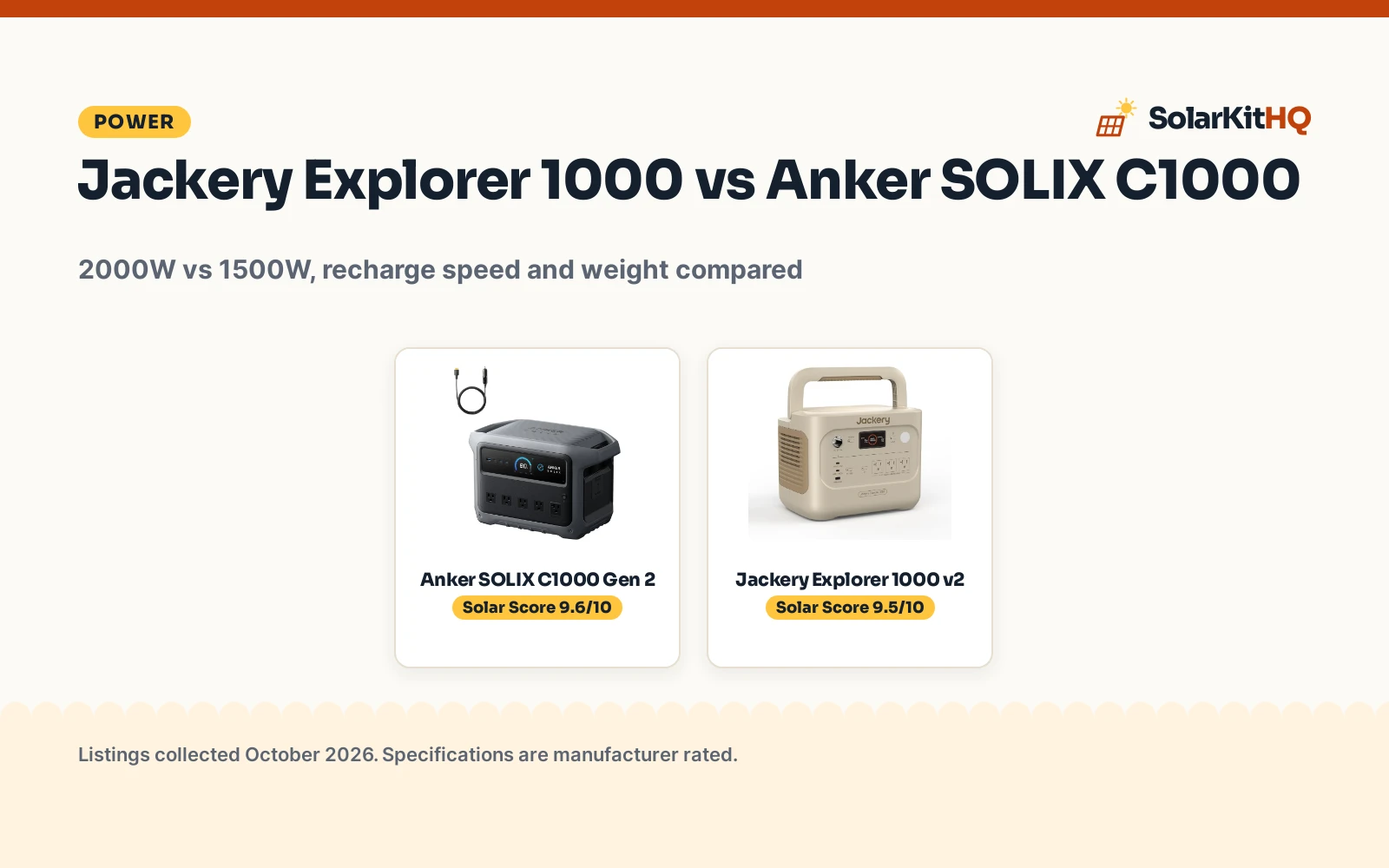
Jackery Explorer 1000 vs Anker SOLIX C1000 is a close fight between two 1kWh-class power stations. The verdict: pick the Anker SOLIX C1000 Gen 2 for higher output and faster recharging, or pick the Jackery Explorer 1000 v2 for a lighter carry and a proven simple setup. Both list 3000W surge peaks, LiFePO4 batteries and roughly 1kWh of capacity.
SolarKitHQ earns a commission when you buy through links on this page, at no extra cost to you. As an Amazon Associate I earn from qualifying purchases. Affiliate disclosure.
Jackery Explorer 1000 vs Anker SOLIX C1000: side by side
| Jackery Explorer 1000 vs Anker SOLIX C1000 | Jackery Explorer 1000 v2 | Anker SOLIX C1000 Gen 2 |
|---|---|---|
| Output | 1500W, 3000W surge | 2000W, 3000W peak |
| Capacity | 1070Wh | 1024Wh |
| Recharge | 1 hour, 0 to 100% | 49 min at 1600W |
| Weight | 23.8 lbs | Not stated |
| Battery life | LiFePO4 | 4000 cycles |
| Solar Score | Runner-up | Top pick |
Figures are as listed, collected 22 October 2026. A figure from one listing describes that listing only.
Output
The Anker SOLIX C1000 Gen 2 lists 2000W output with a 3000W peak across 10 ports. The Jackery Explorer 1000 v2 lists 1500W AC output with a 3000W surge peak. On the stated numbers, the Anker runs bigger loads: the Jackery lists fridges, AC units and electric pots, and the Anker lists emergency backup for up to 10 devices at once.
Capacity
The Jackery lists 1070Wh; the Anker lists 1024Wh. The two are close enough that capacity is not the deciding factor.
Recharging
The Jackery lists one hour fast charging from 0 to 100 percent with emergency charging activated. The Anker lists 49 minutes of ultrafast recharging at 1600W with HyperFlash technology, enabled in the Anker app. The Anker is the faster of the two on the stated figures.
Weight and size
The Jackery lists 23.8 lbs with a foldable handle. The Anker lists 14 percent smaller and 11 percent lighter than similar models, but no absolute weight figure. The Jackery is the one with a concrete weight you can plan around.
Battery life
The Anker lists 10 years of InfiniPower and 4000 cycles before the battery drops to a stated remaining capacity. The Jackery lists a LiFePO4 battery but no cycle count. The Anker is the clearer claim on lifespan.
What the listings leave unclear
The Anker does not state its absolute weight, only relative percentages. The Jackery does not state a cycle count. Neither listing states a warranty term in the text shown, so warranty is not scored.
Two examples

Anker SOLIX C1000 Gen 2
The Anker SOLIX C1000 Gen 2 portable power station, 1024Wh, 2000W output and 49-minute ultrafast recharging.
Pros
- 2000W, 3000W peak
- 49 min recharge
- 4000 cycles
- 10 ports
Cons
- No absolute weight stated
- Weight relative only
- App needed for HyperFlash
- No warranty stated
Detailed Review
The listing states a 1024Wh capacity with 2000W output, 3000W peak and 10 ports, 49 minutes of ultrafast recharging at 1600W with HyperFlash technology enabled in the Anker app, a compact body that is 14 percent smaller and 11 percent lighter than similar models, and 10 years of InfiniPower with 4000 cycles. It suits emergency backup for up to 10 devices.
Who it is for: maximum output and fastest recharge. Who should skip it: anyone wanting a stated absolute weight.
Its Solar Score of 9.6/10 comes from performance 33/35, build 22/25, value 21/25, safety 0/10 and warranty 0/5: 76 of 100 points, placed on our 9.2 to 9.8 scale.
Key Specifications
| Capacity | 1024Wh |
|---|---|
| Output | 2000W |
| Recharge | 49 min |
| Cycles | 4000 |
Figures as published on the retailer listing, collected 22 October 2026. Performance figures are manufacturer rated.
Safety and Warranty
What this listing states. No UL, FCC or battery management statement is stated, so safety scores zero. No warranty term, so warranty scores zero. See How We Pick.
Power station limits. Stay within the stated continuous output and solar input limits, keep the unit ventilated and dry, charge within the stated temperature range, and never connect it to home wiring except through equipment a licensed electrician installs.
This is general buying information, not professional advice. Follow each product manual and local rules, and see our Safety Disclaimer.

Jackery Explorer 1000 v2
The Jackery Explorer 1000 v2 portable power station, 1070Wh, 1500W output and one-hour fast charging.
Pros
- 1070Wh capacity
- 1500W, 3000W surge
- 1 hour fast charge
- 23.8 lb carry
Cons
- 1500W output cap
- No cycle count stated
- No warranty stated
- Heavier at 23.8 lbs
Detailed Review
The listing states a 1070Wh capacity with 1500W AC output and 3000W surge peak, one hour fast charging from 0 to 100 percent with emergency charging activated, a LiFePO4 battery, a 23.8 lb build with a foldable handle, and support for AC units, fridges and electric pots. It suits outdoor camping, road trips and emergencies.
Who it is for: a light, simple 1kWh carry. Who should skip it: anyone needing 2000W output.
Its Solar Score of 9.5/10 comes from performance 32/35, build 22/25, value 21/25, safety 0/10 and warranty 0/5: 75 of 100 points, placed on our 9.2 to 9.8 scale.
Key Specifications
| Capacity | 1070Wh |
|---|---|
| Output | 1500W |
| Recharge | 1 hour |
| Weight | 23.8 lbs |
Figures as published on the retailer listing, collected 22 October 2026. Performance figures are manufacturer rated.
Safety and Warranty
What this listing states. No UL, FCC or battery management statement is stated, so safety scores zero. No warranty term, so warranty scores zero. See How We Pick.
Power station limits. Stay within the stated continuous output and solar input limits, keep the unit ventilated and dry, charge within the stated temperature range, and never connect it to home wiring except through equipment a licensed electrician installs.
This is general buying information, not professional advice. Follow each product manual and local rules, and see our Safety Disclaimer.
As an Amazon Associate I earn from qualifying purchases.
How we scored them
The Solar Score weighs performance, build, value, safety and warranty. For these stations, performance means stated output and recharge speed; safety means the listed LiFePO4 battery chemistry. Neither listing states a warranty term, so that field is not scored.
| Product | Solar Score | Perf. /35 | Build /25 | Value /25 | Safety /10 | Warranty /5 |
|---|---|---|---|---|---|---|
| Anker SOLIX C1000 Gen 2 | 9.6 | 33 | 22 | 21 | 0 | 0 |
| Jackery Explorer 1000 v2 | 9.5 | 32 | 22 | 21 | 0 | 0 |
Scores run from 9.2 to 9.8: each product’s point total is placed on that range, so more points always means a higher score.
Jackery Explorer 1000 vs Anker SOLIX C1000: which should you choose?
Pick the Anker SOLIX C1000 Gen 2 if you want the most output and the fastest recharge: 2000W, 49 minutes and 4000 cycles. Pick the Jackery Explorer 1000 v2 if you want the lightest listed carry at 23.8 lbs and a one-hour full charge with a simple setup.
Sizing Notes
Size to the biggest load first: 2000W caps the Anker, 1500W caps the Jackery. Both list 3000W surge peaks for motor starts.
Frequently Asked Questions
Which has more output?
The Anker SOLIX C1000 Gen 2 lists 2000W with a 3000W peak; the Jackery Explorer 1000 v2 lists 1500W with a 3000W surge peak.
Which recharges faster?
The Anker lists 49 minutes at 1600W with HyperFlash; the Jackery lists one hour from 0 to 100 percent.
Which is lighter?
The Jackery lists 23.8 lbs. The Anker does not state an absolute weight.
Which has the longer battery life claim?
The Anker lists 4000 cycles and 10 years of InfiniPower. The Jackery lists a LiFePO4 battery with no cycle count.
Related guides
See every power stations guide.
More picks: portable power stations for road trips, portable power stations for travel.