On this page
Picture a campsite after dark: the lantern is fading, the phone is nearly dead, and the cooler full of food is warming by the hour. That is the moment power inverter vs power station stops being a search term and becomes a decision. The verdict is short: pick the power inverter side if you already own the battery, whether that is a tool battery or a 12V vehicle system, and just need AC output; pick the power station side if you want the battery included in one grab-and-go box. Below is what each of the three listings states, what they leave unclear, and how the scores were built. The three listings span 175W to 3000W of stated output, and the Milwaukee runs on M18 batteries many jobsites already own.
SolarKitHQ earns a commission when you buy through links on this page, at no extra cost to you. As an Amazon Associate I earn from qualifying purchases. Affiliate disclosure.
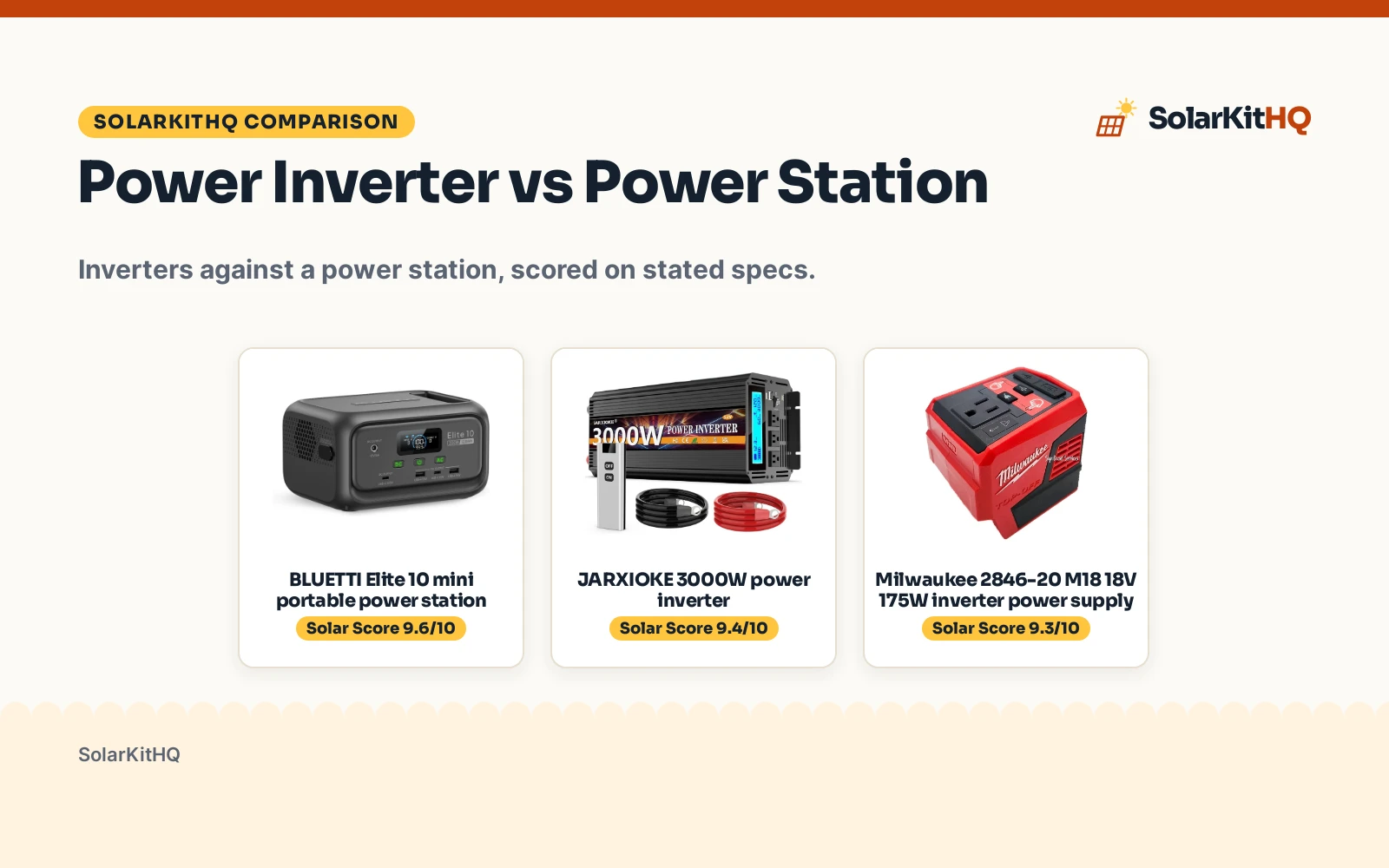
| # | Product | Solar Score | Buy |
|---|---|---|---|
| 1 |  BLUETTI Elite 10 mini portable power station | 9.6/10 | Buy on Amazon |
| 2 |  JARXIOKE 3000W power inverter | 9.4/10 | Buy on Amazon |
| 3 |  Milwaukee 2846-20 M18 18V 175W inverter power supply | 9.3/10 | Buy on Amazon |

BLUETTI Elite 10 mini portable power station
128Wh portable power station with 200W AC outlet, 100W USB-C fast charging, 10ms UPS with 350W bypass, 3000+ LiFePO4 cycles, three recharge methods and Bluetooth app control with 3 lighting modes in 4.0 lbs.
Pros
- 128Wh with 200W AC and 100W USB-C
- 10ms UPS with 350W bypass
- 3000+ LiFePO4 cycles with BMS
- 3 recharge methods including 150W AC
Cons
- No warranty stated
- Only 200W AC output
- No waveform figure stated
- 2 hours spec-table runtime
Detailed Review
The only all-in-one listing here: battery, inverter and UPS in 4.0 lbs.
Flight-friendly 128Wh with app control and 3 lighting modes.
The 70-min AC recharge is the fastest stated recharge here.
Its Solar Score of 9.6/10 comes from performance 29/35, build 21/25, value 20/25, safety 5/10 and warranty 0/5: 75 of 100 points, placed on our 9.2 to 9.8 scale.
Key Specifications
| Capacity | 128Wh |
|---|---|
| AC output | 200W |
| USB-C | 100W fast charging |
| UPS | 10ms, 350W bypass |
| Battery | LiFePO4, 3000+ cycles |
| Recharge | 150W AC in 70 mins |
| Weight | 4.0 lbs |
| Dimensions | 7.87 x 5.75 x 4.33 in |
Figures as published on the retailer listing, collected 22 October 2026. Performance figures are manufacturer rated.
Safety and Warranty
What this listing states. BMS protection, so safety scores 5 of 10. No warranty term, so warranty scores zero. See How We Pick.
Inverter limits. Stay within the stated continuous watts (surge watts last only a moment), use the cable size and fuse the manual gives, ventilate it, and never connect an inverter to home wiring yourself; that is work for a licensed electrician.
This is general buying information, not professional advice. Follow each product manual and local rules, and see our Safety Disclaimer.

JARXIOKE 3000W power inverter
3000W continuous, 6000W surge modified sine wave inverter with 3 AC outlets, 3.4A USB port, remote control, LED display, dual cooling fans and soft start protection for car, RV, boat and home use.
Pros
- 3000W continuous with 6000W surge
- 3 AC outlets plus 3.4A USB
- Remote control within 100 meters
- Dual cooling fans
Cons
- Modified sine wave output
- No clear warranty term stated
- No certification stated
- Battery not included
Detailed Review
The raw-power pick: highest stated output on either side.
Modified sine wave and thin certification lines cap its score.
The 100-meter remote is the longest stated control range here.
Its Solar Score of 9.4/10 comes from performance 33/35, build 18/25, value 19/25, safety 0/10 and warranty 0/5: 70 of 100 points, placed on our 9.2 to 9.8 scale.
Key Specifications
| Output | 3000W continuous, 6000W surge |
|---|---|
| Input | 12V DC |
| Output voltage | 110V/120V AC |
| Outlets | 3 AC |
| USB | 3.4A port |
| Waveform | Modified sine wave |
| Remote | 100 meters |
Figures as published on the retailer listing, collected 22 October 2026. Performance figures are manufacturer rated.
Safety and Warranty
What this listing states. No UL or ETL listing and no protection detail is stated, so safety scores zero. No warranty term, so warranty scores zero. See How We Pick.
Inverter limits. Stay within the stated continuous watts (surge watts last only a moment), use the cable size and fuse the manual gives, ventilate it, and never connect an inverter to home wiring yourself; that is work for a licensed electrician.
This is general buying information, not professional advice. Follow each product manual and local rules, and see our Safety Disclaimer.

Milwaukee 2846-20 M18 18V 175W inverter power supply
175W pure sine wave compact inverter that runs on M18 18V batteries, with rafter hooks, 1.1-pound body and UL compliance, sold as an adapter-only unit for jobsite use.
Pros
- 175W pure sine wave output
- Runs on M18 18V batteries
- Rafter hooks for the jobsite
- UL compliance stated
Cons
- Battery not included
- Only 175W output
- 1 outlet only
- No warranty stated
Detailed Review
A jobsite adapter, not a home backup unit: 175W from a tool battery.
Pure sine wave and UL compliance are its quality markers.
Its 1.1-pound weight is the lightest stated figure here.
Its Solar Score of 9.3/10 comes from performance 21/35, build 19/25, value 15/25, safety 7/10 and warranty 0/5: 62 of 100 points, placed on our 9.2 to 9.8 scale.
Key Specifications
| Output | 175W continuous |
|---|---|
| Input | 18V M18 battery |
| Waveform | Pure sine wave |
| Capacity | 250 volt-amp |
| Outlets | 1 |
| Weight | 1.1 pounds |
| Dimensions | 4.5"L x 6.9"W x 9.9"H |
Figures as published on the retailer listing, collected 22 October 2026. Performance figures are manufacturer rated.
Safety and Warranty
What this listing states. UL, so safety scores 7 of 10. No warranty term, so warranty scores zero. See How We Pick.
Inverter limits. Stay within the stated continuous watts (surge watts last only a moment), use the cable size and fuse the manual gives, ventilate it, and never connect an inverter to home wiring yourself; that is work for a licensed electrician.
This is general buying information, not professional advice. Follow each product manual and local rules, and see our Safety Disclaimer.
As an Amazon Associate I earn from qualifying purchases.
Power Inverter vs Power Station: the verdict
The inverter side turns a battery you own into AC power. The JARXIOKE example converts 12V DC to 110V/120V AC at 3000W continuous with 6000W surge through 3 outlets, plus a 3.4A USB port and a remote control that works within 100 meters. The Milwaukee 2846-20 example is the compact end of the same idea: 175W of pure sine wave output from an M18 18V battery, with rafter hooks for the jobsite. Battery, charger and device cords are not included.
The Milwaukee example deserves a note: at 175W from an M18 battery with rafter hooks, it is a jobsite adapter for small loads, not a home backup unit. Its 1.1-pound body and 4.5″L x 6.9″W x 9.9″H size make it the most portable listing here.
The power station side includes the battery. The BLUETTI Elite 10 example packs 128Wh with a 200W AC outlet, 100W USB-C fast charging and multiple DC ports into 4.0 lbs, with a 10ms UPS and 350W bypass output. It recharges three ways: 150W AC in 70 mins, 100W solar, or 100W car charging. Choose inverters when the battery already exists; choose the station when you want one box that does it all.
What the power inverter side states
The JARXIOKE example states 3000W continuous output with 6000W surge capacity, converting 12V DC to AC 110V/120V. It offers 3 AC outlets, a 3.4A USB port, DC terminals and a remote control usable within 100 meters, with an LED display showing the actual working status through a battery level indicator and an audible alarm. Protection covers overvoltage, undervoltage, overload, short circuit, overheat and soft start, with dual cooling fans for heat dissipation. The output waveform is modified sine wave at 60 hertz. The box includes the inverter, a user manual, a set of cables and the remote control. The listing names cell phones, laptops, lights, digital cameras, breast pumps, televisions, power tools and microwave ovens among compatible loads, and its antenna line adds car, travel, office, home, camping, RV, boat and household appliances.
The Milwaukee 2846-20 example states 175W continuous watts of pure sine wave output from an 18V M18 battery, with 1 outlet and AC/USB display. Rafter hooks let it hang on common jobsite materials or carts. It weighs 1.1 pounds, measures 4.5″L x 6.9″W x 9.9″H, and states UL compliance with a 250 volt-amp inverter capacity. The listing is explicit that the battery, charger and device cords are not included: it is an adapter only. The display type is AC/USB.
What the power station side states
The BLUETTI Elite 10 example is a 128Wh portable power station with a 200W AC outlet, 100W USB-C fast charging and multiple DC ports, described as equivalent to 4 regular power banks. At 4.0 lbs with an ergonomic handle, it falls in the 100 to 160Wh range and can be carried on most major airlines with prior approval, limited to 2 per passenger. A 10ms UPS with 350W bypass output keeps laptops, Wi-Fi routers, security cameras and gaming setups running through outages.
Recharging runs three ways: 150W AC for a full charge in 70 mins, 100W solar with 60W/100W panels, and 100W car charging. The LiFePO4 battery is stated for 3000+ cycles with BMS protection. Bluetooth app control adjusts charging modes and lighting, and 3 lighting modes offer up to 50 hours of illumination. The box lists the station at 7.87 x 5.75 x 4.33 in and 3.97 lbs with an AC charging cable and a car charging cable. Spec-table runtime is 2 hours. The 3 lighting modes are warm light, cool light and SOS.
What the listings leave unclear
The JARXIOKE warranty description reads simply 1, which states no clear term, so its warranty column scores 0 along with the Milwaukee and BLUETTI listings. Neither inverter listing states a battery capacity of its own: the Milwaukee runs on an M18 battery and the JARXIOKE on a 12V system, both sold separately. The BLUETTI is the only listing with a stated recharge time: 70 mins on AC. Neither inverter listing states one, so no winner is declared on recharge speed. Waveform is stated on both inverter examples, pure on the Milwaukee and modified on the JARXIOKE, while the station listing does not state a waveform figure. The BLUETTI spec table lists 1 outlet against 3 on the JARXIOKE and 1 on the Milwaukee; outlet counts describe different product shapes, so they are not scored as wins.
Where the points went
Each listing was scored across performance, build, value, safety and warranty using only stated figures. Performance weighed continuous watts first: 3000W, 200W and 175W across the three listings. Safety reflected stated compliance: UL on the Milwaukee, BMS protection on the BLUETTI, and nothing stated on the JARXIOKE. The BLUETTI led with 128Wh in 4.0 lbs, 3000+ LiFePO4 cycles with BMS protection, three recharge methods and app control. The JARXIOKE followed with 3000W and 6000W surge, 3 outlets and a remote, but modified sine wave and no clear warranty or certification held its build and safety columns down. The Milwaukee scored as a compact pure sine wave tool-battery adapter with UL compliance, limited by its 175W output and battery-not-included format.
Power inverter vs power station: which should you choose?
Choose the power inverter side when you own the battery. The JARXIOKE example suits a 12V vehicle or boat system needing 3000W for power tools, microwaves or TVs; the Milwaukee example suits a jobsite where M18 batteries already live and 175W covers the task. For background on waveform choice, see our pure sine wave vs modified sine wave inverter guide.
Choose the power station side when you want everything in one box. The BLUETTI example covers travel, camping and outages with 128Wh, 200W AC and a 10ms UPS in 4.0 lbs. The 10ms UPS suits Wi-Fi routers and security cameras that cannot tolerate dropouts. Do not buy an inverter expecting a built-in battery, and do not buy this station expecting 3000W: match the wattage to the load first.
| If you need | Look at | Amazon |
|---|---|---|
| AC power from a battery you own | JARXIOKE 3000W inverter, 3000W with 6000W surge | |
| An all-in-one rechargeable box | BLUETTI Elite 10, 128Wh with 200W AC | |
| A jobsite adapter for tool batteries | Milwaukee 2846-20, 175W from M18 | |
| Fastest stated recharge | BLUETTI Elite 10, 70 mins on AC |
Sizing Notes
- Match wattage to the load: 3000W on the JARXIOKE example, 200W on the BLUETTI and 175W on the Milwaukee.
- Match the battery plan: the inverter examples need a battery you own; the station includes 128Wh.
- For portable station ideas, see our best portable power station for road trip picks.
- Check the waveform: pure sine wave on the Milwaukee example, modified sine wave on the JARXIOKE.
- Match recharge options: 150W AC, 100W solar and 100W car on the BLUETTI; the inverter listings state no recharge figures.
- Match weight to portability: 1.1 pounds on the Milwaukee, 4.0 lbs on the BLUETTI.
- Match the remote range: 100 meters on the JARXIOKE example.
- Match the package: the JARXIOKE ships a set of cables and a remote; the BLUETTI ships AC and car charging cables.
FAQ: power away from the grid
Which side includes a battery?
The BLUETTI power station example includes a 128Wh LiFePO4 battery. Both inverter examples need a separate battery: an M18 pack for the Milwaukee, a 12V system for the JARXIOKE.
Which listing states the highest output?
The JARXIOKE example states 3000W continuous with 6000W surge. The BLUETTI states 200W AC with 350W bypass, and the Milwaukee states 175W, the smallest stated output, suited to small jobsite loads.
Can the BLUETTI fly with you?
The listing states its 128Wh capacity falls in the 100 to 160Wh range and can be carried on most major airlines with prior approval, limited to 2 per passenger.
Which listings state a warranty?
None of the three listings states a clear warranty term: the JARXIOKE warranty description reads 1 with no unit, and the other two state none.
What waveform do the inverters state?
The Milwaukee example states pure sine wave; the JARXIOKE example states modified sine wave. Both inverter listings state their waveform clearly, unlike the station listing.
Which listing is the lightest?
The Milwaukee at 1.1 pounds, followed by the BLUETTI at 4.0 lbs. The JARXIOKE listing states no weight.