On this page
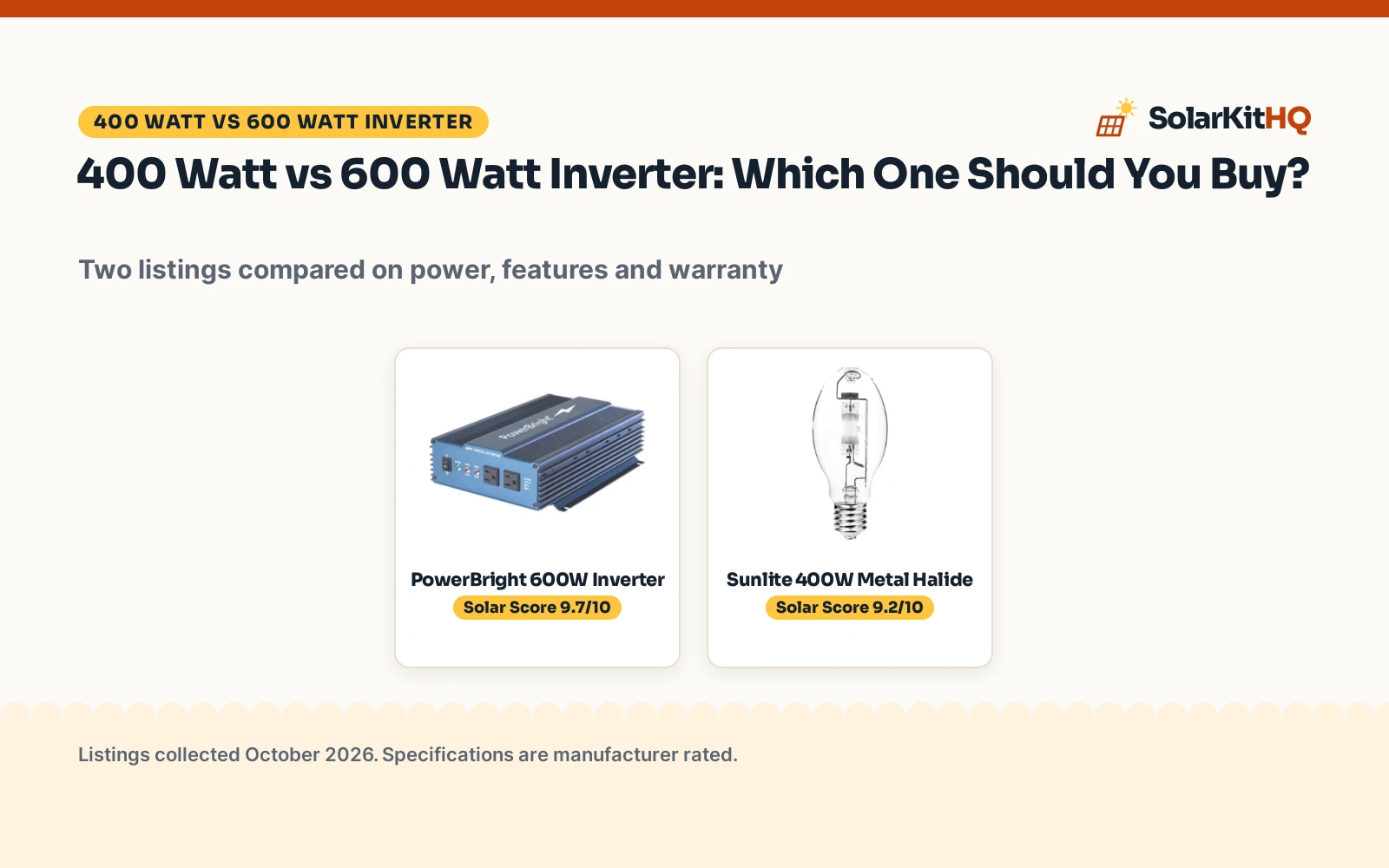
The garage went dark at dinner time and the phone on the table was already fading: that is when a side-by-side comparison stops being a spec sheet and starts being a plan. We looked at the two listings behind the 400 watt vs 600 watt inverter keyword: a 600 watt pure sine wave inverter from PowerBright and a 400 watt listing from Sunlite that turns out to be a metal halide lamp, not an inverter. The short verdict: choose the PowerBright if you need to run household AC gear from a 12 volt battery; the Sunlite listing is a 400 watt lamp for fixed outdoor and commercial fixtures, so it cannot fill an inverter role at any wattage.
SolarKitHQ earns a commission when you buy through links on this page, at no extra cost to you. As an Amazon Associate I earn from qualifying purchases. Affiliate disclosure.
400 watt vs 600 watt inverter: side by side
| Inverter | Solar Score | Type | Continuous power | Peak power | Outlets or base | Warranty |
|---|---|---|---|---|---|---|
| PowerBright 600W Inverter | 9.7/10 | 600 watt pure sine wave inverter | 600 watts | 1000 watts | 2 GFCI 120V AC outlets | 1 year parts and labor |
| Sunlite 400W Metal Halide | 9.2/10 | 400 watt metal halide lamp | 400 watts | Not stated | E39 mogul base | Not stated |
Specifications are manufacturer rated as listed, collected 22 October 2026.
What the 600 watt listing states
The PowerBright listing states a 600 watt pure sine wave inverter that converts 12 volt DC battery power to 120 volt AC power, with 1000 watts of peak power stated separately from the 600 watt continuous figure. It lists 2 internally protected GFCI outlets, a built-in thermal controlled cooling fan, an anodized aluminum case, and CE approval with RoHS compliance. The protection list names overload, over voltage, under voltage, high temperature and short circuit, and the warranty description reads 1 Year Parts and Labor. The listing gives a weight of 6.3 pounds, and the box contents name the inverter, mounting brackets and a user manual. The maker points it at car, truck, van, trailer and RV battery banks, naming camping gear, laptops, small appliances and gaming consoles among the loads.
What the 400 watt listing states
The Sunlite listing states a 400 watt metal halide lamp: 36,000 lumens, 4000K color temperature, an ED37 shape with a mogul base, a 12,000 hour average lifespan and an ANSI Code M59, which the bullets say means it needs an M59 ballast fixture. The maker lists street lights, parking lot fixtures, perimeter lighting and warehouses among the intended uses. This listing cannot serve as an inverter: it is a bulb that screws into a fixture, and no DC input, AC output or waveform figure appears anywhere in it.
Where the two sides actually differ
Because only one side is an inverter, the comparison is really about expectations. The PowerBright states every figure an inverter shopper asks for: continuous and peak watts given separately, pure sine wave output with less than 3% THD, a 12 volt DC input, 120 volt AC output at 60 hertz, and protections named one by one. The Sunlite listing answers a different question entirely: lumens, color temperature and lamp life for fixed lighting. The two share a wattage figure on paper and almost nothing else. If your plan involves a battery, outlets and AC loads, only the PowerBright listing belongs to it.
What the listings leave unclear
The PowerBright spec table has a Wattage row that reads 1, which the 600 watt title and bullets clearly override: trust the title and bullets. The same listing mentions USB ports in a heading but never states how many, and it states no DC cable length. The Sunlite spec table lists an E17 bulb shape next to the E39 mogul base in the title: the title and bullets say mogul base, so use E39. Its warranty description says only to see the packaging, which is no stated term. Neither listing names a UL, ETL, CSA or FCC certification.
Two examples

PowerBright 600W Inverter
A 600 watt pure sine wave inverter with 1000 watts of peak power, 2 GFCI outlets and a 1 year parts and labor warranty.
Pros
- States 600 watts continuous and 1000 watts peak power
- Pure sine wave output with less than 3% THD stated
- 2 GFCI-protected 120V AC outlets
- CE approved and RoHS compliant with overload, over voltage, under voltage, high temperature and short circuit protections stated
Cons
- The spec table Wattage row reads 1, conflicting with the 600 watt title and bullets (the title and bullets win)
- The listing mentions USB ports in a heading but never states how many or their rating
- 6.3 pounds stated, before any battery or mounting hardware
- No DC cable length is stated
Detailed Review
The listing states a 600 watt pure sine wave inverter converting 12 volt DC to 120 volt AC, with 1000 watts of peak power given separately, 2 internally protected GFCI outlets, a built-in thermal controlled cooling fan and an anodized aluminum case. It names CE approval and RoHS compliance, lists overload, over voltage, under voltage, high temperature and short circuit protections, and describes a 1 year parts and labor warranty at 6.3 pounds. The spec table has a Wattage row that reads 1, which the 600 watt title and bullets clearly override; the same listing mentions USB ports in a heading but never states a count.
Who it’s for: campers, RVers and drivers who need to run AC gear from a 12 volt battery and want pure sine wave output stated. Who should skip it: anyone who needs more than 2 outlets or a stated USB count.
Its Solar Score of 9.7/10 comes from performance 30/35, build 21/25, value 20/25, safety 8/10 and warranty 3/5: 82 of 100 points, placed on our 9.2 to 9.8 scale.
Key Specifications
| Continuous power | 600 watts |
|---|---|
| Peak power | 1000 watts |
| Outlets | 2 GFCI 120V AC outlets |
| Weight | 6.3 pounds |
Figures as published on the retailer listing, collected 22 October 2026. Performance figures are manufacturer rated.
Safety and Warranty
What this listing states. CE approved and RoHS compliant; overload, over voltage, under voltage, high temperature and short circuit protections listed, so safety scores 8 of 10. 1 Year Parts and Labor warranty stated. It does not say everything a buyer needs, such as who pays return shipping, so warranty scores 3 of 5. See How We Pick.
Inverter limits. Stay within the stated continuous watts (surge watts last only a moment), use the cable size and fuse the manual gives, ventilate it, and never connect an inverter to home wiring yourself; that is work for a licensed electrician.
This is general buying information, not professional advice. Follow each product manual and local rules, and see our Safety Disclaimer.

Sunlite 400W Metal Halide
A 400 watt metal halide lamp with 36,000 lumens at 4000K, an E39 mogul base and a 12,000 hour lifespan, not an inverter.
Pros
- States 36,000 lumens at 4000K from a 400 watt metal halide lamp
- 12,000 hour average lifespan stated
- Mogul E39 base for M59 ballast fixtures stated
- Clear finish, ED37 shape, ANSI Code M59 listed
Cons
- Not an inverter: this listing describes a metal halide lamp, so it fills no inverter role
- No warranty term is stated (the listing says see packaging for details)
- No safety certifications are stated
- The spec table lists an E17 bulb shape, conflicting with the E39 mogul base in the title
Detailed Review
The listing states a 400 watt metal halide lamp with 36,000 lumens, 4000K color temperature, an ED37 shape and a mogul base for M59 ballast fixtures, with a 12,000 hour average lifespan and intended uses that include street lights, parking lot fixtures and warehouses. The title and bullets say E39 mogul base while the spec table lists an E17 bulb shape; trust the title and bullets. The warranty description says only to see the packaging, which states no term.
Who it’s for: facilities replacing a 400 watt metal halide lamp in an M59 ballast fixture. Who should skip it: anyone shopping for an inverter, since this listing describes a lamp.
Its Solar Score of 9.2/10 comes from performance 15/35, build 19/25, value 16/25, safety 0/10 and warranty 0/5: 50 of 100 points, placed on our 9.2 to 9.8 scale.
Key Specifications
| Power | 400 watts |
|---|---|
| Output | 36,000 lumens, 4000K |
| Base | E39 mogul base |
| Life | 12,000 hours |
Figures as published on the retailer listing, collected 22 October 2026. Performance figures are manufacturer rated.
Safety and Warranty
What this listing states. No UL or ETL listing and no protection detail is stated, so safety scores zero. No warranty term, so warranty scores zero. See How We Pick.
Inverter limits. Stay within the stated continuous watts (surge watts last only a moment), use the cable size and fuse the manual gives, ventilate it, and never connect an inverter to home wiring yourself; that is work for a licensed electrician.
This is general buying information, not professional advice. Follow each product manual and local rules, and see our Safety Disclaimer.
As an Amazon Associate I earn from qualifying purchases.
How we scored them
The Solar Score weighs performance, build, value, safety and warranty. For inverters, safety means stated protections and certifications; the PowerBright lists CE approval, RoHS compliance and named protections, while the lamp listing names none. One of the two listings states a warranty term, the 1 year parts and labor on the PowerBright. How we pick explains the weights.
| Product | Solar Score | Perf. /35 | Build /25 | Value /25 | Safety /10 | Warranty /5 |
|---|---|---|---|---|---|---|
| PowerBright 600W Inverter | 9.7 | 30 | 21 | 20 | 8 | 3 |
| Sunlite 400W Metal Halide | 9.2 | 15 | 19 | 16 | 0 | 0 |
Scores run from 9.2 to 9.8: each product’s point total is placed on that range, so more points always means a higher score.
400 watt vs 600 watt inverter: which should you choose?
Choose the 600 watt side if you have a 12 volt battery and AC loads to run: the PowerBright listing states 600 watts continuous, 1000 watts peak, pure sine wave output and 2 GFCI outlets, which covers the camping gear, laptops and small appliances in the maker use list. Choose the 400 watt listing only if you actually need a replacement metal halide lamp for an M59 fixture: the Sunlite states 36,000 lumens at 4000K with a 12,000 hour life. There is no inverter function in the Sunlite listing, so a head-to-head on inverter merits has only one real entry. For a broader look at the category, see the best 400 watt power inverter roundup, our best inverter comparison and the best pure sine wave inverter for mini split.
| If you need | Look at |
|---|---|
| AC power from a 12 volt battery | PowerBright 600W Inverter, 600 watts continuous |
| A 400 watt lamp for a fixed fixture | Sunlite 400W Metal Halide, 36,000 lumens |
| Pure sine wave output stated | PowerBright, less than 3% THD |
| Named protections | PowerBright, with CE approval and RoHS compliance |
Sizing Notes
- Match the stated continuous watts (600) and peak watts (1000) on the PowerBright to the loads you plan to run, keeping the two figures separate as the listing does.
- The PowerBright needs a 12 volt DC battery supply and puts out 120 volt AC at 60 hertz; the Sunlite lamp needs a 120 volt M59 ballast fixture, not a battery.
- Count the connections: the PowerBright lists 2 GFCI outlets and weighs 6.3 pounds before mounting hardware.
- The Sunlite listing states 36,000 lumens at 4000K and a 12,000 hour life, so compare it against other lamps, not against inverters.
Frequently Asked Questions
Can the 400 watt Sunlite listing work as an inverter?
No. The Sunlite listing describes a 400 watt metal halide lamp for M59 ballast fixtures, with no DC input, AC output or waveform stated. Only the PowerBright listing is an inverter.
What power figures does the PowerBright listing state?
600 watts continuous and 1000 watts peak, stated separately, with pure sine wave output and less than 3% THD.
What protections does the 600 watt inverter list?
Overload, over voltage, under voltage, high temperature and short circuit protections, plus CE approval and RoHS compliance.
What warranty does each listing state?
The PowerBright states 1 year parts and labor. The Sunlite listing says to see the packaging for details, which is not a stated term.
Do the listings state any UL or ETL certification?
No. Neither listing names a UL, ETL, CSA or FCC certification; the PowerBright names CE approval and RoHS compliance.
Related guides
See every Power Inverters guide and all Controllers and Inverters guides. For the battery side, see the deep cycle battery vs power station comparison and our best inverter cable kit picks.
More picks: our best pure sine wave inverter for generator, our best inverter cable kit picks and solar panel kit with inverter vs without.