On this page
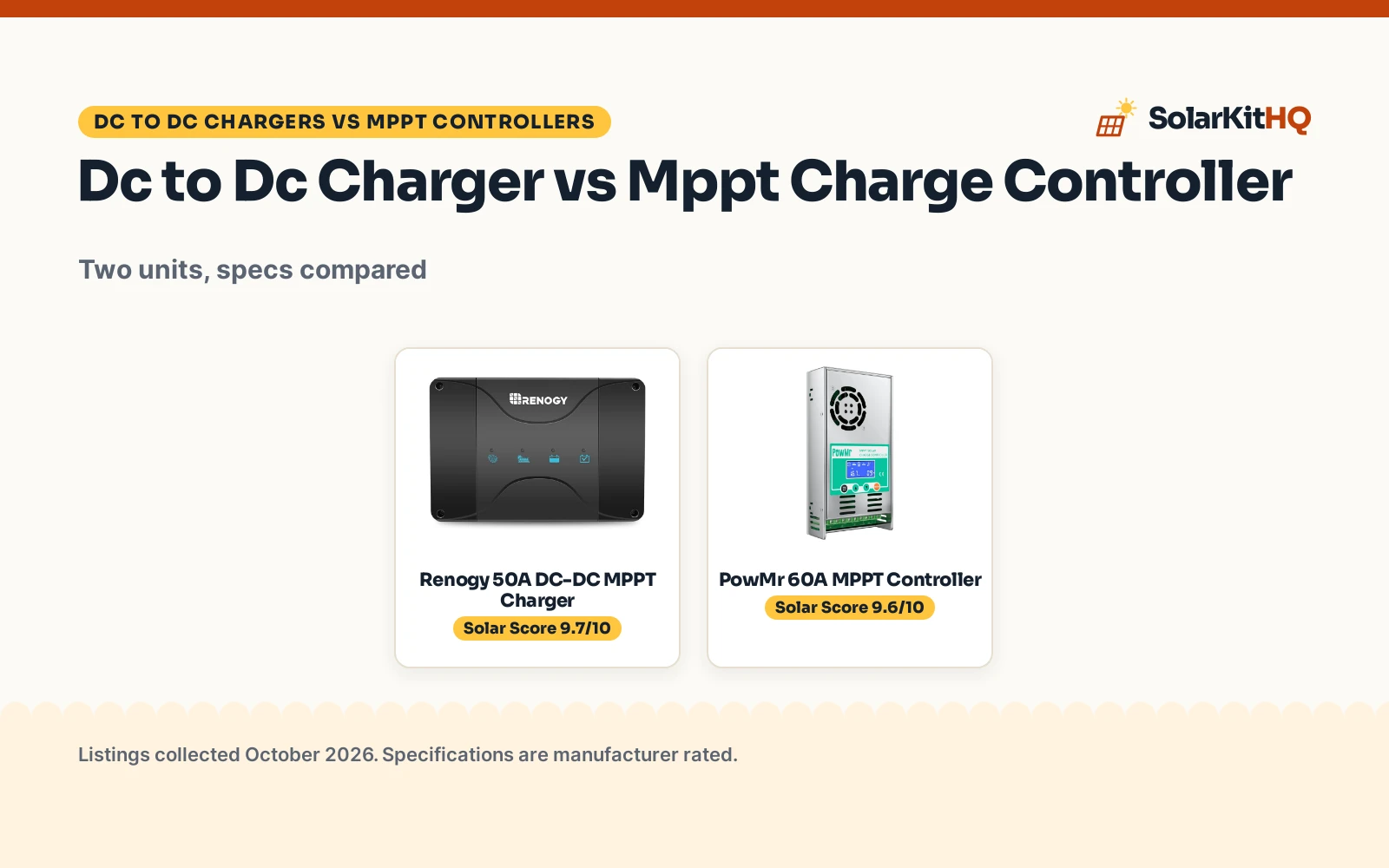
The short answer on dc to dc charger vs mppt charge controller: pick the DC to DC charger if your house battery charges from the alternator while you drive, and pick the MPPT charge controller if your panels are the power source. We compared the two listings on stated charge current, solar input, efficiency figures, protections and warranty terms. The Renogy DC to DC charger takes both alternator and solar input with a 3-year warranty; the PowMr MPPT controller takes solar only, at 60A with a 160VDC maximum input.
SolarKitHQ earns a commission when you buy through links on this page, at no extra cost to you. As an Amazon Associate I earn from qualifying purchases. Affiliate disclosure.
DC to DC Charger vs MPPT Charge Controller: side by side
| Unit | Solar Score | Charge current | Solar input | Efficiency | Warranty |
|---|---|---|---|---|---|
| Renogy 50A DC-DC MPPT Charger | 9.7/10 | 50A | 50V/660W | 99% MPPT tracking | 3 years |
| PowMr 60A MPPT Controller | 9.6/10 | 60A | 160VDC max | 98.1% max | Not stated |
Specifications are manufacturer rated as listed, collected 22 October 2026.
What each side charges from
The Renogy example is the dual-input side: it charges a service battery from a starting battery linked to an alternator, and it also takes solar input, with a built-in voltage sensitive relay for traditional alternators and an IGN port for smart alternators. The PowMr example is the solar-only side: it charges from solar panels with a maximum 160VDC input and no alternator input stated. If your van charges its house battery while you drive, only the Renogy side covers that; if your power comes from panels on the roof, both sides cover solar, and the Renogy example’s solar input is stated at 50V/660W.
Current, voltage and efficiency figures
The Renogy example states 50A with a 12V service battery, 50V/660W solar input, up to 99% MPPT tracking efficiency and up to 97% peak conversion efficiency. The PowMr example states 60A with automatic 12V/24V/36V/48V battery detection, a maximum 160VDC solar input, at least 98.1% maximum efficiency and at least 99% PV utilization. The PowMr example states the higher charge current and the wider voltage range; the Renogy example states dual-input charging that the PowMr example does not.
Protections and monitoring
The Renogy example lists battery isolation, over-voltage protection, battery temperature protection, over-current protection, overheat protection, reverse current protection, and solar panel and alternator reverse polarity protection, plus a 3-phase charging profile of Bulk, Boost and Float. The PowMr example lists a backlight LCD showing PV voltage, output power, battery voltage, charging current, working mode and temperature, with a troubleshooting function, and fan heat dissipation that switches on above 45℃ and off below 40℃. For remote monitoring, the Renogy example has an RJ45 port for the BT-2 Bluetooth module and the DC Home app; the PowMr example states no Bluetooth. See our charge controllers guides for more controller picks.
What the listings leave unclear
The Renogy included-components line reads “1*50 Amp MPPT charge controller with Alternator Power Input and Cables needed”, which leaves unclear whether cables are included or required. The PowMr spec table puts the voltage range in the Color field, so trust the title and bullets for the 12V/24V/36V/48V figures. The Renogy title runs “Renogy12V” together; the 12V figure is confirmed in the spec table. Neither listing states an IP weather code.
Two examples

Renogy 50A DC-DC MPPT Charger
Dual-input 50A DC to DC charger with MPPT, 50V/660W solar input and a 3-year warranty.
Pros
- 50A charge current stated
- Alternator and solar dual input stated
- Up to 99% MPPT tracking efficiency stated
- 3-year material and workmanship warranty stated
Cons
- The included-components line ends with "and Cables needed", which reads as if cables are required
- The title runs "Renogy12V" together
- No IP weather code is stated
- Plastic case stated
Detailed Review
The listing states a 12V 50A smart DC to DC battery charger with MPPT, dual alternator and solar input, 50V/660W solar input, up to 99% MPPT tracking efficiency and up to 97% peak conversion efficiency, AGM, gel, flooded and lithium support, a 3-phase Bulk, Boost and Float charging profile, and a long list of protections: battery isolation, over-voltage, battery temperature, over-current, overheat, reverse current, and solar panel and alternator reverse polarity. The included-components line ends with "and Cables needed", which reads as if cables are required rather than included. It states a 3-year material and workmanship warranty.
Who it's for: RV and van owners who want alternator and solar charging in one unit with phone monitoring. Who should skip it: anyone who needs a metal case or a stated IP code.
Its Solar Score of 9.7/10 comes from performance 30/35, build 20/25, value 21/25, safety 9/10 and warranty 4/5: 84 of 100 points, placed on our 9.2 to 9.8 scale.
Key Specifications
| Current | 50A |
|---|---|
| Solar input | 50V/660W |
| Efficiency | Up to 99% MPPT tracking |
| Warranty | 3 years |
Figures as published on the retailer listing, collected 22 October 2026. Performance figures are manufacturer rated.
Safety and Warranty
What this listing states. Stated battery isolation, over-voltage, battery temperature, over-current, overheat, reverse current and reverse polarity protections, so safety scores 9 of 10. 3-year material and workmanship warranty. It does not say everything a buyer needs, such as who pays return shipping, so warranty scores 4 of 5. See How We Pick.
Match the charger. Use a charger mode that matches your battery's stated chemistry and voltage, connect in the order the manual gives, and keep it ventilated and dry.
This is general buying information, not professional advice. Follow each product manual and local rules, and see our Safety Disclaimer.

PowMr 60A MPPT Controller
60A MPPT solar charge controller with 12V to 48V auto detection and a 160VDC maximum input.
Pros
- 60A charge current stated
- Automatic 12V/24V/36V/48V battery detection
- 160VDC maximum solar input stated
- Metal case stated
Cons
- No warranty term is stated
- The spec table puts the voltage range in the Color field; trust the title and bullets
- Solar input only; no alternator charging is stated
- Lithium batteries need manual parameter adjustment per the listing
Detailed Review
The listing states a 60A MPPT solar charge controller with automatic 12V/24V/36V/48V battery detection, a maximum 160VDC solar input, at least 98.1% maximum efficiency and at least 99% PV utilization, a backlight LCD with a troubleshooting function, 9 AWG copper wires and fan heat dissipation that switches on above 45℃ and off below 40℃. The spec table puts the voltage range in the Color field; trust the title and bullets. No warranty term is stated.
Who it's for: solar system owners who want the highest stated charge current with wide voltage detection. Who should skip it: anyone who needs alternator charging or a stated warranty.
Its Solar Score of 9.6/10 comes from performance 30/35, build 21/25, value 21/25, safety 8/10 and warranty 0/5: 80 of 100 points, placed on our 9.2 to 9.8 scale.
Key Specifications
| Current | 60A |
|---|---|
| Battery | 12V/24V/36V/48V auto |
| Solar input | 160VDC max |
| Efficiency | 98.1% max |
Figures as published on the retailer listing, collected 22 October 2026. Performance figures are manufacturer rated.
Safety and Warranty
What this listing states. Stated LCD troubleshooting display and temperature-controlled fan heat dissipation, so safety scores 8 of 10. No warranty term, so warranty scores zero. See How We Pick.
Match the charger. Use a charger mode that matches your battery's stated chemistry and voltage, connect in the order the manual gives, and keep it ventilated and dry.
This is general buying information, not professional advice. Follow each product manual and local rules, and see our Safety Disclaimer.
As an Amazon Associate I earn from qualifying purchases.
Where the points went
The Solar Score weighs performance, build, value, safety and warranty. For charging gear, safety means stated protections and build details the listing actually states; both listings state these. One of the two listings states a warranty term: the Renogy example states a 3-year material and workmanship warranty. How we pick explains the weights.
| Product | Solar Score | Perf. /35 | Build /25 | Value /25 | Safety /10 | Warranty /5 |
|---|---|---|---|---|---|---|
| Renogy 50A DC-DC MPPT Charger | 9.7 | 30 | 20 | 21 | 9 | 4 |
| PowMr 60A MPPT Controller | 9.6 | 30 | 21 | 21 | 8 | 0 |
Scores run from 9.2 to 9.8: each product’s point total is placed on that range, so more points always means a higher score.
DC to DC charger vs MPPT charge controller: which should you choose?
Choose the DC to DC charger if your house battery charges from the alternator while you drive: the Renogy example takes alternator and solar input with a built-in voltage sensitive relay for traditional alternators and an IGN port for smart alternators. Choose the MPPT charge controller if your system is solar-fed and you want the higher stated charge current: the PowMr example states 60A with automatic 12V to 48V detection and a 160VDC maximum input.
| If you need | Look at |
|---|---|
| Alternator and solar input | Renogy 50A DC-DC MPPT Charger, dual input stated |
| Highest stated charge current | PowMr 60A MPPT Controller, 60A stated |
| A stated warranty | Renogy 50A DC-DC MPPT Charger, 3-year stated |
| Phone monitoring | Renogy 50A DC-DC MPPT Charger, BT-2 Bluetooth stated |
Sizing Notes
- Match the charger to the battery: the Renogy example states 12V with AGM, gel, flooded and lithium; the PowMr example auto-detects 12V, 24V, 36V and 48V.
- Match the solar input: the Renogy example states 50V/660W; the PowMr example states a 160VDC maximum.
- Check the charge current: 50A on the Renogy example, 60A on the PowMr example.
- Leave any connection to shore power to a qualified technician.
FAQ: power away from the grid
Can the Renogy example work with a smart alternator?
Yes. The listing states compatibility with traditional and smart alternators, with an IGN port that auto-triggers when it detects the vehicle is started, and a built-in voltage sensitive relay for traditional alternators.
What battery voltages does the PowMr example detect?
12V, 24V, 36V and 48V automatically.
Which example states a warranty?
The Renogy example states a 3-year material and workmanship warranty. The PowMr listing states no warranty term.
Do either of these run without a fan?
The Renogy example uses an integrated heat sink instead of a cooling fan for 0 dB operation. The PowMr example uses a fan that switches on above 45℃ and off below 40℃.
Related solar guides
See every Charge Controllers guide and all Controllers and Inverters guides.
More picks: DC to DC charger with MPPT. MPPT vs PWM charge controller. DC to DC charger for RV. MPPT solar charge controller for RV.